
Direct answer: A stick lit before a sitting does three jobs, none of them chemical. It times the session, because the coal runs out and the sit ends with it. It gives a wandering attention one fixed smell to come back to. And it marks a threshold, so that striking the match becomes the act of beginning. The materials that dominate the tradition — sandalwood 檀香, agarwood 沉香, frankincense 乳香 — earn their place by staying quiet, not by being impressive.
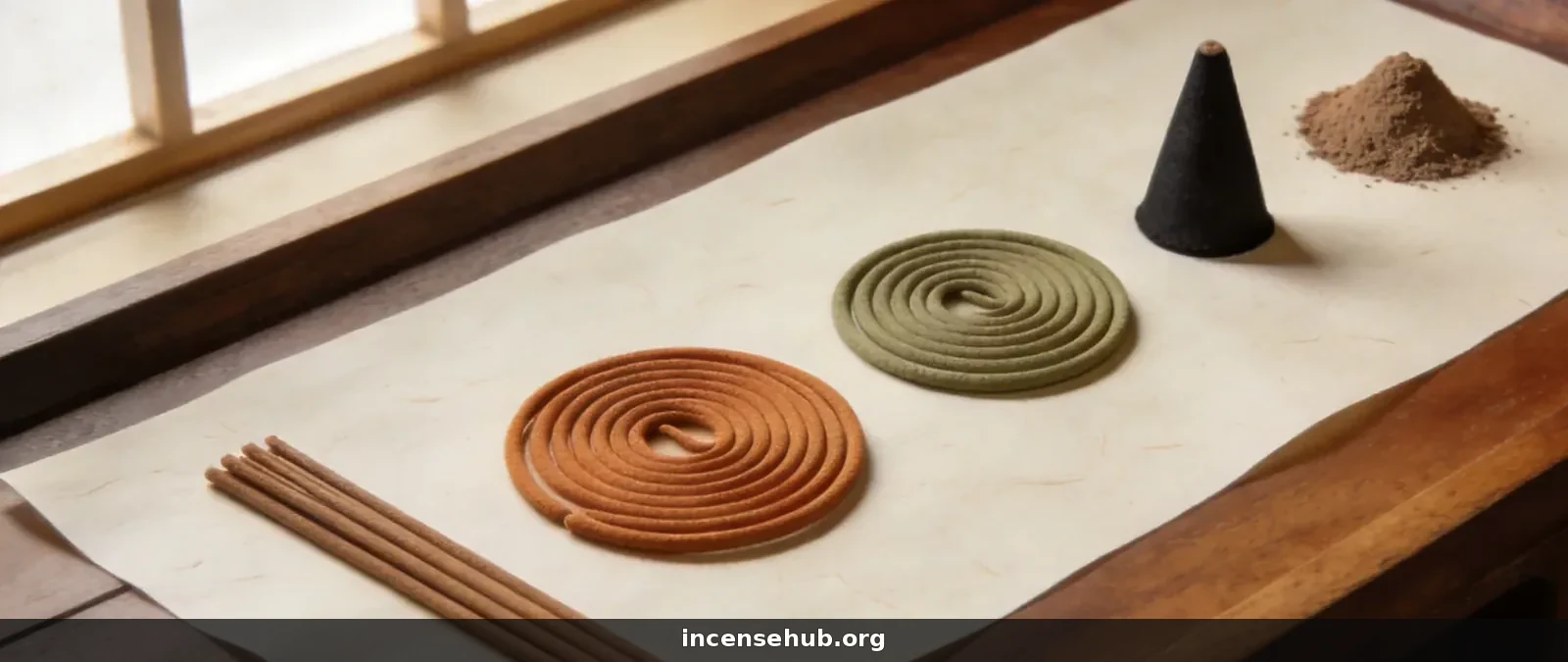
Key facts
Direct answer: Format decides the length of the session, the scent decides whether you can ignore it, and airflow decides whether the room is usable afterwards.
- Length belongs to the shape, not the blend. A cone and a coil are an order of magnitude apart in duration even when they smell identical.
- Every quoted duration is a band. Gauge, packing, draught and damp storage all move the number; plan for a window, not an instant.
- Quiet materials do the job better. Anything with a bright opening competes with the sitting instead of supporting it.
- 一炷香 (yī zhù xiāng, “one stick of incense”) is a real duration idiom, recorded in classical incense literature, from an era when a burning stick was a workable clock.
- Fragrance is ambiance and cue. It is not a treatment, and no page should imply that it is.
The coal is a fence, not a stopwatch
Direct answer: A predictable burn gives the sitting an edge you can feel without touching a device, and that edge is doing more work for the practice than the smell is.
A phone alarm carries the same information and spoils the room delivering it. The object that announces the end of the sit is also the object holding messages, and once it is on the cushion some fraction of attention stays in negotiation with it. A coal makes no such demand. It is struck, it creeps, and at some point the plume thins and the glow disappears from view. Nothing is left to decide, because the clock has already run out.
The chain is short enough to follow with a fingertip:
the tip catches a flame and is blown out → a coal remains at the crown of the column → the coal eats downward at a rate fixed by gauge and packing → the burning boundary shortens the stick → the coal meets the holder and the plume stops → the sitting ends without a decision.
Each link is physical, and that explains the character of the timing: sound in outline, loose in detail. A stick leaned into moving air burns faster on its exposed face and can run crooked. A box kept in a bathroom lights badly, because damp binder resists the coal. A still, warm room stretches everything slightly. What you own is an edge, not a metronome, and an edge is what a sitting needs.
One further effect deserves naming. A known end makes it easier to stay, because open-ended practice turns into clock-watching — the mind keeps auditing whether it has suffered long enough. A visible endpoint removes the audit. That reading comes from practice experience and is offered as interpretation, not measurement.
What each format buys you
Direct answer: Shape fixes three things at once — how long it burns, how much smoke it puts into the air, and how much attention the setup demands — and no shape wins on all three.
| Format | Span to plan around | Smoke behaviour | Setup effort | The trade you accept |
|---|---|---|---|---|
| Japanese coreless stick (~14 cm) | ~25–30 min | Thin, even, low plume | Holder only | Hard stop; no grace period if you run over |
| Bamboo-core stick | ~45–60 min | Slightly heavier, and the core adds a note late | Holder only | Bamboo smell joins the blend near the end |
| Cone | ~10–15 min | Dense at the start, short tail | Small dish, ideally over sand or ash | Wastes scent in a small shut room |
| Coil 盘香 | Hours | Continuous; accumulates in still air | Stand, plus somewhere for the ash | Needs moving air or the room thickens |
| Seal / trail 篆香 | Set by the pattern | Fine, even, follows the groove | Tray, sieve, steady hand | High setup cost for a short burn |
Read the table downward rather than across, because the columns trade against each other. A stick is the default for a reason: it balances a sit-length burn against a plume that ordinary rooms can absorb. A cone only wins when the sitting really is short — ten minutes of settling before something else — since ten minutes of dense smoke in a shut bedroom is a much larger presence than the duration suggests. A coil wins for long or shared practice and loses instantly wherever air is still, because hours of smoulder in a sealed box become a haze rather than a scent.
For a wider comparison of shapes, including which ones suit different rooms, see which incense format fits a given space. The seal is the outlier. Its duration is not a manufacturer’s figure at all: you dress powder into a pattern, light one end, and the path is the clock. That makes it the most deliberate option and the least forgiving, since a shaky hand leaves a gap, and a gap stops the clock mid-session.
Scent, chosen for what it does to attention
Direct answer: The right material is the one you stop noticing; the wrong one becomes a second thing to think about.
| Scent | Reads as | Effect on a sitting | Where it fails |
|---|---|---|---|
| Sandalwood 檀香 | Soft sweet wood, low contrast | Disappears into the background, which is the point | Cheap stock smells of sawdust |
| Agarwood 沉香 | Deep resin that shifts as it heats | Rewards attention, which cuts both ways | A strong piece owns a small room |
| Frankincense 乳香 | Resin with a bright citrus edge | Lifts the feel of the space, ceremonial | The edge reads sharp at first light |
Sandalwood is the safest first purchase because it does least. There is little in it to argue with: no opening flare, no sweetness that turns cloying, just a woody constant that a distracted mind can relocate. Agarwood is the interesting choice and the riskier one, since the change across a burn is exactly what makes it worth buying and exactly what makes it a distraction on a bad day. Frankincense sits between them — resinous enough to feel ceremonial, bright enough that some sitters find it crisp rather than calm.
Nothing in the repertoire forbids flowers; they answer a different brief. A floral blend is built to be noticed — the whole point of it is the lift you get walking into the room — and a sitting asks its materials for the reverse. Where a floral earns a place is at the close of an evening: five minutes of it is pleasant, an hour of it is a guest who will not leave. The individual material guides go deeper on sandalwood, agarwood and lavender.
One selection rule that ranking articles skip: match intensity to room volume, not to taste. The stick that is lovely in a tall, airy space is oppressive in a small one with the window shut, and no amount of personal preference changes that arithmetic.
Running a sitting, start to finish
Direct answer: The sequence matters more than the ritual: light early, sit while the plume is steady, and let the last of the burn close the session.
Before. Fill the holder, check that nothing above or beside it can catch, and put a lighter where you will not have to hunt for it. Open a window a finger’s width, or a door to the next room if the weather forbids windows. Set a cushion where the plume will pass near you but not into your face — a stick at nose height becomes a smell you fight rather than a smell you rest in.
The first two minutes. Light, let the tip take a flame, blow it out, and set the stick. Then sit down and do nothing. That short gap is the transition; it gives the room time to take up the scent and gives you time to stop working. Lighting after you are settled turns the setup into an interruption, which is the opposite of a threshold.
The middle. The plume thins as the column shortens, and the smell flattens rather than fades — less top note, more warm base. That drift is normal and is one argument for keeping the session inside the format’s span. If you notice yourself checking the stick, the format is too short or the room is too small; either way the fix is physical.
The end. Let it go out. Ash falling into the dish, the glow dropping, the smell arriving in one last wave — that is the closing cue, and it does the same job as the opening one. Standing up early to stub it out throws away the half of the ritual that tells you the session is over.
After. Leave the room for a few minutes and let air move through it. A session that ends with the window shut leaves yesterday’s residue in the curtains, and tomorrow’s stick will be burning into that.
The room is part of the format
Direct answer: A format that works in one room fails in another, and the variable is air, not square metres.
Smoke does not vanish; it drifts until it lands on something. In a room with a cross draught it leaves through the gap and you smell the incense; in a sealed room it rises, spreads, and settles into fabric, where it stays. The same coil is a pleasure on a porch and a mistake in a bedroom with the door shut.
Three practical readings follow. First, still air makes any format feel stronger, because the plume accumulates instead of dispersing — cut the duration rather than the ventilation when a room feels heavy. Second, a draught close to the stick is worse than a draught across the room, because it bends the burn and can put the coal out; move the holder rather than closing the window. Third, soft furnishings hold smoke the way they hold cooking smells, so a room with curtains, rugs and a bed will carry the session into the evening, which may be welcome or may not.
If you can smell the stick from the doorway, the room is holding more smoke than the sitting needs. That test is useful because the nose adapts within minutes: whoever is sitting in the room stops registering the plume long before a visitor would. Judging from the threshold, a minute after lighting, gives a truer reading than judging from the cushion. The same adaptation explains why the stick that seemed right in March feels faint by June — the room has not changed, and neither has the stick, but the nose has stopped reporting it.
Anything that smoulders adds particles to the air, and that is the plainest argument for leaving a gap somewhere. The smoke comparison sets out how a smouldering plume differs from the mist a diffuser throws. Acting on it needs no instrument: keep the moment brief where the room is small, let air through, and put the coal out before you go.
Storage decides the second session
Direct answer: Most disappointing sticks were ruined in the box, not in the making.
Incense is a dried, bound material, and it behaves like one. A box left open in a humid kitchen takes up moisture; the coal then fights the water and the stick sputters or dies. A box left on a sunny sill dries unevenly and can crack along the grain. A box stored beside something strongly scented — soap, spices, a candle — will pick up that smell, and no amount of careful lighting will remove it.
The routine that avoids all three is unglamorous: keep the sticks in their original sleeve, keep the sleeve in a tin or a drawer away from the kettle and the window, and keep the drawer away from anything loud. If a stick will not hold a coal at all, the batch is the suspect rather than your technique.
There is a second-order point that matters for anyone buying in quantity. A coil and a stick age differently, because the coil’s mass holds moisture longer and its wider body dries unevenly; a coil that has been open for months often burns with a wobble before it settles. Buying in the quantity you will actually finish, rather than the quantity that saves money, is the practical answer.
A holder is a piece of equipment
Direct answer: The dish under the stick is doing three jobs — catching ash, steadying the column, and putting a heat barrier between the coal and the table — and most decorative holders do only the first.
Start with the weight. A holder that can be knocked over by a sleeve is a fire risk, and the lighter the object, the smaller the knock required. Ceramic with a wide foot, or a metal dish heavy enough to stay put, both pass. A slim wooden block with a drilled hole passes too, provided the block itself is wide enough not to tip when the stick is two-thirds gone and top-heavy.
The second job is the heat barrier. The coal sits at the very top of the stick, but heat travels down through the holder and into whatever is under it; a thin lacquered tray will show a ring, and a shelf will show it permanently. A saucer, a stone coaster, or a bed of sand inside the dish solves this without any purchase. Sand has a second use: it swallows the falling ash, which keeps the surface clean and stops a draught from lifting flakes across the room.
The third job is a surprise to most people — a holder can shield the burn. A deep bowl with a narrow mouth cuts the air reaching the coal, which slows it and steadies it in a room with a draughty doorway. An open dish does the opposite and lets a cross-current bend the burn. Neither is wrong; they are different tools, and matching the holder to the room is as sensible as matching the stick to the sitting.
Cleaning belongs in the routine, not at the end of the month. Ash left in a damp dish sets into a crust that holds moisture against the base of the next stick. Empty it after each session, wipe it dry, and the holder stops being a variable.
Sitting with other people
Direct answer: A shared sitting adds two problems a solo one never has — a room full of different sensitivities, and a clock that has to suit everyone.
Sensitivity is the harder of the two. One person’s faint sandalwood is another person’s headache, and in a group there is no way to test in advance. The workable compromise is the smallest, plainest stick the room will tolerate, placed further away than you would place it alone, with air moving. If the group meets regularly, the scent should stay the same week to week — a shared anchor is worth more than a varied programme, and rotating blends means nobody ever gets the settled familiarity that makes an anchor work.
Duration is the easier problem. A group sits until the slowest sitter is ready, not until the stick is done, so the format should run long rather than exact: a coil, or a stick chosen at the upper end of the band. The cost is smoke, which means the room needs either volume or ventilation. A short stick in a group is a mistake in the other direction — it ends while people are still settling, and someone has to decide whether to relight, which is exactly the kind of small decision a shared practice should not be making.
Two housekeeping points that nobody writes down. Whoever lights the stick is not necessarily the person leading the sitting, and separating those roles keeps the start unhurried. And the person nearest the holder takes the most smoke; rotate places, or move the holder to the edge of the circle rather than the centre.
What to do when the room has no window
Direct answer: A room without an opening is a room where the format has to shrink — short sticks, small cones, and a gap under the door doing the work of a sash.
Plenty of practice spaces are windowless: a store room, a basement corner, a rented room with sealed glazing. The instinct is to skip the ventilation and accept the haze, which is the one option worth refusing. Three substitutions work. Leave the door open to a corridor or a stairwell, because a door is an air path even when it is not a window. Run a fan on its lowest setting, pointed away from the stick rather than at it, so the room mixes without bending the burn. Cut the burn to the shortest format that still covers the sitting, since the accumulated plume is a product of duration more than of size.
What does not work is masking. A stronger scent over a stale room produces two smells arguing, and the argument outlasts the session. If the room cannot clear, the honest answer is a shorter practice in it and a longer one somewhere else, rather than more fragrance to cover the residue.
Testing a new stick before you sit with it
Direct answer: Burn one on a saucer, away from the cushion, and watch it from start to finish — a single test tells you more than any description on a box.
The test is cheap and it answers four questions that matter later. Does the tip hold a coal without repeated relights? Does the column stay straight, or does it curl and drop ash to one side? Does the smell stay roughly constant, or does it turn sharp, sooty or hollow two-thirds of the way down? And how long does it actually run against the band printed on the sleeve?
Run the test somewhere you can leave the room, because the point is to judge the burn rather than to sit inside it. Keep a note of the batch and the date on the sleeve; a maker’s stock changes between lots, and the stick that behaved in spring may behave differently in a humid August. If a stick fails the test, it has not failed your practice — it has told you something about storage, gauge, or quality that you would otherwise have discovered mid-session with your eyes closed.
The last question is the one people skip: does it leave a residue you dislike? Some sticks clear from a room in minutes and some leave a sweetness in the curtains that greets you the next morning. That character is not visible in a product description and is the single best argument for testing before buying a box.
Beyond the cushion: other transitions worth marking
Direct answer: The same three jobs work anywhere a period of time needs edges — the start of focused work, the end of a working day, the close of an evening.
A stick lit at the top of a work block does what a timer cannot: it announces the beginning without a notification, and it ends the block without an alarm. The discipline it enforces is modest and real. You are less likely to open a second browser tab when the room has already been told that this hour has a purpose, and you are less likely to keep going past the point of usefulness when the plume has stopped.
The end-of-day version is the one people discover by accident. Lighting something small after the last message has been answered gives the evening a seam — before the stick, you were working; after it, you are not. That seam is the whole benefit, and it costs ten minutes of a cone. Anyone who has tried to stop working by simply deciding to stop knows why a physical marker is more reliable than an intention.
Where this reasoning breaks down is worth stating. A marker does not create focus, any more than a fence creates a garden. It marks a boundary you have already chosen. Light a stick at the start of a scroll through messages and you have not made the scrolling into practice; you have only given it a smell. The same thinking, applied to the markers that structure an ordinary day, runs through incense in daily ritual.
Five signatures of a badly matched format
Direct answer: The failures are recognisable, and each one points to a specific physical fix rather than to more willpower.
| What you notice | What it usually means | The fix |
|---|---|---|
| You check the stick repeatedly | Span shorter than the sitting | Move up one format step |
| The room feels heavy by the halfway point | Still air plus too much mass | Shorter burn, or crack the window |
| The stick dies mid-session | Draught, damp stock, or a tilted holder | Reposition, then check storage |
| You relight halfway through | Format chosen by mood, not by minutes | Choose by sitting length next time |
| The scent is still there next morning | No air exchange after the session | Air the room before you leave it |
The pattern in that table is worth stating plainly: every entry is a mismatch between three quantities — minutes available, smoke the room can absorb, and attention you are willing to spend on maintenance. Fixing the mismatch is a matter of choosing a different shape, not of sitting harder.
Where the wellness copy crosses the line
Direct answer: A page can describe what a stick does; it cannot claim what a smell cures, and the difference is the whole of the compliance question.
Search this term and a good share of what comes back presents the product as an intervention with outcomes attached — stress down, nervous system soothed, sleep improved. None of that is something a burning stick can do. The description that survives scrutiny is narrower: a timed sensory ritual that gives a practice a start, a duration and an end.
Where the boundary sits:
- Properties you can verify by sitting down: it measures time, it supplies a consistent smell, it cues a transition. Those are structural facts about a burning stick.
- Claims the material cannot carry: that the fragrance lowers stress, regulates anything, or treats a condition. Aromas do not work that way, and pages that say so are writing cheques the product cannot honour.
- The distinction that matters: a pleasant smell inside a pleasant routine is not evidence of a therapeutic effect. The routine is doing the work. The incense is marking it.
That position is not a softer pitch. It is the version that survives a customer actually trying the product, and it keeps a fragrance page out of the territory where regulators take an interest.
The author’s view
Position: Ranking incense by “spiritual depth” is the least useful thing a guide can do. The useful questions are narrower — will this still be burning when I finish, and can I ignore it while it burns?
Reasoning:
- The burn carries the structure. It opens the sitting and closes it; the smell is only the thing attention returns to in between.
- A seller who promises the fragrance will deepen the practice is describing an outcome the material cannot deliver, and that promise is the first sign the rest of the page is unreliable.
- The best meditation incense, in practice, is the one you forget about until it goes out.
This is an editorial position drawn from use, not a verified finding.
FAQ
Q: What is the best incense for meditation?
The question hides a prior one, which is which format you are burning. Among materials, the traditional three are sandalwood 檀香, agarwood 沉香 and frankincense 乳香, all chosen for staying in the background. Sandalwood is the least argumentative of the three and the sensible first buy; agarwood is deeper and changes character as the burn advances; frankincense is resinous with a bright edge that some sitters find crisp. Pair whichever you choose with a shape whose span lands near your sitting length.
Q: How long should a stick burn during meditation?
Until the sitting ends, and not much past it. The working bands are in the format table above; treat them as windows rather than appointments. If your sitting length varies from day to day, a coil forgives the variation and a stick does not. If you tend to run over, buy one size down and accept that you will occasionally finish early — sitting for two minutes without a plume is a smaller problem than sitting for ten inside one.
Q: Can meditation incense relieve anxiety?
Nothing on this page is offered as therapy, and that is a choice rather than an omission. What a stick contributes is scaffolding: two edges around a stretch of time, which makes the stretch easier to keep. Scaffolding is not treatment. Aromas have no documented pathway to changing a mood by themselves, so a page promising relief is selling something the product cannot supply. Real distress belongs with a clinician, not a shopping cart.
Q: What does “one stick of incense” mean as a measure of time?
一炷香 (yī zhù xiāng) is the habit of naming a period after the object that measures it. How long it meant depended on what you were burning: a thin stick finished sooner than a thick one, so the phrase read as an approximate interval somewhere in the region of thirty to sixty minutes, and ordinary use never needed it tighter than that. The idiom is still alive in speech for “a while”, which says a good deal about how ordinary the practice once was. 香乘 (Xiang Cheng), the classical compendium, records it. A seal or trail (篆香) made the measurement explicit: powder is dressed into a groove, a coal touches one tip, and the groove’s length is the interval. [need-source] for a firm minute figure.
Q: Why does my incense keep going out before the sitting ends?
Three causes cover most cases. Moving air reaches one face of the stick and the coal advances unevenly until it stalls. Damp storage leaves a stick that lights and then dies once the dry outer skin is consumed. A holder that grips too tightly, or a stick set at an angle, can break contact with its own ash. Move the holder out of the airflow, keep the box sealed and dry, and stand the stick upright. If it still dies, suspect the batch: a stick that will not hold a coal is a manufacturing problem, not a technique problem.
Q: Should I light the incense before or after I sit down?
Before, then take your seat. The gap between striking and the first steady plume is the transition itself — the room picks up the scent and you stop doing whatever you were doing. Lighting after you are settled turns preparation into interruption. The exception is a very short sitting with a cone, where the opening minute is the loudest part of the burn: light it, step back, and let the plume settle before you begin.
Sources
Span bands follow vendor guidance from Sensing, J-Life International and Incenzo, quoted as bands, not specifications. Kōdō and monkō material, including the convention of 聞 (“listen”), comes from Koju and Nippon Kodo. The idiom 一炷香 and its classical record sit in cultural references; the text itself, 香乘 (Xiang Cheng), is readable via the Wikisource edition. On combustion and indoor air, see the American Lung Association. Pillar notes: chinese-incense-pillar-notes.md, R-003.
Related Resources
- Sandalwood Incense Guide — species differences, and how to spot synthetic stock sold under the name.
- Agarwood (沉香) Incense Guide — grading, heat behaviour, and why one piece smells different at different temperatures.
- Japanese Incense & Kōdō — the listening practice behind the “anchor” idea.
Natural next step: the quietest entry point is a plain sandalwood stick in a coreless format. Read the sandalwood guide before buying, and the kōdō page if the ritual side interests you more than the material.
Summary
- A burning stick is a clock, an anchor and a threshold. The clock is the part most guides underrate.
- Shape sets span, smoke and setup cost; pick the shape first and the material second.
- Quiet woods and resins work because they recede. Loud openings compete with the practice.
- 一炷香 is a genuine timekeeping idiom, and the seal format turns it into a pattern you draw.
- Fragrance supports a routine. It does not treat anything, and no page should suggest otherwise.