
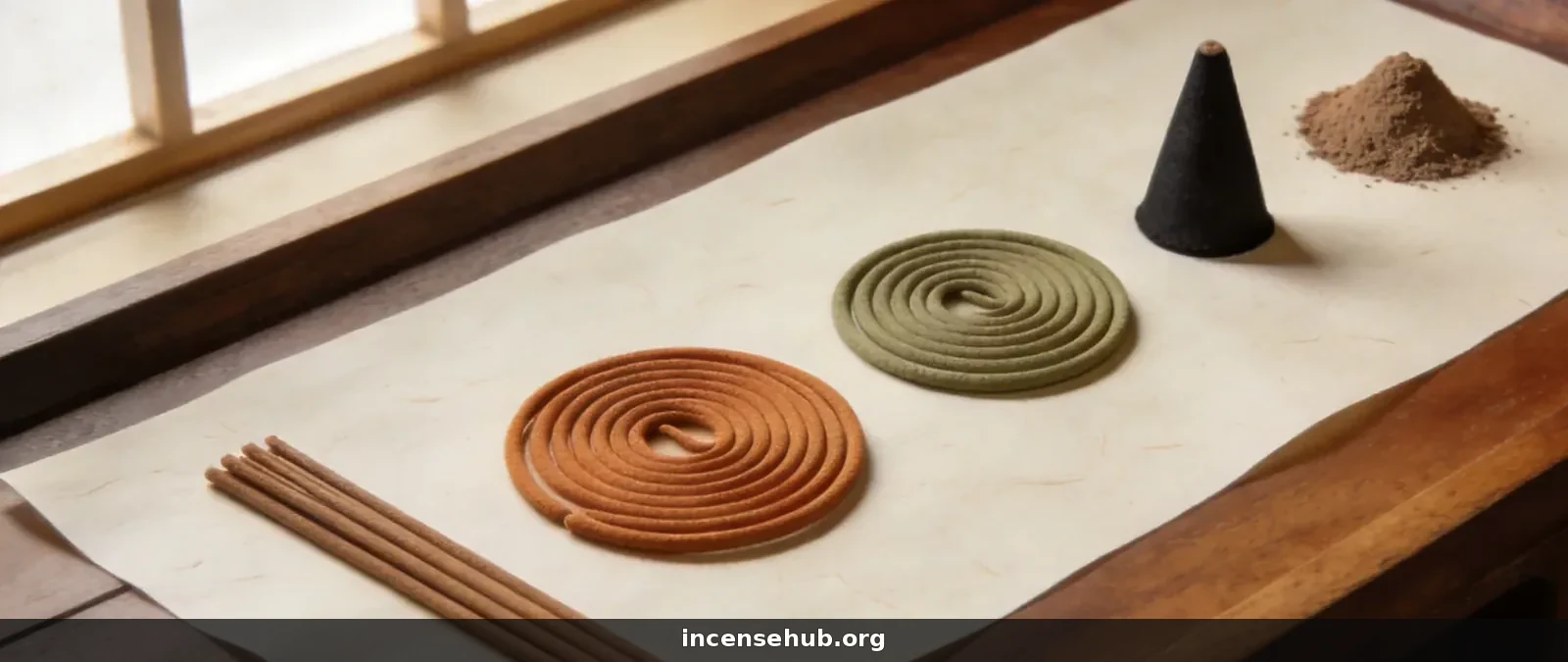
Direct answer: The incense shelf splits into six physical shapes — sticks, cones, backflow cones, coils, powder & resin, and aromatherapy beads — and choosing one comes down to three dials you can set before you smell anything: how long it runs, how much smoke it gives off, and whether you want anything to watch while it does.
Key facts: Burn time is the cleanest first cut. A stick runs roughly twenty to sixty minutes, a cone ten to fifteen, a coil for hours. Two of the six never ignite at all — resin is warmed on heat (the least smoke), and beads are worn (no smoke, no flame).
Sort by Burn Time Before You Sort by Scent
Direct answer: The length of the sitting you actually plan to keep should name the format before the fragrance does — a forty-minute meditation calls for a stick, a five-minute reset for a cone, and an afternoon of background scent for a coil.
Most people open with “what smells good?” and only later notice a twenty-five-minute stick dying halfway through a forty-five-minute sit. Burn time is the one variable you can lock down before buying, because it follows from geometry rather than from the aroma. Treat the figures below as planning ranges, not specifications:
| Format | One burn lasts | Smoke | What it is for |
|---|---|---|---|
| Stick | ~20–60 min | Moderate | Timed sessions, daily scent, meditation |
| Cone | ~10–15 min | Moderate | A short ritual, a quick accent |
| Backflow cone | ~10–15 min | High (visual) | The downward-smoke waterfall |
| Coil | Hours | Low–moderate | Long, steady room scent |
| Powder / resin | n/a (heated) | Low | Pure-material scent, incense craft |
| Beads | n/a (worn) | None | Portable scent, no burning |
The two “n/a” rows are the trap worth flagging. Resin and beads never combust, so they sit off the burn-time scale entirely. That is not a small detail — it is the hinge the whole next section turns on.
Burn, Warm, or Wear: Three Release Families
Direct answer: The six formats fall into three release families — things you burn, things you warm, and things you wear — and the family decides the smoke before any individual product does.
This is a deeper sorting line than the familiar “stick vs cone” question, and it is the one that actually matters for air quality. Combustion sets a solid glowing → the material chars and sheds volatile aromatics → visible smoke and fine particles trail the entire burn. Warming resin on an electric heater holds the material below its ignition point → aromatics evaporate off without charring → almost no visible smoke appears. Wearing a bead skips both steps, because fragrance evaporates from a bracelet at skin temperature.
In three buckets:
- Burn — sticks, cones, backflow cones, coils. Solid paste or wood lit at a single point.
- Warm — powder and resin on an electric heater, or on charcoal (the smokier traditional route). See incense powder & resin.
- Wear — aromatherapy beads, scented with no combustion. See aromatherapy beads.
The smoke question resolves here, not later. If a sealed small room or a sensitivity is the constraint, the decision is between warm and wear, because every combustion format adds particles to the air and ventilation is the mitigation — see incense safety.
Why the Family Decides More Than You’d Think
Direct answer: The release family does not just sort smoke — it sorts the whole feel of the scent, because each family delivers aroma at a different speed and temperature, and that changes how the same material reads.
Consider one material, sandalwood, run through the three families. Burned as a stick, the wood chars and throws a warm, smoky, developing scent that shifts as it goes. Warmed as powder on an electric heater, the same sandalwood releases a cleaner, cooler, more literal aroma — you hear the wood, not the fire. Worn as a scented bead, it gives a faint skin-level trace that sits close and never fills a room. Same plant, three temperatures, three completely different experiences. This is the reason “which format” is not a trivial question: the family is a temperature dial, and temperature changes the character of the scent far more than most shoppers expect. For a buyer, the practical significance is that you are choosing a temperature and a delivery speed first, and a fragrance second.
Stick vs Cone: Same Paste, Two Geometries
Direct answer: A stick and a cone are the same dough poured into different shapes, and the geometry alone explains the burn time, the plume, and the intensity — the material has nothing to do with it.
The paste is identical. What changes is how much of it meets the ember at any moment. A thin stick exposes a small cross-section → the ember consumes a little material each second → the burn stretches long and even. A cone carries a wide base for its height → a larger cross-section smolders at once → material converts to scent faster, in a shorter and denser plume. One geometric fact resolves the whole comparison without ranking either shape above the other. The full deep dive lives at incense stick vs cone.
| Criterion | Stick | Cone |
|---|---|---|
| Shape | Long, thin rod | Compact pyramid |
| Burn time (typical) | ~20–60 min | ~10–15 min |
| Scent release | Steady over a longer window | Faster, more intense at once |
| Smoke plume | Longer, more even | Shorter, more concentrated |
| Visual option | None by default | Backflow cone adds a waterfall |
One boundary worth stating plainly: “cone is shorter” holds for typical retail sizes, but it does not mean every cone finishes before every stick. A large, densely packed cone can outlast a short, thin stick — burn time is a product of size and packing, not a law of the shape itself.
The Backflow Cone Is a Different Purchase Entirely
Direct answer: A backflow cone is not a stronger cone — it is the same ten-to-fifteen-minute cone with a hollow channel through its center, bought for the smoke waterfall rather than for the scent.
The channel changes where the smoke goes, not what the cone is made of. Lit normally, the hollow core cools and densifies the smoke → the denser smoke sinks and spills through a hole at the base → it cascades down over a purpose-built burner. On a flat dish the effect cannot form, because the smoke has nowhere to fall. It demands a matched backflow burner, and its heavier, more visible smoke pushes ventilation from “nice to have” to “required.” See backflow cones.
A Confusion Table: Which Shape Are You Actually Holding?
Direct answer: Four of the six formats get mixed up by name or by silhouette, and the confusion is nearly always between two things that share a shape but not a purpose.
The shelf forces two visual look-alikes and one name-alike on you, and each pair fails differently:
| Confusion | What they share | What actually separates them |
|---|---|---|
| Cone vs backflow cone | Identical pyramid shape, same paste | A hollow channel that redirects smoke downward |
| Coil vs mosquito coil | The same flat spiral | Incense material vs insecticide payload |
| Resin vs powder | Both loose, both heated | Chunks of hardened sap vs ground blend |
| Stick vs coreless stick | Both straight rods | A bamboo splint inside, or none |
Reading this table before you buy is worth the thirty seconds: the backflow cone needs a matched burner you may not own, the mosquito coil must never be burned as fragrance, and the stick’s core decides its smoke and length. Each row is a “same shape, different job” trap, not a taste preference.
How to Choose in Three Steps
Direct answer: Name the session length, then the smoke tolerance, then whether you want a visual — in that order — and the format mostly chooses itself.
- Burn time. A short sit → stick or cone; all-day scent → coil; a no-combustion preference → warmed resin or beads.
- Smoke. A sealed room or a sensitivity → warm or wear, not burn. Combustion always adds particles, and ventilation is the mitigation; see incense safety.
- Visual. Backflow cones exist almost entirely for the waterfall. If that is the draw, the decision is already made.
The full selection framework — including the material-versus-fragrance split that a format guide cannot settle — is at how to choose incense.
A Match-the-Situation Table
Direct answer: Rather than asking which format is “best,” map the format to the concrete situation — the right answer is conditional on the room, the smoke budget, and the kind of session.
| Your situation | Format that fits | Why |
|---|---|---|
| A sealed, small bedroom at night | Beads or a heated-resin setup | No flame, near-zero smoke |
| A half-hour meditation | Stick | One burn covers the whole sitting |
| A five-minute reset between tasks | Cone | Short, self-contained, quick |
| Hours of steady background scent | Coil | Long burn, no relighting |
| The pure material itself, no binder | Powder / resin on heat | Warm, not burned |
| A visual centerpiece | Backflow cone | The waterfall is the point |
The table is conditional, not absolute — a large aired living room tolerates a coil that a small bedroom would not, and the same format flips from “ideal” to “wrong” the moment the ventilation changes.
Format and Material Are Separate Choices
Direct answer: Picking the shape does not pick the scent, and picking the scent does not pick the shape — a format guide ends where the material question begins, and the two are easy to confuse.
Hold the material constant and move the shape: the same sandalwood can be extruded as a stick, pressed into a cone, wound into a coil, or left loose as powder for heating. The aroma family stays the same in all four; what changes is the burn and the smoke. The reverse is just as true — a beautiful backflow cone carrying a forgettable synthetic scent and a plain stick carrying real sandalwood are solving different wants, and only one of them is about the material. When the goal is the material itself, see incense powder & resin; when the goal is reading a label honestly, see natural vs synthetic incense. The author’s view, not a verified fact.
A Misconception: “Longer Burn = Better Format”
Direct answer: Burn length is a feature only when the room can take the smoke for that whole stretch — a coil is not an upgrade over a stick, it is a commitment to hours of continuous combustion, and that is a liability in a sealed or unattended space.
The instinct to read duration as quality is the single most common error in format shopping. A coil’s hours-long run is the correct tool for a temple, a long ceremony, or an aired room you are actively tending. The same coil in a small closed bedroom is smoke accumulating with nobody watching it. So “longer” does not mean “better” unless ventilation and supervision are already in place — the condition, not the duration, is what makes a long burn wise. For the person who actually shops this shelf, the point is to name the session honestly before the product, not to let a bigger number on the box stand in for a decision. The author’s view, not a verified fact.
A Second Misconception: “The Prettiest Shape Is the Best One”
Direct answer: A backflow waterfall and a coil’s spiral are the most photogenic formats on the shelf, and neither is a better scent than a plain stick — looks and performance live on separate axes.
The marketing almost always leads with the visual: the cascading backflow cone, the neat concentric coil. What the photo leaves out is the trade each look carries. The backflow cone produces heavier, more visible smoke and needs a matched burner; the coil commits you to hours of supervision. A plain stick, by contrast, is unphotogenic and quietly does the most common job better than either. So the shopping rule is to resist the cover image: a format’s appearance is a feature you either want or don’t, not a signal of how good the incense is. Judge the burn and the material, then let the look be the last tiebreaker. The author’s view, not a verified fact.
The Temperature Ladder: How Heat Shapes the Scent
Direct answer: Every format sits on a temperature ladder — burn is the hottest, warm is the middle, wear is the coolest — and where a material sits on that ladder changes the aroma it gives off, not just the smoke.
Walk one material up and down the ladder and the point becomes obvious. At the cool end, a scented bead evaporates fragrance at skin temperature → only the lightest, most volatile notes ever leave the bracelet → the scent reads faint and close to the body. In the middle, powder or resin on an electric heater warms the material enough to drive off its aromatics without charring them → you hear the wood or resin cleanly, with no fire note laid over it. At the hot end, a burning stick or cone chars the material → the heat cracks the larger molecules into smaller, smokier ones → the scent reads deeper, darker, and more “cooked.” The same sandalwood is three different smells across those three rungs. The practical lesson for a buyer: you are choosing a temperature first and a fragrance second, and a material you loved as a warm resin may surprise you as a burned stick — or the reverse.
A Regional Quick Reference
Direct answer: The six formats did not all arrive at the same time or for the same reason — some are old temple tools, some are modern conveniences, and knowing which is which explains why each still exists.
A short lineage, marked honestly as traditional belief where the historical detail is oral rather than documented:
- Sticks and coils carried the long-burn need of temples and long ceremonies, where a steady scent across hours beat a short one (traditional belief for the specific origins; the burn-time fact stands on its own).
- Powder and seal incense (篆香) served as a clock as much as a fragrance — a pressed powder pattern burned at a known rate could mark a span of time, a use that survives today mainly as a meditative craft.
- Resin on heat is the refined, low-smoke method (隔火焚香) that prizes the material’s own voice over the fire’s.
- Beads and the modern diffuser-like conveniences are the newest arrivals, trading ritual for portability and ease.
None of this is required to choose a format — the burn-time and smoke dials matter more day to day. But the lineage explains why the shelf looks the way it does: each shape earned its place solving a different, older problem.
How to Judge a Format Before You Buy It
Direct answer: Three visible checks — the burn length on the box, the smoke it will produce, and the material it actually names — let you judge a format on the shelf without ever lighting it.
Shopping by photo is how the wrong format ends up at home. The better routine is a three-line read. First, find the stated burn time and treat it as the maker’s estimate of the session length — a cone labeled ten minutes will not stretch to a half hour no matter how much you like its scent. Second, note the smoke class the format belongs to: anything that combusts adds particles to the room, while resin-on-heat and beads do not, so a format’s smoke level is fixed before you ever strike a match. Third, separate the material from the shape — a beautiful backflow cone can still carry a forgettable synthetic scent, and a plain stick can carry real sandalwood. Those three reads, done in order, catch almost every mistake the shelf can offer, and they cost nothing but thirty seconds of attention.
Summary
- Six formats, three families: burn (stick, cone, backflow, coil), warm (resin/powder), wear (beads).
- The family is a temperature dial — burn, warm, and wear deliver the same material differently.
- Burn time is the first dial: stick twenty to sixty minutes, cone ten to fifteen, coil hours.
- Stick versus cone is geometry, not material — same paste, different cross-section.
- Resin and beads never combust; they are the low-smoke and zero-smoke options.
- A backflow cone is a visual purchase, not a scent upgrade.
- Format and material are separate axes — do not let the shape answer the scent question.
FAQ
Q: Are incense sticks or cones better?
Neither is better in the abstract — they serve different session lengths. A stick runs roughly twenty to sixty minutes, so it covers a half-hour meditation or a working session in a single burn; a cone runs roughly ten to fifteen minutes, which suits a short ritual or a quick room refresh. The gap is geometry, not quality: the cone’s wider base exposes more material to the ember at once, so it releases faster and finishes sooner. Choose by how long you want the sitting to last. See incense stick vs cone for the full comparison.
Q: How long does an incense coil burn?
Count on hours. A small, narrow coil finishes in a few; a broad, thick spiral can carry most of a day, which is why temples and long ceremonies reach for coils when a stick would need constant relighting. The duration scales with the spiral’s diameter and the ribbon’s thickness acting together, so the figure printed on the package is the number that matters. See incense coils for how to set one up safely.
Q: What burns the longest?
The coil, by a wide margin — hours against a stick’s twenty to sixty minutes and a cone’s ten to fifteen. Warmed resin on an electric heater can also hold a room for hours, but through a different mechanism: the material evaporates below combustion instead of burning. For a single self-contained burn, the coil is the longest-running common format, and the longer burn asks for more attention to placement and airflow. See incense coils for the setup.
Q: What is a backflow cone?
A hollow cone with a channel running through its center. Lit normally, the enclosed channel cools and densifies the smoke → the smoke sinks through a hole in the base → it spills downward over a matched burner as a waterfall. The paste and scent are the same as any cone; what you are buying is the visual. It needs a backflow burner and produces heavier smoke, so ventilate the room. See backflow cones.
Q: Can I reuse a stick or cone after putting it out?
You can snuff either early and relight the remainder later, though the relit end rarely burns as evenly as a fresh tip — the paste was packed to smolder as one piece. A coil handles this more cleanly, because the unburned spiral stays intact and can be relit segment by segment. A cleaner path is to pick a shorter format to begin with: a cone instead of a stick, or a small coil instead of a large one, so the burn ends when your session does.
Q: Which format is best for a gift?
A stick is the safest universal choice — self-contained, predictable, and it needs only a simple holder. A backflow set is more gift-like but assumes the recipient has (or wants) the matching burner. If you are unsure of their setup, a stick plus a basic holder is the lowest-risk option, and you can pair it with the holder guide.
Q: Which format is best for a total beginner?
A standard stick. It is self-contained, has a predictable twenty-to-sixty-minute burn, and needs only a simple holder with an ash tray — no special technique, no matched burner, no tending beyond lighting it and watching the ash. From there you can branch out once you know your real session lengths: a cone for shorter moments, a backflow cone for the visual, a coil for hours of steady scent, or loose resin on an electric heater for a low-smoke, pure-material session. Start simple, then expand toward the format that matches how you actually use incense rather than the one that photographs best.
Q: Why does the same stick burn faster on a breezy day?
Because the glow point at the tip runs on the air around it. A draft — a window, a fan, or a ceiling vent — acts like a bellows, feeding the ember more oxygen so it burns hotter and consumes the paste faster. The reverse is also true: a stick laid flat with its underside smothered gets less air and can stall or snuff out partway. Airflow is a hidden dial on burn time, which is why a stick rated forty minutes can finish early in a drafty room and stretch late in still air. The material did not change; the oxygen supply did.
The Combustion Front and Its Air Supply
Direct answer: A stick does not burn on its own — the glow point at the tip is fed oxygen from the surrounding air, and a holder or a draft that chokes that feed changes the burn time and the scent for reasons that have nothing to do with the material itself.
Walk through what a burn actually is at the tip. The paste reaches its ignition temperature → the aromatic oils vaporize and the binder chars → the vapor ignites and releases heat → that heat conducts a short distance into the unburned paste and keeps the glowing front advancing. Every link in that sequence wants oxygen. A glow point starved of air drops below its ignition threshold → combustion slows or stalls → the burn stretches or the stick quietly snuffs out. A glow point fed a strong draft burns hotter and faster → the paste is consumed in a rush → the top notes scorch before your nose can catch them.
That is why the holder is not furniture. A stick laid flat on a dish has its underside smothered, so it smolders unevenly and often dies partway; the same stick propped upright draws air evenly around the whole tip and burns clean. A window, a fan, or a ceiling vent acts as a hidden second dial on the burn — a cone rated ten minutes can finish in six under a strong current of air. Read the air supply before you blame the stick for a patchy or hurried burn, because the glow point does not care what the box promised.
A Substitute Matrix: What to Reach For When the Shelf Is Empty
Direct answer: When the format you planned on is gone, the fix is to swap for the one that matches your session length and smoke budget — not to grab the nearest look-alike and hope.
| You wanted | What to grab instead | The trade-off you accept |
|---|---|---|
| A stick for a forty-minute sit | Two cones burned back to back | One relight; denser smoke per minute |
| A cone for a quick reset | A short, thin stick snuffed at half | You manage the stop yourself |
| A coil for an afternoon | Resin on an electric heater | Near-zero smoke, but you tend the temperature |
| A backflow cone’s waterfall | Any cone on a tall dish | The cascade is lost; the scent is identical |
| Warmed resin (no flame) | Aromatherapy beads | No flame, but a skin-level scent instead of a room fill |
The matrix makes one thing plain: format and session are paired, so a swap is a negotiation about which dial you bend. Bending the smoke dial (cone for stick) costs you smoothness; bending the burn-time dial (two cones) costs you a relight; bending the flame dial (resin for coil) gives up the smoke entirely and hands you temperature control in return. Name the dial you are willing to bend and the substitute chooses itself.
A Misconception: “More Smoke Means More Scent”
Direct answer: The plume and the aroma are two separate channels, and a format that throws heavy smoke is not automatically throwing more fragrance — often it is throwing more of the binder and carrier charring.
The instinct to read a big white cloud as “stronger” is one of the most durable errors on the shelf, so it is worth breaking the two apart. Smoke is the visible product of combustion — charred plant matter and binder leaving as particles. Aroma is the volatile aromatic compounds evaporating off. A backflow cone produces a dense, showy plume because its hollow channel cools and concentrates the smoke, not because it carries more scent than a plain cone of the same paste. The reverse holds just as firmly: warmed resin gives almost no visible smoke yet delivers the material’s aroma more literally than a smoky burn ever will. Judge the scent by what reaches your nose after a minute, not by the size of the cloud in the first ten seconds.
The author’s view, not a verified fact.
Scent Throw: How Far a Format Reaches Across a Room
Direct answer: The six formats do not fill a room equally — each projects its scent to a different radius, and the throw is a function of the burn’s heat output and smoke volume, not of how strongly the material itself smells.
Think of the ember as a small radiator. A hotter, smokier burn pushes volatiles further from the source → the scent reaches across a larger space → a stick or coil fills a room, while a cool electric-heated resin projects only a few feet. The throw ladder runs like this: a coil radiates the farthest and longest, a stick reaches a comfortable room radius, a cone throws intensely but briefly, and a warmed resin or a worn bead stays close to the body. The same sandalwood, run through these formats, is three different throw distances. This is the dial most shoppers forget to set — a scent you want as a room-wide background needs a high-throw format, while a scent you want as a private, close ritual needs a low-throw one. Match the throw to the space, and the same material does the right job; mismatch it, and a lovely blend reads as either invisible or overbearing.
A Second Misconception: “No Smoke Means No Scent”
Direct answer: The belief that smoke is the vehicle for fragrance gets the physics backwards — the smoke is a byproduct of combustion, and the cleanest delivery of a material’s true aroma is often the one that produces the least of it.
The confusion is understandable, because a burning stick offers smell and smoke at once, so the two feel inseparable. They are not. Aroma is carried by the volatile compounds evaporating off the material, and those leave whether or not anything is charring. Warm a resin below its ignition point and you get the full aromatic profile with almost no visible smoke; burn the same resin on a flame and you get smoke plus a harsher, partly scorched version of the scent. The smoke, then, is not the messenger — it is the noise, the visible waste of burning. A buyer who reads a big plume as “stronger scent” is praising the byproduct and missing that the smoke is exactly what a low-smoke format removes while keeping the aroma. For anyone who wants the fragrance without the particulate load, the no-smoke route is not a compromise; it is the cleaner signal.
The author’s view, not a verified fact.
Joss Sticks, Dhoop, and Other Names on the Same Shelf
Direct answer: The same six formats reappear under different names across traditions — a “joss stick” is a stick, “dhoop” is an extruded or pressed mass, “agarbatti” is the Indian stick — and the name usually marks a tradition and a binder, not a new physical shape.
A cross-tradition field guide for the label on the package:
| Name | What it maps to | What to watch for |
|---|---|---|
| Joss stick | A coreless or bamboo-core stick | The core decides smoke and burn; check whether it is wood or bamboo |
| Agarbatti | An Indian stick, often on a bamboo splint | Often dipped in fragrance oil rather than rolled from wood paste |
| Dhoop | An extruded or hand-pressed mass, sometimes a thick stick | Denser than a cone; longer, heavier smoke |
| Bakhoor | Resin and wood chips scented with oil, burned on charcoal | A loose-burn format, not a formed one |
The table’s purpose is to stop the name from hiding the format. A shopper who buys “dhoop” expecting a slim stick gets a thick, smoky block; one who buys “agarbatti” expecting pure rolled wood may get a fragrance-oil-dipped splint. The name is a tradition label first and a shape second, and reading the physical description — core or coreless, rolled or dipped, formed or loose — is what actually tells you what will burn.
Reading the Burn: What the Ash and Ember Tell You Mid-Session
Direct answer: A burning format reports on its own health through two live signals — the color and shape of the falling ash, and the steadiness of the glow point — and reading them mid-burn catches a poorly made stick before the room is full of it.
Treat the session as a running diagnostic. A well-packed stick drops ash in a clean, gray-white column that holds its shape → a crumbly, dark, or sputtering ash signals a loose pack, a wet core, or too much binder → the ember advances as a steady, even glow rather than flaring and dimming. The same reading applies across formats: a cone that caves inward as it burns is fine, while one that splits open and falls sideways was packed unevenly; a coil whose glow point races ahead on one ring was dried non-uniformly. None of this requires instruments — just a glance at the ash and the tip. The payoff is a cheap quality check you run on the first burn of any new box, before you decide whether the brand earns a second purchase.
A Burn-Cost Ledger: What Each Format Spends Per Session
Direct answer: Every format has a hidden cost per session — the material it consumes, the air it loads with particles, and the attention it demands — and a buyer who compares formats only on scent is pricing only one of the three columns.
Run the ledger line by line. A stick spends a modest length of paste and a moderate amount of smoke → it asks for a holder and a watchful first minute, then runs itself out. A backflow cone spends the same paste but a far larger plume → the air quality cost rises even though the material cost is identical. A coil spends the most material of any single light and the longest continuous smoke → the ventilation and supervision cost runs for the whole afternoon. A heated resin spends almost no smoke at all → the cost shifts entirely to the electricity and the tending of a temperature dial. The point of the ledger is not to make one format look wasteful — it is to show that “cheap to burn” and “clean to burn” are different columns, and a format can be inexpensive per minute while still being costly in air quality. Price all three columns before you commit, and the choice stops being about scent alone.
A Field-Test Routine: Verifying a New Format on Its First Burn
Direct answer: You can verify a format’s honest behavior in its first five minutes by watching three things — how it lights, how the ash forms, and how the scent opens — and that short check is worth more than any shelf photo.
Set the routine in a fixed order. Light the tip and hold the flame a full three seconds → a well-packed stick catches cleanly and settles into a steady glow, while a damp or loose one sputters and needs relighting. Watch the first centimeter of ash → clean, gray-white, self-supporting ash signals a consistent pack, while dark, crumbly, or lopsided ash signals a wet core or uneven density. Sniff at the one-minute mark → the opening note should arrive clean and then shift, not flare perfume-like and collapse. Run this once on a fresh box and you know whether the brand’s process control is real before you commit to a whole shelf of it. The routine costs five minutes and needs nothing but a lighter, a holder, and a nose.
The Wick Analogy: Why a Format Burns the Way a Candle Does
Direct answer: An incense format behaves like a wick in slow motion — the paste is the fuel and the ember is the flame — and the reason a stick lasts longer than a cone is the same reason a thin candle burns longer than a wide one of the same wax.
Borrow the candle’s logic and the whole shelf snaps into focus. A candle’s burn time is set by how fast the wick draws wax up to the flame and how much wax is there to draw; a thin candle feeds the flame slowly → it lasts long. An incense stick feeds its glow point a thin ribbon of paste per second → the material is consumed slowly → the burn stretches. A cone presents a wide base to the ember → more paste meets the heat each moment → the fuel is spent faster → the burn is short and intense. The coil is the same candle wax curled into a longer wick, so the glow point simply has a longer path to walk. Once you see the format as a wick-and-fuel geometry problem, “which burns longer” stops being a lookup table and becomes a prediction you can make by eye.
The Shape-and-Smell Pairing: Which Formats Flatter Which Fragrance
Direct answer: A format does not just carry a scent — it shapes it, and certain fragrances read better through one geometry than another, which is why the same blend can shine as a stick and fall flat as a cone.
Think of the format as the lens and the fragrance as the light. A slow, low-heat format (a coil, a gently heated resin) gives delicate, volatile top notes time to surface → a light floral or a fine agarwood opens gradually and reads at its best. A fast, hot format (a cone, a dense dhoop) drives a big burst at once → it favors bold, resinous, or spicy blends that can take the heat without collapsing. The pairing rule that follows: match gentle scents to slow formats and robust scents to fast ones. A precious, subtle wood poured into a fast cone is largely wasted, while a heavy, resinous blend in a slow coil may never fully wake up. When a favorite scent disappoints, the first question is not “is the blend bad” but “is the geometry wrong for it.”
The author’s view, not a verified fact.
Sourcing a Format: What the Box Should Tell You Before You Buy
Direct answer: A format’s label should disclose three things — the burn time, the smoke class, and what the aromatic material actually is — and a box that omits any of the three is asking you to buy on faith rather than on information.
Treat the package as a contract. The stated burn time tells you the session length the maker intends; the smoke class (combusting, warming, or wearing) tells you the air-quality cost; the material line tells you whether you are buying real wood, a blend, or a scented carrier. Cross-check all three against the price: a cone that promises a real agarwood note at a few cents per piece is making a claim its own numbers cannot support, and the label is the place that contradiction shows first. The routine is not about distrust — it is about reading the box the way a serious buyer reads any specification, so the format that arrives is the format you intended to buy, not the one the photograph promised.
A Storage Note: How the Format Survives the Shelf
Direct answer: Different formats age differently on the shelf, because a format’s surface area and moisture handling decide how fast it absorbs damp air or loses its volatiles — and storage is part of what you are buying when you buy a shape.
Map the exposure to the format. A loose powder presents the most surface area to the air → it takes on humidity and ambient odors fastest → it needs the tightest seal. A thin stick exposes a moderate surface → it dries or dampens more slowly but still drifts over months. A dense cone or a coil, packed tighter, resists the air a little better → it keeps its character longer than a powder but still needs a closed tin. The worn bead is the exception, since it is already sealed in a finish and exposed to skin instead of air. The practical rule: store the loose and thin formats in sealed, cool, dark containers, and expect the denser ones to be more forgiving. A format’s shelf life is a property of its geometry as much as its ingredients.
A Beginner’s Error Audit: The Four Ways a Format Choice Goes Wrong
Direct answer: Most format mistakes are not taste mistakes but reading mistakes — four recurring ones account for nearly every “I bought the wrong thing” story, and each has a single preventive read.
- Buying the photo, not the burn. A backflow waterfall or a neat coil is the cover image; the burn time and smoke are the product. Read the numbers before the picture.
- Ignoring the smoke class. A combusting format in a sealed room is the wrong tool no matter how good the scent; the family, not the fragrance, decides the air cost.
- Confusing the material with the shape. A pretty cone can carry a forgettable scent, and a plain stick can carry a great one; the shape and the material are two separate questions.
- Trusting duration as quality. A longer burn is not a better burn — it is a commitment to more smoke and more supervision, and in a small sealed room it is a liability.
The audit’s value is that every one of the four is caught before purchase by reading the label and naming the room honestly. None requires expertise, only the discipline to ask the three dials — session length, smoke, and material — in that order.
Sources
- The format pages linked above carry the burn-time and usage detail this hub summarizes.
- EPA indoor air quality — context on the smoke a burning format releases.
- American Lung Association indoor air pollutants — on particulate matter from indoor burning.
Related Resources
- How to Choose Incense
- Incense Sticks
- Backflow Cones
- Incense Coils
- Incense Powder & Resin
- Incense Stick vs Cone
- Incense Powder vs Wood Chips
- Agarwood Powder vs Chips
- Aromatherapy Beads
Natural next step: start from the sticks if you want the default, or the coils if you want hours of scent from a single light.