
Direct answer: Kōdō (香道) is a Japanese practice built around a very small piece of fragrant wood, warmed from below rather than set alight, and around the habit of staying with that smell long enough to notice it change. Participants speak of listening rather than smelling. The ceremony, the grading language, and the parlour games belong to Japan; the heating trick itself arrived from Song China.
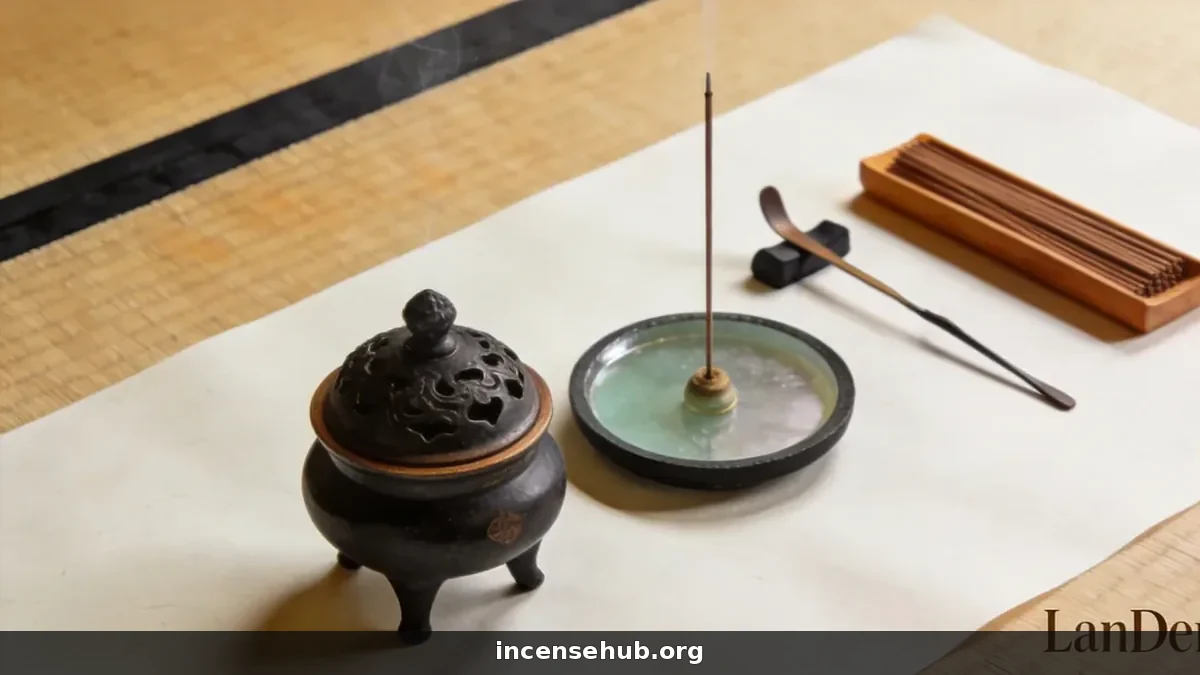
Key facts: Buddhist practice carried incense into Japan around the sixth century. The art was formalised in the Muromachi period, in the circle around the shogun Ashikaga Yoshimasa. Two teaching lines survive today, Oie-ryū and Shino-ryū, with procedures that do not match each other. Everything centres on agarwood (沈香, jinkō), sorted through a six-type, five-taste vocabulary. At its best the session is nearly smokeless.
Key Takeaways
- Japanese form, Chinese method. The heating arrangement, 隔火焚香, is recorded in Song China.
- “Listen” is the operative verb, and monkō (聞香) means attention sustained over minutes rather than a single sniff.
- Agarwood is the material, described through rikkoku gomi (六国五味).
- No flame touches the wood. A hidden coal heats a thin plate; the plate heats the piece.
- Games carry the pedagogy. Kumikō and genjikō give discrimination a right answer.
- Cost limits the audience. The material is scarce, which kept the practice small and lineage-bound.
The Correction: Form Is Japanese, Technique Is Chinese
English writing often credits Japan with inventing refined incense appreciation. The documents point elsewhere. The technique kōdō depends on — charcoal hidden under ash, a thin plate, wood warmed rather than ignited — is recorded in Song China as 隔火焚香, and it travelled to Japan in the same centuries as Buddhism and tea.
What Japan added was organisation. A courtly circle turned a technique into a curriculum: named parts, fixed gestures, graded materials, and games with answers. That is a real achievement, and it is why the practice survived with its terminology intact while the Chinese tradition diversified into blending, medicine, and household use.
The framing that holds up is therefore simple. China supplied the method; Japan supplied the school. Neither claim diminishes the other, and both are more interesting than the nationalist version in which one country invented everything.
See the history of Chinese incense for the older timeline, and what Chinese incense is for the material culture behind 隔火焚香.
How the Practice Grew Up
Incense entered Japan as temple material in the sixth century and stayed liturgical for generations. The court adopted it during the Nara and Heian periods, which created the audience a connoisseurial art needs. The rules, categories, and games took shape in the Muromachi period, in the circle around the shogun Ashikaga Yoshimasa. The Edo centuries turned transmission into schools and materials into a trade. What remains today is small, taught within lineages, and expensive to practise.
The Verb Is “Listen”
Japanese distinguishes 聞く (kiku), to hear or listen, from 嗅ぐ (kagu), to smell. Kōdō uses the first. Monkō (聞香), “listening to incense,” is the name of the practice, and the choice of verb is the whole method in miniature.
A quick sniff answers one question: what is this? Listening answers a different set: how does it begin, what does it do in the middle, where does it go, and how long does the arc last? The first is identification. The second is attention. Kōdō trains the second, which is why a session can last an hour and involve three small pieces of wood.
The distinction has a practical consequence for anyone trying the practice outside Japan. If you sit down, light something, and sniff once, you have not done kōdō — you have used incense. The practice begins when you stay with the material long enough for it to change. Agarwood does change: the opening is often sharp or resinous, the middle rounds out, and the tail turns woody, sometimes bitter. Listening is simply noticing that sequence instead of missing it.
There is a second consequence, less flattering. Because the verb implies sustained attention, kōdō is easy to describe and hard to do. A distracted session is not a failed session — the tradition expects the mind to wander and the practice to bring it back — but a session conducted while checking a phone is not the practice at all.
Setting the Heat: The Chain That Makes Kōdō Possible
The physical setup is a chain of small decisions, and each one changes what the wood does.
ash is sifted into the censer → the ash is pressed into a smooth bed → a lit charcoal is buried at the centre → the ash is shaped into a cone over it → a mica plate is laid on the apex → the fragrant wood rests on the plate → radiant heat warms the wood from below → volatiles rise without combustion → the aroma arrives without smoke
Read the chain backwards and the failure modes become obvious. If the ash is loose, air reaches the charcoal and it burns hot, and the wood scorches. If the charcoal sits too close to the surface, the plate gets too hot and the aroma turns acrid. If the plate is missing or cracked, ash dust reaches the wood and the note turns dusty. If the wood is damp, the first minutes are steam rather than scent.
The genius of the method is that heat is delivered indirectly. A stick of incense is a controlled fire; a kōdō session is a controlled oven. The difference is not spiritual, it is physical: combustion destroys a large share of the aromatic compounds before they reach the nose, while gentle heating releases them more or less intact. That is why a few grams of good agarwood can fill a small room for an hour, and why the same wood burned on a coal would smell crude by comparison.
This is the same principle behind the Chinese 隔火焚香 method, and behind the modern electric heater used by people who want the aroma without managing charcoal.
The Kit, and What Each Piece Does
A working set is short: a censer wide enough to hold a bed of ash, fine ash to insulate the heat, a small piece of incense charcoal, a press to shape the bed, a mica plate to carry the wood, and long tweezers so fingers never touch either. Add a lidded container for the day’s pieces.
Each item removes one variable. The ash controls distance; the plate controls contact; the tweezers control contamination; the container controls what the wood smells of before it is heated. Remove the plate and the method is no longer kōdō, because the wood would sit in ash and scorch.
Where the Session Goes Wrong
Four failures account for most bad first sessions, and all four are heat problems rather than material problems.
The charcoal is too hot. The wood scorches within seconds and the note turns sharp and burnt. The cure is time: let the buried charcoal settle under the ash for several minutes before the plate goes on.
The ash is too thin. Heat reaches the surface too quickly and the session runs hot from the start. The cure is more ash and a taller cone.
The wood is too close to the plate’s edge. Heat distribution across a mica plate is not perfectly even; a piece placed near the rim may get less heat and release nothing, while the centre scorches. The cure is placement, and it is learned by watching the first minute.
The room is too cold or too draughty. A cold room slows volatilisation and the wood seems mute; a draught carries the aroma away before it reaches the nose. The cure is a still, moderate room — the same condition a tea ceremony assumes.
Notice what is not on the list: the quality of the wood. Beginners tend to blame the material. In practice, a modest wood handled well will outperform an expensive wood handled badly, and the difference is almost entirely in the ash bed and the wait.
Rikkoku Gomi: A Language, Not a Map
Practitioners describe a wood with two labels at once: an origin type and a taste. The origin set has six members — kyara, rakoku, manaka, manaban, sasora, sumotara — and the taste set has five: sweet, spicy, sour, salty, bitter. Together they make a compact phrase that another practitioner can understand without seeing the piece.
The labels are not geography. Manaban means something like “southern barbarian,” which names a direction of trade rather than a country. Sasora’s mapping is disputed. Kyara names a grade and a behaviour more than a place. Using the scheme to certify provenance is a misuse; using it to compare two pieces on the same afternoon is exactly what it was built for.
Kyara and the Rest: What the Grades Describe
The word kyara (伽羅) is the most abused term in the agarwood trade, and kōdō is where it comes from.
The classical account of kyara describes wood in which resin has replaced so much of the tissue that the material behaves differently: fibres soften, the piece carries a smell before any heat is applied, and density can rise far enough for it to sink. Ordinary agarwood (沈香, jinkō) is the opposite arrangement — hard timber threaded with resin, which gives up its scent only when warmed.
That difference in physical state is what the trade calls “oil-wraps-wood” versus “wood-wraps-oil.” It is a description of how the resin is distributed, not a botanical species. There is no tree called kyara; there is agarwood that has been transformed to a degree the tradition labels kyara.
Two consequences follow. First, the term is a grade and a description, not a species name, so claims about “kyara trees” are marketing. Second, because the grade depends on a physical property that is hard to verify at a distance, kyara is the easiest category in the trade to counterfeit — the agarwood guide covers the practical checks.
For a kōdō beginner, kyara is not the starting point. It is the far end of the scale, expensive enough that practicing on it is like learning to cook with truffles. The traditional teaching order starts with recognizable middle-grade woods and moves upward once the nose has references.
Why Fifty-Two Patterns: The Arithmetic of Genjikō
Genjikō (源氏香) is the most famous of the incense games, and its structure is usually described as mysterious. It is not. It is a counting problem.
The game presents five fragrant woods. The player listens to each in sequence and must decide which of them are the same wood and which are different. The answer is therefore a grouping — a partition of five items into sets of “same.”
The number of ways to partition five distinct items is fifty-two. The count is not arbitrary; it is the fifth Bell number, and it can be built up by hand:
- One group of five: 1 pattern (all the same)
- One group of four plus a singleton: 5 patterns
- One group of three plus a pair: 10 patterns
- One group of three plus two singletons: 10 patterns
- Two pairs plus a singleton: 15 patterns
- One pair plus three singletons: 10 patterns
- Five singletons: 1 pattern
Add those and the total is 52. That is exactly the number of named answer patterns in the classical game, each conventionally attached to a chapter of The Tale of Genji. The tale has fifty-four chapters, and the convention leaves two aside, which is why the count lands where it does.
Seeing the arithmetic changes how the game reads. It is not a mystical exercise with an occult answer key; it is a discrimination test with a complete, finite answer space. The player is not guessing at hidden meanings but placing an observation into one of fifty-two possible groupings. That is a very Japanese kind of elegance — a formal constraint that makes an aesthetic judgment comparable between people — and it explains why the game survived as a teaching tool. A practice without a right answer cannot be taught; a practice with fifty-two right answers can be examined.
The Two Schools
Two teaching lines came through the Edo reforms. One, Oie-ryū, descends from court circles linked to the Sanjōnishi family and carries a mannered, etiquette-first character. The other, Shino-ryū, descends from a samurai household and carries a plainer, more austere one.
The split explains a confusion that frustrates newcomers: there is no single correct procedure. The right grip, the right bow, the right order of gestures are defined inside a lineage. A video from one school will contradict a video from the other, and both will be right.
Kōdō Against Its Neighbours
Placing kōdō beside other incense traditions makes its choices visible. The point of comparison is not quality but intent.
| Tradition | Material | Heat source | Smoke | Social form |
|---|---|---|---|---|
| Japanese kōdō | Agarwood, small pieces | Buried charcoal under mica | Almost none | Ritual, games, lineage teaching |
| Chinese 香 | Blends of wood and resin (合香) | Indirect heat or burning | Low to moderate | Composition, connoisseurship, daily use |
| Indian agarbatti | Paste on a bamboo core | Direct combustion | Heavy | Devotion, daily practice, market sale |
| Tibetan incense | Dense herbal and resin mixes | Direct combustion | Heavy | Monastic ritual |
| Middle Eastern bakhoor | Resin and wood chips | Coal or electric heater | Moderate | Hospitality, household ritual |
The table shows three separate design decisions: what material is central, how heat is applied, and what the practice is for. Kōdō chooses a single precious material, indirect heat, and a contemplative-social form. Agarbatti chooses a composite material, direct combustion, and a devotional-daily form. Neither is a more advanced version of the other.
The world incense traditions page sets these side by side in more detail.
The Economics of Austerity
Kōdō’s minimalism is often described as an aesthetic choice. It is also an economic fact, and the two are hard to separate.
Agarwood is a scarce material formed only when a tree responds to injury or infection over years, and the resin-rich portions are a small fraction of the wood. Kyara-grade material is rarer still. The result is a material whose price per gram can exceed that of precious metals, which shapes the practice in visible ways: tiny pieces, careful handling, tweezers rather than fingers, and a ritual that treats a fragment as sufficient for an hour.
The austerity that reads as spiritual discipline is therefore also rationing. A tradition that burned agarwood by the bundle could not have sustained itself; a tradition that heats a sliver can. The same logic explains why kōdō remained a court and warrior practice rather than a popular one, and why it is less widespread than tea ceremony, whose central material is affordable and renewable.
This is not a debunking. A practice can be both economically shaped and aesthetically meaningful; the tea ceremony’s aesthetics are equally tied to the economics of tea. What the economic reading adds is realism about entry: kōdō is expensive because its material is scarce, not because its teachers are gatekeeping, though lineage teaching adds a second barrier on top.
Trying It Without a Lineage
A reader outside Japan cannot join a school easily, but the physical practice can be approximated. What cannot be approximated is the correction — the teacher who adjusts your ash cone — so treat the following as an introduction to the mechanics rather than as kōdō proper.
What you need. A small censer with a wide mouth, fine white ash, good-quality charcoal, a mica plate, long tweezers, and a few small pieces of agarwood. An electric heater is a legitimate substitute for the charcoal and removes most of the difficulty, at the cost of the ritual’s charcoal stage.
What to do. Sift the ash, press it smooth, bury a lit charcoal at the centre, and shape a cone over it. Wait several minutes. Lay the mica plate on the apex, place one small piece of wood on the plate with tweezers, and sit with it. Do not lean in and sniff. Sit back and let the aroma reach you.
What to notice. The first two minutes are usually the wood’s opening; the middle ten minutes are its body; the last stretch is the tail. Note where it changes. That note-taking is the actual practice, and it is what a teacher would be training.
What to avoid. Do not use a charcoal designed for barbecue. Do not practice in a sealed room. Do not handle the wood with fingers if you can avoid it, because skin oil changes the aroma. Do not buy expensive wood until you can describe the difference between two cheap pieces.
Safety: Charcoal Indoors
Kōdō involves burning charcoal inside a room, which is a genuine hazard and not a decorative detail.
Lit charcoal produces carbon monoxide, an odourless gas that accumulates in closed spaces. The traditional setting is a Japanese room with ventilation and a session of limited length; the practice assumes fresh air, not a sealed modern apartment. Anyone adapting the method should keep a window open, avoid long sessions in small rooms, and never leave a buried charcoal unattended.
The ash bed reduces but does not eliminate the risk. A mica plate and a layer of ash slow combustion; they do not make it clean. An electric incense heater avoids the problem entirely and is the sensible choice for a small flat, a shared office, or anyone in a household with children or pets.
The same caution applies to the wood itself. Heating agarwood produces aromatic volatiles, and some people are sensitive to smoke or to particular resins. A headache, a dry throat, or irritation is a signal to ventilate and stop, not to push through.
What the Nose Does During a Session
A kōdō session is partly a lesson in how smell behaves, and the most useful thing to learn is that the nose is not a measuring instrument. It is a change detector.
Olfactory receptors respond to variation more than to steady concentration. Hold a constant aroma under the nose and the signal weakens within minutes, not because the wood has stopped releasing volatiles but because the receptors have stopped reporting them. This is adaptation, and it shapes everything about how a session is organised. The piece that seemed intense at the start will read as mild by the tenth minute, and a second piece will seem stronger than it is simply because it is different.
Three practical rules follow.
Judge the opening immediately. The first minute carries the most information, because adaptation has not yet set in. What you smell then is closer to the wood’s actual output than anything you will smell later.
Air the room between pieces. Adaptation is local and temporary; fresh air and a few deep breaths away from the censer restore most of the sensitivity. A short pause is not ceremony, it is recalibration.
Do not trust the tail as a quality signal. The last minutes of a piece are heard through a fatigued nose. A weak tail may mean a weak wood, or it may mean you have been sitting in the same cloud for twenty minutes.
The coffee-bean reset deserves a note, because it circulates as fact. Sniffing coffee between fragrances is a perfumery convention; it does not demonstrably reset olfactory receptors. What it does is give the nose a strong, familiar, contrasting signal, which interrupts attention and makes the next sample easier to notice. That is a useful trick and a different claim from a physiological reset.
Heat, Air, and the Room
The same wood behaves differently in different weather, and the reason is physics rather than mood.
Volatilisation depends on temperature. A cold room lowers the vapour pressure of the aromatic compounds, so less material enters the air per minute and the wood reads thin and slow. A warm room does the opposite, sometimes pushing a delicate wood past its best range into something sharp.
Humidity adds a second variable. Water vapour competes for surface sites and slows the release of the lighter compounds, which is why a damp day can make a familiar piece smell muted and slightly heavy. Air movement is the third: a draught carries aroma away from the nose before it accumulates, and a still room lets it pool.
The chain is short and worth memorising:
cool air → lower vapour pressure → slower release → thinner aroma → the temptation to raise the heat → scorching → a burnt note that was never in the wood
That chain explains the most common seasonal error. In winter, a practitioner adds heat to compensate for a cold room, overshoots, and concludes that the wood is harsh. The wood is fine; the room is cold. Warming the room, or waiting longer at the same heat, solves the problem without touching the setup.
The reverse error appears in summer. A wood that performed well in January turns cloying in July, and the practitioner blames the material rather than the temperature. A shorter session, a little more distance from the censer, and a lower coal solve it.
A Starter Kit Without a Specialist Shop
Kōdō equipment is sold as a set, and the set is expensive. Most of it can be assembled from ordinary sources, with two exceptions that should not be improvised.
| Piece | Improvised version | Why it works | Where improvisation fails |
|---|---|---|---|
| Censer | A wide, thick-walled ceramic bowl | Holds ash and tolerates heat | Thin glass or glazed decorative bowls can crack |
| Ash | Fine, dry, clean white ash | Insulates and regulates | Sand holds heat differently and may crack the bowl |
| Plate | A genuine mica sheet | Thin, inert, heat-tolerant | Foil wrinkles, hotspots, and can scorch the wood |
| Tweezers | Long kitchen tweezers | Keeps fingers off the wood | Short tweezers put your hand in the heat |
| Charcoal | Incense charcoal, not barbecue fuel | Consistent size and heat | Barbecue charcoal smokes and smells of fuel |
| Container | A small tin with a tight lid | Keeps pieces separate | Plastic bags transfer odour |
Two rules are absolute. The plate must be mica or a purpose-made equivalent, because a metal substitute changes both the heat transfer and the smell. The charcoal must be incense charcoal, because fuel-grade charcoal introduces combustion products that will dominate the session.
Everything else is tolerant. A bowl is a bowl. Tweezers are tweezers. The parts that matter are the ones in contact with heat and aroma.
Judging a Wood You Cannot Smell
Most buyers now encounter agarwood through a listing rather than a censer, and the vocabulary of those listings is not neutral.
Weigh the words. “Kyara-grade” is a comparison, not a category. “Sinking” describes a density test that can be faked by treating the wood. “Wild” describes a harvesting origin that is difficult to verify and increasingly rare. None of these words is meaningless, and none is a substitute for a test.
Ask for the physical evidence. Weight and dimensions together give a density estimate. A photograph with a scale reference gives size. A seller who will not provide either is selling a story.
Buy small before buying well. A few grams of a mid-grade wood teaches more than a single expensive piece, because comparison requires more than one sample.
Check the return terms. A seller confident in the material will accept a return on an unsmould piece. A seller who refuses is telling you that the transaction is final in a way that the listing did not.
Distrust the certificate. A certificate of authenticity certifies a document, not a piece of wood. It is useful when the issuing body is identifiable and the sample is traceable to the piece in hand, and decorative otherwise.
Moving the Wood Across Borders
Agarwood is not an ordinary commodity, and a buyer who plans to import it should understand why before ordering.
Several Aquilaria species, and the related Gyrinops genus, appear in CITES Appendix II. That listing does not ban trade; it requires that exports be accompanied by permits issued by the exporting country’s management authority, and that the trade be judged non-detrimental to wild populations. For a private buyer, the practical consequences are straightforward. A parcel without paperwork can be held at customs. A seller who offers to ship “without the paperwork” is offering a risk that lands on the importer, not on them.
The permit system also explains a phrase that circulates in the trade: “wild” versus “plantation.” Wild-collected material requires documentation of legal harvest; plantation material is generally easier to move because its origin is traceable. Neither category is automatically better for the nose, and a plantation wood can outperform a poorly handled wild piece. What the category changes is the paperwork and the price.
Three habits reduce friction. Ask for the species name rather than a trade name, because permits and restrictions attach to species. Ask for the harvest or plantation documentation before payment, not after. And keep the paperwork with the shipment, since a customs officer will not accept a screenshot from a chat.
None of this is specific to kōdō — the same rules apply to any agarwood buyer — but kōdō’s material is exactly the kind of high-value, restricted wood that attracts scrutiny. A practitioner who buys a few grams at a time may never encounter a permit requirement; a collector shipping a hundred grams across a border will.
What It Costs to Learn
The economics of kōdō are unusual among classical arts because the material cost dominates everything else.
Lessons in a school are paid for, and the fees are set by the lineage rather than by a market. A teacher’s time is the visible cost. The invisible cost is the wood: practice consumes material, and material at kyara grade is priced per gram in a range where a single session’s sliver can cost more than a month of lessons.
That imbalance shapes the pedagogy. A teacher cannot let a student burn through expensive wood on drills, so the early curriculum uses cheaper material and concentrates on procedure: the ash bed, the placement of the plate, the timing of the wait, the order of the gestures. Discrimination training comes later, when the student can be trusted not to waste the piece.
It also shapes who persists. A student with a generous budget progresses faster in the material-heavy parts, and a student without one progresses more slowly, but neither route is closed. The tradition has always had practitioners who owned very little and practised carefully.
For a reader outside Japan, the practical translation is simple. Spend on technique first — a modest censer, plenty of ash, a reliable charcoal, a mica plate — and spend on wood last. The kit is reusable; the wood is not. A person who learns the ash bed on sandalwood will handle kyara better than a person who owns kyara and has never built a bed.
Kōdō and the Tea Room
Kōdō is usually grouped with tea and flowers as one of the three classical arts, and the grouping is not arbitrary: the three share a spatial and temporal grammar.
All three assume a prepared room, a seated posture, a sequence of gestures that is repeated rather than improvised, and an attention to season. All three treat the gathering as the unit of practice rather than the object. A tea gathering is not about tea leaves in the way a meal is about food; a kōdō session is not about wood in the way a candle is about wax. The object is the occasion.
The differences are equally instructive. Tea has a host and guests, a served bowl, and a conversation. Flowers have an arrangement that persists after the gathering ends. Kōdō has neither: the material is consumed by the air, the participants sit with their own attention, and nothing remains to be photographed. That ephemerality is the point, and it is why the practice resists the kind of documentation that made tea ceremony famous abroad.
For a modern practitioner, the tea-room comparison offers a practical lesson about rooms. A space used for kōdō should be quiet, uncluttered, and free of competing smells — no scented candles, no air freshener, no cleaning products used an hour before. The room is part of the instrument. A great wood in a room that smells of detergent is a wasted session.
Storing Wood Between Sessions
Agarwood changes in storage, and most of the change is avoidable.
The enemies are light, heat, moisture, and odour transfer. Light bleaches the surface and accelerates oxidation of the resin. Heat drives off the lighter aromatic fractions, which is why a piece kept on a sunny shelf smells flatter after a year. Moisture swells the wood and can encourage mould in the softer, resin-rich tissue. Odour transfer is the quiet one: a piece stored beside a scented candle or a bar of soap will pick up the neighbour’s smell, and the contamination is permanent.
The working method is simple. Keep pieces in a small wooden box or a glass jar with a tight seal, away from windows and radiators. Separate grades into separate containers, because a strong wood will scent a mild one given time. Handle with tweezers rather than fingers, since skin oil sits on the surface and oxidizes. Label the containers, because memory is unreliable after a year and a piece’s identity is part of its value.
Do not refrigerate. Condensation cycles are worse than room temperature, and the aroma will suffer for it. Do not seal damp wood in plastic; if a piece feels cool and heavy from humidity, let it dry in a shaded, ventilated space first.
Travel is the other risk. A piece carried in a coat pocket for a week absorbs whatever the coat contains — tobacco, perfume, cooking fat — and the contamination cannot be washed out. Wrap it in paper or a cloth pouch, keep it away from toiletries, and unpack it at the destination before the smell has time to settle.
A small collection kept this way will outlast the packaging it arrived in by decades. The wood is stable; the handling is what varies.
The Air in the Room
Kōdō is a combustion practice, even a restrained one, and the air is part of the equipment.
A buried charcoal produces carbon monoxide as it burns, along with a small quantity of fine particles. In a traditional room with sliding screens and seasonal ventilation, the dilution is adequate for a session of ordinary length. In a modern flat with sealed windows and mechanical extraction switched off, the same charcoal can raise the concentration in a small room surprisingly quickly, and the gas is odourless.
The practical rules are not exotic. Ventilate before and after rather than during, so the session is not disturbed by a draught. Keep sessions short in small rooms. Never leave a censer burning unattended, and never sleep in a room where a charcoal is still live. If anyone in the household has a respiratory condition, use an electric heater instead — the aroma is nearly identical and the combustion products are absent.
The same logic applies to the wood. Heated agarwood releases volatile organic compounds, and a session in a closed room concentrates them. A headache, a dry throat, or a feeling of stuffiness is the signal to open a window and stop, not a sign that the wood is especially fine.
None of this is meant to frighten anyone away from the practice. It is meant to make the practice sustainable: a session that leaves the room fresher than it found it is a session that can be repeated for years, and repetition is what the art is built on.
A cheap carbon-monoxide monitor takes the guesswork out of the question. Placed a metre from the censer, it will read close to background in a ventilated room and climb in a sealed one, which turns an invisible hazard into a number. For anyone practising in a modern flat, that is the single most useful piece of equipment in the room, and it costs less than a decent censer.
Reading a Piece in the Hand
Before a wood reaches the plate, it can be examined, and the examination is mostly about grain.
Look at the transition between pale fibre and dark resin. Natural agarwood shows irregular, wandering resin lines that follow the grain, with pale wood still visible between them. A block that is uniformly dark from edge to centre is either exceptionally rich or has been treated, and the two are hard to tell apart without heat.
Look at the surface. Aged wood has a dull sheen and a slightly uneven texture; freshly cut faces are lighter and drier. A piece that has been sanded smooth and polished may be hiding its grain, which is convenient for a display object and unhelpful for a buyer.
Weigh it against its size. Agarwood is denser than the parent species in proportion to resin load, so a small piece that feels heavy for its volume is promising. A large piece that feels light is not.
Smell it at room temperature, but do not expect much. Most agarwood is quiet until warmed; a piece that fills the room while cold is either kyara-grade or perfumed. In a first purchase, the second explanation is more likely.
Common Mistakes
- Treating kōdō as the origin of incense appreciation. It is a Japanese codification of a Chinese technique, and the distinction is documented.
- Reading rikkoku gomi as geography. The “six countries” are trade labels, not verified origins.
- Expecting smoke. Refined kōdō is defined by the near-absence of it; a smoking session usually means the heat is wrong.
- Starting with kyara. The top grade teaches nothing to a nose without references and costs a great deal to learn on.
- Buying the kit before learning the heat. Tools do not substitute for the ash bed and the wait.
- Copying one school’s video as universal procedure. Lineages differ, and both can be correct.
The Author’s Position
Position: The Chinese origin of kōdō’s technique is worth stating plainly, and so is the Japanese achievement of codifying it.
Reasoning: English sources tend to treat kōdō as the beginning of refined incense appreciation, which makes the Chinese tradition look like a precursor rather than a source. The documents show the reverse: the indirect-heat technique is Song Chinese, and the Japanese contribution is the ritual grammar built on top of it. Saying that does not diminish kōdō. It explains why the practice looks the way it does.
Boundary: This is a reading of the historical record, not a claim about cultural ownership. Traditions move, and a technique that travels and is transformed belongs to both ends of the journey. What deserves correction is the framing that treats one end as original and the other as derivative — in either direction.
This is the author’s editorial view, based on published sources rather than a single primary document.
Verification Notes
- The sixth-century date and the Muromachi formalisation are the conventional ones; both are approximations, not fixed events.
- Rikkoku gomi is described as a classification scheme, and its place names are flagged as unreliable geography rather than suppressed.
- The fifty-two-pattern count is given as a combinatorial fact about partitions; the chapter naming is labelled convention.
- Nothing here is a therapeutic claim. Charcoal appears as a combustion hazard with a ventilation requirement.
FAQ
Q: Is kōdō the same as Chinese 香道?
No. They share a name and an ancestor, not a method. The Chinese tradition is broader: blends, powders, sticks, and the indirect-heat method all belong to it. Kōdō narrowed the field to one material and one heating technique, then wrapped both in a fixed procedure and a game with a key. The Chinese practice is a culture; the Japanese one is a curriculum.
Q: What does “listening to incense” actually mean?
It describes a duration, not a metaphor. You stay with the piece long enough to hear it change — opening, body, tail — instead of taking one sniff and naming it. Anyone can do this on the first attempt with modest wood; the skill that takes years is describing what you heard in words another practitioner accepts.
Q: What is rikkoku gomi?
A pair of labels used to compare agarwood: one of six traditional origin types plus one of five taste qualities. It is a shared shorthand, not a certificate. The origin names came from trade routes and old geography, and several are disputed, so the scheme says more about how a piece behaves than about where it was cut.
Q: Why is kōdō rarer than tea ceremony?
Material cost, kit cost, and silence. Tea uses a renewable leaf and produces a social occasion with a host, a bowl, and a photograph. Kōdō uses a scarce wood, requires a specialised set, and leaves nothing behind but a smell that has already gone. It is difficult to popularise an art whose only product is attention.
Q: Is kyara a species?
No. The word describes agarwood whose resin has saturated the tissue to the point where the material turns soft and scented at room temperature. The trade shorthand is “oil-wraps-wood,” against ordinary agarwood’s “wood-wraps-oil.” Because the category is defined by a physical property rather than a botanical one, it is the easiest grade to fake.
Q: Can it be learned without a teacher?
The mechanics can: the ash bed, the buried coal, the plate, the waiting. What a teacher supplies is correction — of your cone, your timing, your vocabulary — and correction is the part that written instructions cannot deliver. Self-teaching is a reasonable preparation for study and a poor substitute for it.
Q: Is there a religious requirement?
No. The practice grew in Buddhist settings and still appears in temple ritual, but the codified art is courtly and aesthetic rather than doctrinal. Participants range from observant Buddhists to people with no religious affiliation who are interested in wood and attention.
Q: How much wood does a session use?
A sliver. The method releases aroma slowly from a small surface, so a fragment can carry an hour. That economy is partly aesthetic and partly forced: at the prices good agarwood commands, a practice built on bundles could not have survived. Beginners should train on inexpensive material and save the good pieces for when their nose can use them.
Sources
- 《香乘》 — a Ming compilation, and the basis for the indirect-heating account here.
- 《香谱》 — Song-era heating conventions.
- 《梦粱录》 — where the “four refined arts” grouping appears.
- Koju and Nippon Kodo culture pages — teaching lines, game rules, the six-type framework.
- Wikipedia, Kōdō — word history and the dates of the old houses.
- Project notes R-003 — the reasoning behind the Song-export reading.
Related Resources
- What Is Chinese Incense? — the tradition kōdō grew out of.
- History of Chinese Incense Culture — the timeline behind 隔火焚香.
- Agarwood (沉香) Incense Guide — the material at the centre of the practice.
- World Incense Traditions — kōdō beside China, India, Tibet, and the Middle East.
Natural next step: kōdō is only as good as its material, so read the agarwood guide next — it covers 奇楠, grading, and the checks that separate real wood from treated substitutes.
Summary
- A Japanese ceremony wrapped around a Chinese heating method: that is the shortest accurate description of kōdō.
- Warmth climbs through ash to a thin plate to a fragment of wood; nothing ignites, so nothing smokes.
- Listening means staying long enough to hear the piece change — opening, middle, tail.
- The six-type, five-taste vocabulary is a comparison tool; treat any origin claim built on it with suspicion.
- Fifty-two answer patterns is arithmetic, not mysticism: the partitions of five items, each named for a chapter.
- Expensive material and private teaching explain the art’s size, and neither is an accident.