
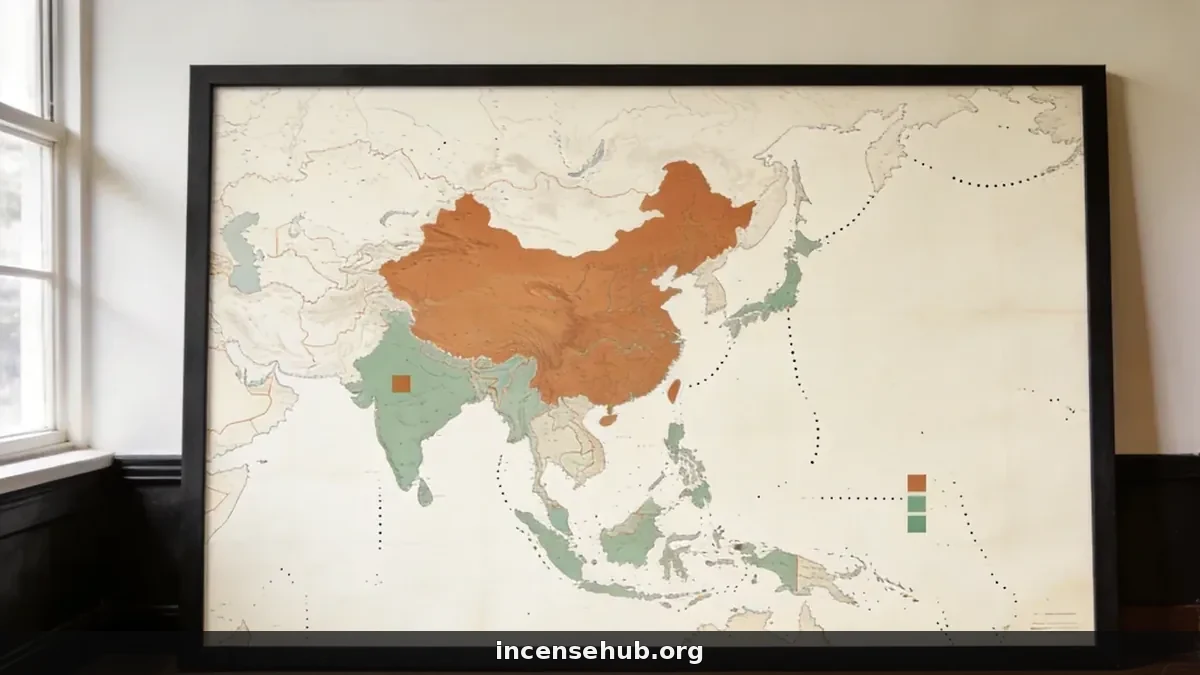
Direct answer: The world’s incense practice sorts into five working schools — Chinese 香, Japanese kōdō, Indian agarbatti, Tibetan 藏香, and Middle Eastern bakhoor — and the border on a map explains less than the object in your hand. Shape, heat source, and ritual job separate them more cleanly than nationality does.
Key facts
- Five schools, five objects: a Chinese blended stick or seal, a thin Japanese coreless stick, an Indian bamboo-core stick, a thick Tibetan herbal rod, a Middle Eastern chip or resin tear.
- China holds the oldest written record and the indirect-heating technique (隔火焚香) that Japan later formalized.
- Japan’s kōdō turns burning into listening: a small piece of wood, an ash bed, very little smoke.
- India splits its sticks into masala (material rolled onto the bamboo) and dipped (a blank core soaked in fragrance).
- Tibet treats incense as a recipe: herbs and woods pressed into a coreless rod, tied to monastery workshops and the Sowa Rigpa medical lineage.
- The Middle East skipped the stick. Prepared chips and resin tears go onto heat, usually in company.
- None of these traditions is a medical product. Ritual meaning is real; therapeutic claims are not established.
Five schools, three axes
Direct answer: Ask what the object is, what heats it, and what the burn is for, and the five schools fall apart into five distinct products.
| School | Object | Heat | Job | Scent signature |
|---|---|---|---|---|
| Chinese 香 | Sticks, coils, loose powder, seal-pressed cakes | Flame for sticks; buried charcoal or a heater for appraisal | Daily scenting, tea, study, 香道 | Warm, layered, usually several materials |
| Japanese kōdō | Thin coreless stick; small wood chips for 聞香 | Flame for the stick; ash bed over heat for chips | Attentive appreciation, often in company | Restrained, single-voice, low smoke |
| Indian agarbatti | Bamboo-core stick; dhoop as the coreless cousin | Flame | Worship (puja, aarti), household scenting | Bold, floral, spicy, openly smoky |
| Tibetan 藏香 | Thick coreless rod | Flame, in a dish or burner | Monastery ritual, household practice | Earthy, herbal, heavy smoke |
| Middle Eastern bakhoor | Prepared chips; loose resin tears | Charcoal or electric burner | Hospitality, clothing and room scenting | Resinous, sweet-balsamic, warm |
Two columns carry most of the information. “Object” tells you what equipment you need before you buy. “Job” tells you whether the product suits your evening; a bakhoor chip bought for a small bedroom will announce itself through the whole floor.
Why the job comes first
Direct answer: A tradition picks its incense the way a workshop picks a tool — the task decides the shape, and the shape decides the smoke.
Follow the chain through three cases. A rite that must fill a courtyard and be seen burning → a thick stick or a chip on live charcoal → a hot, sustained burn that throws visible smoke → a scent that reads as bold and public. A practice built on sitting quietly with one piece of wood → a small chip warmed through ash → a slow, low-temperature release → almost no smoke and an aroma that unfolds in stages. A household custom of scenting a guest’s clothing → a loose, oil-bearing chip dropped on a burner → a fast resinous plume → a room that keeps the smell after the guest leaves.
The chain runs one way. Nobody designed a thick Tibetan rod for its own sake; the rod is what a monastery recipe becomes when it has to burn long and carry across a hall. Read a form backward and you recover the room it was made for. That is the most reliable way to judge whether a given incense will fit your own space.
The Chinese root, and Japan’s narrowing
Direct answer: China produced both the material culture and the technique Japan refined; kōdō is a deliberate reduction of a much wider practice.
Chinese incense covers blended sticks, coils, loose powder, and seal-pressed cakes, and it treats blending (合香) as a craft in its own right: several materials weighed into one formula with a stated hierarchy. The older heating method is 隔火焚香 — burying the heat source under ash so the aromatic never touches flame. That technique is the ancestor of the Japanese practice.
Japan took the method and narrowed the subject. Kōdō keeps the ash bed and the indirect heat, but fixes attention on a single small piece of agarwood rather than a composed blend. Sessions are often a group affair with formal etiquette, and the vocabulary is one of listening (聞香, “listening to incense”) rather than smelling.
A correction worth making: English guides often equate 聞香 with 隔火焚香. They sit at different levels. 隔火焚香 names a heating method; 聞香 names the act of attending to the scent. A Japanese session uses the first to serve the second, and treating the two terms as synonyms blurs exactly the distinction the tradition cares about. That is an editorial note on terminology, not a claim about any school’s precedence.
India: a stick built around a core
Direct answer: Agarbatti is a delivery system — bamboo core, paste, finish — and the masala-versus-dipped split decides more about what you smell than the fragrance name does.
Masala sticks are made by rolling a paste of ground aromatic material onto bamboo; the scent comes from what is in the paste. Dipped sticks begin as a blank, often charcoal-based, and are soaked in a fragrance oil or compound; the scent comes from the bath. The two look similar on a shelf and behave differently in a room.
| Masala | Dipped | |
|---|---|---|
| Where the scent lives | In the rolled paste | In the applied fragrance |
| Raw-material load | Higher: woods, resins, herbs, spices | Lower; the core carries volume |
| Burn character | Denser, often spicier, residue varies | Brighter top note, can fade fast |
| Cost driver | Material cost | Fragrance cost |
| What to check on the box | Ingredient list, paste weight | Fragrance disclosure, solvent smell |
The split matters because a “sandalwood” dipped stick may contain little or no sandalwood; the name describes the fragrance, not the material. Masala does not guarantee quality either — a thin paste with filler smells flat — but the label at least points at materials rather than at a bottle. Dhoop is the coreless cousin of agarbatti: a thicker molded stick without bamboo, closer in build to the Tibetan rod than to its own shelf neighbors.
Tibet: the recipe is the unit
Direct answer: 藏香 is not a scent chosen from a list; it is a formula, and the formula is the product.
A Tibetan rod is coreless and thick, pressed from a ground mixture of herbs, woods, and other plant material. The recipe, not any single aromatic, carries the identity: two workshops can both sell “Tibetan incense” and produce completely different objects. The craft is tied to monastery workshops and to the Sowa Rigpa medical tradition, which is why the vocabulary around it can sound clinical to outside ears.
Label that lineage carefully. Sowa Rigpa is a medical tradition with its own texts and practice; an incense made inside that lineage is not thereby a treatment, and this page makes no therapeutic claim for any rod. The recipe lineage is documented. The effect claims that sometimes travel with it are traditional belief, not established clinical fact.
In practice, Tibetan incense is the smokiest of the five. It suits a ventilated room and a dish that can take ash; it does not suit a sealed bedroom, and no tradition’s framing changes that.
The Middle East: heat, resin, and the guest
Direct answer: The Middle Eastern school is built on material dropped onto heat rather than shaped into a stick, and its social setting — the majlis — is part of the design.
Bakhoor is prepared wood, often agarwood, soaked or coated with fragrance oils and resins and then dried. A piece goes onto charcoal or an electric burner and smoulders. Oud is the wood itself, graded and traded as a material; bakhoor is the prepared, scented form. Frankincense and myrrh belong to the same family of practice but come from a different source: they are exudates, not wood.
Trace a resin tear from tree to burner. A Boswellia or Commiphora trunk is scored → the tree weeps a milky gum at the wound → the gum beads and hardens in dry air → the tears are collected, sorted, and shipped → a tear dropped on hot charcoal releases a balsamic, faintly citrus smoke. No binder, no core, no press: the tree makes the object.
The social layer explains the smoke. In a majlis the host heats the bakhoor and often passes the burner or wafts smoke toward guests, scenting clothing as part of the welcome. A visitor who judges that smoke by the standards of a quiet Japanese session will find it excessive; in its own setting the volume is the point. Etiquette varies by country and household, so treat any single description as an example rather than a rule. [need-source] for a region-by-region etiquette claim.
What the word “exotic” hides
Direct answer: “Exotic” describes the buyer’s distance from the product, not the product, and it is the most common way a purchase goes wrong.
A shopper who buys on the word alone ends up with a bakhoor chip and no burner, or a thin coreless stick expected to scent a hallway. The category hides three facts that decide the experience: the object’s shape, the heat it needs, the job it was built for. Once those are answered, “exotic” has nothing left to add.
The boundary is worth stating plainly. This is a correction of a marketing habit, not a claim that one tradition is more refined than another. A Tibetan monastery rod and a Japanese chip are both precise objects; they are precise about different things. Treating them as interchangeable because both are “Eastern” is an error, and it is a buying error before it is a cultural one.
Materials travel farther than traditions
Direct answer: The same plants appear in traditions that never met because materials moved along trade routes long before finished products did.
Frankincense was gathered in southern Arabia and the Horn of Africa and moved by caravan and ship toward the Mediterranean, India, and China. Sandalwood moved outward from India. Agarwood came from the forests of Southeast Asia and southern China and reached Japan as an imported luxury, which is part of why a single chip could carry so much ceremony. When a material turns up in two distant traditions, the route is usually the explanation, not a coincidence.
| Material | Source region | Where it became central |
|---|---|---|
| Frankincense | Arabia, Horn of Africa | Middle Eastern and church use |
| Myrrh | Arabia, Horn of Africa | Middle Eastern use, blended medicine |
| Sandalwood | India | Indian sticks, Chinese blends |
| Agarwood | Southeast Asia, southern China | Japanese kōdō, Chinese blends, Gulf bakhoor |
| Herbal mixtures | Tibetan plateau and Himalayas | 藏香 |
The table is diagnostic. A “sandalwood” product from a tradition with no sandalwood in its history is not automatically wrong — trade is old — but the claim deserves a second question about what the wood is doing in that formula.
Equipment follows the object
Direct answer: The five schools cannot share one setup; the equipment list is the object’s shape written as hardware.
| School | What you need | What fails without it |
|---|---|---|
| Chinese stick or coil | Holder, coil stand, or heater | Coil sags; ash drops |
| Japanese coreless stick | Low holder; ash bed for chips | Stick tips; chip scorches |
| Indian agarbatti | Holder with an ash tray | Ash marks the surface |
| Tibetan 藏香 | Heatproof dish, ventilation | Residue and heavy smoke |
| Bakhoor | Burner plus charcoal or electric heat | Nothing burns at all |
The rule that follows: match the fuel to the fire before matching the scent to the room. A bakhoor chip without a burner is a scent you own but cannot use. Ventilation belongs on the same list. Every one of these products produces smoke, and the low-smoke character of kōdō comes from heating a small chip indirectly, not from a universal property of Japanese sticks.
Reading an unlit object
Direct answer: Most of what you need to know is visible before a flame touches the incense: weight, surface, core, and the smell of the cold stick.
A bamboo-core stick shows its spine at the cut end and feels light for its length. A coreless rod is uniform across the cross-section and usually heavier, because the mass is all aromatic material. A masala stick has a slightly rough, matte surface from the paste; a dipped stick is smoother and often more strongly perfumed when cold. Bakhoor is irregular by design — chips, not a manufactured line — and should smell of resin and oil rather than of solvent.
The cold smell is a rough filter, not a verdict. A strong unlit scent can mean a heavy fragrance load in a dipped stick, or a fresh masala that will settle. What it reliably catches is the product that smells of nothing at all, or of a sharp chemical note that belongs to no named material. That is the one to put back.
Common mistakes
Direct answer: Four errors account for most disappointed first purchases.
- Buying a form your setup cannot burn. Chips need heat; coreless sticks need a low holder; coils need a stand.
- Reading a fragrance name as an ingredient list. “Sandalwood” on a dipped stick may describe the perfume, not the wood.
- Judging smoke volume as quality. A majlis burns loud on purpose; a kōdō session burns quiet on purpose.
- Taking lineage language as medical evidence. A Sowa Rigpa recipe lineage is documented; a therapeutic effect is not established.
FAQ
Q: What actually separates Chinese incense from Japanese kōdō?
Scope and intent. Chinese practice spans blended sticks, coils, loose powder, and seal-pressed cakes, with 合香 blending as a discipline in its own right. Kōdō inherited the indirect-heating method and narrowed the subject to one piece of wood, attended closely, often in company. China composes; Japan isolates. See Japanese incense and kōdō.
Q: Is bakhoor the same thing as oud?
No. Oud is the aromatic wood — the material itself, graded and sold by origin and density. Bakhoor is a prepared product: chips, often oud but not always, soaked or coated with oils and resins and dried for burning. A bakhoor blend can contain little agarwood, and an oud chip can be burned with no preparation at all. See Middle Eastern incense.
Q: Are these traditions religious?
Several are embedded in religious practice, and none is exhausted by it. Agarbatti belongs to puja and aarti; Tibetan incense belongs to monastery ritual; bakhoor belongs to hospitality in the majlis; Chinese and Japanese practice includes both temple use and secular appreciation. The same object can carry an offering, a welcome, or an evening’s attention. This page makes no spiritual-power claim for any of them.
Q: Can one tradition’s incense stand in for another’s?
For the physical experience, often yes — match on form and heat rather than on country. A thin coreless stick from a Chinese maker gives a quiet, low-smoke burn close to a Japanese stick; resin on charcoal gives the resinous release of bakhoor without a Gulf label. What does not transfer is the ritual frame and the vocabulary. Decide which of the two you are buying. See Indian agarbatti, Tibetan incense, and Chinese incense.
Q: How should these different forms be stored?
Keep sticks and rods dry, upright, and away from strong kitchen smells; a paper box is not airtight and the paste picks up odors. Chips and resin keep longer in a sealed jar out of sunlight, though the oil coat on bakhoor will slowly lose its top notes. Heat is the common enemy — a shelf above a radiator will flatten a masala stick within a season.
Sources
- Background on the incense traditions of China, Japan, India, Tibet, and the Middle East, drawn from the regional guides linked below.
- Xiang Cheng (香乘), full text on Wikisource — a Ming-era Chinese incense manual.
- Incense burner, China, The Metropolitan Museum of Art.
Related Resources
- What Is Chinese Incense? — the root tradition, its history, and 合香 blending.
- Japanese Incense and Kōdō — the ash bed, the listening practice, the etiquette.
- Indian Incense: Agarbatti — masala and dipped builds, and what the labels mean.
- Tibetan Incense 藏香 — recipe lineage, monastery workshops, and smoke.
- Middle Eastern Incense: Bakhoor and Oud — chips, resin, and the majlis.
- Incense Safety — ventilation, ash, and combustion risk.
Summary
The five schools are five answers to one question — how do you get aromatic smoke into a room — and each answer is shaped by the room it was designed for. China composed. Japan isolated a single material and built a discipline of attention around it. India industrialized the stick and split it into material-built and fragrance-dipped lines. Tibet pressed a medical-lineage recipe into a thick rod. The Middle East skipped shaping altogether and burned the tree’s own exudate in company. Learn the object, the heat, and the job, and “incense” stops being a blur.