
Direct answer: Chinese incense is what happens when fragrant plant matter meets heat — resin-soaked heartwood, hardened sap, dried flower or root — either set alight in the ordinary way or warmed slowly over buried coal until scent rises without flame. The character 香 (xiāng) holds the smell and the substance in one syllable, and that doubling sets the tone of everything that follows: here the material is the subject, and the stick is one route to it among several.
Key facts
Direct answer: Six questions cover the outline — what the stuff is made of, how far back the writing goes, which century refined it, what the signature method does, how it relates to Japan, and what it refuses to claim about health.
| Question | Answer in brief | Why the answer stays slippery |
|---|---|---|
| What gets burned | Wood that has taken up resin, hardened sap, dried plant parts, and something to hold them together | Sticks dipped in perfume use the same word and none of the material |
| First appearance | 香 scratched onto divination bone in the Shang period (c. 1600–1046 BCE) | Round figures such as five millennia have nothing behind them |
| When it matured | Song, 960–1279 | “Golden age” is a later label, not a contemporary boast |
| What makes it distinct | A plate held between the coal and the material | Most incense in daily use is simply lit |
| Link to Japan | Technique carried east, then formalised there | The school and the game were Japanese additions |
| Health | Nothing claimed on this page | The four roles came from medicine; the purpose did not follow |
Why one character covers both the smell and the stuff
Direct answer: 香 declines the split English makes between an effect and an object, which is why Chinese texts can grade, store, and heat a piece of agarwood without once mentioning a stick.
English keeps two words in play: “fragrance” for what you notice, “incense” for what you buy. 香 runs them together. A manual can therefore weigh 沉香 agarwood as stock with a grade, a shelf life, and a known behaviour under heat, and the question “which product is it?” never comes up. Reading a material culture through product categories is the first place an English-speaking reader loses the thread.
Diviners of the Shang period (c. 1600–1046 BCE) cut the graph into oracle bones among offering records, where aromatic matter travels toward a spirit rather than into a room. By the Han (206 BCE–220 CE) the ritual side is past argument, and the object that settles it is the 博山炉 (bóshān lú): bronze, lidded, the lid modelled as a range of hills with vents at the summits, so vapour creeps out between the ridgelines. Somebody engineered a vessel to make smoke mimic weather. No culture does that for air freshener.
Four words then organise the field, and each points at a different kind of thing: a composition, a practice, a literature, a social setting. Keep them apart and the rest of the subject stays legible.
The physical layer: four families, four behaviours
Direct answer: Almost everything the tradition heats comes from four groups — resinous heartwood, resin tears, dried botanicals, and the binders that hold a piece together — and each group answers heat in its own way, which is why swapping one material changes a formula more than swapping the fragrance does.
| Class | Typical members | Under heat | Role in a blend |
|---|---|---|---|
| Wood carrying resin | 沉香 agarwood, 檀香 sandalwood | Opens slowly, keeps releasing for an hour, keeps its shape | Skeleton of the formula |
| Hardened exudate | 乳香 frankincense, 没药 myrrh, 安息香 benzoin | Melts early, gives a bright first impression, dies back before the wood does | First impression over a heavier floor |
| Flowers, roots, barks | 丁香 clove, 桂皮 cassia, 茉莉 jasmine | Flashes off quickly, can char at the edge | Character in the opening; rarely the floor |
| Holding agents | 抹香 makko, 蜂蜜 honey, 甲香 operculum | Barely smells; decides if the piece stays in one piece | Structure and pacing |
| Fillers and ash | 羊脛灰 ash, 杉木炭 charcoal | Governs temperature and steadiness | Volume and control |
Agarwood is the material most often described badly, so it earns a longer note. No tree species simply smells of agarwood. The wood comes from Aquilaria trees that have been wounded and then colonised by fungi; the tree walls the injury off with a resin-soaked layer, and that layer is the aromatic part. Grade therefore follows resin content rather than size or looks, and a pale, unremarkable block can beat a dark showpiece. The old water test — a chip that sinks is richer than one that floats — is a traditional belief about resin load, useful as a sorting habit and worthless as a certificate.
Sandalwood sits at the other end of the scale. It is a genuine heartwood, aromatic in a steady way, far less variable between pieces, and far cheaper. That steadiness is why it turns up as the supporting material in so many formulas: it rounds off a temperamental chief without arguing with it.
Resins behave like resins wherever they come from. They soften before they burn, so the most volatile part leaves first — an asset in a compound, where it supplies the opening, and a slow loss in storage, where the best fraction evaporates while the jar sits. Botanicals show the same trait in a harsher form, which is why a flower or a spice rarely anchors a blend and usually signs it.
Heat through a plate: what changes when the flame goes away
Direct answer: 隔火焚香 (gé huǒ fén xiāng), the “fire-separated” method, puts a plate between coal and material: heat arrives as radiation, the wood never ignites, and the aromatic fraction evaporates instead of burning.
The apparatus is homely — a bowl of fine ash, a coal buried in it, a disc of mica or silver leaf laid on the levelled surface, the material resting on the disc. The logic behind it is not homely at all, because two different physical events can happen to the same chip.
Put flame to wood and the sequence runs: the surface reaches ignition temperature → the lightest aromatic molecules combust within seconds → what leaves the chip is a mix of combustion gases and whatever survived → the opening note is spent before anyone has settled into the room. Interpose a plate and the sequence inverts: radiant heat penetrates the chip → volatile compounds evaporate in order of boiling point → nothing ignites → the scent unfolds in stages instead of arriving all at once. Same material, two different products.
That is the answer to the question beginners ask first: why bother heating incense when lighting it is easier? Heating is not a fussier version of burning. It is a different operation with a different output, and the materials worth the trouble are exactly the ones a flame would ruin.
| Route | What reaches the material | What survives | What it asks of you |
|---|---|---|---|
| Direct burn — stick, cone, coil | Flame, then a smouldering edge | Volume and convenience | Nothing beyond a light; the top notes are lost |
| Coal under ash, plate on top | Radiant heat through mica or silver | The volatile opening and the staged development | Time, a steady hand with the ash, attention |
| Electric heater | Regulated radiant heat | Repeatability; no coal to manage | Some of the ritual, and the faint radiant character of coal |
| Warm plate, no coal | Gentle conduction | The quietest possible opening | Low intensity; suits a small room and a short sitting |
None of those rows is a rank in a hierarchy of taste. A coil burning in a temple courtyard is not a failed scholar’s session; it is a different job done with the same material. What matters is that the buyer knows which operation the material is meant for, because a wood chosen for the plate and a stick chosen for the room are not interchangeable.
Five ways to deliver the same material
Direct answer: Loose material is the classical core, and the four formed types — stick, coil, cone, seal — are delivery systems that each trade something away.
| Form | Built how | What it does well | Where it usually fails |
|---|---|---|---|
| Loose material 香材 | Chips, tears, powder, heated on a plate | Lets you judge a material on its own | Needs heat, a plate, and patience |
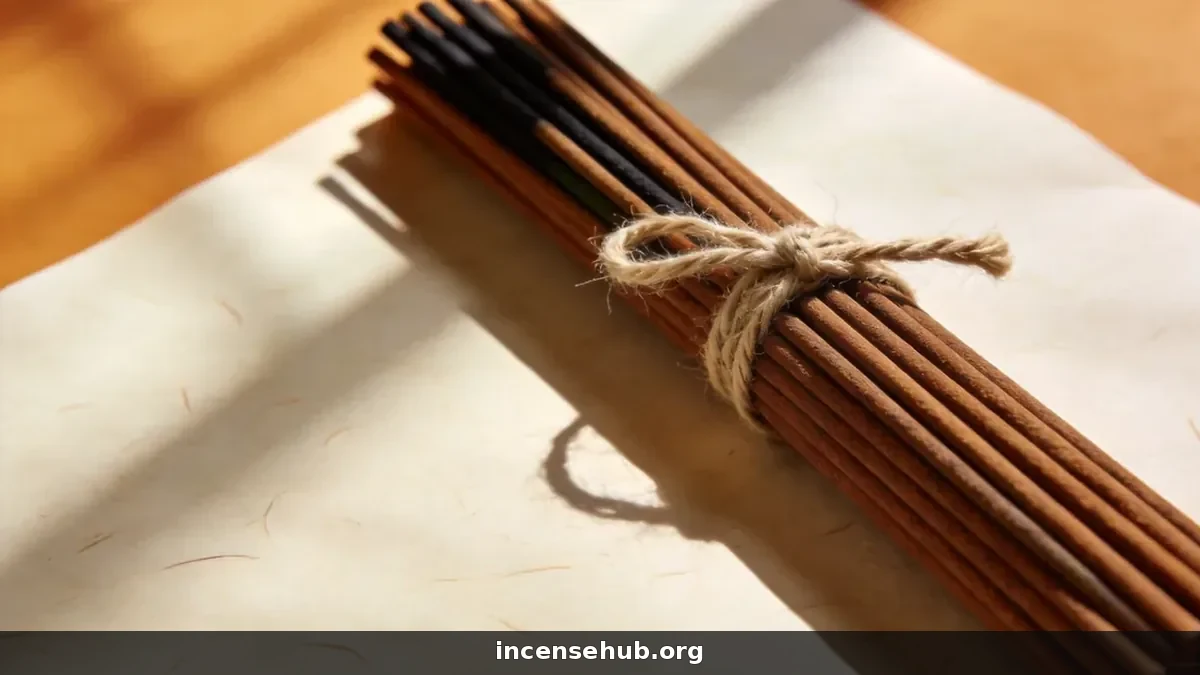
| Stick 线香 | Powder extruded around a bamboo core, or coreless | Everyday use in a small room | Binder and core colour the scent |
| Coil 盘香 | A spiral, sometimes on a metal support | Hours of uninterrupted burn | Too much smoke for a domestic room |
| Cone | Damp powder pressed into a cone | Short sittings and quick comparisons | Burns hot; can scorch the opening |
| Seal 篆香 | Powder pressed into a metal pattern, lit at one end | Timing, ritual, and visual pleasure | A draught breaks the burning path |
The stick is what most English speakers picture, and it is the newest of the five to be perfected — a Ming-era refinement rather than an ancient default. It is also the form in which material and product diverge most: powder, binder, often a bamboo core, so what reaches the nose is a compound plus a combustion profile. Judging a stick tells you less about a wood than judging the wood does.
Seal incense deserves its own paragraph because it turns time into something visible. Powder is pressed into a template, the template lifted, one end touched with heat, and the burn walks a fixed route. It was a clock that smelled, and it is the clearest evidence that duration and control mattered to the tradition as much as the note in the air.
How the supply changed the practice
Direct answer: The craft did not develop on a fixed ingredient list. What could be imported in a given century decided which materials a formula could assume, so the history is a history of supply as much as of taste.
The earliest layer is domestic. 香 appears on Shang divination bone beside offerings; by the Han the ritual side is settled, and the 博山炉 censer — a hill-shaped lid, vents at the ridge — belongs to that moment. A vessel built so vapour drifts out of a landscape is made for watching, not only for burning.
Trade then widens the palette. Between roughly 220 and 589, Buddhist observance and long-distance routes bring agarwood, sandalwood, frankincense, borneol, and clove into regular circulation, and formula-building starts to resemble the craft recorded later. Sui and Tang courts consume at scale, and the blended practice matures inside that demand. Song is where technique, writing, and social habit converge; Ming workshops fix recipes into stable texts, cast 宣德炉 bronzes, and settle the stick into its modern shape. Qing restriction, imported scent, and twentieth-century rupture break the chain; reprints and small workshops reopen it from about 2000.
| Era | What the record supports |
|---|---|
| Shang, c. 1600–1046 BCE | 香 on divination bone, beside offerings |
| Han, 206 BCE–220 CE | Ritual burning settled; mountain-form censers |
| 220–589 | Trade and Buddhist practice widen the material list |
| 581–907 | Court demand; blended work matures |
| 960–1279 | Four pastimes, plate-heating, manuals |
| 1368–1644 | Fixed recipes, 宣德炉, modern stick |
| Qing onward | Restriction, imports, rupture, then revival |
Two dates need holding at arm’s length. “Five thousand years” is a sales figure; what survives is the Shang graph and a Han ritual record, and undocumented is not the same as disproven. Song primacy is a judgement shared by secondary writers rather than a statement from one text — which is why the manuals themselves are the place to check.
Four terms, in the order that makes them make sense
Direct answer: 合香, 香道, 香谱, and 四般闲事 each name a different kind of thing — a composition, a practice, a literature, a social setting — and starting from the composition is the quickest route into the rest.
合香 (hé xiāng) is compound incense: several materials arranged on four roles borrowed from herbal prescribing, with a chief carrying the scent, a minister supporting it, an assistant giving it a signature turn, and a guide binding or directing the whole. Its unit is a formula, and its literature is a shelf of recipes rather than a list of ingredients. Everything else in the tradition assumes this idea — that a scent can be built, not just found.
香道 (xiāngdào), the “Way of Incense,” names the practice that surrounds the building: preparing material, managing heat, sitting with what comes off the plate. The word borrows the grammar of a discipline rather than a hobby, which is why it grates slightly when English marketing uses it as a synonym for a scented stick.
香谱 (xiāng pǔ) is the manual literature — 陈氏香谱, 洪芻香谱, and the Ming 香乘 among the survivors. It is the largest body of writing on incense anywhere and among the least translated, and that gap is the main reason English-language accounts of this tradition stay thin and repetitive. The manual tradition has its own page because it carries the technical content.
四般闲事 (sì bān xián shì), the “four leisure arts,” places the practice socially: burning incense (烧香), preparing tea (点茶), hanging scrolls (挂画), arranging flowers (插花). 吴自牧’s 梦粱录 records the list for a Song capital audience, and the line carries a warning inside the compliment — these pursuits, it says, should not become a burden on a household. Incense is placed beside tea and painting deliberately: the company tells you what kind of attention was expected.
Set the four side by side and the shape shows: a method of composition, a practice around heat, a literature of formulas, a social slot among refined pastimes. None of them is a product, and none can be bought.
China and Japan: which way the influence ran
Direct answer: The technique moved from China to Japan. Japanese kōdō (香道) took a Song-era method, systematised it, taught it, and preserved it — which is a real achievement and not an origin.
The confusion is easy to understand. Japan’s incense culture is documented in English, taught in schools of practice, and exported with a vocabulary attached; China’s is documented mostly in Chinese, in manuals that remain untranslated. Search in English and Japan arrives first, and the reasonable but wrong conclusion follows.
The record runs the other way. Chinese practice is described centuries before kōdō appears as a named discipline, and the operation at kōdō’s centre — material warmed over indirect heat, releasing scent without burning — is the Song method described above. Japan named it, drilled it, turned it into a pedagogy and a parlour game, and kept it alive through centuries when the Chinese practice was disrupted. Credit for preservation is real. Credit for invention is not, and loose versions of the claim get used as marketing in both countries.
Taste diverged as well, and the divergence is technical rather than patriotic. Japanese practice centres on one precious wood at a time, valued for purity, often inside an exercise that asks a group to tell one faint scent from another. Chinese practice reaches for composition, and the compounding tradition is where its distinctive engineering sits. One isolates a material; the other builds with several. A reader trained in the first will find the second strange in a specific way: the question stops being “which wood is this?” and becomes “how was this assembled?”
Three traditions, three different jobs
Direct answer: Agarbatti, Chinese 香, and Japanese kōh answer three different briefs — fill a space, develop a material, discriminate between woods — and judging one by another’s brief produces false verdicts.
| Brief | What carries the scent | Smoke | What a good example does |
|---|---|---|---|
| Fill a large or busy room | Paste of wood powder, resin, and flower on a bamboo core | Heavy | Reaches the far corner without turning sour |
| Develop one material over an hour | Loose chips on a plate, or powder with binder | Low to none | Changes in three or four recognisable stages |
| Tell two woods apart | A sliver of agarwood, almost no binder | Minimal | Leaves a difference you can name afterwards |
Read the middle column as a design decision rather than a virtue. Volume hides a mediocre material; austerity hides it behind discipline; a built compound has nowhere to hide, because its structure is the product. That is the commercial cost of the middle brief, and the reason many brands claim it while few deliver it.
Four things this is not, and what to buy instead
Direct answer: Aromatherapy, candles, temple stock, and remedies each borrow the word for something else. If one of those is what you actually want, the honest answer is to buy that instead.
| If you want | Buy | Why incense is the wrong tool |
|---|---|---|
| A scent with no fire | A diffuser and an oil | Oils disperse as vapour; this craft needs heat and solid material |
| Light plus fragrance | A candle | Wax at a wick is a lighting technology; incense is scent first |
| Volume for an offering or a big room | Temple coils and joss sticks | The refined end of the craft is built for one small room |
| A treatment for a condition | Medical care | No scent treats, cures, or prevents anything |
Each row protects a distinction the tradition cares about. Therapy language imports a frame it never used. Candle language shrinks a craft to decor. Temple language collapses a refined practice into its cheapest commercial form. Medical language is simply untrue, and the most consequential of the four.
Smoke is not the same question as “natural”
Direct answer: Burning anything creates particulate, and “natural” describes where material came from rather than how much smoke it makes. Those two facts together decide how the practice should be run indoors.
The mechanism is straightforward. Solid material is heated until it smoulders → incomplete combustion releases gases and fine particles → the particles stay suspended in the room → the smallest ones travel deepest into the airway. Whether the material grew in a forest changes none of that. A natural resin and a synthetic fragrance both produce particulate when burned; what differs is the chemistry of the output, not the amount of smoke.
That gap is where a lot of marketing operates. “Natural” answers a sourcing question, and a fair one, but it says nothing about smoke volume, particle size, or indoor air. A room can fill with entirely natural smoke and still be a room with bad air. The useful label is not “natural” but disclosure: what the piece contains, how it is meant to be used, and whether the seller says anything about ventilation at all.
Four habits cover most of the risk in practice:
- Move air through the room; a fan beats a sealed box.
- Keep sittings short, because exposure tracks minutes rather than intentions.
- Keep smoke away from children, pets, and anyone whose breathing is fragile.
- Heat rather than burn where the material allows it; a plate produces far less smoke for the same scent.
The evidence on smoke and indoor air is collected on the smoke and air quality page, and the handling rules — storage, ash, embers, what to do with a live coal — sit in the safety guide. Neither page exists to talk anyone out of the practice. They exist because a tradition built on combustion should be honest about combustion.
One further caution belongs here. Smoke is not the only hazard: an unattended coal, a hot plate on a varnished table, ash tipped into a waste bin, a child or a cat at exactly the wrong height. The refined method is still a fire method, and it repays being treated as one.
Auditing a label in ninety seconds
Direct answer: Two questions do most of the work — which species, and material or fragrance — and a label that answers neither has told you something by staying quiet.
| The label says | What it actually establishes | What stays open |
|---|---|---|
| “Agarwood” or “sandalwood” | A material family | Species, which part of the tree, and whether it leads or trails |
| A species or genus name | A claim you can check | Whether that material leads the blend |
| “Natural” | A sourcing claim | Smoke level, particle load, every safety question |
| “Handmade” | A labour claim | Proportion, structure, material grade |
| “Fragrance” or “perfume oil” | A different product category | The entire material tradition being borrowed |
| A named binder (makko, honey) | A construction choice | How much, and whether the binder is doing work the aroma should |
| A stated burn time | A testable number | Whether it holds in your room, with your draught |
| Nothing | Nothing | Everything |
The short version: find the species, find the binder, find the burn time. All three present means the seller is disclosing and the product can be argued about. None present means the product may still be pleasant and cannot be checked, which is a different situation from being bad.
Price also carries information, though it reads best as a question rather than an answer. Agarwood costs what it costs because resin is rare and the supply chain is slow; sandalwood costs what it costs because a tree needs decades before its heartwood is worth cutting. A very cheap “agarwood” stick is telling you about proportion, and the honest inference is dilution rather than fraud. The substitution cross-reference maps how material names travel and where one English word covers several substances, which is the single most useful check on a cheap claim.
Judging the material cold, before any heat
Direct answer: A chip can be assessed before it is lit — by species and part, by how the cut face looks, by weight for size, by smell at room temperature, and by how much the seller is willing to state.
| Signal | What it hints at | What it is worth |
|---|---|---|
| Species and part named | A traceable material | The strongest single signal, because it can be checked |
| Resin visible on a cut face | Higher resin load in agarwood | Useful, and not a grade by itself |
| Weight for its size | Density, loosely tied to resin in agarwood | Suggestive; a heavy piece of the wrong species proves nothing |
| Sinks in water | The old agarwood test for resin load | Traditional belief, not an assay; the practice is old, the inference rough |
| Smells of something while cold | Volatile content, often a good sign in resin | Imprecise; some excellent woods are silent until warmed |
| Smells strongly of perfume when dry | Added fragrance | A reason to ask what else is in the piece |
| Seller states species, part, and harvest | Disclosure | Worth more than any adjective on the packet |
The water test deserves proportion rather than dismissal. It has a long history in agarwood sorting, it takes a second to perform, and it separates very light material from denser material — information, if coarse. What it cannot do is measure resin chemistry, travel across species, or certify anything. A chip that floats may still be a good piece of a different material. Use it as one rough instrument among several, and treat anyone presenting it as a certificate with suspicion.
Cold smell is the other skill worth building, and it is underrated. A wood that says nothing at room temperature is not thereby inferior; its aromatic fraction may simply need heat to lift. What cold smell does reveal is whether the surface has been dressed with something — an oil, a fragrance, a coating — because added material announces itself immediately while the wood’s own scent waits for the plate.
The room is part of the instrument
Direct answer: One piece of incense can smell like two different products in two rooms, and the variables are ordinary: draught, humidity, temperature, vessel shape, distance, and how long you have been sitting there.
Draught comes first because it is the strongest and the least discussed. Moving air does two things at once: it brings scent to you faster and carries it away faster. A still room accumulates a concentration that a ventilated one never reaches, so a blend that reads rich in a closed study reads thin beside an open window. Neither reading is wrong. They are measurements of different rooms.
The chain from there is worth following: a coil set in a draught → the ember runs unevenly down one side → the aromatic fraction releases in bursts rather than steadily → the scent arrives in waves that the nose reads as inconsistency. Move the same coil behind a screen and the burn evens out, the release steadies, and the product becomes a different experience. That is why traditional settings keep the burner away from doorways rather than in the middle of a table.
Humidity works through the material rather than the air. A hygroscopic powder takes up moisture in a damp room, which slows combustion and mutes the top note; the same piece in dry air lights faster and reads sharper. Anyone comparing a blend in a humid summer and again in a dry winter is comparing two products without having changed the recipe.
Temperature matters less than humidity and more than most people assume, because the aromatic fraction has to volatilise before it can be smelled. A cold room suppresses the opening; a warm one pushes it forward. A session in an unheated room needs a longer warm-up before the material starts to speak.
| Variable | What it changes | How you notice it |
|---|---|---|
| Draught | Burn evenness, concentration | Scent arrives in waves, or the ember runs to one side |
| Humidity | Combustion speed, clarity of the top note | The same piece reads muted or takes longer to open |
| Room temperature | Speed at which volatiles lift | A cold room delays the opening |
| Vessel shape | Spread versus concentration | A wide dish reads flat; a narrow censer reads forward |
| Distance from the nose | Intensity versus the arc of the burn | Close is loud and tiring; far is longer |
| Time in the room | Nose fatigue | The scent “vanishes” and returns when you step outside |
That last row explains most reports of a failed product. The nose adapts within minutes to a constant stimulus, and the adaptation belongs to the nose rather than to the incense. Two minutes outside resets it; a second piece in the same sitting will feel weaker than the first, whatever it is.
Storage: the failures usually blamed on the material
Direct answer: Most incense that seems badly made is badly kept. Moisture, heat, light, and odour transfer do the damage, roughly in that order.
The materials are hygroscopic, aromatic, and porous, which means they take on the character of wherever they sit. A jar next to a spice rack will taste of the spice rack; a jar on a sunny sill loses its brightest fraction and keeps its heaviest. These failures are quiet, which is exactly why they are worth naming before they happen.
| Symptom | Likely cause | What to do |
|---|---|---|
| The piece will not stay lit | Moisture, excess binder, or too coarse a grind | Dry the batch further; check the binder fraction |
| Opening dull but the base fine | Volatile fraction lost to heat or time | Store cooler, sealed, and use sooner |
| Scent turns harsh halfway down | Combustion running hot; the material is scorching rather than warming | Heat more gently, or put a plate in the way |
| A flat cardboard note | Odour transfer from packaging or shelf | Move to glass or ceramic, away from other aromatics |
| A white haze on the surface | Mineral or sugar migrating as moisture cycles | Usually cosmetic; check for mould before use |
| Sticks bent or crumbling | Humidity, or an under-bound batch | Dry gently; keep a desiccant in the headspace |
Two habits prevent most of that table. Keep material in sealed glass or ceramic, out of daylight, away from heat, and away from anything strongly scented — including other incense, since aromas migrate in both directions. Write the date on the container, because the brightest fraction is also the most mobile, and a two-year-old stick is not the product you bought even when nothing looks wrong.
Whether ageing improves a compound is a longer question and deserves a careful answer. The tradition holds that a rested blend marries and rounds, and there is a plausible mechanism behind the claim: in a sealed jar the volatile fraction redistributes through the mass instead of flashing off, so the opening softens and the parts read as one. How much that helps, and whether a given blend improves or merely changes, is not something this page can assert. Test it — split a batch, use half now, half later, and compare side by side rather than from memory.
Learning by contrast, not by collecting
Direct answer: The skill is comparative rather than absolute. Two materials smelled against each other teach more than twenty smelled in sequence, and a written note makes the difference survive the week.
A beginner’s instinct is to gather experiences: buy samplers, smell everything, build a shelf. The instinct is understandable and it slows learning, because the nose owns no absolute scale. It registers difference and adapts to constancy. Given one material it has nothing to work with; given two it has a contrast, and contrast is the only thing it stores reliably.
Build each sitting around a single question. If the question is “what does heat do to this wood?”, warm one chip gently and another hard, then compare. If the question is “what is the minister contributing?”, burn a two-material blend with and without it. A good sitting yields one answer and one surprise.
The notebook matters more than it sounds. The nose forgets inside a few hours; paper does not. Record what you used, how much, how it was heated, what you noticed, what you would change. Within a month the notes show patterns the sittings did not — that every blend you liked had a quiet base, say, or that every harsh opening came from the same assistant.
Vocabulary grows the same way. “Sweet,” “deep,” “bright,” “dry” are comparatives, not measurements, and they become useful only when tied to specific materials you have smelled. Learn that “creamy” points at sandalwood and “resinous” at agarwood and you have two anchors; with five or six, the descriptions in old manuals stop being decorative and start being readable.
One habit is worth resisting: chasing rarity early. Rare material teaches caution, because every session costs enough to make you careful. Ordinary material teaches craft, because you can afford to waste it, change it, and burn it twice. The first year is better spent on sandalwood, a common resin, and one bright botanical than on a single precious chip.
A session you can repeat
Direct answer: A sitting is short, quiet, and repeatable — prepare the heat, place the material, sit with it, put it out, air the room — and the ritual exists mainly to remove distractions so that small changes become noticeable.
| Step | What you do | Why it matters |
|---|---|---|
| Clear | Empty the surface; set the dish on something heatproof | Most accidents are ordinary: a hot plate on a finished table |
| Build heat | Ash bed and coal, or an electric heater turned low | Even heat is what makes a material behave predictably |
| Place | Rest the piece on mica or a plate, never on the coal | Contact with coal scorches and shortcuts the development |
| Sit | Give it five to ten minutes with nothing else in hand | The opening is brief and the most commonly missed part |
| Note | Write one line about what changed | Memory is the weakest instrument in the room |
| Extinguish | Put it out deliberately; never leave it running | A smouldering coal is a fire that has not finished |
| Air | Ventilate once the session ends | Particulate stays after the scent has gone |
Beginners skip the fourth step. Sitting still for ten minutes is harder than it sounds in a room with a phone in it, and that is precisely where the practice lives, because the arc of a burn cannot be seen in thirty-second glances. Experienced users skip the sixth. A coal that looks finished can smoulder for a long while inside an ash bed, and putting it out on purpose is the difference between a craft and a small domestic hazard.
Twelve verbs that do the real work
Direct answer: Most of the technique in old formulas is carried by a dozen process verbs, and each one changes the material physically rather than adding a flavour.
蒸 (zhēng) steams, softening material and driving moisture inward. 炒 (chǎo) dry-roasts, burning off volatile sharpness. 炙 (zhì) grills over direct heat, usually to tame a resin’s surface. 炮 (páo) roasts through a medium, slower and more even. 炼 (liàn) simmers honey or resin down to a workable thickness. 浸 (jìn) soaks, carrying a soluble fraction in or drawing one out. 窨 (xūn) rests material sealed so aromas marry. 研 (yán) grinds, and in doing so fixes particle size, which fixes burn behaviour. 捣 (dǎo) pounds coarser than grinding, keeping some structure. 筛 (shāi) sieves — the most underrated variable in reproducibility. 焙 (bèi) dries over gentle heat. 煨 (wēi) buries in hot ash, the gentlest treatment on the list.
Read the set as a menu, not a sequence. A formula picks three or four, and the picks explain most of the gap between two recipes with identical ingredient lists. The pear formula is steamed in method and sealed in finish, which is why its sweetness sits inside the wood rather than on the surface. Two makers working from one jar of sandalwood will produce different material if one roasts a portion and the other merely dries it.
Vessels, and what the names tell you
Direct answer: The equipment has its own vocabulary, and knowing four or five words makes museum labels, auction notes, and vendor listings legible at once.
香炉 (xiānglú) is the censer itself, in any of a hundred shapes. 博山炉 (bóshānlú) is the Han form cast as a mountain ridge, smoke seeping from the summits. 宣德炉 (xuāndélú) names Ming bronze censers and, later, the whole type. 香盘 (xiāngpán) is the shallow dish that holds loose material or a burning piece, while 云母 (yúnmǔ) and 银叶 (yínyè) are the mica sheet and silver leaf that sit between heat and material. Around those sit the small tools: 香篆 for pressing seal patterns, 香匙 for powder, 香箸 for a hot piece, 灰押 for levelling ash, 香炭 for the buried coal, 香盒 for storage.
The list is short because the practice is minimal — heat, a plate, a dish, something to level ash with. Everything beyond that is refinement. A reader who has stood in front of a museum case of bronzes and found the labels unhelpful now holds the two words that matter most: 香炉 for the object and 博山炉 for the mountain form, which is enough to date a piece roughly and to know what it was for.
How to read a 香谱 entry without classical Chinese
Direct answer: An entry looks impenetrable and resolves into five parts — title, list, units, method, variants — and reading them in that order turns a wall of characters into a recipe.
Start with the title. It usually names the effect the maker wanted rather than the material that carries it: Snow in Spring, a bedchamber scent, a scholar’s gathering. The title is a promise about character, and it is nearly always delivered by the smallest dose in the list.
Then take the list without trying to translate every character. Count the lines. Four lines suggest a compound with one material per role; twelve suggest either a more elaborate design or a text that has absorbed regional substitutions over centuries. The count tells you what kind of entry you are holding before you know what any of it means.
Take the units next. Weighed units (两, 钱, 分) rank the lines against each other; counted units (枚) mark whole fruit; a line with no unit at all marks a step in the method. That single pass gives you the skeleton, and the skeleton is what the entry is really teaching.
Take the method fourth and read it as verbs. Steaming, roasting, soaking, binding, resting — treatment is half the design, and an entry with six materials and three verbs is more specific than one with ten materials and none. The manual tradition treats this reading skill as the entry point to the literature.
Take the variants last, and treat them as evidence rather than noise. Where two editions agree you are looking at the design; where they disagree you are looking at transmission, taste, and the practical difficulty of copying a text across centuries. The history of the tradition explains why so many entries survive in several versions at once.
Names worth keeping in Chinese
Direct answer: Matching a Chinese term to a material is the practical entry point: the same set of eyes then reads a label, a manual line, and a vendor’s claim.
| Term | Pinyin | English | What it names precisely |
|---|---|---|---|
| 沉香 | chénxiāng | agarwood | Aquilaria heartwood after fungal injury and resin response |
| 檀香 | tánxiāng | sandalwood | Santalum heartwood; steady, creamy, widely traded |
| 乳香 | rǔxiāng | frankincense | Boswellia resin tears; bright, citrus-balsamic |
| 没药 | mòyào | myrrh | Dark bitter resin; fixes well, overdoses easily |
| 安息香 | ānxīxiāng | benzoin | Sweet balsamic resin; sticky, used to bind |
| 龙脑 | lóngnǎo | borneol | Crystalline aromatic; cool and piercing |
| 樟脑 | zhāngnǎo | camphor | Crystalline; the cold snap in Snow in Spring |
| 丁香 | dīngxiāng | clove | Dried flower bud; sharp warmth in tiny doses |
| 桂皮 | guìpí | cassia bark | Warm sweetness with a peppery edge |
| 甘松 | gānsōng | spikenard | Earthy root; classic supporting body |
| 甲香 | jiǎxiāng | operculum | Marine fixative, processed before use |
| 抹香 | mǒxiāng | makko | Bark powder; the combustible binder for sticks |
| 香材 | xiāngcái | raw material | Loose chips, tears, or powder, unformed |
| 线香 | xiànxiāng | stick incense | Extruded powder, cored or coreless |
| 盘香 | pánxiāng | coil incense | Spiral form built for long burns |
| 篆香 | zhuànxiāng | seal incense | Powder pressed into a pattern, lit at one end |
Two things follow. First, the material vocabulary is small — roughly two dozen substances carry most of the literature — which is good news for a beginner, because the list is learnable across a week of evenings.
Second, several English words cover more than one Chinese term, and several Chinese terms have no clean English equivalent. “Incense” collapses 香材, 线香, and 篆香 into a single word and hides the difference between a material, a formed product, and a ritual pattern. Keeping the Chinese term beside the English one keeps that difference, and the difference is where the practical information lives.
First purchases: one material, one method
Direct answer: Begin with a single material and a single method rather than a collection. One piece of sandalwood and a plate over coal will teach more in an evening than a shelf of sticks teaches in a month.
Sequence matters because the practice is comparative. Buy one material you can smell clearly, learn how it behaves warm and how it behaves hot, and only then add a second so there is something to compare against. Two materials side by side answer more questions than ten tasted in a row, because the nose holds a contrast far better than an absolute.
For the sandalwood and agarwood pages the same logic applies with one addition: buy small. Both materials vary enormously by species, origin, and grade, and a small sample from a disclosing seller teaches more than a large purchase from an anonymous one. The first buy is a question, not a commitment.
Equipment can stay minimal — a heatproof dish, fine ash, small tongs, a disc of mica or silver — with an electric heater standing in for coal when convenience matters more than ritual. What no equipment list supplies is attention, and attention is the only thing the practice requires.
Summary
- The subject is matter before it is merchandise: wood, sap, flower, root, and the binders that give them shape.
- One syllable covers both odour and stock, so the literature reasons about substances rather than SKUs.
- Plate-heating is not fussiness for its own sake; it is the reliable way to keep the delicate part of a wood intact.
- Song is where technique and writing converged. The five-millennium slogan belongs to advertising.
- Technique moved eastward and was formalised there; taste then split in two directions.
- Particles are the cost of fire. Ventilation and short sittings do more than any sourcing claim.
- A label answering species, binder, and duration is a label worth arguing with; silence is also information.
- Air movement, damp, heat, bowl shape, and distance all rewrite the result.
- When a stick disappoints, suspect the jar before the maker.
- Comparison teaches the nose; accumulation only fills a shelf.
FAQ
Q: What does Chinese incense smell like?
There is no single answer, which is the honest response. Sandalwood 檀香 reads creamy and sweet-woody; agarwood 沉香 is deep and resinous and opens in stages as it warms; frankincense 乳香 is fresh and citrus-woody; compounds range from floral to herbal to warm. Warmth and layering are the shared signature, and that is exactly why the question invites a second one: which material, heated which way?
Q: How long does a stick burn?
Between 20 and 60 minutes in most cases, and the spread comes from three things: stick length, stick thickness, and whether bamboo runs through the middle. A slim coreless stick lands near 25–30 minutes; a fat cored one near 45–60. Cones are the sprinters at 10–15 minutes, coils the marathon. Any figure on a packet is a range rather than a promise, and your own draught will move it.
Q: Does incense help you sleep or reduce anxiety?
No claim of that kind is made here. Insomnia, anxiety, and pain are not what a scent addresses, and nothing aromatic substitutes for medical care. What many people do is use a familiar smell to close a working day, which is a habit rather than an effect. Hold that distinction when a product claims more.
Q: Is temple incense the same thing?
They overlap, and they are not the same product. Temple stock means joss sticks and coils bought by the box, made to fill a courtyard and to be used up in quantity. The tradition also holds the opposite case: one chip on a plate, in a room where nobody is counting. Same materials, opposite economics.
Q: What separates 合香 from a simple blend?
Structure. A blend is several materials in one place; 合香 is several materials arranged on four roles — chief, minister, assistant, guide — with doses that create a hierarchy. The difference shows when you try to rebuild one: a blend gives you a list, a formula gives you proportions you can argue with. The blending system covers the scheme.
Q: Why is the literature so poorly translated?
Because the 香谱 manuals are technical, allusive, and full of historical units and material names that do not map onto modern trade terms. Translating one demands classical Chinese and craft knowledge in the same person, and the commercial incentive is thin. English readers therefore meet the tradition through summaries, which is why the same few claims circulate — including the ones this page has qualified.
Sources
- 洪刍《香谱》 — Song-period compilation of recipes, and one of the first attempts to treat the craft as a body of written method. Wikisource.
- 周嘉胄《香乘》(Ming) — the largest Ming gathering of formulas, material notes, and anecdote. Wikisource.
- 吴自牧《梦粱录》 — a portrait of the Song capital; source for the four pastimes and for the caution that they should not weigh on a household. Wikisource.
- 李时珍《本草纲目》 — the materia medica, consulted for how aromatic substances were described and handled, never for treatment. Chinese Text Project.
- American Lung Association — guidance on combustion particles and other indoor pollutants. lung.org.
- 光明日报 (Guangming Daily) — newspaper features on Song incense culture; secondary, used for context.
- Oracle-bone inscriptions — the first surviving appearance of the graph 香, Shang period.
Related Resources
- History of Chinese Incense Culture — the long sequence from Shang offerings to the present revival.
- Sandalwood Incense Guide — the dependable heartwood, and how to read a piece.
- Agarwood (沉香) Incense Guide — resin, injury, and why prices swing so wide.
- The 香谱 Incense Manuals — the literature this page keeps pointing at.
- Incense Smoke and Air Quality — what the evidence says about indoor particulate.
- Incense Safety Guide — coals, ash, storage, and handling rules.