
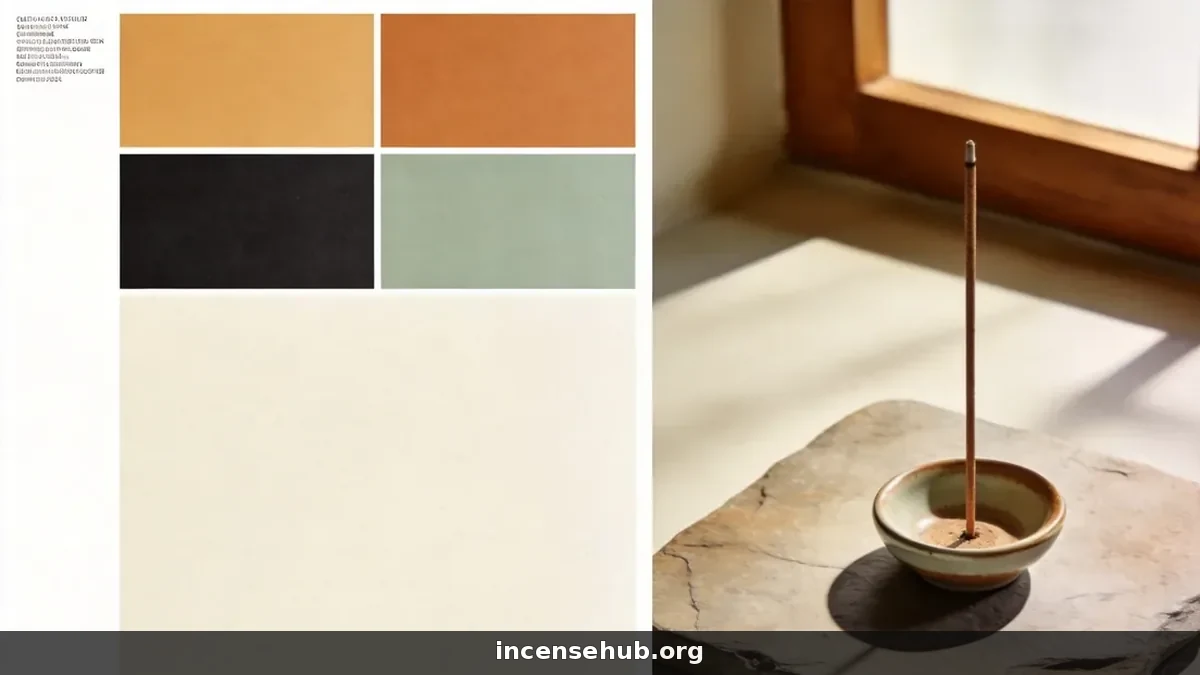
Direct answer: A burn becomes safe only when three conditions hold at the same moment — the support is fireproof and matched to the shape you are burning, the room can exchange air, and a person remains in the room until the ember has gone cold. Lose any one of the three and you are left managing either a fire hazard or a smoke hazard, which are the only two dangers the practice actually has.
Key facts: Every lit format — stick, cone, coil, or resin — gives off fine particles (PM2.5) and volatile gases, and none of that changes whether the plant grew wild or was assembled in a laboratory. “Natural” is a statement about what went into the product; it has never been a statement about how clean the burn is.
Two Dangers on Two Different Timers
Direct answer: Fire acts in seconds and smoke acts in hours, so each calls for its own habit — staying present defeats the first, moving air defeats the second.
A glowing tip is a small open fire, and an open fire has exactly one way to fail: it finds something that will burn. The path from ember to house fire is short and mechanical — the tip tips over → it meets a curtain, a stack of paper, or a wooden shelf → the fuel lights → the flame spreads. Every link in that chain can be broken at the very first one, which is why the holder and the surface underneath it do most of the safety work before a match is ever struck.
Smoke runs on a longer clock. When plant matter and its binder combust, they throw off fine particles and volatile organic compounds — the same pollutant families a candle or a frying pan gives off. One stick in a room with moving air is a trivial exposure; a sealed room burning stick after stick is a different animal, because the particles have no exit → concentration rises → the dose you inhale rises with it.
| Danger | Time scale | What holds it back | What failure looks like |
|---|---|---|---|
| Fire | Seconds | A stable fireproof holder plus staying present | The ember reaches a fuel |
| Smoke / PM2.5 | Hours | Ventilation plus burning less | A shut room and an endless burn |
| Pets & sensitivities | Hours | Distance; never burn in a room holding a bird | Irritated airways, a tipped holder |
| Children | Seconds–hours | Store out of reach, supervise | Swallowing material or toppling a holder |
The two columns on the left are not equally urgent. Fire demands that you be physically there; smoke demands that you plan the air movement ahead of time. A person who watches the ember but never opens a window has solved one and left the other running.
“Natural” Names the Ingredients, Never the Smoke
Direct answer: “Natural” tells you what went into the stick and nothing about what comes off it when it burns — dried plant material smokes regardless of how it was cultivated.
The reasoning is a chain with no way out: incense is dried plant tissue → plant tissue is fuel → fuel plus heat yields combustion by-products → those by-products are fine particles and VOCs. No step in that sequence checks whether the plant was “natural” or whether a chemist built the aroma molecule. The natural-versus-synthetic question is real, but it lives upstream in what the stick contains; it never reaches the smoke at the far end of the burn.
Run the same logic in reverse and you land on the misconception that shows up most often: because the smoke smells pleasant, the air must be clean. A pleasant note and particle-free air are two unrelated measurements, and they only line up when air is actually moving through the room. The word “natural” has never been a certificate of clean combustion — it is a sourcing label, and reading it as anything more is the single most common error on this page.
A Pre-Light Check That Takes Less Time Than the Burn
Direct answer: Before striking the match, confirm three things — the holder fits the shape, the surface is bare and fireproof, and someone will stay in the room — and if any one fails, reposition or skip the burn.
The full rule set collapses into five lines you can run in the time it takes to pick up a match:
- Holder matched to shape — a stick holder for sticks, a dish for cones, a stand for coils, a fireproof vessel for resin.
- Surface fireproof, stable, empty — ceramic, stone, or metal, set back from any edge, never wood or paper.
- A clear radius — no curtains, bedding, paper, or a draft path that could carry ash or a live ember.
- Air moving — a window left ajar or any room that is not fully sealed.
- Present until cold — extinguish before leaving or sleeping, and keep it away from children and pets.
On the fifth line I take the firmest position on the page: “never leave it unattended” is the line that separates using incense from leaving an open flame in an empty house. The author’s view, not a verified fact.
| Rule | The failure it prevents | What happens if you skip it |
|---|---|---|
| Matched holder | The ember or ash reaching a fuel | A tipped stick lands on something that burns |
| Fireproof surface | Heat transferring through the support | A scorch mark, then a smolder, on wood or paper |
| Clear radius | A draft carrying ash or ember sideways | A stray spark lands downwind |
| Air moving | Particles building to a high concentration | A shut room climbs toward its exposure ceiling |
| Present until cold | An unwatched ember finding fuel | A fire starting in an empty house |
When the Same Stick Becomes a Different Risk
Direct answer: A stick that is harmless in a large aired living room becomes a real exposure in a small sealed bedroom or an hours-long session — the room and the duration are the multipliers, not the incense.
The boundary is ventilation plus duration. A short burn with airflow sits at the floor of the exposure curve; a multi-hour burn in a shut room climbs toward its ceiling. The practical consequence: the smaller and tighter the room, the more a cracked window matters, and the more you should reach for a low-smoke format instead of a thicker stick.
Three situations deserve extra care, each handled in more depth elsewhere: long sessions that chain stick after stick without airing; a room where someone has asthma or allergies; and any room holding a bird, which is far more sensitive to airborne smoke than a person — see the pets & sensitivities guide. What unites all three is the same arithmetic: the more sensitive the occupant and the tighter the space, the harder ventilation has to work.
Natural vs. Synthetic: Where They Actually Part Ways
Direct answer: Natural and synthetic incense are identical on the one axis that matters for safety — the smoke — and differ only on what sits inside the stick.
| Question | Natural stick | Synthetic stick |
|---|---|---|
| What is in it | Plant powders, resins, a plant binder | Plant material plus lab-made fragrance, sometimes other additives |
| Does it smoke | Yes — combustion of plant matter | Yes — combustion of the same base |
| Is the smoke cleaner | No — same PM2.5 and VOCs | No — same PM2.5 and VOCs |
| What the label means | Ingredient provenance, not air quality | Ingredient composition, not air quality |
The lesson sits in the middle two rows being identical. The difference between a natural and a synthetic stick is real but narrow — it lives in the ingredient list, and it has no bearing on the smoke either one produces. Once that clicks, the question people actually ask — “is it safe?” — resolves into the two habits that matter: ventilate, and do not leave it burning.
Reading a Holder Before You Trust It
Direct answer: Three visible checks — the mass and material of the holder, the fit of the stick socket or dish, and the size of the ash catcher — expose most fire risks before a single match is struck.
A holder telegraphs its reliability the way a coil telegraphs its drying history. The checks are quick and mechanical:
| Check | What to look for | Why it matters |
|---|---|---|
| Material | Ceramic, stone, thick metal, or glass | A thin or plastic base conducts heat or melts |
| Stability | A wide, weighted base | A top-heavy holder tips the moment a draft or a bump arrives |
| Fit | The socket or dish is sized to the shape | A loose stick leans and drops its ember early |
| Ash catcher | A tray large enough for the whole burn | Ash has somewhere to land that is not the table |
The rule that ties the rows together: a holder that is too light, too small, or too thin will fail in a predictable way, and you can spot that failure on the shelf instead of discovering it mid-burn. For the full hands-on method, see how to burn incense safely.
Summary
- Incense presents two hazards on two clocks: a fast fire hazard fixed by placement and presence, and a slow smoke hazard fixed by airflow and restraint.
- The fireproof holder plus a person in the room eliminates nearly every fire scenario before it starts.
- Moving air plus burning less eliminates nearly every smoke scenario the same way.
- “Natural” describes the ingredients, not the burn — dried plant matter produces fine particles either way.
- Tight sealed rooms, extended sessions, birds, and any airway sensitivity push those hazards higher.
FAQ
Q: Is incense fine to burn indoors?
Yes, with three conditions running at the same moment. The support has to be the correct one for the shape, sitting on a surface that cannot catch fire, with nothing flammable around it. The room has to exchange air during the burn and for a short while after it goes out. And a person stays put the entire time — never leave it going in an empty room. Two things can go wrong, fire and smoke, and each has its own fix: a solid holder plus no unattended burning handles the fire, while moving air plus burning in moderation handles the particles. In everyday use this is about on par with a lit candle.
Q: Is a “natural” stick any safer to breathe?
Not in a way that touches the smoke. The label names what the stick contains — plant powders, resins, a binder — not what those ingredients do when they burn. A natural stick still turns into smoke and fine particles the moment it ignites, just like a synthetic one, so the air-handling advice is identical for both. Whether the aroma started as a flower or as a lab molecule is an ingredient question, and it lives in a different conversation from the smoke that any lit stick gives off.
Q: What actually comes off a burning stick?
The burn throws off fine particles — the size class called PM2.5 — along with volatile organic compounds, which are the same broad families a candle or a hot stovetop gives off. A rare burn in a room with moving air is a small exposure and nothing to lose sleep over; the worry grows with how much you burn, how often, and whether the room is sealed. Continuous burning in an enclosed space is what pushes the cumulative total up. The useful frame is management rather than alarm: open air, moderate amounts, and lower-smoke formats. This page describes the exposure and stops there — it makes no medical claim about it.
Q: Can I burn incense in the room where I sleep?
It is fine with two conditions, and neither one bends. Keep the room aired, and never let it burn while you are asleep. A bedroom is usually the smallest and most sealed room in the house, so particles gather there faster than anywhere else, and sleeping is the worst time to be breathing any smoke. Leave the window ajar before and after, or clear the air before getting into bed, and always put the stick, cone, or coil out before you lie down. The deeper explanation of managing indoor smoke lives in the ventilation guide.
Q: How long does the smoke linger after I put a stick out?
Longer than the visible smoke suggests. The visible plume clears quickly once the ember dies, but the fine particles it left behind — PM2.5 is small enough to float for a long stretch — can remain suspended in still air for a while after the burn ends. That is why the airing step is not finished at the moment you snuff the stick. A brief window opening after the burn, or a few minutes of cross-draft, clears the residual particles that the eye cannot see. The rule to remember is that an extinguished ember stops adding particles but does not remove the ones already in the room; only air movement does that.
Q: Do I need to clean my holder or burner regularly?
Yes, and for two separate reasons. The ash that builds up in the tray or dish is more than a cosmetic mess: a thick bed of old ash can hide a still-glowing ember after you think the burn is over, and it can also shed fine dust into the air when it is disturbed. Empty the ash catcher once it is full, wipe the holder down when it is cool, and give a resin burner’s ash bed a fresh top layer before each use. The cleaning is quick, and it closes a small loop that otherwise lets a “finished” burn quietly keep a risk alive under the ash.
Sources
- EPA indoor air quality — the agency’s reference on fine particulate matter (PM2.5) and VOCs traced to indoor combustion.
- American Lung Association indoor air pollutants — how combustion particles enter and move through household air.
- U.S. Consumer Product Safety Commission — the federal body covering product and fire safety for things burned at home.
- NFPA fire-safety material on heatproof surfaces, clearances, and the rule against an unattended burn.
- No health or medical claim is made anywhere on this page.
Related Resources
- How to Burn Incense Safely
- Incense, Ventilation & Indoor Air
- Incense Storage & Longevity
- Incense, Pets & Sensitivities
A place to start: the hands-on rules in how to burn incense safely cover placement and extinguishing, while ventilation & indoor air covers the smoke science.