
Direct answer: Incense earns a place in a daily ritual as a cue, not as a substance: one recognizable scent, repeated at the same moment, comes to mark the start of an activity and the end of it. The repetition does the work. Nothing special has to be true about the smoke.
Key facts: Smell travels a short path into the brain’s memory and feeling circuits, which is why an odour paired with a repeated moment becomes a learned signal. That is the plain, non-mystical account of why a stick of incense can hold a ritual together.
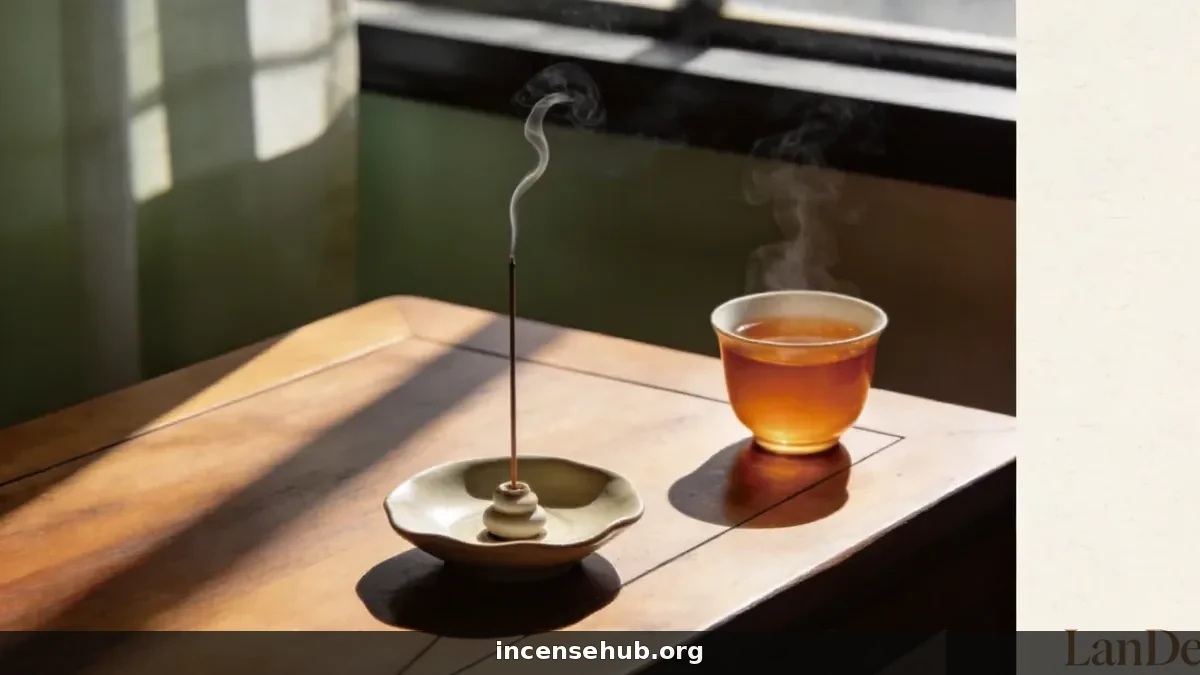
What Turns a Sequence Into a Ritual
Direct answer: A ritual is a repeated sequence with a clear opening and a clear close; incense fits because a lit stick supplies both ends without any effort from the person watching it.
Think of the smallest version: strike a match, light the tip, sit down, and when the burn ends, get up. That is a ritual in three beats. The lighting is the opening gesture, deliberate enough to feel like a decision. The burn is the middle, and its length gives the session a shape. The end of the burn, or the act of snuffing it, is the close.
A habit has no frame. You brush your teeth without a beginning or an ending; the action simply recurs. A ritual is the same kind of repetition with a boundary drawn around it. Incense is unusually good at drawing that boundary because the flame is an obvious start and the ember’s finish is an obvious stop. The object carries the frame for you.
That distinction is the whole practical case for using scent this way. It is not that the smoke is sacred or that the material has powers. It is that a burning stick makes time visible, and a visible span is easier to treat as a practice.
The Short Path From Nose to Memory
Direct answer: A smell reaches the brain’s feeling and memory regions along a shorter route than either a picture or a sound, which gives a repeated odour unusual power as a trigger.
Follow the chain. Molecules from the incense land on receptors in the nose → the signal travels to the olfactory bulb → from there it projects to the amygdala and the hippocampus, regions involved in feeling and memory → the scent is stored together with the state you were in → the next time the same molecules arrive, the state comes back with them.
Sight and sound take a longer route through the thalamus and more processing steps before they reach the same regions. That extra relay is why a song can bring back a year, but a smell can bring back a specific morning. The difference is anatomical, not poetic.
The practical consequence is that scent is a good carrier for a small, repeatable cue. It asks almost nothing of the person using it: no belief, no technique, no special equipment beyond a stick and a holder. The material is a messenger, and the message is “this is the moment we begin.”
Editorial judgment, not a measured finding.
Three Rituals That Work
Direct answer: Most daily rituals reduce to three shapes — a quiet sit, a wind-down, and a block of focused work — and each has a scent character that suits it.
| Occasion | Odour family | The hour it marks | A useful form |
|---|---|---|---|
| A seated practice | Agarwood or sandalwood | Morning or evening quiet | A rod, or loose powder on a warmer |
| The end of the day | Sandalwood or a soft floral | The final hour before bed | A rod, put out at the close |
| A block of concentration | Frankincense or citrus | The opening of a task | A rod long enough to outlast the first push |
The table is a starting point, not a rule book. What matters is that one activity gets one scent and keeps it. A reader who dislikes sandalwood should not force it because a table says so; the cue forms around whatever scent the person actually responds to.
The third column matters as much as the second. A ritual that begins at a different hour every day gives the association a moving target. Pick a moment that already exists in the schedule — the first coffee, the last email, the closing of a laptop — and attach the scent to that moment rather than inventing a new one.
One Scent, One Job
Direct answer: Assign each ritual its own scent, because a smell that appears before several activities stops pointing at any one of them.
The logic is simple. A cue is a link between a signal and a state → a signal used for two different states becomes ambiguous → the link weakens → the scent stops opening either state cleanly. A person who burns the same sandalwood before meditation and before paying bills has given the nose two conflicting instructions.
The rule has a boundary. If two rituals sit far apart in the day and feel different in context — a morning work start and a late-evening wind-down — one scent can serve both without much blur, because the surrounding hour already tells them apart. The test is whether the moment alone is unambiguous. If it is, the shared scent is harmless. If it is not, split them.
A working judgment rather than a verified claim.
How Long the Link Takes to Set
Direct answer: No calendar can promise a date when a scent becomes a cue. The link sets over days and weeks of steady pairing, and more incense does not hurry it.
The chain repeats every time: the same odour arrives just before the same activity → the brain files the two together → repetition thickens the file → the odour begins to summon the state before the activity starts. What strengthens the link is the reliability of the pairing, not the quantity of material. A denser stick or a longer burn adds smoke, not association.
This is why a small ritual outperforms an elaborate one. A sequence that needs three props, a special tray and twenty minutes of setup will be skipped on a busy Tuesday. A sequence that needs one stick and one match will survive the week. The cue is built by showing up, and showing up is easier when the setup is short.
A useful rule for the first month: change nothing except the presence of the scent. Same chair, same moment, same duration, same close. Novelty is the enemy of association, even when the novelty is pleasant.
Matching the Format to the Frame
Direct answer: Choose a burn length that matches the activity, so the ritual closes when the incense finishes rather than trailing past it.
| Form | Approximate window | Where it belongs |
|---|---|---|
| Cone | Fifteen to thirty minutes | A brief pause or one small task |
| Rod | Twenty to sixty minutes | A sitting practice or the first half of a work block |
| Spiral | Ninety minutes to four hours | A long afternoon with someone nearby |
| Resin or powder over heat | Until the device is switched off | An open session with no fixed finish |
A cone lit for an hour-long sit will die halfway through and leave the ritual without its close. A coil lit for a ten-minute pause will still be burning when the person has moved on, which turns the ritual into background smell. The format is part of the design, not an afterthought.
There is a safety dimension here as well. A long-burning format is not a licence to leave the room. Any open flame needs a heatproof surface, clearance from cloth and paper, and a person nearby. If the ritual is meant to run unattended, choose a heated resin device and still give it a safe base. The fuller checklist lives on the safety page, and the ventilation question is covered in incense and indoor air.
The Ending Needs a Gesture
Direct answer: Something has to mark the finish. A stick left to die while you walk away leaves the sequence open, and an open sequence reads as an unfinished session rather than a practice.
The close can be tiny: a hand passed over the ember, a sentence said aloud, a bell tapped once, or simply sitting still until the flame reaches the holder. What matters is that the ending is performed rather than ignored. A performed close tells attention that the segment is over, and that is what separates a framed practice from an ambient odour.
The same principle explains why a ritual feels different from a habit even when the actions are identical. The frame is the difference. A person who lights a stick at the start of work and snuffs it at the end has built a container around the work; a person who lights one and forgets it has only made the room smell pleasant.
What a Ritual Scent Can and Cannot Do
Direct answer: A ritual scent can open a practice, mark its duration and close it; it cannot treat a condition, change a mood by chemistry, or replace a medical approach.
The three jobs are worth stating plainly. It opens: the lighting is a signal that the activity is beginning. It measures: the burn gives the session a visible length. It closes: the end of the burn, or the act of snuffing, marks the finish. Those are functions of attention and repetition, and they are real.
The claims to refuse are the ones that move from cue to cure. “This scent helps me settle into meditation” is a statement about a trained association. “This scent calms anxiety” is a medical claim about a substance, and incense has no established clinical evidence for that. The line between the two is the ethics of the whole practice. A ritual can be honest and still be useful; it does not need a health promise to earn its place.
Mistakes That Break the Cue
Direct answer: Most failed rituals fail for one of five ordinary reasons, and none of them requires abandoning the idea.
- Rotating scents. A different stick each day gives the nose no stable signal. Pick one and stay with it for at least a month.
- Moving the moment. A ritual attached to “whenever I remember” has no anchor. Attach it to something that already happens daily.
- Skipping the close. An unclosed session bleeds into the rest of the day and stops reading as a practice.
- Buying for the label. There is no regulated “ritual grade.” A pleasant, affordable stick used consistently builds the association; an expensive one used irregularly does not.
- Overbuilding the setup. A ritual that takes twenty minutes to arrange will be abandoned. Reduce it to the smallest version you will actually repeat.
The list is deliberately unglamorous. The mechanism is unglamorous too: pairing, repetition, time. The good news is that the same plainness makes the practice cheap to start and hard to get wrong once the frame is set.
A First Week, Written Out
Direct answer: A workable first week uses one scent, one moment and one short burn, and repeats them without variation.
Pick a moment that already has a shape — the first cup of tea, the closing of a laptop, the lighting of a lamp. Put the holder in the same spot each time. Light the stick, sit for the length of the burn, and close with a small deliberate action. Do it for seven days. Do not add a second scent, a second time or a second ritual.
By the end of the week, the scent will not yet be a powerful cue. It will be a familiar one, which is the necessary first stage. The association strengthens with repetition over weeks, not days, and the early sessions are the deposit rather than the return.
If a day is missed, resume the next day without ceremony. One gap does not erase the pairing; a rotating cast of scents and times does. Consistency is the only ingredient that cannot be substituted.
When There Is No Open Flame
Direct answer: A ritual does not require combustion; when a flame is impossible, another consistent signal can carry the same frame, and the association will form around it just as readily.
Rented flats with smoke detectors, shared bedrooms, asthma in the household, office rules: plenty of rooms rule out a lit stick. The mechanism does not care. A small lamp switched on at the same moment, a specific cup, a short piece of music, or a chair moved into position can all serve as the opening signal. What matters is that the signal is distinctive and repeated.
An electric incense warmer is the closest substitute to a flame ritual because it keeps the material. The heater warms resin or wood without burning it, so the scent is present and the start-and-stop actions remain physical: switch on, sit, switch off. That on/off pair is a frame, even without a match.
The judgment boundary is worth naming. A substitute signal weakens the ritual only if it is changed often. The same lamp at the same hour is not a lesser cue than a stick; it is a different carrier for the same association. The practice lives in the repetition, and the carrier is replaceable.
The Room Is Part of the Ritual
Direct answer: Where the incense burns becomes part of the cue, so a ritual that moves from room to room every day gives the nose a weaker anchor than one that stays put.
The brain files a scent together with its surroundings. The same sandalwood in a familiar corner, at the same chair, with the same window light, arrives as a bundle of signals rather than a single one. Move the burner to a different room each day and the bundle changes, which slows the association.
Placement has a practical side too. A holder near a curtain or a stack of paper is a fire risk, and a spot directly under a smoke detector is a nuisance. Choose a stable, heatproof surface with some clearance, away from drafts that scatter ash. The spot should be easy to reach and easy to see, because a ritual that requires moving furniture will not survive a busy week.
Ventilation matters for comfort rather than for the cue. A small room with the door closed will hold smoke; a window or an extractor clears it. Neither changes the association, but both change whether the practice feels pleasant enough to repeat.
The People Around You
Direct answer: A private ritual still happens in shared air, so the practice works best when the household or colleague who shares the room has agreed to the scent.
A daily burn is small, but it is not invisible. Smoke travels, and a scent that feels like a private cue to one person can be an unwelcome intrusion to another. Ask once, before the habit settles. A partner who dislikes sandalwood will not be won over by repetition, and a colleague at the next desk may have a sensitivity that no amount of good intention fixes.
The practical adjustments are simple: burn when the room is empty, choose a milder format, keep a window open, or move the practice to a personal space. None of these breaks the cue, because the cue travels with the scent and the moment, not with a particular chair. A ritual that respects the people nearby is easier to keep than one that has to be defended.
How Strong Should the Scent Be?
Direct answer: A ritual scent should be noticeable at the edge of the room, not dominant in it; strength is a property of the burn, not a measure of the practice.
A common mistake is to treat a bigger plume as a better ritual. A stick that fills the room makes the cue impossible to miss, but it also makes the session about the smoke rather than the activity. The useful target is a scent you notice when you sit down and forget while you work, which usually means a smaller room, a shorter burn or a thinner stick.
Airflow is the variable to adjust first. A window, a door or an extractor changes the concentration more than a change of product will, and it costs nothing. If the room still feels heavy, reduce the burn time before buying a different scent; the cue does not depend on volume.
FAQ
Q: Why does incense work as a ritual if the smoke has no special property?
Because the smoke is not the active ingredient — the pairing is. A scent that reliably appears at the same moment before the same activity becomes a learned signal, and the nose is especially good at forming that kind of link. Lighting the stick opens the sequence, the burn measures it, and the close ends it. The repetition, not the material, is what makes the ritual feel like a ritual.
Q: Does ritual incense require any faith?
No. The practice described here is a repeated sequence with a clear beginning and end. It does not require a doctrine, an initiation or a spiritual framework. A person can sit to meditate, start a work block or wind down for the evening with nothing more than a stick and a match. The page makes no spiritual claims and no medical ones.
Q: Which scent should I choose?
Choose one you actually like and assign it to one activity. Traditional pairings put sandalwood or agarwood with a quiet sit, soft floral notes or sandalwood with the evening wind-down, and citrus or frankincense with focused work. The specific material matters less than the consistency. If you dislike the scent, the ritual will feel like a chore and you will stop. The scent guide can help narrow the field.
Q: How many minutes should the session run?
Match it to the activity, not to a fixed rule. A stick commonly burns for twenty to sixty minutes, which is enough to frame a short meditation or a first work block. A coil can cover a longer stretch. The important part is that the burn and the activity end at roughly the same time, so the close arrives when the session does.
Q: Can I use one scent for two different rituals?
You can, but only when the two moments are clearly separated by time or setting. A morning work start and a late-evening wind-down are different enough that one scent will not blur them. Two activities that sit close together and feel similar will blur, and the cue will weaken. When in doubt, give each ritual its own scent.
Sources
- Practical synthesis of household incense practice, with the ritual framing drawn from established usage rather than from any single text.
- Historical background on Chinese incense culture, including 香道 and the 四般闲事, from the project’s research notes (R-003).
- Xiang Cheng (香乘) on Wikisource — the Ming compendium of incense formulas and lore.
- Zun Sheng Ba Jian (遵生八箋) on Wikisource — a late-Ming guide to refined living that includes incense practice.
Related Resources
- Creating a Calming Evening Ritual — a wind-down sequence built around the same cue logic.
- Incense and Breathwork — using scent as a focus for attention on the breath.
- Incense for Meditation — formats, burn times and scent choices for a sitting practice.
- Four Leisure Arts (四般闲事) — incense alongside tea, painting and flowers in the Chinese literati tradition.
- How Aromatherapy Works — a careful look at what scent can and cannot do.
Summary
- Incense works in a daily ritual as a repeated cue, not as a substance with special effects.
- A ritual needs an opening, a duration and a close; a burning stick supplies all three visibly.
- One scent per activity, at one consistent moment, is the rule that builds the association.
- Match the burn length to the activity so the close arrives on time.
- Keep the practice small enough to repeat, and keep claims about it honest.