
Direct answer: 四般闲事 — “the four leisure arts” — is a Song-dynasty way of arranging cultivated time around four practices: burning incense (烧香), whisking tea (点茶), hanging paintings (挂画), and arranging flowers (插花). Incense appears as one member of a set, not as a standalone hobby, and the set exists to train attention rather than to produce anything.
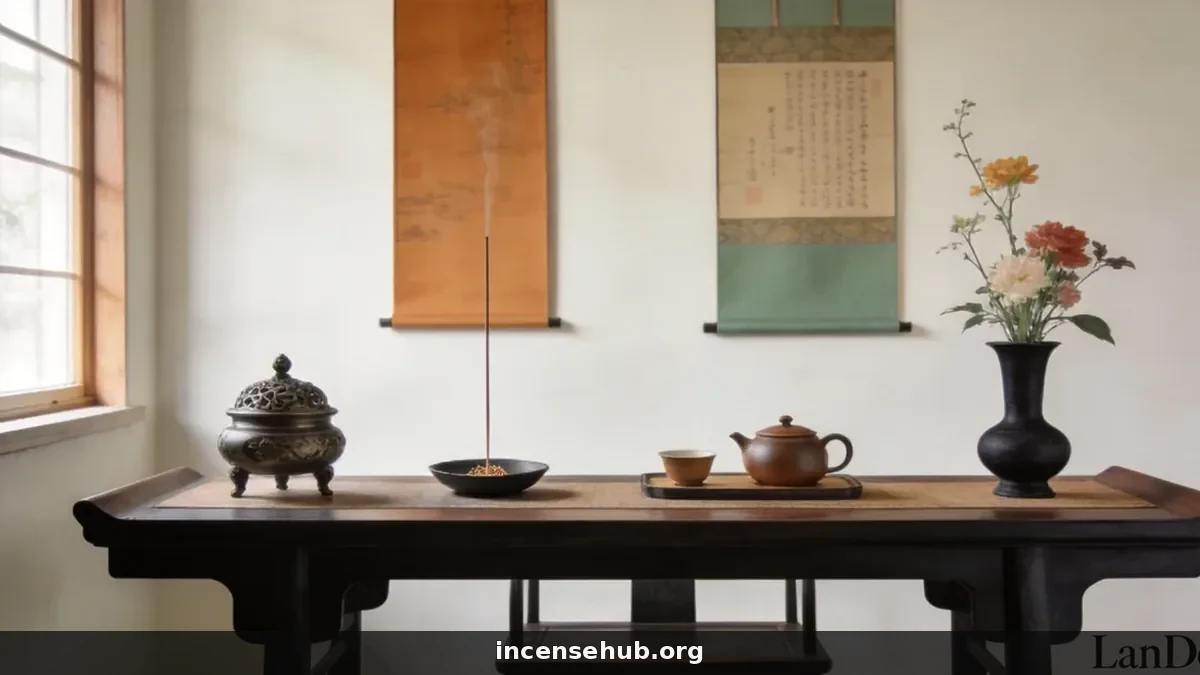
Key facts: The phrase is recorded in 吴自牧’s 梦粱录 (Meng Liang Lu), a memoir of Hangzhou life under the Song. Its full line ends with a condition that most retellings drop: 不宜累家 — the arts should not become a burden on the household.
Key Takeaways
- Four practices, four senses: smell (incense), taste (tea), sight (painting), and the arranging hand (flowers).
- 闲 means release from obligation, not idleness; the arts are leisure because they are not work.
- The closing clause 不宜累家 sets the limit: a practice that weighs on the household has stopped being one of the four.
- Chinese incense stayed informal and embedded; Japanese kōdō formalised the same root into a codified art.
- The set is a stance toward attention, not a checklist of objects to acquire.
Four Practices, Four Senses
Direct answer: The four arts are organised by sense, and each one gives a different channel a disciplined outlet.
| Art | Chinese | What it trains | What it involves |
|---|---|---|---|
| Burning incense | 烧香 | Smell | Preparing and appreciating incense, from simple sticks to 隔火焚香 |
| Whisking tea | 点茶 | Taste | Whisked powdered tea, the ancestor of Japanese matcha |
| Hanging paintings | 挂画 | Sight | Displaying and reading scroll paintings |
| Arranging flowers | 插花 | Hand and proportion | Composing cut stems in a vase |
The mapping is the skeleton of the idea. Incense asks the nose to separate notes and follow a scent as it shifts from opening to base. Tea asks the palate to register temperature, foam, and bitterness in sequence. Painting asks the eye to read composition, paper, and mounting. Flowers ask the hand to judge height, balance, and negative space. None of these is a spectator activity; each requires a small, repeatable act of discrimination.
That is why the four are presented together rather than as four separate hobbies. A person who smells one stick carefully learns more about incense than a person who owns fifty and burns them in the background. The set makes the same wager four times: perception improves when it is practised on purpose.
The Line and Its Condition
Direct answer: The canonical sentence names the four arts and immediately sets a limit on them, and the limit is the part that carries the argument.
The passage reads: 烧香点茶,挂画插花,四般闲事,不宜累家 — “burning incense, whisking tea, hanging paintings, arranging flowers: four leisure arts, not to be a burden on the household.” The final clause is not decoration. It defines what kind of activity these are allowed to be.
The pivot is 闲. English “leisure” suggests spare time or idleness; the Song word points at something narrower — freedom from productive obligation. The arts are 闲 because they are not labour, not status-seeking, and not a claim on the family’s resources. A practice that starts as pleasure and turns into a duty, a display, or an expense that weighs has crossed out of the category, no matter how refined it looks.
This is where the modern pitch runs into trouble. Incense sold as a focus tool for work reverses the original frame: the stick becomes an instrument of productivity, while the Song line places it among things that exist for their own sake. A stick can do both jobs in one life, but the two claims point in opposite directions, and merging them quietly changes what the source said. Editorial reading, not a verified fact.
The Method That Makes the Argument Physical
Direct answer: 隔火焚香 — warming incense over buried heat — turns the set’s argument about restraint into a procedure you can watch.
The chain runs like this: a lump of charcoal is lit → buried under fine ash → the ash bed tempers and spreads the heat → a thin mica or silver leaf is laid over the hot spot → the aromatic chip or paste rests on the leaf → radiant heat lifts the volatiles without reaching combustion → the scent rises slowly, with almost no smoke.
Every layer exists to prevent a failure. A bare ember would char the material and put burnt notes on top of the fine ones; the ash-and-leaf stack trades intensity for control. The result is a longer, cleaner release and a scent that can be followed for an hour instead of a minute.
The same logic runs through the other arts. Tea water is held below a rolling boil so the leaf is not scorched. A scroll is hung away from direct sun and at reading height. Flowers are cut and placed so the stems do not crush. In each case the practitioner manages a fragile process, and the reward for restraint is a finer result. 隔火焚香 simply makes that principle visible.
Chinese Incense and Japanese Kōdō
Direct answer: The two share a root, but one stayed inside a set of four and the other was lifted out and codified into a standalone art.
| Aspect | Chinese 香 tradition | Japanese kōdō |
|---|---|---|
| Frame | One of four leisure arts | A standalone formal art |
| Style | Personal, scholarly, loosely structured | Ritualised, codified, school-based |
| Vocabulary | 香谱 recipe manuals, 合香 blending | 六国五味, 组香 games |
| Materials | Agarwood, sandalwood, 合香 blends | Centred on agarwood (奇楠, “kyara”) |
Chinese practice remained embedded in the scholar’s life: recipe manuals recorded proportions, 合香 arranged materials by role, and the pursuit shared space with tea, painting, and flowers. Japanese kōdō travelled by way of Buddhism and the Tang–Song exchange, then formalised. It acquired set games such as 源氏香, a fixed vocabulary of six countries and five tastes, and graded schools that certified rank.
The structural difference explains the rest. An art that shares the load with three siblings can stay informal; an art promoted to a solo career has to build rules to stand alone. Neither development is a decline or an improvement — they are two answers to different conditions. Cultural observation, not a ranking.
Two Fours That Get Confused
Direct answer: 四般闲事 and 琴棋书画 are both four-part lists from the same era, and folding them together blurs what each was for.
| Signal | 四般闲事 | 琴棋书画 |
|---|---|---|
| The four | Incense, tea, painting, flowers | Zither, chess, calligraphy, painting |
| What they train | The senses | Skills |
| Frame | Leisure, explicitly non-productive | Accomplishment, mastery on display |
| Who is judged | No one | The practitioner |
| Incense present? | Yes, as one member | No |
琴棋书画 names things a cultivated person is good at: music, strategy, writing, brushwork. 四般闲事 names things a person attends to. One list invites assessment; the other resists it. Painting appears in both, which is the main reason the two get merged in modern retellings, and the overlap is real but narrow — a painting can be judged as brushwork and also hung as an object of attention.
Incense belongs only to the first list. Smelling is not a contest you can win, and the four-arts frame treats that as a feature rather than a gap. The moment someone asks which grade of incense appreciation you have reached, the second list’s logic has crept in.
What the Set Does Not Require
Direct answer: It does not require four complete kits, a syllabus, or a rank, and treating it that way produces exactly the burden the source warns against.
Three misreadings are common. The first is the shopping list: buy the censer, the tea set, the scroll, and the vase, then feel obliged to use all four. That is 累 in its most literal form — the objects own the owner. The second is the syllabus: turn the four into levels, badges, and certifications. The source’s closing clause argues against formalisation, because a curriculum teaches you to pass a standard while these arts teach you to notice. The third is the productivity frame already described, where incense becomes a tool for getting more work done.
Each misreading shares a shape: it converts a practice of attention into a system of output. The Song line blocks all three with one condition — keep it light. That condition is not advice about moderation; it is part of the definition.
None of this means the arts were austere. The common misconception is that leisure must be either idleness or luxury; the source proposes a third thing, a disciplined pleasure cheap enough that it does not weigh on a household. In practice the practice can live in one room with one object, and the discipline sits in the noticing rather than in the kit.
A Modern Reading That Keeps the Point
Direct answer: Pick one practice, keep the session short enough to notice, and let attention be the only output.
A workable order for a modern reader:
- Start with the sense you already reach for. For most people that is smell, because incense is the easiest of the four to try in an ordinary room.
- Make the session small. One stick, one cup, one page, one vase. A practice you can finish is a practice you can repeat.
- Notice one thing. The opening note, the temperature of the cup, the balance of the stems. A single observation is the unit of the whole idea.
- Stop before it becomes a duty. If skipping a day feels like failure, the practice has already crossed into 累.
The signals of crossing are easy to recognise in hindsight: burning incense only while working, buying to complete a set, feeling judged by a shelf. Each turns the art into an obligation, and obligation is the one thing the source explicitly rules out.
FAQ
Q: What are the four leisure arts?
Burning incense (烧香), whisking tea (点茶), hanging paintings (挂画), and arranging flowers (插花). The phrase presents them as a coordinated practice of attention rather than four separate hobbies, with incense as the olfactory member of the set.
Q: Where does the phrase come from?
吴自牧’s 梦粱录, a Song-dynasty memoir of daily life in Hangzhou. The line reads 烧香点茶,挂画插花,四般闲事,不宜累家 — four leisure arts, not to be a burden on the household. The closing clause is part of the definition, not an afterthought.
Q: Is Chinese incense the same as Japanese kōdō?
They share a root and diverge in form. Chinese incense stayed one of four informal, scholarly practices. Japanese kōdō, transmitted through Buddhism and the Tang–Song exchange, became a standalone ritual art with set games (组香, such as 源氏香), a fixed vocabulary (六国五味), and graded schools.
Q: What does 不宜累家 mean?
“Not to be a burden on the household.” It limits the four arts to practices that stay light: non-productive, non-competitive, and not a drain on the family. A practice that becomes an obligation or a status display has left the category the phrase defines.
Q: Why is incense grouped with tea and painting at all?
Because the grouping is about trained perception, not about collecting pastimes. Incense trains smell the way tea trains taste and painting trains sight; each art gives one sense a disciplined outlet. Grouping them asserts that attention itself is the point, and that it can be practised through more than one channel.
Sources
- 吴自牧《梦粱录》 — the Song-dynasty source of the 四般闲事 phrase, cited here as cultural history.
- Meng Liang Lu (夢粱錄) full text on Wikisource
- Bencao Gangmu (本草綱目) on ctext.org
- Standard references on Japanese kōdō: 六国五味, 组香 and 源氏香.
Related Resources
- History of Chinese Incense Culture
- Incense for Meditation
- Japanese Incense (Kōdō)
- Incense in Daily Ritual
Natural next step: follow the Japanese development in Japanese Incense (Kōdō), or read the Chinese background in History of Chinese Incense Culture.