
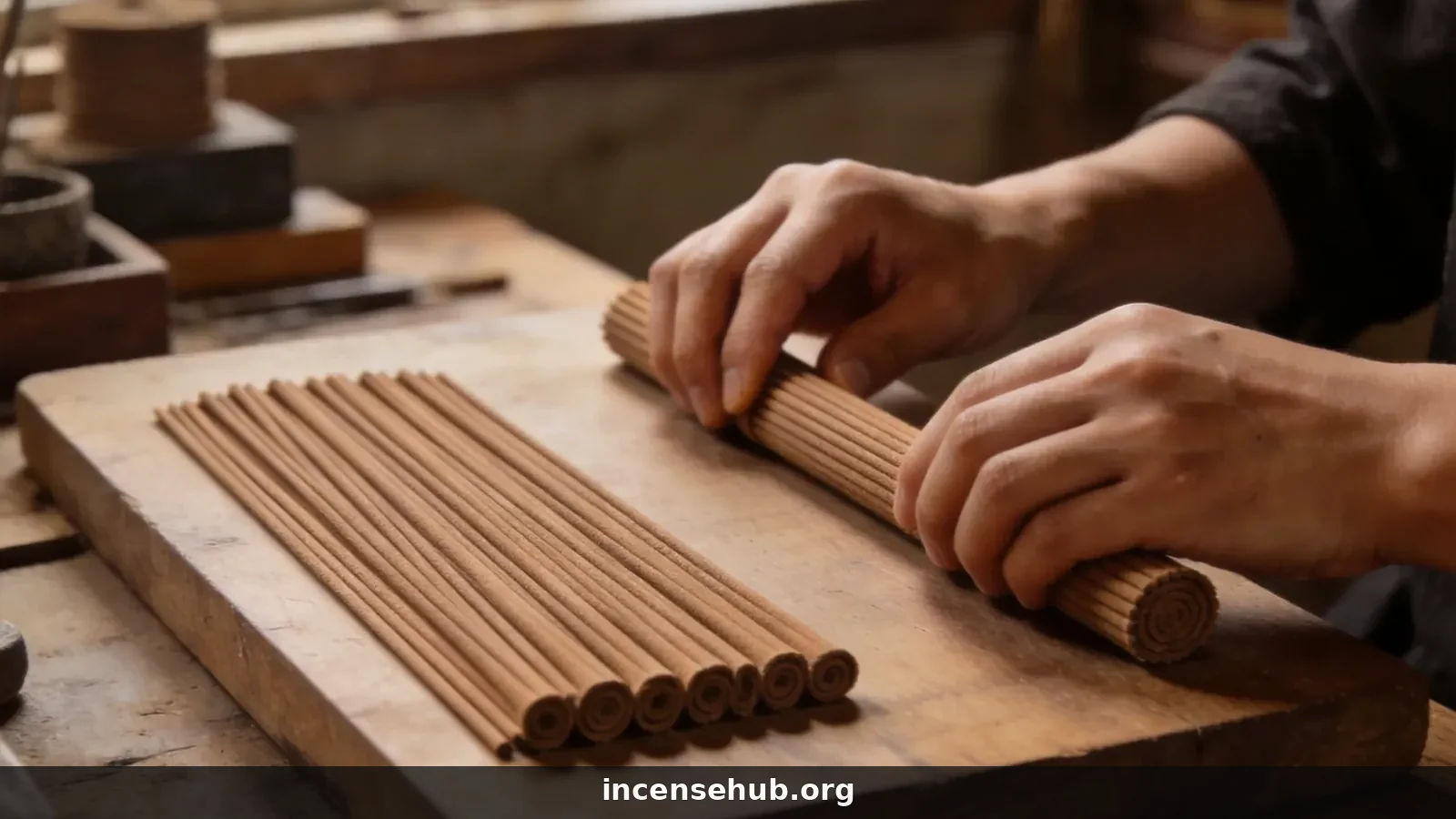
Direct answer: Begin with three materials and four moves: reduce the aromatic parts to powder, work in something that will burn with them, wet the mixture until it can be shaped, then let the water leave slowly. The silhouette is decided last, not first. Behind the retail box sit two routes — a workshop forming damp botanical paste by hand, and a line coating a blank core with fragrance.
Key facts: 合香 (hé xiāng) builds one blend out of several materials, and 君臣佐使 gives each of them a rank and a job. Whatever holds the dust together has to burn as well; makko is the traditional answer. Whatever happened in the workshop stays legible in the ember.
Key Takeaways
- Order is fixed and non-negotiable: reduce, combine, bind, dry. Only the mould changes between formats.
- The binding agent is a second fuel, not a glue — which is why an adhesive substitution is audible at the ember.
- A Chinese stick is a formula, and its parts are ranked by role rather than by price.
- Drying and resting are invisible at retail and decisive in the burn.
- Repeatability comes from records, not from a lucky sample.
Four Operations, in a Fixed Order
Direct answer: Milling, compounding, agglomeration, and dehydration happen in that sequence, and the sequence cannot be reordered without changing the product.
- Grinding settles the size of the meal and how evenly it is distributed. Rushed, it leaves clumps that burn as hot spots, and the scent arrives in bursts instead of a line.
- Blending settles where each material sits inside the mass. Rushed, one note dominates the first third of the stick while a different one appears at the end.
- Binding settles whether powder becomes a body at all. Rushed, the result dusts at the touch, hides hollow centres, and drifts in diameter from piece to piece.
- Drying settles how the water leaves. Rushed, the body splits, curls, or produces a front that keeps dying out.
Whether the output is loose powder, a thin rod (线香), a spiral (盘香), a pyramid, or a Japanese-style coreless bar, the divergence happens at the third move and not before. A coil is not a different recipe from a stick; it is the same paste routed into a spiral before the water leaves. Once you hold the sequence as a map, a defect stops being mysterious: it becomes a pointer to the operation that produced it, and the pointer is usually readable on the shelf.
What Sits in the Mix: Four Roles, Not Four Ingredients
Direct answer: A burnable incense has four functional slots — aromatic load, structural fuel, water, and sometimes a core — and each slot can be filled by more than one material.
| Role | What it contributes | Materials in use | What the cheap version looks like |
|---|---|---|---|
| Aroma carrier | the scent itself | agarwood or sandalwood meal, resin tears, petals, spice | fragrance compound applied to a blank |
| Combustion base | structure plus sustained heat | makko and comparable wood meals | charcoal or bamboo sweepings that burn but say nothing |
| Water | plasticity while forming | clean water, worked in stages | excess water, which returns later as shrinkage splits |
| Core | rigidity for a coated stick | a split of bamboo, occasionally a charcoal rod | a carrier for oil and nothing more |
The aromatic load gets all the marketing attention. The structural fuel is where grade is actually decided, and it is the slot a label is least likely to describe. Wood flour is wood: it adds fuel to the front instead of interrupting it, which is the point made at length in makko and wood-flour binders. What can sensibly enter a mix is catalogued in the material glossary.
Species is the question buyers ask first and it is rarely the decisive one. The decisive one is whether aroma travels inside the body as milled plant matter or arrives as a compound painted onto a blank. Everything downstream — burn behavior, how the scent develops, what the label can honestly claim — forks at that point. That fork is the entire argument of the natural question.
Why the Binding Agent Counts as Fuel
Direct answer: The traditional binding agent is a combustible wood flour, so it both holds the wet mass together and feeds the ember once the stick is lit.
Newcomers hear the word binder and picture glue. That picture is wrong in a way that matters. Trace what actually happens: wood flour is dispersed through the aromatic powder → water is worked in until the mixture behaves like a stiff dough → the dough is formed and holds its geometry as it dries → the dried body is lit, and the wood flour smolders alongside the aromatic particles → the stick releases scent steadily instead of stinking of burnt adhesive. Substitute a non-combustible glue at the second arrow and the chain snaps at the fourth: the product may hold its shape beautifully and still smell wrong when burned.
This is the cleanest available test of whether a manufacturer understands the craft. A maker who describes the binder as glue is describing a different product. The longer argument lives in makko and wood-flour binders.
Reading Grade From the Binder Slot
Direct answer: Whatever fills the binding slot predicts the burn better than the most persuasive note description on the carton.
| Contents of the binding seat | Behaviour at the ember | Where it turns up | How to read it |
|---|---|---|---|
| Makko-type wood meal | even smoulder, soft woody background | hand-formed traditional work | money spent on a material that performs |
| Charcoal | hot and steady, nearly scentless | coated sticks, some Japanese lines | aroma has to arrive from somewhere else |
| Bamboo sweepings | light body, the occasional spit | budget coated goods | filler chosen for price rather than behavior |
| Synthetic glue | ragged draw, a sharp note at the ember | the cheapest extruded imports | the chain stopped before its last step |
Read the table as a diagnostic, not a ranking of virtue. For a dipped stick, charcoal is a sound engineering decision. The trouble starts when a charcoal core is sold as if it were the aromatic material itself. Before anything else, ask which of the two fills the binding slot, because that answer constrains more of the finished behavior than any note pyramid.
Author’s grading judgment; no published standard is claimed.
Milling: Particle Size Sets the Physics
Direct answer: How finely and how evenly the plant matter is cut sets the ceiling on how smoothly the finished piece can burn; the target is chosen per formula, and no universal figure exists.
Two things go wrong when milling is treated as a commodity step. The first is unevenness: a mass with mixed particle sizes draws unevenly, so the ember advances in fits, and the scent arrives in pulses instead of a line. The second is that every material resists the equipment in its own way — resin softens and smears against the burrs, fibrous wood will not break down, and anything oily gums the mesh. Manufacturers adjust the mill to the material; they do not adjust the material to a fixed setting.
Fineness itself trades one property against another. A finer particulate packs more tightly, which slows the front and can cool the burn; a coarser grind packs loosely, burns hotter and faster, and releases more aggressively. Neither is better in the abstract. What matters is that the choice is deliberate and repeated, because the same nominal recipe milled two different ways yields two different products. Grinding has enough failure modes to fill a page of its own: grinding and sieving.
Assigned Roles, Not Ratios
Direct answer: Formulation is ranking and dosing: who leads, who supports, who colours, who merely enables — written in Chinese practice as 君臣佐使, chief, minister, assistant, guide.
The scheme is not decoration. It answers a practical question every formulator faces: when several aromatics compete for the same burn, which one is allowed to dominate, which one supports, which one colors, and which one merely enables? The roles:
- Chief (君) — the structural aromatic, usually a wood, chosen because wood carries heat and scent through a long burn without collapsing. Agarwood and sandalwood occupy this seat most often.
- Minister (臣) — a supporting aromatic at a fraction of the chief’s weight, there to round an edge or reinforce a facet the chief already has.
- Assistant (佐) — the accent the blend is named after: a resin, a petal, a spice, used sparingly and audible in the first minutes.
- Guide (使) — the enabler. Its seat is often filled by the binder, or by a stage in processing rather than by anything scented. Popular accounts tend to forget this one, which is why they read blends as flavour lists.
What follows from the structure is that exact ratios are the craft, not the marketing. No serious workshop publishes them. A page like this one can describe the framework and the reasoning behind it; it cannot hand over a recipe, and any page that claims to is describing something else. The ranking scheme gets its own long treatment at how a formula is composed.
Pressing, Rolling, Winding
Direct answer: Agglomeration is where a wet mass acquires its final geometry, and the equipment used here splits the market into hand-formed and machine-formed goods.
Four outcomes dominate:
- Coreless rod — dough forced through a die and dried with nothing inside it, so the full cross-section is product rather than a splinter wrapped in product (stick format).
- Cored rod — the same dough laid around a split of bamboo, which is what keeps a thin stick from sagging and gives the ember a straight path.
- Coil — a length of dough spiralled flat, trading height for duration, which is why a small disc can run for hours (see coil format).
- Cone — dough pressed into a pyramid, so the coal feeds itself as it descends and the footprint stays narrow wherever a holder would tip.
Each shape changes what the ember has to do, and the maker compensates at the mixing bench: a cone needs a slightly stiffer dough than a coil to keep its point, and a cored rod needs a softer one so it does not tear against the bamboo.
Two production logics sit behind these shapes. Hand methods turn dry powder into paste and shape it on the spot: the material supplies the aroma, output is measured in hundreds rather than thousands, and no two pieces are identical — which is read as character by some buyers and as a defect by others. Machine work coats or impregnates a blank core with a fragrance carrier; output is fast, dimensions are uniform, and the scent comes from the applied liquid rather than from the body of the stick.
The important correction is that method and material are two axes, not one. Hand forming tends to go with botanical loads and dipping tends to go with oil, yet exceptions run both ways; anyone who treats the two words as synonyms will be caught out eventually. Telling the two apart in a shop is a separate skill, walked through in hand versus machine.
Water Out Without Tearing; Then the Long Rest
Direct answer: One operation takes water out and has to do it without tearing the body apart; the other does nothing physical at all, and exists so that aromatics which started as strangers can finish as one voice.
The mechanics of drying are worth stating plainly, because most defects originate here. Water sits in the gaps between particles. If the surface loses moisture faster than the interior can supply it, the outer shell contracts while the core is still swollen → the two layers want different volumes → tension accumulates at the interface → the body cracks, warps, or develops a hollow. A slow, humid-controlled dry keeps the gradient small enough that shrinkage stays uniform.
Curing is a different process with a different purpose. Freshly dried sticks hold their aromatics in separate pockets; given time in a stable environment, volatile fractions redistribute and the blend reads as one character rather than as a list. Skip the rest and the stick smells assembled — recognizable ingredients in sequence instead of a single accord.
For a buyer, neither stage is visible at the point of sale, which is exactly why both are worth asking about. A stick that burns evenly and smells integrated has almost certainly been dried slowly and rested; a stick that smells raw at the top and thin at the bottom usually has not. Both have a page of their own: drying and resting.
The Water in the Dough
Direct answer: How much water the dough carries when it is formed is the number nobody advertises and every later defect refers back to.
Water does two jobs and then must leave completely. While the mass is wet, water films the particles and lets them slide past one another, which is what makes extrusion and rolling possible at all. Once the shape is set, that same water becomes a liability: it occupies volume that will later be empty, and the way it exits determines whether the body stays straight.
Two failure directions exist, and they look nothing alike:
- Too wet at forming. The body is soft, the die or the hand leaves a smooth surface, and the piece looks excellent on the rack. Then it shrinks hard as it dries, the diameter falls below target, and the surface pulls into fine checking that only appears under raking light. A stick like this often burns fast and hot because the pack ended up looser than intended.
- Too dry at forming. The mass crumbles at the edges, the surface tears, and the maker compensates by pressing harder, which creates density bands through the cross-section. Those bands burn at different rates, so the ember front tilts.
The mechanism in the second case is worth spelling out, because it explains a defect that looks like bad material: uneven forming pressure → zones of different density inside one stick → the denser zone needs more heat to sustain combustion → the ember advances faster on the loose side → the stick burns down at an angle and finishes with a stump. Nothing about the aromatic load caused that; the water content did, indirectly, by forcing the maker’s hand.
Process analysis, not a tolerance specification; limits are set per workshop.
Tooling and the Numbers a Workshop Actually Watches
Direct answer: The equipment is simple and the measurements are simpler — diameter, mass, moisture, and time — and the discipline lives in taking them often enough to see drift.
Four instruments cover most of a small workshop’s needs. A caliper checks diameter along a dozen pieces from a rack, because a single measurement hides the wander that matters. A scale checks piece mass, which is a proxy for density and therefore for how the piece will draw. A moisture meter — or, in cheaper shops, a drying oven and a scale — checks the dough at the press. A clock checks burn duration against the reference the batch was specified to hit.
The tooling itself wears in ways that show up as product variation. A die plate rounds at its edges after enough passes, so diameters creep upward and the extruded surface turns from matte to glossy. Rollers pick up resin and start dragging rather than releasing, which leaves a torn surface that dries into a hairline split. Screens blind over as fines pack into the mesh, so what drops through is coarser than the formula asked for.
None of this is exotic, and none of it requires a laboratory. It requires someone to write down what the press was set to, what the caliper said at the start and end of the run, and when the die was last changed. A workshop without those notes is not necessarily making bad incense; it simply cannot tell you whether today’s batch matches last month’s, and neither can you.
How a Batch Is Actually Verified
Direct answer: Verification is a set of checkpoints across production, not a certificate stapled to a carton, and each checkpoint answers a different question.
Four checkpoints do the work: whether the incoming material is the species and grade ordered, whether mix, water and dimensions stay inside tolerance during the run, whether finished goods match the specification they will be sold under, and whether a complaint six months from now can be traced back to a sealed reference held per lot.
The distinction that matters for a buyer is between a claim and a record. A supplier who says “we test everything” is making a claim; a supplier who can produce a retained sample from the lot you are holding is producing a record. Only one of those survives a dispute.
Nothing in this framework requires a laboratory. It requires someone to have decided, before production, what the batch is supposed to be, and to have written down what actually happened. Elsewhere on this site, the factory checklist covers process, and the authentication database covers identity — including qinan, the case that defeats most buyers.
What a Sample Can and Cannot Prove
Direct answer: A sample proves that one batch with certain properties existed; it cannot prove that the next shipment will match, so a buyer has to test the process rather than the object.
Samples are useful, and they are routinely overread. What a physical sample genuinely establishes:
- The form exists at the stated dimensions, and the finish is achievable.
- The aromatic profile is one the supplier can produce at least once.
- The packaging protects the product well enough to survive shipping.
- Someone at the supplier can answer questions about material roles.
What it does not establish is repeatability, and repeatability is the entire commercial question. A sample drawn from a pilot run, hand-selected, or rested longer than production stock will outperform what arrives in a container. The gap between sample and shipment is not usually dishonesty; it is the ordinary difference between a controlled demonstration and a production schedule.
The way around this is procedural rather than rhetorical. Ask for the sample to be drawn from a production lot, not prepared for the occasion. Ask which lot, and ask whether a retained reference from that lot is held. Ask what the batch was specified to be — moisture at forming, nominal diameter, target burn duration — and then compare the delivered goods against those stated values instead of against your memory of the sample. A supplier who can answer the specification question has a process; one who answers only the aesthetic question has a showroom.
A sealed reference per lot is the same idea from the factory side: records outlive claims. The purchasing checklist in the factory checklist is arranged to test exactly that difference.
The Workshop as a Sequence of Rooms
Direct answer: A working incense shop is laid out as a one-way path — dry storage, milling, mixing, forming, drying, resting, packing — and the geometry of that path is itself a quality control.
Walk a small workshop from the door inward and the logic is legible. Raw material sits first, because it arrives damp and dusty and must not contaminate anything downstream. Milling follows, in its own room with its own extraction, because fine particulate travels and coats every surface it can reach. Mixing comes next, close to forming, since a wetted mass has a working life measured in minutes to hours and should not be carried across a yard. Forming opens onto the drying area. The resting room comes last, and it is the quietest space in the building.
Why the order matters is a matter of contamination and humidity. Dust from milling a strong resin will settle into a delicate floral batch two rooms away if the air is not separated. A drying area that shares air with a wet mixing room will never hold a stable gradient, because the room’s own humidity keeps climbing. Resting needs the opposite condition: low traffic, stable temperature, no drafts carrying odour from one shelf to another.
Two practical consequences follow. First, a workshop’s output ceiling is usually set by drying and resting space, not by how fast the press can run — a bottleneck that a buyer can sometimes detect by asking how long a batch waits. Second, a shop that bought presses without buying drying space will show it exactly where the failure map says it will: splits, curl, and lot-to-lot drift.
Process reasoning, not a description of any named facility.
What Changes at Larger Batch Sizes
Direct answer: Scaling a formula up is not a matter of multiplying the recipe, because mixing uniformity, drying gradients, and tooling wear all behave differently at volume.
- Mixing. In a small heap, folding by hand eventually touches every part. In a tall vessel the wall and the middle stop agreeing, and either the blending runs longer or the mixer is rebuilt.
- Drying. Small racks sit close together and their humidity evens out. In a deep room, trays near the inlet dry well before trays at the back, so either the trays rotate or the room is controlled rather than the rack.
- Tooling. Dies and rollers stay cool and sharp for a short run. Sustained friction heats them and rounds their edges, which shows up as a change in surface finish; the answer is a pause and an inspection, not a harder push.
- Hydration. Water spreads through a small heap during a brief rest. A large heap keeps dry pockets in its interior, so the rest before forming has to be longer.
- Memory. One person can hold a small batch in their head. At volume nobody can, which is the point at which written records and retained samples stop being bureaucracy.
The failure that appears first at scale is uneven hydration. Water added to a large mass does not distribute instantly; the outside of the heap hydrates while the inside is still dry powder. Form too soon and some pieces are stiff and others are slack, and the difference only shows after drying, when shrinkage diverges. The correction is patient and unglamorous — mix, cover, wait, mix again.
The failure that appears second is drying, because a bigger rack is a bigger humidity gradient. The pieces nearest the air inlet dry first and shrink first; the pieces in the middle of the stack stay damp longer. In a small batch this is a nuisance. In a large one it is a source of complaints, and it is invisible in a sample.
A Failure Map You Can Read Backwards
Direct answer: Each operation fails in a characteristic way, which makes the finished stick a record of its own manufacture.
- Grinding went wrong when the ember surges and stalls and the scent pulses rather than flows.
- Blending went wrong when a single note dominates, or when a chemical top note sits over everything else.
- Binding went wrong when the piece dusts at the touch or refuses to stay lit at all.
- Forming went wrong when the front runs down one side instead of around the circumference.
- Drying went wrong when splits, curls, or hollow centres appear within a day of unpacking.
- Curing was skipped when the opening smells raw, the finish falls away, and nothing integrates.
Read backwards, the table turns a customer complaint into a diagnosis. A stick that crumbles is not a bad scent; it is a binder calculation that went wrong. A stick that cracks is not old; it dried too fast. A stick that burns down one side was formed with uneven pressure. Separating these from material problems is the difference between fixing a process and blaming a supplier.
Three Complaints, Three Diagnoses
Direct answer: Most finished-product complaints resolve to a single upstream operation, and working three typical cases shows how the reasoning runs.
Case one: the stick cracks along its length within a day of opening. Cracking is a volume-change story. The outer layer lost water faster than the core could follow → the shell contracted while the interior stayed swollen → tensile stress built along the interface → a split opened where the stress exceeded the material’s strength. The fix is upstream of the customer: a slower, more humid first stage of drying, or a rest period before the piece is exposed to dry air. Replacing the batch does not fix it if the drying schedule is unchanged.
Case two: the stick goes out halfway down. A self-extinguishing stick is usually a fuel-continuity problem rather than a scent problem. Suspects, cheapest test first: moisture picked up in storage, too little burnable meal in the formula, or a band of uneven density left by the press. The diagnostic sequence runs moisture first, then binder ratio, then forming pressure — cheapest test first. Note that “went out” is not evidence about the aromatic material at all, which is why replacing an expensive wood rarely solves it.
Case three: the scent is loud for two minutes and then gone. This one is a material question with a process accent. A very volatile top note applied to the surface of a blank flashes off ahead of the ember and leaves nothing behind → the stick reads as strong then empty → the customer concludes the product is weak, when the real issue is that the aromatic load never had a structural role. A blend with a wood chief distributes release across the burn; a surface application cannot. Grinding fineness modulates this — finer particulate holds volatiles slightly longer — but it cannot compensate for a load that was never inside the body.
The pattern across all three: the complaint names a symptom at the point of use, and the answer lives one or two operations earlier. Reading backwards is a learnable skill, and it is the practical payoff of the operation map rather than a rhetorical flourish.
What Happens at the Coal
Direct answer: Nothing is alight in the ordinary sense. The glowing tip is a smoulder: a slow, low-oxygen front that heats the material in front of it until the aromatic compounds escape as vapour, long before anything catches fire.
The sequence at the tip is worth knowing because it explains nearly every sensory difference between a good stick and a poor one. Warmth creeps from the ember into untouched material → volatile molecules in that zone escape as vapour while their solids are still intact → the vapour reaches the room, and the spent solid behind it blackens into char → oxygen at the surface keeps nibbling at that char → the boundary moves a few millimetres each minute, as generation and loss of heat stay roughly matched.
Two consequences follow. First, airflow governs pace: a stick in still air smoulders slower than one in a draught, and a stick placed near a fan will run hot and smell sharper. Second, the char layer is a insulator, and a dense, evenly packed body builds a more uniform char than a loose one, which is why milling and forming keep reappearing in explanations of scent quality. A loose pack lets air channel through cracks; the front then follows the channels instead of the cross-section, and the burn turns ragged.
The ash tells a related story. A stick that holds its ash in a curl burned with an intact char skeleton; one that drops ash constantly had a weaker structure, which usually traces back to binder ratio or forming pressure. Neither outcome is a health claim, and neither says anything about aromatic quality — they are structural evidence, read after the fact.
Qualitative description; no emission measurement is claimed.
Same Recipe, Different Stick
Direct answer: The ingredient list names inputs; it says nothing about the handling between them, and handling is where two batches with identical formulas diverge.
Take two lots built from one formula in one afternoon. Lot A is milled finer, dried slowly, and rested for weeks. Lot B is milled coarser, dried in a warm room to hit a shipping date, and packed the same afternoon. The chain runs: finer particulate → denser pack → slower, cooler front → longer burn with a gentler release; and its mirror: coarse particulate plus a steep drying gradient → uneven pack and internal stress → a faster, hotter, more erratic burn with a raw opening. Same formula, two products.
So the ingredient panel and the quality question are not the same question, and anyone who needs repeatability has to look past the panel toward rest time and batch records. The craft is not the recipe. The craft is the discipline that turns a recipe into the same stick twice.
Editorial framing of process variance; the operations themselves are standard.
Where Cost Lands, and What Price Does Not Tell You
Direct answer: Cost pools in the aromatic load and in the time spent drying and resting, so a cheap stick is usually cheap in one of those two places rather than in every place equally.
Think of a stick’s cost as three buckets: material, labor, and calendar time. Bottled fragrance is cheap per unit of scent and needs no cure. Botanical powder is expensive and does need one. That is the whole economics of the category in two sentences, and it explains most of the price spread on a shelf without requiring any assumption about honesty.
Price is therefore informative but not decisive. An expensive stick can be expensive because it uses a costly wood, or because it is sold in small volumes with heavy packaging. A cheap stick can be cheap because it is machine-formed with oil, or because a workshop is efficient and buys material well. The distinction matters for a buyer deciding what to trust: if the price is being justified by material, ask which material and in what role; if it is being justified by craft, ask how long the batch rested.
Smoke Is Not a Side Issue
Direct answer: Any burning incense produces smoke and particulate, and a well-made stick changes the character of that smoke rather than removing it.
Anything that smoulders releases fine particulate and combustion gases into the room, and a stick made from impeccable material is no exception. The honest framing is quantitative: how much is burned, in what volume of air, with what exchange. Burn briefly, burn where air moves, and treat a “natural” label as a statement about ingredients rather than about air quality. Two places to read further on indoor air: the EPA indoor air programme, and the American Lung Association pages on pollutants.
Material quality shifts the profile of the burn — wood flour and botanical load do not combust the way a fragrance-loaded blank does — while leaving the fact of combustion untouched. Anyone selling incense as harm-free is selling something other than information.
Regional Routes Through the Same Operations
Direct answer: The four operations are universal, but different traditions weight them differently, which is why the same category of product can feel unlike itself from one country to the next.
Chinese practice leans hardest on compounding. A classical stick is expected to be a formula with assigned roles, and the aromatic interest sits in the relationship between materials rather than in any single wood. That emphasis makes formulation the expensive part and pushes makers toward long curing.
Japanese practice leans toward refinement of the burn itself: thin coreless rods, precise diameters, and a low-smoke profile achieved by careful milling and density control rather than by dilution. Consistency is the product there, and the workshop discipline is aimed at dimensional repeatability.
Indian practice — the masala tradition — leans toward the aromatic load, often building a paste from a wide palette of botanicals, gums, and oils, then rolling it onto a bamboo core. The result is generous and complex, and the manufacturing emphasis falls on getting a soft, tacky mass to behave on a stick.
Tibetan and Himalayan compounding tends toward herbal and resinous mixtures with a ceremonial use pattern, where the recipe carries meaning beyond the scent.
Read across these four and the lesson is that “how incense is made” has one grammar and several accents. A buyer comparing products from different traditions is not comparing good and bad; they are comparing where each tradition chooses to spend its effort. Judging a Japanese low-smoke rod by the aromatic density of a masala stick misses what each was built to do.
Editorial comparison of documented traditions; workshop practice varies.
How a Tasting Panel Would Judge a Batch
Direct answer: Sensory evaluation of incense is comparative and blind, and the protocol matters more than the vocabulary, because a nose tires within minutes and expectations leak into every description.
A workable panel is small and repetitive rather than large and impressive. The steps that make results usable:
- Reference first. Every session starts from a retained sample of a known batch, so that “stronger” and “smoother” have a fixed anchor rather than a memory.
- Blind the labels. Code the samples. A panelist who knows which one is the expensive wood will find the expensive wood.
- Fixed dose and distance. The same number of sticks, the same holder, the same distance from the nose, the same room. Change one variable and the comparison is void.
- Short sniffs, long gaps. Two or three seconds at a time, then away. Continuous sniffing saturates the receptors and flattens every sample into the same blur.
- Score attributes separately. Opening, middle, finish, intensity, and off-notes get their own line, because a blend can be excellent in the middle and hollow at the start.
What this buys a buyer is a defence against two common errors: judging a stick by its first thirty seconds, and judging it by how loud it is. Loudness is a function of load and oil content; structure is a function of how the scent develops. Only the second one predicts whether the same product will still be satisfying in a year.
Editorial protocol based on general sensory practice; no incense standard is invoked.
How Geometry Changes the Smoke
Direct answer: The same dough produces very different smoke depending on whether it is a vertical rod, a flat spiral, or a cone, because geometry sets where air reaches the front and how long the plume has to cool.
A vertical stick burns upward into still air, so the plume rises in a narrow column and the room sees a concentrated stream near the ceiling. A coil lies flat: the front travels sideways, the plume spreads across a wide disc, and the smoke disperses lower and more evenly. A cone burns down into itself, concentrating heat at the apex, and the plume starts narrow and widens as the body shortens.
What follows is practical rather than aesthetic. In a small room with poor exchange, a vertical stick puts more particulate into the breathing zone than the same mass burned as a coil. In a large room with movement, a coil’s wider dispersal reads as a gentler presence. A cone suits a short session and a small footprint, and it concentrates output into a shorter window, which is the opposite of what someone wanting a slow background presence is after.
The material constant across all three is total mass burned. Geometry redistributes that mass over time and space; it does not reduce it. Anyone who assumes a smaller format means less smoke is reading shape as quantity.
Qualitative account; concentrations depend on volume, ventilation, and mass.
How Corners Get Cut, and How to Notice
Direct answer: Most quality losses in this trade are not frauds; they are small substitutions made under schedule pressure, and each one leaves a detectable trace.
Substituting the aromatic carrier. Botanical meal is replaced by a cheaper filler plus a fragrance compound. The tell is not the smell at rest, which can be convincing, but the shape of the burn: the opening is loud, the middle thins, and the last third fails to develop at all.
Thinning the coating. A coated stick carries less aromatic mass per unit length. You notice it in duration rather than intensity — the piece finishes before its stated burn time, and the finish is abrupt rather than tapering.
Shortening the rest. Stock ships the week it dries. The tell appears in the first minutes: a raw, slightly sour opening that settles into something decent only after several centimetres have burned. A rested lot does not need that warm-up.
Skipping the slow dry. Water leaves too fast, and the body arrives with internal stress already locked in. Sometimes nothing shows until the goods sit in a dry warehouse for a fortnight, which is why complaints about cracking often arrive long after the shipment was accepted.
Recycling reference samples. The retained sample gets replaced by a newer, better-looking lot, so “matches reference” quietly becomes meaningless. The defence is boring: ask for the retained sample’s date alongside the lot’s date and compare them.
None of these requires a laboratory to catch. Each has a sensory or dimensional signature, and each signature is cheaper to check than a lab test.
One Stick, Read in Order
Direct answer: A single stick can be examined in about ten minutes, and the sequence is fixed: look, weigh, flex, light, watch, smell at three points, then read the ash.
Start with the surface. A matte, faintly granular face suggests milled plant matter; a glossy, uniform skin suggests a coating. Run a thumbnail along the body: a dusting of fine powder is normal, a waxy smear is not.
Weigh a few pieces and compare — a wandering mass across one bundle points at forming or hydration trouble before anything is lit. Flex one gently. It should give slightly and return; a snap means too little binder, a limp bend means too much water was left in.
Then light it and watch the front rather than the smoke. A front that advances evenly and keeps a visible ember line is a sound structure. A front that races down one side, or keeps going out, is telling you about density and continuity, not about the aroma.
Smell three times: at the start, at the middle, at the end. Look for development rather than volume. A stick that opens loud and finishes empty has a surface load; one that opens quietly and grows has material distributed through the body.
Read the ash last. A coherent curl or a clean grey column is structural evidence; a scatter of fragments is not a defect in itself, but it does suggest a looser pack.
Where a Buyer’s Reading Goes Wrong
Direct answer: Most bad judgments about incense come from four confounds — sample size, season, storage history, and batch drift — and each has a cheap correction.
One stick is not a sample. A single piece tells you about one piece. Judging a lot needs a handful at minimum, drawn from different parts of the bundle, because forming and drying variation is positional.
Season changes everything. Winter air in a heated room is dry; summer air is not. The same lot can feel brittle in February and soft in July, and neither observation is about the formula. Compare a new delivery against a reference stored under similar conditions, not against memory.
Storage history is invisible. A month in a hot warehouse leaves goods behaving unlike goods that went straight to a shelf, even from one pallet. When a sample disappoints, ask where it has been — the storage question has its own page, incense storage and longevity.
Batch drift is not a scandal. Small shifts between lots — a slightly different wood parcel, a day’s difference in drying weather — are normal in craft production. What matters is whether the shift is inside the tolerance the specification allows. A drift that stays inside tolerance is a sign of a controlled process, not a defect.
Sort these four and the remaining signal is usually the one worth acting on: an actual change in materials or method.
The Vocabulary of a Bad Burn
Direct answer: Burn faults have names in the trade, and using them shortens every conversation about a defect.
- Channelling — air finds a path through the body and the front races along it, leaving an uneven wall.
- Tunnelling — the same fault running through the core rather than the surface, usually from a density band.
- Rat-holing — a pinhole that opens into a cavity, common where powder was not fully wetted.
- Spalling — flakes lift off the surface as the front passes, a sign of a steep moisture gradient left over from drying.
- Bridging — material fuses across a gap and stops the draw, typical of an over-wet mix.
- Quenching — the ember dies and must be relit, the classic signature of too little burnable meal.
- Flaring — a brief hot flash at lighting, usually a surface coating burning off rather than the body igniting.
Naming the fault is half the diagnosis; the other half is knowing which operation produced it.
Misconceptions Worth Retiring
- “It is just wood.” It is a formulated composite: aromatic particulate, structural fuel, water, sometimes a core.
- “Binder means glue.” Traditional binder is wood flour and burns as part of the product.
- “Hand-rolled equals natural.” Two axes, not one. Method describes forming; natural describes material.
- “Drying is just waiting.” Drying sets the stress state of the finished body and can ruin an otherwise correct batch.
- “A good sample means a good supplier.” A sample proves one batch existed. Only a verification process proves the next one will match.
- “Stronger smell means more material.” It can mean more oil, which is the opposite conclusion.
The Author’s Take
Position: The useful question is not “how is incense made” but “which of the four operations was compromised” — the only version of the question a finished stick can answer.
Reasoning:
- Most explanations stop at the romantic image of rolling paste. The operations are less photogenic and far more predictive.
- The binder slot is a one-question audit. Wood flour or adhesive tells you more than the entire front label.
- The invisible stages — milling tolerance, drying gradient, curing time, retention samples — are where craft reputations are actually made or lost.
Editorial view, not a verified specification.
What the Trade Calls Things
Direct answer: The same object travels under several names depending on the market it is sold into, and the names carry information about construction as well as language.
A thin bamboo-cored stick sold in Western markets is a joss stick; the same construction in India is an agarbatti. Hand-rolled material pressed without a splint is a dhoop in parts of South Asia, while Tibetan and Himalayan practice produces a related form under its own vocabulary. Japanese coreless rods are senko, and the high-end appraisal tradition around them is kōdō. Middle Eastern bakhoor is a different construction again — chips or dough moistened with oil and resin rather than a formed rod.
Vocabulary becomes practically useful at the point of purchase, because a word often implies a build. “Masala” signals a paste of ground botanicals; “charcoal” or “charcoal-free” signals the base; “backflow” signals a hollow cone engineered for smoke that descends. A listing that uses three of these words at once is usually a listing that has not decided what it is selling.
The trap is treating a regional term as a quality grade. Joss stick does not mean cheap, and agarbatti does not mean hand-rolled — both describe form and market, not standard. Anyone comparing two products on the strength of their labels is comparing vocabularies.
Editorial mapping; regional usage varies and no ranking is implied.
Reading a Supplier’s Claim Sheet
Direct answer: Claims are only as useful as the evidence behind them, and most claim sheets can be sorted into what is checkable, what is merely descriptive, and what is decoration.
Three tiers, sorted by what they let you do:
- Verifiable. Species named to genus, declared net mass, stated dimensions, burn duration under a described protocol, moisture at press. These can be tested on arrival, which is what makes them worth putting in a contract.
- Descriptive. “Traditional method”, “hand-finished”, “aged”. Possibly true, unverifiable from the object, and therefore useful only as a question to ask rather than a fact to rely on.
- Decoration. Certifications with no issuing body named, superlatives, origin stories with no documents behind them. None of this is evidence, and its presence is itself information about how the supplier sells.
The practical move is to convert tier two into tier one where you can. “Aged” becomes “how long between drying and packing” — a question with an answer. “Hand-finished” becomes “who forms it, and at what rate” — which also tells you whether hand work is a method or a story.
A supplier who answers those conversions precisely, including the parts where the answer is unflattering, is telling you something more useful than any claim on the sheet.
Workshop, Repacker, or Trading House
Direct answer: Three kinds of supplier sell incense, they control different parts of the chain, and the questions worth asking depend on which one you are talking to.
A workshop buys raw material and performs the four operations itself. It can answer questions about milling, binder ratio and drying, and it can change them on request. Its weakness is usually capacity and documentation rather than craft.
A repacker buys finished goods in bulk — often coils or plain sticks — and puts them into its own cartons, sometimes adding a dip or a fragrance. It controls packaging and presentation, not the burn. Questions about drying schedule will get a polite non-answer because the repacker never saw the drying room.
A trading house does not touch the product at all. It sources, consolidates, and ships. It can be excellent at logistics and documentation, and it cannot tell you anything firsthand about construction.
None of these is illegitimate, and the mistake is asking workshop questions of a trader, or trusting a repacker’s assurance about a process it outsources. The way to locate a supplier on this map is to ask a question only a workshop could answer — say, how long the batch rested before packing — and then listen to whether the answer is specific, borrowed, or absent. A trader who says “I would have to ask the factory” is being more honest than a repacker who invents a number.
Editorial observation; many firms combine roles and no ranking is intended.
FAQ
Q: What is incense made of, at minimum?
Milled plant matter, something that will carry fire through it, and water to make the two behave like dough. The plant matter is wood, resin, petal, or spice, used alone or in combination. The fire carrier is wood flour in traditional practice. The water is temporary and must all leave again. Geometry is the final step, not an ingredient. Whether the aroma in the finished piece descends from that plant matter or from a compound added afterwards splits the industry into two routes that share almost nothing beyond packaging.
Q: Why is makko used instead of a normal adhesive?
Because the product has to burn. An adhesive that holds the shape but does not combust introduces an off note exactly where the consumer will notice it — at the coal. Makko is milled wood, so it holds the mass while wet and then smolders with the aromatic particles rather than fighting them. The trade-off is that wood flour brings its own soft base note, which the formulator has to account for in the blend.
Q: Does the shape change the recipe?
Not the aromatic proportions, usually, but it changes the forming mechanics and the burn. A coil holds a longer ember path in a smaller footprint; a cone concentrates heat at the tip and burns down into itself; a cored rod draws steadily because the splint supports the structure. Makers adjust binder ratio and moisture to suit the shape, so the same formula may appear in several formats with small processing differences. See coil format and format comparison.
Q: Is machine-made always worse?
No, and the framing does the reader a disservice. Machine forming solves a real problem — dimensional consistency at volume — and a well-run line with a good fragrance compound can produce a uniform, pleasant product. What machine dipping cannot do is carry botanical material as the scent source, because there is no material body to carry it. The honest statement is that the two routes optimize for different things, and the label usually does not tell you which one you are buying.
Q: What is the single most useful thing to ask a supplier?
Ask for a retained sample from the lot in front of you, then ask what the batch was specified to be. Those two questions test record-keeping and specification at once, and they are hard to answer convincingly without an actual process. Everything else — origin stories, species claims, craft language — is easier to produce than a sample drawer.
Sources
The process account above synthesises standard workshop practice. Botanical identity: Flora of China, GBIF. Chinese formulation vocabulary follows craft literature on 合香 and 君臣佐使. Indoor-air context is drawn from the EPA and the American Lung Association.
Related Resources
Which thread to pull depends on what you came for. Makko and Wood-Flour Binders takes the binding question apart; Hand Versus Machine handles the method split; The Natural Question tests the label; the Raw-Material Glossary covers the raw palette.
Natural next step: pull the binding thread first — the smallest component and the loudest signal of grade, argued at length in makko and wood-flour binders.
Summary
Four moves, one order, and a binder that doubles as fuel — that is the whole grammar of the craft. Everything that distinguishes one stick from another happens inside those moves: how fine the meal is, who leads the formula, how slowly the water left, how long the batch rested, and whether anyone wrote down what happened. Read a finished piece with that list in mind and most of its behaviour stops being mysterious.