
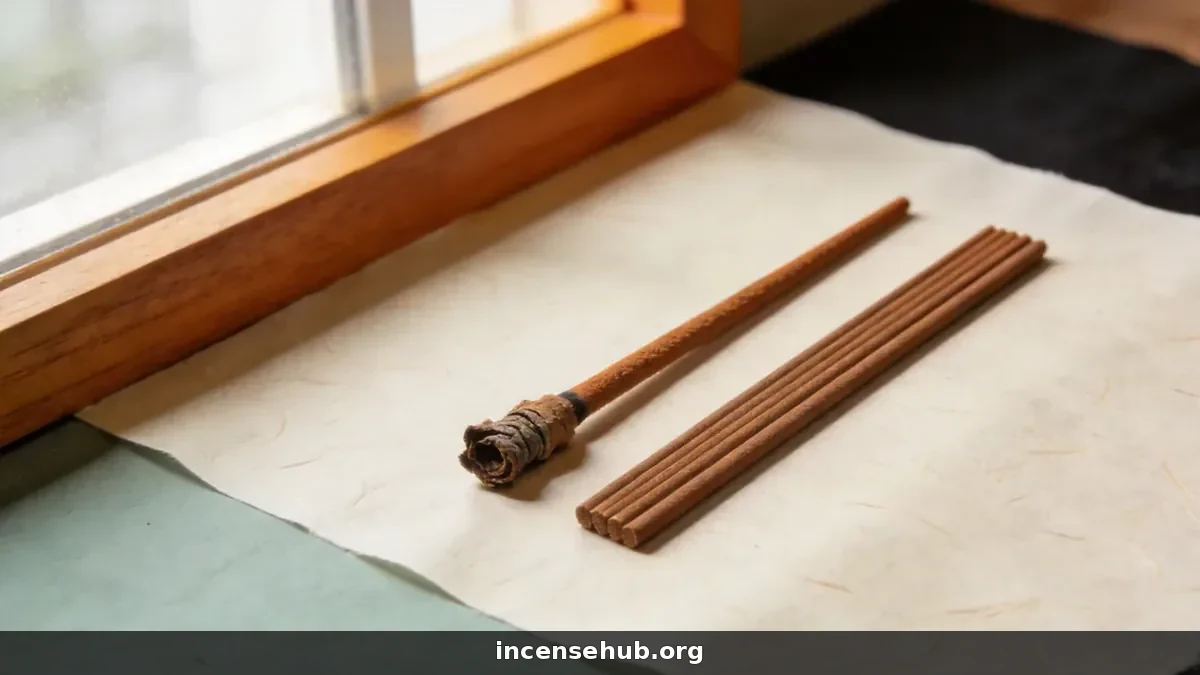
Direct answer: Both phrases describe what happened at the bench, not what the stick contains. Hand-rolled means a person wound damp paste around a splint or pressed it coreless; machine-made means a die extruded the rod or a preformed blank came out of a fragrance bath. Price tracks the method closely. Contents do not.
Key facts: Forming route and material source are independent, and they disagree in both directions often enough to matter. The route does set density, moisture and surface finish, which is why the two kinds of stick behave differently at the ember. A shop test exists that costs one stick and about two minutes.
Key Takeaways
- Hand work is labour-bound: that explains the price and most of the irregularity, not the aroma.
- A machine line buys consistency and volume; it does not choose between resin and a bottle.
- “Who shaped it” and “what is in it” are separate questions, and one answer rarely covers both.
- Grit, cold smell and the way a rod snaps are evidence; a badge on the box is a claim.
- The forming route sets how tight a purchase specification can honestly be written.
Two Labels, Two Different Questions
Direct answer: One word names a bench process, the other makes a statement about contents, and neither implies the other.
Picture a grid. Along one axis sit four forming routes: wound by hand, pressed by hand, extruded by machine, dipped by machine. Along the other sit three material states: ground plant matter and resin, a compounded fragrance, or a mixture of both. Every stick on a shelf occupies one cell, and nothing about the grid forces the diagonal.
The diagonal is still the common case, for a commercial reason rather than a moral one. Hand work is slow, so a workshop that has already spent the labour usually spends on the fill too — otherwise the retail price cannot be defended next to a factory stick. A line built for volume competes on unit cost, and the cheapest route to a cost target is loading fragrance rather than resin.
Correlation is not a rule. A roller can add a fragrance oil to lift a dull batch, producing something genuinely hand-made and partly synthetic. An extruder can run nothing but ground wood, resin and binder, producing something genuinely machine-made and entirely plant-derived. Treating the first label as a purity certificate is the most costly misconception in this corner of the trade.
That reframing is the practical takeaway: “hand-rolled” tells you where the money went, not what the hands were handling.
Four Families on the Shelf
Direct answer: Most comparisons collapse four distinct production styles into one hand-versus-machine split, and the collapse hides the variable that governs behaviour — what carries the burn.
| Family | How the rod is formed | What sustains the ember | Where aroma comes from | Typical weakness |
|---|---|---|---|---|
| Wound masala | Paste wound onto a bamboo splint by hand | The paste, with the splint as skeleton | Ground wood, resin, petal, spice | Cracks in dry air; variation between batches |
| Pressed coreless | Paste moulded or hand-dies, no splint | The paste alone | Same palette, often leaner | Brittle rods; crumbling ends |
| Extruded botanical | Paste forced through a die | The paste, occasionally a thin core | Milled plant material | Die lines; dense, slow rods |
| Dipped blank | Preformed core passed through a fragrance bath | Charcoal or bamboo core | Compounded fragrance, surface-applied | Smells louder cold than lit; soft cores on cheap stock |
Quality does not descend a single column. A pressed coreless stick sits nearer a wound masala on the material axis than to a dipped blank, even when the first two both carry a handmade tag and neither resembles the third. Anyone reading only the method label will misprice at least one of the four.
What the Bench Actually Controls
Direct answer: A person shaping by hand adjusts binder, water and pressure by feel from batch to batch; a die freezes those variables and lets mechanical pressure do the forming.
Binder is the quiet variable. Makko — powdered bark of Machilus, standard in Japanese-style work — holds the powder together and keeps the rod from shedding; gum binders do similar work elsewhere. The trade-off is blunt: more binder gives a forgiving dough, a slower burn and a duller scent, while less gives a brighter scent and more breakage.
Hand work needs a forgiving dough. A roller cannot drive a lean, crumbly mix at production speed, so a hand recipe usually carries a higher binder share than the same aroma formula pushed through a die. The result is denser, slower and less sharp.
Water is the second lever, and it is where hand work pays later. Wetter paste → more water has to leave the rod → the mass shrinks → the skin sets while the centre is still swollen → the two shrink at different rates → the rod curls or opens a hairline split. A roller who adds moisture to gain speed collects the bill at the drying rack rather than at the bench.
Traditional belief in the craft holds that slow, shaded drying beats forced heat. That is workshop lore rather than a measured result, and it should be labelled as such; the mechanism above makes it plausible, which is not the same as demonstrating it.
What a Dipping Line Buys, and What It Spends
Direct answer: A dipping line delivers evenness, throughput and low unit cost by applying aroma to a surface instead of building it into a mass.
The sequence is short: blank into the bath, usually solvent-carried; solvent flashes off; a second pass; then drying. Each pass concentrates fragrance near the surface, which is why a dipped stick can smell almost aggressive in its wrapper.
Two consequences follow. Batch-to-batch sameness is real rather than a marketing fiction, since the line reproduces diameter, load and burn rate run after run. And the aromatic material sits where the ember strikes first, while the core does most of the burning.
Consistency is not a vice, and it is worth saying plainly. A venue that wants the same smell in its lobby every week is well served by a dipped stick honestly sold as one. The failure is not the method; it is the price tag attached when nobody asks which method produced the stick.
Reading a Stick in the Hand
Direct answer: Eyes, nose and fingers narrow a stick to its family in about two minutes, and only the last test costs a stick.
| Check | What it settles | What it cannot settle |
|---|---|---|
| Price per stick | Whether hand labour is plausible in the cost | Whether the materials justify it |
| Surface under raking light | Wound or extruded — laps and fibre versus a smooth wall | Which plants are in the paste |
| Cold smell | Whether fragrance sits on the outside | Whether a botanical base lies underneath |
| Bend and snap | Density, brittleness, presence of a splint | Resin content |
| Finger rub | Whether powder sheds (paste) or the surface stays slick (coating) | Age of the stock |
| Evenness across a bundle | Process capability | Quality of either process |
| Label vocabulary | Whether the maker names materials or only a scent | Whether the naming is accurate |
| One stick burned | Ash behaviour, ember rhythm | Anything about ingredients |
Four of these deserve a note. Price per stick, not per box: hand labour puts a floor under unit cost that a dipping line does not have, so a price far below the rest of the shelf is evidence about method before the wrapper is open. Surface, seen sideways: hold the rod to a lamp at an angle — a wound stick shows overlapping laps and plant fibre proud of the binder, an extruded one shows a smooth wall with occasional die lines, a dipped blank shows a coating that stops where bare core emerges. Cold smell: applied fragrance announces itself as sharp, sweet and faintly solvent, while a resin-and-wood paste smells dull and granular until heated. The snap: a wound rod breaks dry and powdery with visible paste thickness, a dipped blank breaks nearer the core with a distinct shell.
What the Ember and the Ash Say
Direct answer: The burn is a second signal about forming and a poor signal about material — worth reading, easy to overread.
Follow the hand case: density varies along a wound rod → the ember meets thicker and thinner sections → its advance speeds and slows → ash sheds in uneven crumbs → the spent stick looks ragged. The machine case: diameter and density near-constant → the ember advances at one rate → ash falls in a tidy line.
The boundary is what matters. This test reads forming, not contents. A machine-extruded stick built from real powder also leaves tidy ash, and a hand-rolled stick loaded with fragrance oil also burns raggedly. Ash tells you which bench shaped the rod; it does not audit the recipe.
Burn time is not a quality score either. Diameter, density, binder share and room airflow all move it, so a slow stick may be dense, damp, over-bound or simply fat. A long burn is a specification value, not a verdict.
Three Sticks, Three Prices
Direct answer: A worked comparison shows how price, method and material line up in practice — and where they come apart.
Imagine three sticks on one shelf. The first is cheap, perfectly even, smells strong in the packet, and snaps with a shell around a hard core: a dipped blank, priced honestly for what it is. The second is mid-priced, slightly variable in diameter, smells muted cold and opens when lit: a pressed coreless or a lightly wound stick, plausibly botanical. The third is expensive, visibly hand-wound, irregular, quiet in the packet and generous when burned: a wound masala with real material.
Now move one variable. Suppose the second stick costs as much as the third. Nothing about the object changed, so the price is now evidence of a positioning decision rather than a material one. Suppose instead the first stick is priced like the third: the buyer is paying for a story, because the object’s tell-tales have not moved.
Reading the shelf this way — object first, price second — is the habit that protects a buyer. Price is a claim about the object; the object itself is the evidence.
Misconceptions That Cost Money
Direct answer: Most bad purchases here come from a handful of shortcuts that feel like expertise.
- “Hand-rolled means natural.” It means a person shaped the rod. Contents remain a separate question.
- “Machine-made means chemical.” An extruder can run ground wood and resin with nothing synthetic in the mix. A machine is not an ingredient.
- “Strong smell means good material.” Strength in the wrapper usually signals surface-applied fragrance; resin-rich paste stays quiet until heated.
- “Irregular means artisanal.” Variation can be craft, or it can be uneven moisture in a bad batch. Irregularity alone is not a credential.
- “Smooth means premium.” Smooth means a die or a coating — a forming signature, nothing more.
- “A longer burn means better.” It means denser, damper or thicker: three explanations, none of them quality.
These are editorial judgments drawn from the mechanics above rather than measured findings.
Writing the Method Into a Purchase Document
Direct answer: The forming route sets how tight a specification can honestly be, and machine tolerances written against hand work describe a product that cannot exist.
The chain runs: forming route → process capability → honest tolerance → inspection plan. Hand work has a wider natural spread, so its specification is written as a band — diameter within a range, weight within a range, burn time within a range — with a stated sampling plan and accept/reject rule. A line has a narrow spread, so the same attributes can be pinned to tight numbers without turning each shipment into an argument.
| Attribute | Honest wording for hand work | Honest wording for a line |
|---|---|---|
| Diameter | Range, measured at mid-shaft | Single value with a small tolerance |
| Weight | Range across a sampled bundle | Tight mean with tight spread |
| Burn time | Range with stated test conditions | Single repeatable figure |
| Surface | “Characteristic lap marks permitted” | “Free of die lines and blisters” |
| Scent | Described by material, judged by panel | Described by reference sample |
| Defects | Cracks and chips defined by size | Dimensional and coating defects |
Two notes for a buyer. Put the method into the specification before the numbers, because the numbers follow from it. And when a supplier offers hand-rolled goods at a machine price, ask which of the two they intend to ship — the question is cheap and the answer is informative. The same discipline runs through quality control and the spec sheet and COA material, where tolerance bands and test records work as separate instruments.
The Question This Comparison Cannot Answer
Direct answer: Both routes burn, and neither label says anything about what leaves the tip.
Burning incense produces smoke, and smoke is a particulate aerosol regardless of how the rod was shaped. A resin-heavy hand-rolled stick can put out as much visible smoke as a dipped one; “natural” is a materials claim, not a safety rating. Room volume, airflow and duration affect exposure more than the forming method does.
What follows is unglamorous: burn less, burn where air moves, keep flame away from anything that catches. Anyone with a respiratory condition has reason for care around any combustion source, this one included. Background sits with the EPA indoor air quality pages and the American Lung Association guidance.
Author’s Take
Position (editorial, not a verified fact): the hand-versus-machine framing is useful for pricing and nearly useless for judging what you are burning.
Reasoning:
- The route explains irregularity, price floor and the shape of a tolerance band. It explains almost nothing about ingredients.
- The material question has its own evidence — cold smell, label honesty, the way the room smells an hour later — and it does not care which bench shaped the rod.
- The two questions get conflated because the same two words are used for both in marketing copy. Separating them costs nothing and prevents most expensive mistakes.
FAQ
Q: What actually separates the two?
A hand-formed rod was shaped by a person, usually by winding damp paste onto a splint, sometimes by pressing it coreless. A machine-made rod was extruded through a die or coated on a preformed blank. That difference sets density, surface and burn rhythm. It does not set the recipe, which is why two sticks from one route can differ more than two sticks from different routes.
Q: Can a machine-made stick be all botanical?
Yes, in principle and occasionally in practice. An extruder can run ground wood, resin and binder with no compounded fragrance at all — the machine supplies pressure, not ingredients. The assumption survives for an economic reason: lines are usually built to hit a price, and fragrance is the cheapest way to hit it. That is a market tendency, not a property of the equipment.
Q: Is a perfectly even stick a sign of poor quality?
No. Evenness signals process, not contents. A smooth wall means a die or a coating and cannot tell you whether the powder inside is resin-rich or mostly filler. Judge material from label and cold smell, forming from surface and snap. Mixing the two is how buyers dismiss good machine work and pay premium prices for a dipped blank.
Q: Does a slower burn prove hand-rolling?
It does not. Burn rate responds to diameter, density, moisture, binder share and airflow, and any of those can slow a machine-made rod. A dense extruded stick can easily outlast a loosely wound one. Record burn time as a specification value; it is not a provenance test, and treating it as one rewards exactly the products built to game it.
Q: Where does 合香 fit?
合香 (hé xiāng) is a composing framework, and 君臣佐使 — chief, minister, assistant, guide — is traditional belief about how materials should be balanced rather than a laboratory method. It sits on the material axis: a 合香 formula can be wound by hand or run through a die. Reading it as proof of hand work is a category error.
Sources
- Craft literature on stick-making: binder selection, paste consistency, and the distinction between winding and extrusion, synthesised for this page.
- Traditional Chinese sources on 合香 blending, used only for the composing framework and labelled traditional belief where it appears.
- EPA indoor air quality — background on combustion particles indoors.
- American Lung Association indoor air pollutants — guidance on particulate from indoor burning.
Related Resources
- How Incense Is Made — the sequence of blending, forming and drying both routes share.
- Makko & Natural Binders — the binder decision behind dough behaviour and burn rate.
- Incense manufacturing quality control — why tolerance bands and tight specifications are different instruments.
- Incense spec sheets & COAs — recording the forming method in a purchase document.
- What Makes Incense “Natural” — the materials question this page leaves open.
Summary
- The label answers a bench question; it does not answer an ingredient question.
- Four families share the shelf — wound masala, pressed coreless, extruded botanical, dipped blank — and three axes separate them better than price does.
- Hand work needs forgiving dough, so binder and water run higher; a die runs leaner and steadier. That is the source of the burn difference.
- Surface, cold smell, the snap and one burnt stick are cheap evidence. A badge is not.
- Write the method into a bulk specification first; the tolerance band follows.
- Both routes produce smoke, and “natural” is not a safety claim.