
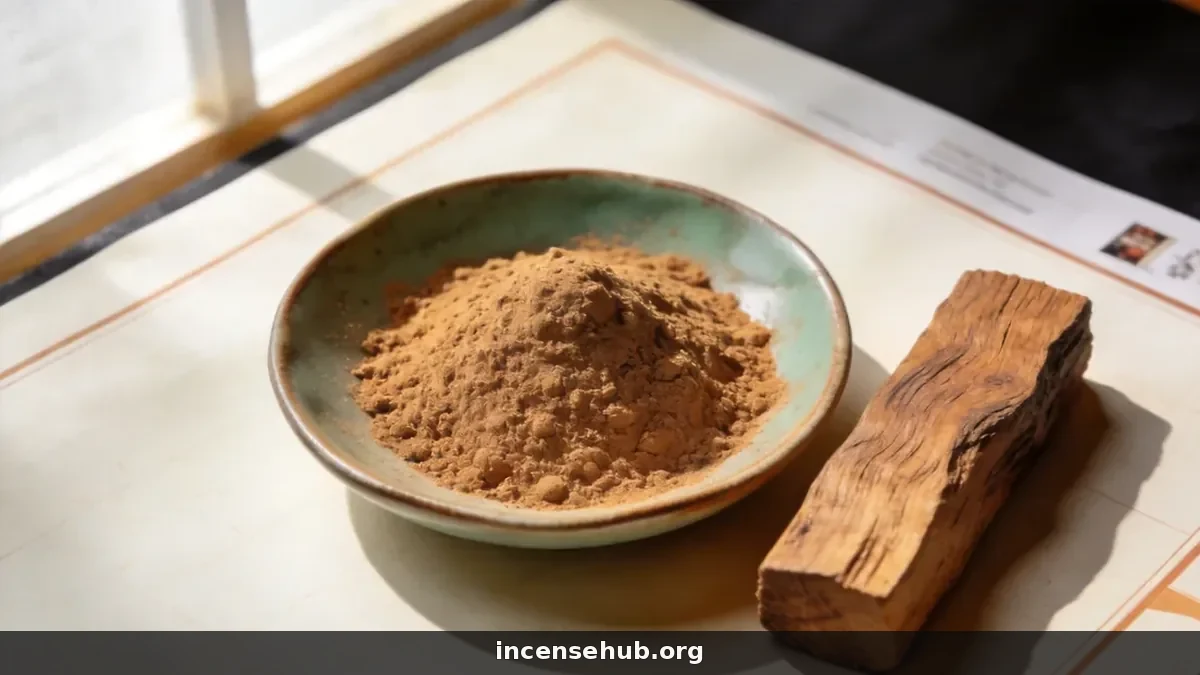
Direct answer: Incense powder is ground dried botanical material — wood, resin, flower, spice — sorted before milling, reduced to particles, screened to one band of sizes, then combined in fixed proportions. Some of it is burned or warmed as it stands; most is wetted with a binder and shaped into sticks, coils and cones.
Key facts: Nearly every formed incense begins as powder, which makes the mill the place where quality is decided rather than the shaping bench. What comes out of the sieve constrains everything after it: how the blend holds together, how the paste behaves, how the finished piece burns.
Key Takeaways
- One material, two careers. Sold loose it is the finished article; wetted with a binder it becomes the body of sticks, coils and cones.
- The sequence never changes. Sort, reduce, sift, weigh out. Whatever a stage leaves undone, the next stage cannot put right.
- Size is never universal. Plant and destination together set the band.
- Warmth is the hidden bill. Every pass through a cutter adds heat, and heat is what carries the scent away.
- A tight band beats a low average. One consistent size burns predictably; a mixture of flour and grit does not, whatever the average claims.
Powder at Both Ends of the Chain
Direct answer: The same material can be the finished article or the raw stock for one. Loose, it is spooned onto heat and used as it stands; wetted with a binder and water, it becomes the dough from which shaped incense is built.
Where the process stops decides which it is. Loose botanical powder is the pure-material format set out in incense powder & resin. The identical powder, worked with makko and water, formed and dried, is what how incense is made describes from the paste onward.
That double life is why the mill deserves more attention than the shaping bench. Nothing added later can remove a fault introduced earlier: a shard, a smear, a note scorched by a hot pass all travel into the finished piece. Shaping decides what the product looks like. Milling decides what it is.
First Stage: Sorting Settles the Material Question
Direct answer: Nothing reaches the mill until someone has decided what the pile actually is. Species, plant part and condition are checked first, because a mill reproduces a mistake as faithfully as it reproduces a wood.
Machinery cannot correct a mislabelled consignment. Feed it sapwood and the output is sapwood; feed it a blend of two species and the output carries both. Sorting is the last point where the material can still be argued about, and the first point where a buyer’s claim can be tested. Three checks carry the weight:
- Which plant. A species name is an assertion, and assertions can be tested. The incense authentication database marks which claims yield to examination and which rest on the seller’s word.
- Which part. Core wood against outer wood, bark against leaf, gum against the timber under it — one tree supplies four materials that behave in four ways.
- What state it is in. Wet, old, dusty, or kept beside something pungent: every one of those travels through the cutter and lands in the jar.
The commercial point follows directly: rejecting a bad lot is cheap before the mill and impossible after it. Powder removes the evidence that made the fraud visible — grain, colour, figure, the smell of a cut face. That is precisely why powder is the easier form to adulterate, and why the sorting bench is the buyer’s real defence.
Second Stage: Milling, and the Heat Nobody Budgets For
Direct answer: A mill does two jobs at once: it makes grains smaller and it makes material warmer. The second job is the one that decides whether the powder still smells of anything.
Follow the warmth and the whole stage explains itself. Metal bites into plant tissue → the bite converts motion into heat at the contact point → the material’s lightest scent compounds turn to vapour before the powder is cool → what reaches the jar is a fraction lighter than what went in. Nothing in that chain is visible. Two powders can look identical and differ entirely in what they retained.
The account is thermal before it is dimensional. A quick pass makes more cuts each second, banks warmth faster, and trades scent for minutes. Anything that pulls heat away is an ally: cold steel, a slack feed, a rest between passes, resin chilled before it meets the cutter. Reduce the material, yes — but reduce it while spending the least warmth you can. The same accounting reappears when incense is dried and cured further along the line.
Tissue type then dictates the setup, since no single setting suits four kinds of plant matter:
| Tissue | Behaviour at the cutter | Correction |
|---|---|---|
| Hard core woods | Fibres stretch before they part, then fall as clean meal | Even feed; return the fibrous tail for another pass |
| Gums and resins | Heat makes brittle lumps sticky, then smeary | Chill first, pulse briefly, keep the head cold |
| Blossom and leaf | Fragile, scatters at once, loses scent as airborne dust | Gentle speed, short bursts, collect the flour |
| Fatty seeds and spice | Becomes a paste that jams the rotor | Very small loads; crush before reducing |
How small to go is a choice, not a rule. A tight meal packs densely, holds an ember low and burns cool; an open, gritty meal runs hot and finishes fast. Which is correct depends on where the powder is headed — a heater plate, a bound stick, a scattered mound — and no single micron figure covers all three.
Why Resins Fail in the Mill
Direct answer: Resin is the ingredient most likely to ruin a run, because the trait that gives it value — going soft when warm — is also the trait that gums the equipment.
The failure runs in one direction. The chamber warms as it works → resin passes from glassy to tacky → the tacky mass coats the grinding surfaces → the chamber blocks and the batch leaves as paste. At that point the loss is double: a spoiled lot and a machine that needs cleaning before anything else can be milled.
Cold breaks the chain at its first link. Chilled resin stays glassy → it fractures instead of smearing → the surfaces stay clear → the meal stays free-running. Many makers take a further step, reducing resin coarsely and then folding it through a dry wood meal that absorbs surface tack and keeps the fragments apart.
For a buyer, this yields one diagnostic and one warning. The diagnostic: a resin-rich jar that has clumped is usually evidence of a warm mill, not of a fake. The warning: a “resin” powder that flows like sand and shouts at room temperature may not be resin at all, but carrier with oil on it.
A Materials Note: What Each Class Does at the Cutter
Direct answer: Incense materials fall into a handful of working classes, and knowing the class tells you what the mill will do before you switch it on.
| Class | Examples | Working character |
|---|---|---|
| Dense aromatic woods | Sandalwood, agarwood | Fibrous, slow to part, tolerant of a second pass; the meal keeps well |
| Gum resins | Frankincense, benzoin, myrrh, opopanax | Brittle cold, tacky warm; want chilling and short pulses |
| Blossom | Osmanthus, jasmine, rose | Fragile, quick to shed scent as dust; low speed, small loads |
| Aromatic barks | Cassia, cinnamon bark | Tough, slightly oily; grind coarse before refining |
| Oily spice | Clove, nutmeg | Behave closer to resin than to wood; small lots, watch the chamber |
| Leaf and herb | Patchouli, vetiver, mugwort | Light and fibrous; easy to overheat and easy to over-dry |
The table is a starting point rather than a specification. Two lots of the same species can behave differently depending on age, moisture and how the material was cut before it reached you, which is why a maker runs a small trial on any new consignment rather than trusting the class.
Resins deserve one more note. Frankincense and myrrh arrive as tears of uneven size, and a mill handles them best when they are chilled and fed slowly. Benzoin is softer still and often benefits from being reduced with a little dry wood meal already in the chamber, so the sticky fraction has something inert to cling to instead of the walls.
Blossom is the opposite problem: it gives up its scent easily, so the whole aim is speed without heat. A brief pulse, a rest, another brief pulse. Anyone who has watched a rose note vanish in a hot blade grinder understands why the slow method exists.
Third Stage: Screening, and Why the Spread Matters More Than the Size
Direct answer: Screening narrows a milled batch to one band of sizes, because a piece of incense can only burn as evenly as the material packed inside it.
A milled batch is a population, not a grade. One pass yields everything from flour to grit, and the range — rather than any average — governs what happens later. Three failures follow from a wide range:
- The burn stumbles. Grit holds an ember longer than flour; the line stalls on the coarse material and races through the fine.
- The blend drifts. A large fragment carries a disproportionate share of whichever plant it came from, so the mixture is uneven before it is lit.
- The pack varies. Different sizes compact to different densities along the same piece, which destabilises the burn all over again.
Screening closes the range. Material passes a mesh of a chosen aperture, and whatever will not pass returns to the mill instead of into the batch. The aperture is a decision, not a default: a loose powder for a heater and a powder bound into a stick are cut to different bands.
Two properties are routinely confused here, and separating them is the useful move:
| Property | What it governs | How it fails |
|---|---|---|
| Fineness | How fast and how hot the material burns | Too fine for loose use: the bed smothers itself and the scent flattens |
| Evenness | How steadily it burns | Wide band: the ember stalls and surges, and the blend separates |
A coarse cut, screened hard, burns quickly but evenly. A dust that was never screened burns slowly and raggedly. That is why “grind it smaller” is usually the wrong answer to a bad burn, and “make it one size” is usually the right one — a sieve decision rather than a mill decision.
Moisture and Static Before the Mill
Direct answer: Two invisible conditions shape a grind before the cutting starts — how much water the material holds, and how much charge it carries — and both are cheaper to fix beforehand than to correct afterwards.
Damp tissue behaves badly under a mill. Water makes fibres limp → limp fibre tears rather than cuts → the chamber clogs and the meal clumps → the spread of sizes widens and the burn inherits the unevenness. Drying the material to a crisp, brittle state before milling is the standard remedy, and it also protects the scent fraction, since heat applied later to drive off water would carry scent with it.
Static is the second nuisance. Particles rub against each other and the chamber → charge builds on the fines → fine material clings to walls, lid and sieve → the cut is uneven and the sieve blinds over. Letting a batch rest, working in a slightly humid room, or earthing the equipment all reduce it. Neither problem is visible in the finished jar except as a signature: a powder that fights the sieve or clings in sheets has told you about the room it was milled in.
Judging Uniformity in the Jar
Direct answer: Pour, look, rub and burn a pinch. Four checks, no instruments, and they say more than any claim printed on the container.
Tip a spoonful onto dark paper. A well-screened lot falls as a steady ribbon; a wide spread separates in the air, flour drifting while grit drops. Look at the heap: distinct grades show as bands of colour or texture. Rub a pinch — a narrow band feels the same throughout, a wide one alternates between silk and sand. Burn a small cone on a heat-safe surface and watch the ember line: steady advance means a tight spread, stalling and surging means the opposite.
None of it produces a micron figure, and none of it needs to. The question is whether the jar behaves like one material or several.
Fourth Stage: Combining, Where the Formula Actually Lives
Direct answer: Combining settles the ratios; in the Chinese tradition it also turns a set of ingredients into a system — 合香 (hé xiāng), ordered by 君臣佐使, the chief–minister–assistant–guide scheme in which each material holds an office rather than merely a note.
Where only one material is used, there is no real blend: a pure sandalwood or agarwood lot is decided at the sorting bench and under the cutter. Composition begins with the second ingredient, and that is where ratio and role take over. The chief (君) sets the intention, the minister (臣) upholds it, the assistant (佐) rounds or softens it, and the guide (使) steers the result toward a room or an hour. The combining system treats that architecture properly.
Mixing is a physical problem before it is a creative one. Each species brings its own density and its own size range → a brief stir lets the dense and the fine settle while the light and the coarse climb → the jar sorts itself into layers → top and bottom stop being the same material. The remedy is mechanical: tumble, turn, re-mix as the jar is filled, rather than stir once and stop.
That gives a test any buyer can run in seconds: tip the jar, look for bands, stir before use. A powder can be perfectly even inside each ingredient and still uneven across the blend, and separation is a mixing fault rather than a sign of age — no amount of resting fixes it.
Ratios in a working formula stay private; that is the maker’s capital. The architecture is discussable: every material has a role, and the blend is built so the roles balance rather than so the loudest note wins.
A Lexicon of Common Materials
Direct answer: The same eleven materials recur across Chinese incense work, and each has a name, a plant behind it, and a behaviour at the cutter.
| Chinese | Pinyin | Material | Working note |
|---|---|---|---|
| 檀香 | tán xiāng | Sandalwood heartwood | Fibrous, steady, keeps its scent well in storage |
| 沉香 | chén xiāng | Agarwood | Resinous and scarce; often blended with fibre to extend it |
| 乳香 | rǔ xiāng | Frankincense | Pale tears, brittle cold, sticky warm |
| 安息香 | ān xī xiāng | Benzoin | Softest of the gums; benefits from a dry meal in the chamber |
| 没药 | mò yào | Myrrh | Darker, denser, slower to soften than frankincense |
| 龙脑 | lóng nǎo | Borneol | Crystalline; volatile and easily lost to a hot pass |
| 桂皮 | guì pí | Cassia bark | Tough, slightly oily, grinds coarse before refining |
| 丁香 | dīng xiāng | Clove | Oil-heavy; behaves closer to resin than to wood |
| 藿香 | huò xiāng | Agastache | Leafy, light, quick to shed its note |
| 甘松 | gān sōng | Spikenard root | Earthy and dense; a little carries a long way |
| 艾草 | ài cǎo | Mugwort | Coarse leaf; often used for its smoke as much as its scent |
Read the table as a map of milling problems rather than a shopping list. The gums at the top soften; the leaf and root at the bottom scatter; the crystalline entry in the middle volatilises before the batch is cool. Each row implies a different feed rate, and none of them implies a number.
Names for the Forms
Direct answer: Chinese practice separates the loose material from the shapes built out of it, and the vocabulary is worth knowing because catalogues use it untranslated.
Loose material is 香粉 (xiāng fěn), literally incense powder. Bound into a straight stick it becomes 线香 (xiàn xiāng), thread incense. Wound into a spiral it is 盘香 (pán xiāng), coil incense; pressed into a cone, 塔香 (tǎ xiāng), pagoda incense. A seal or character traced in loose material is 香篆 (xiāng zhuàn), and the gathering where material is judged and shared is 香席 (xiāng xí).
The distinction is commercial as well as cultural. A workshop tooled for 线香 may own no press for 塔香 and no winding frame for 盘香, so a quotation that names one form and a buyer who assumes another will produce a mismatch that looks like bad faith and is really a translation gap.
Ground Wood or Scented Base: The Distinction That Follows the Powder
Direct answer: The name on a jar may describe milled heartwood or a neutral carrier dosed with oil. In the hand they are nearly indistinguishable; over heat they are not the same product at all.
This is the material-versus-fragrance question moved one stage upstream, and it bites harder here because powder offers so little to inspect: no shape, no finish, no burn. See incense powder vs wood chips for the same test on a coarser form, and what makes incense “natural” for the words a label uses when it is being careful.
| What you check | Milled plant material | Carrier plus oil |
|---|---|---|
| Smell in the jar | Subdued, dry, vegetal | Sharp, already at full volume |
| Smell over mild warmth | Unfolds, deepens, then recedes | Barely moves |
| Rubbed between fingers | Sandy, irregular, sometimes tacky | Slippery and even, like powder paint |
| Dropped into water | Clouds, sinks, keeps its plant smell | May film the surface |
| Cost against the plant | Follows scarcity | Follows the oil price |
| Printed detail | Species and part named | “Fragrance”, or silence |
The second row is the test that matters. Plant tissue holds scent inside cells and gives it up as heat arrives; a dressed base has nothing to give up. Quiet when cold and expressive when warm is the signature of material. Loud when cold and flat when warm is the signature of something applied.
One caution on reading price alone: a very low price is a strong hint of a carrier, but a high price proves nothing, since expensive powder can be poorly milled material. Price narrows the question; only the label and the warm test answer it.
Three Tests You Can Run With Your Hands
Direct answer: A rub, a cold smell and a warm smell will separate most sound powder from most poor powder before you commit to a second jar.
Rub it. Press a little between thumb and forefinger. Milled plant tissue feels like fine sand, irregular in a way that changes with the species. A carrier dosed with oil feels manufactured — smooth, even, closer to talcum than to sawdust.
Smell it cold. Straight from the jar, real wood or resin is restrained. A dressed base is already loud, because the oil sits on the surface instead of inside the cells.
Warm it. Put a pinch on a gentle heat source — a mug warmer, foil over a low flame — and smell again. Plant material opens, deepens and then thins. A dressed base stays roughly where it began, sometimes losing brightness as the top notes flash.
Individually none of the three settles anything; together they catch the crude substitutions, carrier sold as wood and heavily oiled powder sold as resin. What they cannot catch is genuine material of poor grade, which is a question of provenance rather than of chemistry.
Field method, not a laboratory protocol.
Buying Powder or Milling Your Own
Direct answer: Most people should buy ready-milled powder from a supplier who names the species; milling at home is worth it when provenance or constant small-lot freshness matters more than time.
Doing it yourself has two genuine advantages. You see the material before it is reduced, so no substitution can hide behind a label, and you can mill a small quantity close to the moment of use, when the material is at its most expressive. Against that sits the cost: a cheap blade grinder runs hot and strips the top notes, a cool-running burr or stone mill costs more, and every batch needs cleaning and a little experimentation with feed rate.
| Your situation | Sensible choice | Why |
|---|---|---|
| You burn a little and want one dependable material | Buy, from a label naming species and part | The equipment never pays for itself |
| You blend and adjust often | Mill small lots | Iteration and freshness |
| You must know the material is what it claims | Buy whole material, reduce it yourself | Identity is checkable before the mill |
| You need a steady supply for years | Buy, but stay with one source | Continuity of grade matters more than novelty |
The summary is blunt: buy for convenience, mill for control. Neither choice is more serious than the other; they purchase different things. If you mill, the binder question is separate and covered in makko and natural binders.
What the Maker Writes Down
Direct answer: A usable batch note records six things — material, supplier, moisture, cutter setting, screen, and weight out — because without them a good result cannot be repeated and a bad one cannot be explained.
The list is short and unglamorous. Material lot and supplier make provenance traceable when a jar smells wrong months later. Moisture at the start explains why one batch ran hot and another did not. Cutter setting and screen aperture are the two numbers that fix the band, and therefore the burn. Weight out against weight in gives the yield, which is where a mill’s losses become visible: fine dust that never reaches the jar, material left in the chamber, spillage during filling.
Written down, those six fields turn a craft into a process that can be corrected. Left in memory, they turn every batch into a fresh experiment and every fault into a mystery.
What a Label Should Tell You
Direct answer: A powder label should read like a short spec: which plant, which part of it, what the powder is for, and whether the smell is material or additive.
Four fields do most of the work. Plant narrows the species rather than the scent. Part explains both behaviour and price, since heartwood, bark, leaf and resin are not interchangeable. Intended use separates a powder for heating from one for binding. Scent source says whether the aroma is botanical or applied.
A jar reading “sandalwood powder” and nothing else has answered none of the four. That is not proof of fraud; small producers under-label from habit. It does mean the work of verification has moved to you, and the three tests above are where it lands.
Storage: Surface Area Is the Whole Story
Direct answer: Powder ages faster than shaped incense because it offers air far more surface to work on, so it wants a closed container, a cool dark shelf and no fragrant neighbours.
The arithmetic is simple. Milling multiplies exposed surface → more surface means faster moisture exchange and faster oxidation → the scent thins and the powder grows reluctant to light → the change cannot be reversed. A stick may hold its character for months; a powder can lose it in weeks.
What follows is practical rather than fussy. Use a screw-top jar or tin, not a folded bag. Keep it out of sunlight and away from warm equipment. Add a desiccant where humidity is high, and replace it when it stops working. Store powder away from spices, coffee and cleaning products, because it will absorb whatever sits beside it.
One habit is worth adopting: keep a small working jar and leave the reserve sealed. Every opening exchanges air with the entire contents, and the last spoonful from an often-opened jar is rarely the powder that was bought. Incense storage and longevity covers formed incense under the same conditions.
Smoke, Ventilation and the Honest Caveat
Direct answer: Any burning incense releases fine particles and combustion gases, and loose powder on a heater is no exception. That is a ventilation issue, and it belongs on a page about how powder is made.
Public-health guidance treats indoor burning as a source to manage. The EPA’s indoor air quality material and the American Lung Association’s pages on indoor pollutants both cover particulates and the groups most affected — people with asthma or other respiratory conditions, children, anyone in a small closed room.
Practice follows: burn less at a time, keep a window or extractor open, do not fall asleep in a room where incense has just burned, and do not read a pleasant smell as clean air. A heater and loose powder generally produce less particulate than a smouldering stick, though “less” is not “none.”
Nothing here is a health claim in either direction, and nothing here should be read as reassurance. The point is narrower: the craft and the air around it are one subject, and a page about milling should not leave the room out.
The Mill Itself: Four Tools, Four Trade-offs
Direct answer: The device doing the cutting sets the heat, the spread and the loss, so choosing a mill is choosing which of those three you are willing to sacrifice.
| Tool | Heat produced | Size spread | Suits |
|---|---|---|---|
| Mortar and pestle | Almost none | Wide and coarse | Tiny lots, delicate petals, resins that must stay cold |
| Stone mill | Low to moderate | Fairly even | Traditional woods, steady small production |
| Burr grinder | Moderate | Narrow and repeatable | Consistent cuts across batches |
| Blade grinder | High | Widest, most erratic | Rough work only; it spends aroma for speed |
The pattern in that table is uncomfortable but reliable: the faster the tool, the more of the scent it costs. A mortar is tedious and preserves the most; a blade is quick and strips the lightest notes first. A burr sits between them, trading some heat for repeatability — which is often the right trade when the goal is a consistent blend rather than a single precious batch.
Scale changes the failure mode rather than the principle. Hand work risks inconsistency across a long session; a production line risks heat, because throughput rewards speed and speed rewards nobody’s nose. The question to ask of any powder follows from that: not “how fine” but “how cool did it run, and how tight is the spread.”
When a Burn Misbehaves
Direct answer: Most burn faults trace back to the powder, and the symptom usually names the cause.
| Symptom | Likely cause | What to change |
|---|---|---|
| Ember keeps dying | Too coarse, or damp | Screen tighter; dry the material before milling |
| Burn races and finishes early | Too fine, or too much combustible binder | Open the cut; revisit the binder share |
| Smoke turns harsh and acrid | Overheated milling, or resin scorched in the chamber | Slow the feed; chill resin before grinding |
| Scent fades halfway down | Uneven blend, or fines burned off first | Re-mix; screen to one band |
| Stick splits or crumbles | Poorly sized powder packing unevenly | Narrow the spread before shaping |
Read the table as a diagnostic order rather than a list of equal options. Powder problems appear before shaping problems, and shaping problems appear before drying problems; working from the top down saves the effort of fixing the wrong stage.
Mistakes That Keep Recurring
Direct answer: Five habits explain most disappointment, and four of them are errors of preparation rather than of lighting.
- Treating “fine” as a mark of quality. The correct band follows the plant and the intended shape; a figure borrowed from another species means nothing.
- Letting the cutter run hot. The jar looks right; the dish smells hollow.
- Skipping the sift. A wide spread of sizes is the usual reason a burn stalls, surges and stalls again.
- Reading a botanical name as a guarantee of content. Carrier dressed with oil travels under the same names.
- Leaving the lid off. Nothing in the incense family is as exposed as loose material.
The pattern is worth noticing: every fault sits upstream of the flame. A stick that misbehaves is usually testimony about the mill rather than about the recipe, and blaming the recipe is the most common misdirection in the craft.
Three Chinese Terms for Processing
Direct answer: Chinese practice names three stages that English usually folds together: 炮制 (páo zhì), the preparation of raw material; 阴干 (yīn gān), drying in shade; and 陈化 (chén huà), deliberate ageing.
炮制 covers everything done to a material before it is used — cleaning, trimming, drying, sometimes gentle heating or soaking. The point is to make the material workable and predictable rather than to change what it is. 阴干 is the slower half of that: drying away from direct sun, so the material loses water without losing the fraction that sunlight and heat would carry off. 陈化 is the most contested. Makers describe aged material as rounder and less sharp, and the claim is traditional belief rather than a measured result; what is measurable is that storage conditions decide whether ageing helps or ruins a lot.
The three terms are useful even to a buyer who does not read Chinese, because they name three different promises. A supplier who says the material was shade-dried is making a claim about heat. One who says it was aged is making a claim about time. Those are separate claims and deserve separate questions.
Buying in Quantity: What the Packaging Has to Do
Direct answer: At volume, the container matters as much as the contents: a powder that arrives damp, scented by its own carton, or compacted into a brick has lost value in transit rather than in the mill.
Three forces act on a shipment. Humidity moves through paper and thin film → the meal takes on water → it clumps, dulls and burns badly → the loss is discovered only when the bag is opened. Odour migrates between materials → a strong cargo nearby leaves its mark → the jar smells of the warehouse rather than of the plant. Vibration compacts fine material → the load settles into a dense block → the top of the bag is dust and the bottom is stone.
Good packing answers all three: a barrier layer rather than a single paper sack, an inner liner sealed before the outer bag is closed, and a carton that keeps its shape so the contents are not compressed by whatever sits above them. Headspace matters too, because air inside the package is water waiting to be absorbed.
For the buyer, the practical checks are simple. Ask what the inner layer is made of. Ask whether the material is filled by weight or by volume, since a settled meal occupies less space for the same mass. Open one unit on arrival rather than the whole consignment, and judge before storage hides the evidence.
None of this is exotic. It is the ordinary discipline of moving a hygroscopic, odour-hungry, easily compacted material from one country to another — and it belongs in the same conversation as the mill, because a perfect batch can be ruined by a poor sack.
Specifying Powder to a Supplier
Direct answer: A powder order is only as good as its written terms, and five of them decide whether the jar that arrives matches the jar you approved.
Write down the plant and the part, the band you want, the intended use, the scent source, and the packing unit. Those five fields let a supplier quote against something real and let you reject a delivery against something agreed. Vague instructions produce a conversation; written ones produce a specification.
Ask for a trial lot before a full run, and treat the trial as the only evidence that matters. A photograph of powder proves nothing, a sample chosen by hand proves less than a lot produced without special attention, and a certificate says nothing about the batch in front of you. What you want is a quantity made under normal conditions, then checked for band, smell and burn.
Expect the reply to include what cannot be promised. Powder varies with the harvest and the season, and a supplier who claims perfectly repeatable colour and aroma across years is either blending to hide variation or not paying attention. Consistency of behaviour is a reasonable ask; consistency of shade is not.
Keep the approved trial sealed and labelled. When a later delivery is disputed, that jar is the reference, and without it the argument becomes one opinion against another.
The Author’s Take
Position: Powder is where incense quality is settled, and it is the stage almost no buyer ever sees.
Reasoning:
- Everything downstream inherits from the mill. A blend cannot rescue a scorched note, and a binder cannot hide a spread of sizes.
- The two questions worth putting to a maker are not “how fine” but “how cool” and “how even” — one asks about heat, the other about screening, and between them they cover most of what can go wrong.
Disclosure: An editorial position drawn from working with the material, not a verified fact. No proprietary recipe, plant capacity or certificate is asserted anywhere here.
FAQ
Q: How is incense powder made?
Check the dried material first and throw out what does not belong. Reduce it under a cutter, sift into one band, weigh the parts and combine. From there it goes two ways: loose onto heat, or into a paste with makko and water, shaped and dried. Identity of the plant and tightness of the band decide more than anything else.
Q: What grain size should incense powder be?
No figure applies across the board. A dense, fine meal holds an ember low and long; an open, gravelly meal burns hot and finishes quickly. Material headed for a heater is not cut like material headed for a stick. Consistency counts for more than the figure: one band, never flour mixed with grit.
Q: Why must resin be chilled before grinding?
Because a mill turns motion into warmth, and warmth is exactly what softens resin. Once tacky, it coats the grinding surfaces, jams the chamber and converts the batch into paste. Chilled, the same resin stays glassy, breaks into fragments and leaves the chamber clean. If a resin-heavy jar arrives clumped, suspect a warm mill before suspecting the resin.
Q: Is incense powder always pure botanical material?
No. Ground heartwood and an inert base carrying perfume oil answer to the same names on the shelf. Heat separates them where the fingers cannot: real tissue stays quiet until warmed and then unfolds, while a dressed base is loud straight from the jar and hardly shifts when heated. Start with the printed detail; if it names only a scent, treat the claim as unproven.
Q: How should powder be stored?
Sealed, dark, cool and away from anything fragrant. A jar with a proper lid beats a folded bag, and a desiccant earns its place in humid weather. Keep the jar in use small and the reserve closed, since each opening exchanges air with the whole contents. Nothing restores powder that has already lost its edge.
Sources
- What follows is editorial synthesis. The four stages are described as workshop practice in botanical reduction, not as a published standard.
- Binder botany, Machilus thunbergii: Machilus in Flora of China and Machilus thunbergii on GBIF.
- EPA indoor air quality — the reference used here for particulates released by indoor burning.
- American Lung Association indoor air pollutants — the health framing for smoke in an enclosed room.
Related Resources
- How Incense Is Made — where powder becomes paste, shape and finished stick.
- Incense Powder & Resin — the loose, pure-material format and how it is used.
- Incense Powder vs Wood Chips — the same material in two forms, compared.
- Makko & Natural Binders — what holds a stick together and what it costs in burn behaviour.
Summary
Powder is made in a fixed order: sort the material, mill it while spending as little heat as possible, screen to one band of sizes, then combine in proportion. Sort → mill → screen → combine is the whole sequence, and the quality of the finished incense is largely settled by the second and third steps rather than by anything the shaping bench can add.
Heat is the variable that never appears on a specification sheet. Friction warms the material, warmth drives off the lightest scent compounds, and the loss is invisible until the powder is warmed weeks later. Temperature discipline, not fineness, is what separates a mill that preserves from one that merely reduces.
Evenness is the second quiet variable. A narrow spread of grain sizes burns smoothly, blends evenly and packs consistently; a wide spread fails in three ways at once. Screening is how that spread is narrowed, and it is the step most often skipped when someone chases a finer grind instead.
What follows for a buyer is a short list: read the label for species and part, ask whether the scent is material or applied, test with fingers and warmth, and store the result sealed. None of that requires equipment. All of it assumes the powder was made with the same care the questions imply.