
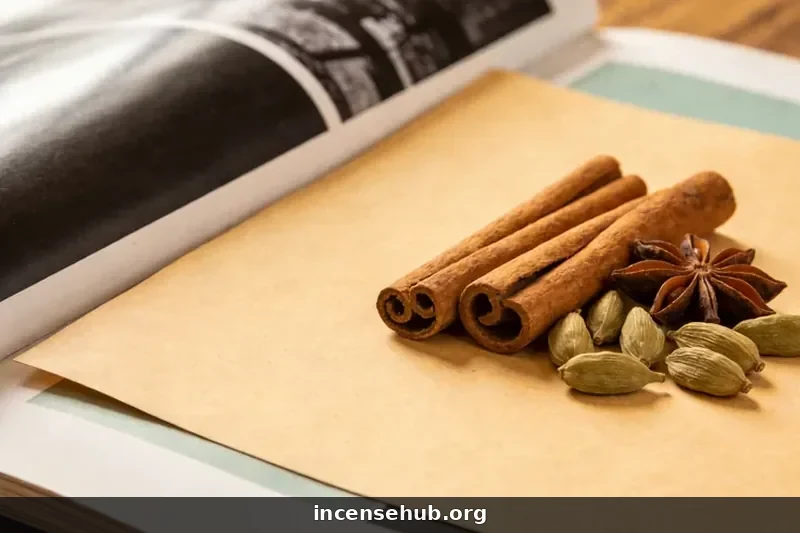
Technical answer: Fennel is 小茴香 (xiǎohuíxiāng), the ribbed dried fruit of Foeniculum vulgare, an umbellifer grown across the Mediterranean and much of China. Kitchens know it as a sweet anise spice. Incense knows it as a minor classical material: 茴香 appears in blended formulas such as 寿阳公主梅花香, where it sweetens and softens rather than leads. It is not star anise, though both carry a 茴香 name.
Key facts
| Chinese name | 小茴香 (xiǎohuíxiāng); 茴香 in short form. The 大茴香 name belongs to star anise |
| Species and family | Foeniculum vulgare Mill., Apiaceae |
| Traded part | The dried fruit; the “seed” is one mericarp of a split pair |
| Scent register | Sweet anise, warm, with a green and slightly hay-like edge |
| Classical use | A rounding sweet-spice note in 合香; named in the 寿阳公主梅花香 formula |
| Lookalike risk | 八角 (star anise, Illicium verum) and 茴芹 (anise, Pimpinella anisum) |
| Form in trade | Whole fruit, ground powder, and a distilled oil from the flavour trade |
The fruit behind the name
Direct answer: Fennel is the ribbed, oblong fruit of an umbelliferous herb, not a true seed. Each “seed” is a half-fruit that splits away from its twin, and that structure is one of the quickest ways to tell fennel from the spices it is confused with.
The word “seed” is trade language, not botany. The fennel plant produces a schizocarp — a dry fruit that separates at maturity into two one-seeded halves called mericarps. What a buyer receives in a sack is mostly those halves: small, pale green-brown, faintly curved, with five prominent ridges running lengthwise. A flat inner face marks where the two halves met.
That detail matters more than it sounds. Star anise is a whole star-shaped fruit of a tree; anise is a smaller, tear-shaped mericarp; fennel is the larger, ridged half with a visible flat side. Once you have handled all three, the shapes stop looking interchangeable.
Foeniculum vulgare is a herbaceous perennial that dies back to a crown and pushes up hollow stems each season. The leaves are thread-fine, the flowers are tiny and yellow in umbels, and the fruit is the part that keeps. In a garden the plant spreads readily; in trade it is ordinary, cheap, and sold by the sack.
One name, three plants
Direct answer: 茴香 is a name element, not a species. 小茴香 is fennel, 大茴香 (also 八角) is star anise, and 茴芹 is anise — three different plants that share a sweet anethole smell. A label or recipe that says only 茴香 is ambiguous, and the scientific name is the only clean fix.
This is the single most useful thing to understand about fennel in a Chinese context. The names converged because the aromas converged, not because the plants are related.
| Written name | Plant | Family | Fruit shape | Aroma register |
|---|---|---|---|---|
| 小茴香 | Foeniculum vulgare | Apiaceae | Ridged oblong half-fruit, 4–6 mm | Soft, green, sweet anise |
| 大茴香 / 八角 | Illicium verum | Schisandraceae | Eight-pointed woody star | Sharp, penetrating licorice |
| 茴芹 | Pimpinella anisum | Apiaceae | Small tear-shaped seed | Clean, pure licorice |
| 孜然 (for contrast) | Cuminum cyminum | Apiaceae | Longer, narrower, bristly | Earthy, warm, cumin-aldehyde |
A classical recipe that lists 茴香 without a qualifier is usually read as fennel, because fennel was the common Chinese material while star anise became widely traded later. That reading is a convention, not a proof. When a formula’s other ingredients suggest a southern or export context, or when the intended effect is a sharp licorice lift rather than a soft one, the 茴香 in the text may well mean star anise. The honest position is that the word alone does not settle it.
What follows for a buyer is simple: put Foeniculum vulgare on the purchase order, not 茴香. A supplier who cannot confirm the binomial is not confirming the material.
What Flora of China records
Direct answer: Foeniculum vulgare is recorded by Flora of China as a plant 0.4–2 m tall with finely divided, thread-tipped leaves and compound umbels 5–9 cm across. The fruit is 4–6(–10) mm long and 1.5–2.2(–2.5) mm wide. It flowers May–June and fruits July–September.
The Flora of China description is worth keeping at hand because it gives a buyer a physical scale to check against. The leaves are 4–5-pinnatisect, meaning divided so many times that the final segments are hair-like — the familiar feathery fennel foliage. The umbels carry 6–29(–40) rays and measure 5–9 cm across. The fruit is a schizocarp of the dimensions above.
Flora of China records the species as cultivated and adventive in China at 200–2600 m. GBIF holds the global occurrence record. Neither source grades the material for incense, and neither would: fennel is an agricultural crop, and its quality language comes from the spice trade.
One botanical point deserves emphasis because it explains a processing behavior. The aromatic compounds sit in oil ducts in the fruit wall, not in a free pool of oil. The fruit has to be crushed, chewed, or heated for those ducts to release their contents. That is why whole fennel smells mild in the bag and strong between the fingers, and why grinding changes the material’s behavior so sharply.
Supply: a spice before it is an aromatic
Direct answer: Fennel is native to the Mediterranean and now cultivated and naturalized across China. It enters the incense supply chain as a culinary spice, priced and graded by the food trade, with no separate incense-grade system.
This is a supply-chain fact with practical consequences. Fennel is grown in quantity for kitchens, for pickling, for sausage, for five-spice blends, and for the flavour industry. A Chinese incense workshop that wants fennel buys from the same wholesalers who supply restaurants and food factories. The sack may be food-grade, which is good; it will not be incense-grade, because that category does not exist for this material.
The result is a pricing floor. Fennel is cheap relative to agarwood, sandalwood, or resin, and a supplier who quotes a dramatically high price for “incense fennel” is selling a story rather than a material. The meaningful variables are freshness, cleanliness, and whether the fruit was ground recently — not rarity.
Origin matters less than it does for resins. Mediterranean fennel and Chinese-grown fennel are the same species, and the culinary trade moves both. A buyer can ask for the crop year and the grinding date, which are more useful than a province name.
Why fennel smells sweet
Direct answer: Fennel’s sweetness is driven mainly by anethole, the same compound that dominates anise and star anise. The three plants are unrelated; they converged on the same molecule, which is why they smell like relatives and why their names overlap.
Anethole is a small aromatic ether with a distinctly sweet, licorice-like character. It is volatile — it leaves the plant material at room temperature, slowly at first and quickly once the oil ducts are broken. That single property explains most of fennel’s commercial behavior: fresh whole fruit keeps its smell for a long time, ground fennel does not, and heat drives the note off rather than fixing it.
Fennel’s aroma is not pure anethole, though. The fruit carries related aromatic compounds in smaller amounts, and those minor fractions are what give fennel its green, slightly herbaceous edge — the quality that separates it from the blunter sweetness of star anise. A taster who pays attention can usually place fennel as “anise plus hay” and star anise as “anise plus heat.”
There is a useful correction here. The licorice note in fennel does not come from licorice root (甘草, Glycyrrhiza), and the two materials are not interchangeable. Licorice is sweet because of glycyrrhizin, a completely different molecule with a different kind of sweetness and a different behavior in blends. A formulator who substitutes one for the other because both are “sweet” will get a blend that tastes wrong in a way that is hard to diagnose.
The classical paper trail
Direct answer: Fennel appears in Chinese incense through classical blended formulas, above all the 寿阳公主梅花香, where 茴香 is listed alongside clove bark and rosewood. Its job is to add a warm sweet-spice layer, not to define the fragrance.
The 寿阳公主梅花香 is the reference point. The formula is a plum-blossom composition, and fennel sits in it as one of several warm, sweet, woody materials rather than as the featured note. That placement is the whole story: fennel is a team player in a formula built to suggest plum blossom in cold weather.
Why would a plum-blossom incense contain fennel at all? Read the formula’s logic rather than its name. Plum blossom itself has a cool, thin, almost bitter floral scent that does not survive burning. A classical composer rebuilding that impression needs a structure: woods for body, clove and other warm spices for the “cold air” sharpness, and a soft sweet layer to keep the blend from turning austere. Fennel supplies that soft sweet layer. It is not there to smell like fennel; it is there to keep the composition from sounding harsh.
That reading is editorial, but it is testable in practice. Remove the fennel from a plum-blossom blend and the result usually reads thinner and more medicinal. Increase it and the blend turns food-sweet and loses the cold-floral illusion. The usable range is narrow, which is characteristic of a supporting material.
Where it sits in 君臣佐使
Direct answer: In the 君臣佐使 (chief–minister–assistant–guide) framework, fennel works as an assistant — 佐 — that softens and sweetens. It does not have the weight to act as chief, and treating it as one produces a blend that smells like a sweet shop rather than an incense.
| Role | Function in a blend | Typical materials | Where fennel fits |
|---|---|---|---|
| 君 chief | Defines the fragrance | Agarwood, sandalwood, a dominant resin | No |
| 臣 minister | Supports and extends the chief | Clove, frankincense, myrrh, patchouli | No |
| 佐 assistant | Corrects, softens, rounds | Fennel, anise, citrus peel, sweet herbs | Yes |
| 使 guide | Carries the blend, modifies lift | Borneol, camphor, musk-type fixatives | Rarely |
The framework is a diagnostic tool, not a law. Its value is that it forces a formulator to ask what a material is doing. Fennel’s answer is almost always “rounding”: it takes the edge off sharper spices and adds a sweet top layer that reads warm rather than sugary when the dose is low.
The failure mode is predictable. A formulator who likes the smell of fennel in the jar may double the dose, and the blend collapses into anise candy. The woods disappear behind the sweetness, the resin’s texture flattens, and the finished stick smells cheaper than its ingredients. Fennel is one of the materials where “a little” and “too much” are separated by a small margin.
From umbel to powder
Direct answer: Fennel is harvested when the fruit is ripe, dried, cleaned, and either sold whole or milled to powder. There is no extraction step in the whole-fruit and powder forms; the milling decision is the one that changes the material most.
The harvest window follows the plant’s cycle: flowering in late spring, fruit ripening through summer. Growers cut the umbels when the fruit has colored but before it shatters, then dry them and thresh the fruit free of stem and flower debris. Cleaning removes dust, stem fragments, and lightweight chaff.
Milling is where the material changes character. Grinding ruptures the oil ducts across a much larger surface area, so the aromatic fraction becomes available immediately — and leaves immediately. A freshly ground fennel powder smells louder than the whole fruit and loses that intensity faster. The trade-off is not a defect; it is the physics of a volatile aromatic.
For incense work, the powder’s particle size and moisture content matter as much as its smell. A coarse grind packs loosely and burns unevenly; a fine grind can choke a stick if the binder cannot hold the mix open. Moisture affects how the binder hydrates and how the stick dries. None of these targets can be set from a table, because they depend on the binder, the other ingredients, and the forming method. The general mechanics are covered in how incense is made, and the behavior of seed and resin powders in incense powder & resin.
A distilled fennel oil also exists in the flavour and fragrance trade. It is a different material: concentrated, liquid, and dosed by weight in tiny fractions. It is not a drop-in replacement for ground fruit in a stick, because the oil carries no fiber, no bulk, and no burn behavior of its own.
Whole, ground, distilled
Direct answer: Fennel is sold as whole dried fruit, as ground powder, and as a distilled oil. Whole fruit is for storage and inspection, powder is for blending, and the oil belongs to a different formulation tradition.
| Form | What it is good for | What it costs you | Best practice |
|---|---|---|---|
| Whole fruit | Long storage, aroma retention, incoming inspection | Must be milled before blending | Buy whole, grind to order |
| Ground powder | Direct incorporation into sticks, cones, loose blends | Loses top note within weeks; dusts | Buy small quantities, seal tightly |
| Distilled oil | Flavour and fragrance work, precise dosing | No bulk or burn structure; easy to overdose | Treat as a separate ingredient, not a swap |
The form decision is usually made for the wrong reason. A workshop buys powder because it is convenient, then wonders why the finished sticks smell flatter than the trial batch. The trial batch was made with fruit ground that morning. The production batch used powder that had been in a sack for a season. Same supplier, same species, different material state.
Incoming inspection
Direct answer: Good fennel is whole, pale green-brown, clean, and sharply sweet when crushed. Poor fennel is dull, dusty, full of stem, or smells of hay and cardboard. These are sensory checks, not laboratory tests, but they catch most of what goes wrong.
A practical incoming inspection runs in this order:
- Look at the shape. Whole fruit should be intact halves, 4–6 mm, with five ridges and a flat face. Broken dust suggests handling damage or an old lot.
- Look at the color. Fresh material is green-brown to grey-green. Uniform dull brown usually means age or heat exposure; black specks mean debris or mold.
- Crush a pinch. The smell should arrive immediately: sweet, anise-like, slightly green. Hay, dust, or a faint cardboard note means the volatiles are gone.
- Check the cut. Stem pieces, sand, and chaff should be minimal. A sack that is half stem is a sack priced wrong.
- Squeeze the powder, if buying powder. Powder that clumps has taken on moisture; powder that flows freely but smells flat has lost its top note.
- Read the label. The binomial Foeniculum vulgare should appear. If the label says only 茴香, ask which plant is meant.
| Symptom | Likely cause | What it means for a blend |
|---|---|---|
| Pale, uniform, no smell when crushed | Old crop or heat-damaged storage | Adds bulk, not aroma; reject |
| Strong smell that fades in minutes | Freshly ground, high volatiles | Good material, but use quickly |
| Musty or cellar smell | Moisture uptake, possible mold | Reject; do not blend |
| Gritty powder | Poor cleaning or worn milling equipment | Wear on equipment, uneven burn |
| Very dark color | Oxidation or roasting | Aroma shifted; test before use |
The limit of these checks is that they cannot detect a blend that has been stretched with a similar-looking material. Fennel is cheap enough that stretching is rarely worth the effort, which is one reason the material is low-risk. The real risk is not adulteration but staleness sold as fresh.
Working grades, not standards
Direct answer: There is no formal incense grade for fennel. In practice, buyers distinguish whole fresh-crop fruit, whole old-crop fruit, powder ground to order, and clearance powder — and the differences show up in the finished stick, not on a certificate.
| Working grade | What it looks like | Aroma | Sensible use | Risk |
|---|---|---|---|---|
| Fresh-crop whole | Plump, green-brown, clean | Loud sweet anise when crushed | Blending, tincture, premium work | Higher cost, short window |
| Old-crop whole | Duller, lighter, more stem | Faint sweetness, hay edge | Utility blends | Flat top note |
| Ground to order | Fine, warm, fragrant | Strong at first, fading | Production batches | Must be used within weeks |
| Clearance powder | Dusty, clumped or bone-dry | Weak, sometimes musty | Not recommended | Off-notes, inconsistent burn |
These are working distinctions, not standards, and a supplier may use the same words differently. The way to make them mean something is to tie them to a sample and a date: keep a reference sample from each lot, note the grinding date, and compare the next delivery against it. That is more reliable than any grade name.
Five ways fennel ruins a blend
Direct answer: Fennel fails in four predictable ways: overdose turns the blend candy-sweet, pre-ground material loses its top note, coarse powder burns unevenly, and moisture creates mold and draw problems. Each has a visible symptom in the finished stick.
| Failure | Mechanism | What you notice | Fix |
|---|---|---|---|
| Overdose | Anethole dominates the top notes | Blend smells of anise candy; woods vanish | Cut dose, rebuild the middle with resin |
| Stale powder | Volatiles left the ruptured oil ducts | Stick smells sweet in the box, flat when burned | Grind to order, buy smaller lots |
| Coarse grind | Uneven packing and hot spots | Stick burns down one side, spits | Match particle size to binder and format |
| Moisture | Binder hydrates unevenly; mold risk | Sticks crack, go out, or smell musty | Dry the powder, control storage humidity |
| Star anise doubled | Two anethole sources stack | Harsh, penetrating licorice; loses fennel’s green edge | Use one anise source per blend |
The overdose failure deserves a longer look because it is the most common. Fennel’s aroma is pleasant in isolation, and a formulator testing a blend by smell from the jar will underestimate how much the note grows when burned. Combustion drives off the light fractions and concentrates the sweet-spice impression. A dose that seems timid in the mixing bowl can be assertive in the finished stick.
The stale-powder failure is subtler. A stick made with old powder may still smell acceptable before burning, because the binder and the woods carry the aroma. The loss shows up in the burn: the smoke is thin, the sweetness is momentary, and the base notes arrive too early. Buyers who judge only by the unlit stick will miss it.
When another anise material is the better call
Direct answer: Fennel, star anise, and anise can stand in for one another only partially. Fennel is the softest and greenest, star anise the sharpest and strongest, anise the cleanest. Substitution changes the blend’s shape, not just its sweetness.
| If the formula wants | Choose | Why | Dose adjustment |
|---|---|---|---|
| A soft, green anise lift that sits under the woods | Fennel | Gentle, herbaceous, forgiving | Use as written |
| A sharp licorice top note that announces itself | Star anise | Much more penetrating | Start at a fraction of the fennel weight |
| A clean, pure licorice note with no green edge | Anise | Sweeter and simpler than fennel | Similar weight, taste-test |
| A warm, hay-like sweetness rather than anise | Fenugreek | Different register entirely | Not a direct swap |
| A fresh, green herbal note with less sweetness | Dill | Same family, different balance | Not a direct swap |
The first three are the real substitution set; dill and fenugreek are adjacent materials that a formulator may consider, not drop-in replacements. The mistake to avoid is a one-for-one swap by weight between fennel and star anise. Star anise is a different fruit with a much louder aromatic load, and a fennel-weight substitution will overwhelm the blend.
There is also a naming substitution risk. A supplier out of fennel may offer “茴香” and mean star anise, because both are sold under that element. The formula then gets a material it did not ask for. The binomial on the paperwork prevents this; the smell alone does not, because both are sweet.
Shelf life is a grinding-date problem
Direct answer: Whole fennel keeps its aroma far longer than ground fennel, and both decline faster with heat, light, and air. Store whole fruit in a sealed container away from heat, grind in small batches, and treat the grinding date as the real start of shelf life.
The mechanism is simple: anethole is volatile, and the fruit wall is the barrier that slows its escape. Whole fruit keeps the barrier intact. Grinding breaks it everywhere at once. That is why a sealed sack of whole fruit can smell good after a long storage period while a jar of powder from the same lot smells flat.
A practical storage rule: buy whole, store whole, grind what a production run needs, and label the grind date. Keep the container closed, dark, and cool. Avoid storing fennel next to strongly scented materials, because the fruit will pick up odors from its surroundings — a real problem in a workshop that also handles camphor, borneol, or smoke-cured materials.
The same logic applies to the finished stick. A fennel-forward stick loses its top note in storage before the base notes fade, so the blend’s balance drifts with age. If a product depends on a fresh anise top note, that is a reason to shorten the time between production and sale, or to accept that the aged stick will read differently.
How fennel behaves in the burn
Direct answer: Fennel’s note arrives early in a burn and fades early. The aromatic fraction is light and volatile, so the first heated centimetres of a stick release most of what the material has to give, and the long dry-down belongs to the woods and resins around it.
A burning incense stick is not a gentle warm bath for aromatics. The coal front runs hot, far above the point at which anethole leaves the fruit, and the material closest to the front gives up its volatiles in a rush. What reaches the nose first is therefore the lightest fraction of the blend — the citrus, the sweet spices, the floral top notes — while the heavier resins and woods come later as the front retreats and the charred matrix smoulders.
For fennel this has a concrete consequence. Its sweetness is a top-note event, not a background hum. A stick that smells strongly of fennel from beginning to end is usually dosed high enough that the note is masking something, or built with a fixative that holds the volatile fraction longer than the fruit alone would. Neither is automatically wrong, but a buyer should know which effect is intended.
The physical form changes the shape of that release. A fine powder exposes more surface per gram, so the first millimetres of a stick can deliver a sharp burst that reads as “more fennel” even at the same formula percentage. A coarser grind releases more slowly and unevenly. This is one of the reasons a bench trial made with one powder does not transfer cleanly to production with another.
The moisture chain runs in the opposite direction: damp powder → steam forms inside the stick → the matrix cracks → air channels open → the burn races and the note turns acrid. Moisture is not a minor housekeeping issue; it changes the physics of the burn.
The chain runs like this: grinding ruptures the oil ducts → the exposed surface area rises sharply → anethole leaves the powder faster → the lot smells loud for a few days and flat within months. That is why the grinding date, not the harvest date, is the number that predicts how a powder will perform.
| What changes | What happens in the burn | What you notice |
|---|---|---|
| Finer powder | More surface area, faster volatile release | Sharper opening; the note fades sooner |
| Coarser powder | Slower, patchier release | Uneven sweetness; hot spots |
| Higher moisture | Steam forms inside the matrix | Cracking, spitting, acrid edge |
| Higher fennel dose | Anethole dominates the early burn | Sweet opening, thin middle |
| Resin-rich base | Slower, hotter coal, longer smoulder | Fennel note buried or scorched |
The last row is the one formulators underestimate. A resin-heavy blend burns with a different heat profile from a wood-only blend, and a fennel dose that reads well in a sandalwood base can disappear or turn harsh in a resin base. The variable is not the fennel; it is the fire around it.
There is a second-order effect worth naming. Fennel’s sweetness can make a thin blend seem fuller in the unlit stick, because the nose reads sweetness as body. When the stick burns, the illusion collapses: the smoke is thin and the sweetness is gone in the first minute. That gap between cold smell and hot smell is one of the most common reasons a trial batch disappoints in production.
Reading a formula by dose
Direct answer: A classical ingredient list tells you order and pairing, not percentages. What you can read is hierarchy: a material named among many aromatics, after the woods and resins, is not the chief. Fennel’s position in the lists is consistently that of a minor warm-sweet material.
Chinese formula lists were written for people who already knew the craft, so they tend to name materials in a rough order of importance rather than weigh them. The reader is expected to understand that a list beginning with agarwood or sandalwood and ending with a sweet spice is a formula built on wood, not on the spice.
That convention is useful even without numbers. It tells a modern formulator where to start: with the chief material, then the supporting resins and spices, and only then the rounding notes. Fennel belongs in the last group. A trial that begins by weighing fennel and builds the blend around it has inverted the formula’s own logic.
| Position in the list | What it usually signals | How to treat it in a trial |
|---|---|---|
| First, or named as the aromatic | Chief note | Fix the quality and dose first |
| Early, paired with resins | Minister or structural support | Match the chief’s weight |
| Middle, among spices | Assistant | Start low, adjust last |
| Last, among sweeteners | Rounding note | Treat as seasoning, not substance |
| Absent but implied by name | A concept, not a material | Build the impression from other notes |
The last row matters for this page’s relatives. A “plum blossom” or “lotus” formula may contain no plum and no lotus; the name describes an impression. Fennel can appear in such a formula as part of the impression’s softness rather than as a flavour in its own right. Reading the name as a literal ingredient list is the fastest way to misread a classical recipe.
For a modern batch sheet, the practical translation is simple: write the chief and the structural materials as percentages you can defend, and write the rounding notes as a small fraction you tune by sensory trial. The exact fraction depends on the base, the format, and the market, so no universal number exists. What transfers between projects is the order of operations, not a figure.
What a spec sheet should say
Direct answer: A usable fennel spec names the binomial, the plant part, the form, the crop year, the grinding date for powder, moisture, and foreign-matter limits. None of these fields is an industry standard for incense, because no such standard exists for this material; together they make a lot traceable and comparable.
The absence of an official grade is not an excuse for a vague purchase order. It is a reason to write a tighter one. A supplier who can answer the fields below is a supplier who knows the lot; one who cannot is repackaging.
| Field | Why it matters | Good sign | Red flag |
|---|---|---|---|
| Binomial | Separates fennel from star anise and anise | Foeniculum vulgare stated | “茴香” only, or no botanical name |
| Plant part | Confirms fruit, not leaf or stem | Dried fruit / seed | “fennel herb” for a powder order |
| Origin | Explains the supply route | Region and crop year | No origin at all |
| Crop year | Predicts volatile freshness | Recent, stated | “Current stock” with no year |
| Form and mesh | Determines burn behavior | Mesh range for powder | “Fine powder” with no range |
| Moisture | Affects binder and mold risk | Measured, within your limit | No measurement |
| Foreign matter | Cleanliness | Stated limit and method | “Cleaned” with no figure |
| Grinding date | The real start of shelf life | Date on the lot | Unknown |
| Lot number | Traceability | Unique per batch | Reused or absent |
Two fields deserve emphasis. The grinding date is more useful than a best-before date for powder, because the decline that matters is aromatic, not microbiological. The mesh range is more useful than “fine” or “coarse”, because the same word means different things to different mills.
A spec sheet is also a test of the supplier’s honesty. Ask for a field the supplier cannot know — the grinding date of a lot bought from a third party, for instance — and see whether the answer is “I will find out” or an instant number. The first is normal; the second is a guess dressed as a record.
Sample evaluation, scored
Direct answer: Evaluate fennel by comparing samples, not by judging one in isolation. Weigh the same amount into the same base, form identical sticks, label them blind, and score the unlit smell, the first third of the burn, and the tail. Differences that survive that protocol are real.
A single sample tells you whether the material is pleasant. A comparison tells you whether it is better. The distinction matters because fennel is cheap and most lots are acceptable; the buying decision is usually between good and slightly stale, not between good and bad.
A workable protocol:
- Same base. Use one neutral wood-powder base and one binder for every sample. Changing the base between samples measures the base, not the fennel.
- Same dose. Weigh the fennel as a fixed fraction of the total. Do not adjust per sample.
- Same format. Roll or press identical sticks; a cone and a stick burn differently.
- Blind labels. Have someone else code the samples. Expectation is a powerful flavouring.
- Three checkpoints. Score the unlit stick, the first third, and the last third separately.
- Record, then discuss. Write the scores before talking about them.
| Checkpoint | What to score | What a low score means |
|---|---|---|
| Unlit | Sweetness, green edge, absence of hay | Old crop or poor storage |
| First third | Lift, clarity, whether the note reads clean | Stale powder or overdose |
| Middle | Balance with the base, absence of soapiness | Dose too high for the base |
| Last third | Whether any sweetness survives | Volatiles spent early; consider a fixative |
| Ash and burn | Evenness, cracking, spitting | Moisture or particle-size problem |
The protocol is sensory, not analytical. It will not tell you the anethole content or the species purity; it will tell you which lot makes a better stick, which is the decision in front of you. For identity, use the binomial and, where the stakes justify it, a laboratory check.
One editorial caution: scores are only comparable within a session. Palates drift, rooms smell different, and a sample scored after a strong resin will read flatter than it is. Run the comparison in one sitting, and keep the reference sample sealed between sessions.
Myths that survive in the trade
Direct answer: Six beliefs about fennel recur in sourcing conversations, and most of them confuse a name, a form, or a feeling with a fact. Correcting them changes what you buy and how you dose it.
“Fennel seed is a seed.” It is a fruit — specifically a half-fruit. The difference matters when you are comparing it with true seeds such as anise, which are smaller and differently shaped. A buyer who knows the structure can spot a substitution in the hand.
“Fennel and star anise are the same because both are 茴香.” They are different plants in different families. The shared name reflects a shared smell, not a shared identity. A formula that means one and receives the other will be wrong in a way that is hard to correct later.
“There is an incense grade of fennel.” There is not. Fennel is a food commodity, and the quality language around it comes from the spice trade. Anyone selling “incense grade” is selling a distinction they invented.
“Ground fennel is cheaper, so it is better value.” Ground fennel is cheaper per kilogram and more expensive per unit of aroma, because the volatile fraction leaves faster. The value calculation has to include the time between grinding and use.
“A sweet smell means fresh.” Sweetness is the last thing to go. A stale lot can still smell sweet while its green, herbaceous edge has vanished. Look for the green note, not just the sugar.
“More fennel makes a sweeter incense.” Up to a point. Past it, the sweetness masks the base and the blend reads cheaper. Fennel is a seasoning, and seasonings are judged by what they do to the whole dish.
Each of these myths has the same shape: a real observation (fennel is sweet, fennel is cheap, fennel is called 茴香) extended past its evidence. The correction is not to distrust the observation but to ask what it actually tells you.
Three roles in the Chinese record
Direct answer: Chinese sources use 小茴香 in three registers: food, traditional medicine, and blended incense. Food and incense are documented practice; the medical register is traditional language and carries no clinical claim here.
Start with the kitchen, because that is where the material’s public identity was formed. 小茴香 is a standard braising spice and a component of five-spice mixtures, and its culinary job — sweetening the edge of stronger flavours without taking over — is the same job it does in a blend. A cook who knows how fennel behaves in a braise already understands most of what it will do in a stick.
The medical register is older and more formal, and it is easy to overread. Traditional materia medica lists 小茴香 as a warming aromatic, and Flora of China records the stem, leaves, and fruit as the dietary herb “xiao hui xiang.” That is a record of how the plant was used, not a demonstration that it works. This page keeps the distinction: traditional use is history, not prescription.
The incense register is the narrowest and the most specific. 茴香 appears in classical 合香 formulas such as 寿阳公主梅花香, where it sits among warm sweet materials rather than at the head of the list. That placement is consistent across the record and consistent with the plant’s chemistry: a soft, volatile sweetness that supports but cannot anchor.
Telling the umbellifer fruits apart
Direct answer: Fennel is one of several small, ribbed fruits in the carrot family, and several of them are sold as “seed.” Shape, size, and the direction of the ridges separate them in the hand; smell confirms. This is a field guide, not a laboratory key.
The carrot family is full of lookalikes, and the spice trade does not help by calling all of them seeds. A buyer who handles fennel, anise, caraway, cumin, coriander, and dill side by side will notice that the differences are consistent once you know what to look for.
| Material | Shape in the hand | Ridge pattern | Smell |
|---|---|---|---|
| Fennel | Oblong half-fruit, slightly curved, flat inner face | Five prominent ridges | Sweet anise with a green, hay edge |
| Anise | Small, tear-shaped, plumper | Fine, less prominent | Clean, pure licorice |
| Caraway | Crescent, tapering to both ends | Five ridges, sharper | Warm anise with a peppery back note |
| Cumin | Long, narrow, straight | Bristly, rough | Earthy, heavy, slightly acrid |
| Coriander | Nearly spherical | Fine ribs, pale | Citrus and wood, not anise |
| Dill | Flat, oval, thin | Fine ribs | Lighter, greener anise |
Fennel and anise are the pair most often confused in a bowl, because both are small and both smell sweet. The shape difference is reliable: fennel is longer and has a flat face where the two mericarps separated; anise is plumper and more symmetrical. Caraway is crescent-shaped and reads warmer and sharper on the nose. Cumin is the outlier — long, rough, and earthy, with almost none of the anise sweetness.
Coriander deserves a mention because it is often stocked beside fennel in spice warehouses and looks nothing like it once you look closely: round, pale, and citrus-woody rather than sweet. A formulator who grabs the wrong jar will notice immediately in the blend, but a warehouse picker working by label may not.
The practical use of this table is incoming inspection. If a lot labelled fennel contains a visible mix of shapes, it has been blended or badly cleaned. If the shapes are right but the smell is flat, the problem is age rather than identity. Those are different failures with different remedies.
Format matters: loose, stick, cone, coil
Direct answer: The same fennel behaves differently in loose incense, a stick, a cone, and a coil, because each format changes the heat, the airflow, and the time the aroma spends near the coal. A dose that works in one format does not automatically transfer.
Loose incense sprinkled on a coal is the oldest and least controlled format. The material sits directly on the heat, the aromatic fraction flashes off almost at once, and the note is loud but short. Fennel reads clearly here, which makes loose burning a good way to evaluate a lot — and a poor way to judge how it will behave in a stick.
A stick slows things down. The binder and the packed powder insulate the interior, so the coal front moves through the matrix rather than across a loose surface. Fennel’s volatiles are released over a longer window, and the base materials have time to contribute. The same percentage that reads subtle in loose incense can read prominent in a stick, because the heat is gentler and the note accumulates.
A cone burns hotter at its core and pulls air through the centre. The result is a more intense, faster release, with the top notes arriving in a concentrated burst. Fennel-heavy cones can smell sharp for the first minute and hollow afterwards, especially if the cone is dense and the powder fine.
A coil is the slowest format: a long, thin spiral that smoulders for a long time. Fennel’s contribution is spread thin, and the note tends to disappear into the background unless the formula gives it structural support. A coil is a poor showcase for a volatile top note and a good one for the resins that surround it.
| Format | Heat and airflow | Fennel’s behavior | Practical adjustment |
|---|---|---|---|
| Loose on coal | Direct, hot, uncontrolled | Loud, brief, immediate | Use for evaluation, not production judgment |
| Stick | Insulated, steady | Longer window, accumulates | Match powder mesh to binder |
| Cone | Hot core, strong draft | Sharp opening, fast fade | Lower dose, coarser powder |
| Coil | Slow, low, prolonged | Thin and easily lost | Support with resin or wood |
The lesson is that “dose” is not a property of the material alone. It is a property of the material in a format. A workshop that develops a stick formula and then sells the same blend as a cone has changed the delivery system without changing the recipe, and the sensory result will not match the sample.
There is a further variable inside each format: density. A tightly packed stick burns slower and hotter at the front; a loose pack burns cooler and faster. Fennel, being a top note, is more sensitive to that difference than a resin. This is why hand-rolled and machine-made versions of the same formula can smell different even when the batch sheet is identical.
Kitchen specification vs workshop specification
Direct answer: A spice that is excellent in a braise is not automatically excellent in a stick. Cooking tolerates salt, oil, roasting, and coarse grind; incense tolerates none of the salt and cares much more about moisture, dust, and the date of milling.
Cooks judge fennel by how it behaves in fat and water. The aromatic compounds are oil-soluble, so a braise extracts them into the cooking liquid and the fat carries them through the dish. Salt and long heat are part of the method, and a slightly coarse grind is often desirable because it releases slowly.
A workshop has different tolerances. There is no fat to carry the aroma and no liquid to buffer the heat. The powder goes into a binder, dries, and burns. Salt is an impurity, oil can go rancid and stain the stick, and a coarse grind can leave channels that make the burn uneven. The same sack can be perfect for one use and marginal for the other.
| Property | Kitchen tolerance | Workshop tolerance |
|---|---|---|
| Salt or mineral grit | Low, but masked by other ingredients | None; shows as ash and spitting |
| Surface oil | Acceptable in fat-based cooking | Risk of rancidity and staining |
| Coarse grind | Often desirable | Can cause uneven burn |
| High moisture | Tolerated in wet cooking | Causes cracking and mold risk |
| Age | Masked by salt, fat, and heat | Reads immediately as flatness |
| Stem and chaff | Cosmetic in a stew | Dust and uneven packing |
The consequence is that a food-grade certificate is a starting point, not a finish line. It tells you the material is fit for food, which is a meaningful baseline; it does not tell you the moisture, the mesh, or the grinding date. Those are the numbers a workshop actually needs, and they have to be asked for.
There is an economic angle too. Kitchen fennel is bought in large lots and rotated by food manufacturers on their own schedule. A small incense workshop buying from a food wholesaler may receive the tail of a lot that has been open for months. The material is still food-grade; it is simply no longer fresh. Buying whole fruit and milling in-house is the simplest defence.
What fennel does not do
Direct answer: Fennel cannot carry a blend, cannot replace star anise by weight, cannot survive rough heat, and cannot make smoke harmless. Its limits are as useful to a formulator as its virtues.
It cannot carry a composition. A blend built on fennel alone has no body. The smoke is thin, the sweetness peaks and vanishes, and there is nothing underneath it. Fennel needs a wood or a resin to give the burn a floor, which is exactly why the classical formulas place it among other materials rather than at the top.
It cannot be swapped with star anise by weight. The two fruits carry very different aromatic loads. A formulator who replaces one with the other at the same weight will either lose the note or overwhelm the blend. If star anise is the substitute, start at a fraction of the fennel weight and taste upward.
It cannot survive rough heat. Anethole leaves the fruit at modest temperatures, long before a stick reaches its coal front. That is why fennel is a top note rather than a base, and why a blend that depends on it for the dry-down will disappoint. The fix is structural — add a resin or a fixative — not more fennel.
It cannot be judged by the unlit stick alone. A sweet cold smell can hide a stale lot, and a modest cold smell can bloom in the burn. The only reliable test is a burn comparison against a reference sample, ideally blind, with the first third and the tail scored separately.
It cannot make smoke safe. Burning anything produces smoke and particulate matter, and a pleasant aromatic does not change that. Ventilation, distance, and sensible exposure limits apply to fennel blends exactly as they apply to any other incense. A “natural” or “food-grade” label is not a safety claim.
It cannot hold its quality in powder form indefinitely. Grinding is irreversible in aromatic terms: once the oil ducts are open, the clock runs. A workshop that buys a year of powder to save a little money is buying a year of decline.
| Expectation | Reality | What to do instead |
|---|---|---|
| Fennel can be the main note | It has no body and fades early | Build on wood or resin, use fennel as rounding |
| Fennel and star anise are interchangeable | Different aromatic load and shape | Substitute by sensory trial, not by weight |
| A sweet smell proves freshness | Sweetness outlasts the green edge | Check for the herbaceous note as well |
| Powder is just convenience | Powder starts an aromatic countdown | Grind to order, label the date |
| Natural means safe to breathe | Smoke is smoke | Ventilate and limit exposure |
The table is a boundary map, not a criticism. Every material has a range within which it works; fennel’s range is narrow and sweet, and a formulator who respects it gets a useful rounding note at low cost. A formulator who asks it to do more gets a blend that smells like anise candy and burns thin.
What is documented, what is claimed
Direct answer: The plant’s identity and its kitchen use rest on solid records. Its place in incense is documented through formulas. Its place in medicine is traditional language, and no clinical claim is made on this page.
| Question | What the record shows | How this page treats it |
|---|---|---|
| Which species is this? | Flora of China and GBIF describe Foeniculum vulgare | Accepted botany |
| Is it eaten? | A standard spice in Chinese cooking and five-spice blends | Documented practice |
| Is it used in incense? | 茴香 is named in 合香 formulas, including 寿阳公主梅花香 | Documented formula use |
| Does it treat illness? | Materia-medica descriptions exist | Traditional only; no claim |
| Does it relax or calm? | No clinical evidence is cited here | Not asserted |
| Is it the same as star anise? | Different species, different family | Corrected above |
The useful discipline is to keep three kinds of statement apart. “The plant is Foeniculum vulgare” is a botanical fact. “Classical makers put 茴香 in blended incense” is a historical fact about practice. “Fennel is warming” is traditional vocabulary that describes a sensation and a category, not a measured effect.
Mixing the three is how plant pages turn into advertisements. A formula that lists fennel tells a reader what a historical maker chose to do; it does not tell a reader what will happen to their body. This page stays on the history and craft side of that line, and says so plainly where the line is.
A purchase checklist
Direct answer: Confirm the species, prefer whole fruit, demand a recent grinding date for powder, and smell before you buy. Fennel is a cheap material, so the main risk is staleness, not fraud.
- Species: Foeniculum vulgare on the label or spec sheet; 小茴香, not 大茴香.
- Form: whole fruit for storage, powder only for a near-term production run.
- Aroma: crush a sample; sweet anise should arrive at once, with a green edge.
- Cleanliness: minimal stem, sand, and dust; no musty or cellar note.
- Moisture: powder should not clump; whole fruit should not feel soft.
- Date: ask for crop year and grinding date; record both.
- Sample: keep a sealed reference sample from each lot for comparison.
For the wider sourcing frame, see the wholesale guide. For how fennel sits against other materials, the material comparison matrix is the general reference.
FAQ
Is 小茴香 the same as the fennel in a kitchen spice jar? Yes. The culinary fennel sold for braises, pickles, and five-spice blends is the same species, Foeniculum vulgare, and usually the same fruit. What differs is handling and freshness, not botany. A spice-jar lot that has sat in a warm cupboard for years is still fennel; it is simply fennel whose aromatic fraction has largely left.
Why do fennel and star anise share the 茴香 name? Because they share a smell. Both carry anethole, which reads as sweet licorice, and Chinese naming grouped them by that impression rather than by botanical relationship. 小茴香 (“small fennel”) is the herb; 大茴香 (“large fennel”) is the tree fruit. The size words describe the material in the hand, not a family tree.
Which part of the plant ends up in the bag? The dried fruit. Botanically it is a schizocarp that separates into two mericarps, so a sack of “fennel seed” is mostly half-fruits with a flat inner face and five lengthwise ridges. The feathery leaves smell similar but are not the traded material and do not keep.
What produces the licorice note? Anethole, a volatile aromatic compound concentrated in oil ducts in the fruit wall. The same molecule dominates anise and star anise. Fennel’s version reads softer because its minor aromatic fractions add a green, herbaceous edge that the other two lack.
Does fennel really belong in a classical 合香? Yes, as a supporting material. 茴香 is named in classical blended formulas, and the 寿阳公主梅花香 is the documented example. The formula uses it among other warm sweet materials, not as the defining note. A modern blend can use it the same way, or leave it out; the tradition does not require it.
Can fennel essential oil stand in for the ground fruit? Not weight for weight. The oil is a concentrated liquid with no fibre, no bulk, and no burn structure of its own. A stick formula built around ground fruit will draw, pack, and burn differently if the fruit is replaced by oil. Treat the oil as a separate material with its own trials.
How do I keep a lot from going flat? Buy whole fruit, store it sealed and cool, and grind only what a production run needs. Label the grinding date. Powder loses its top note in weeks, while whole fruit holds it far longer because the fruit wall still protects the oil ducts.
Is a sweet-smelling sample always fresh? No. Sweetness outlasts the green edge. A lot can still smell sugary while its herbaceous freshness has gone, which is why an experienced buyer looks for the green note and a faint hay quality rather than sweetness alone.
Why does fennel appear in a plum-blossom incense? Because the formula is building an impression, not listing flavours. Plum blossom is a cool, thin floral idea that does not survive burning, so a classical composer assembles it from woods, warm spices, and a soft sweet layer. Fennel supplies the softness. It is there to keep the blend from turning austere, not to announce itself.
Does fennel pair well with citrus and floral notes? Yes, within limits. Its green anise edge sits naturally beside citrus peel, neroli, and light floral notes, and it can bridge them to a woody base. The limit is dose: too much fennel turns a fresh accord into candy. Add it last, in small steps, and taste the blend at each step rather than adjusting by smell from the jar.
Summary
Fennel is a kitchen spice that Chinese incense borrowed rather than adopted. The material is the dried fruit of Foeniculum vulgare, a Mediterranean umbellifer now grown across China, and its sweetness comes from anethole — the same molecule that makes anise and star anise smell like licorice. That shared chemistry, not kinship, is why the three plants carry overlapping 茴香 names.
In the classical record, 茴香 appears as a supporting note in blended formulas, most clearly in 寿阳公主梅花香. It rounds and sweetens; it does not carry a fragrance. The same logic holds in modern work: fennel is a seasoning, dosed low, judged by what it does to the whole blend rather than by its smell in the jar.
The commercial risks are ordinary ones. Naming confusion can put star anise in a fennel slot; stale powder can flatten a stick that smelled fine unlit; overdosing can turn a composition into anise candy. Confirm the binomial, buy whole, grind to order, and treat the grinding date as the start of the material’s useful life.
Sources
- Foeniculum vulgare in Flora of China — the botanical description, the Chinese distribution, and the recorded food use of 小茴香.
- Foeniculum vulgare on GBIF — the global occurrence record, useful for confirming the species range.
Identification follows the two botanical references above. The formula reference to 寿阳公主梅花香 comes from the classical 香乘 tradition. Medicinal language is traditional materia-medica usage and is not clinical evidence. This is editorial knowledge content, not medical advice.
Related Resources
- Star anise — the eight-pointed fruit that most 大茴香 labels mean.
- Anise — a third anethole plant, cleaner and less green than fennel.
- Clove — the warm spice that shares the 寿阳公主梅花香 formula.
- Dill and fenugreek — neighbouring seed materials with different sweetness.
- Shouyang princess plum recipe — the formula in which 茴香 is documented.
- How incense is made and incense powder & resin — milling, binding, and powder behavior.
- Hexiang blending system — how 君臣佐使 is applied in practice.
- Incense material comparison matrix and the scent guide — cross-material reference.
- Safety guide — smoke, ventilation, and combustion safety.