
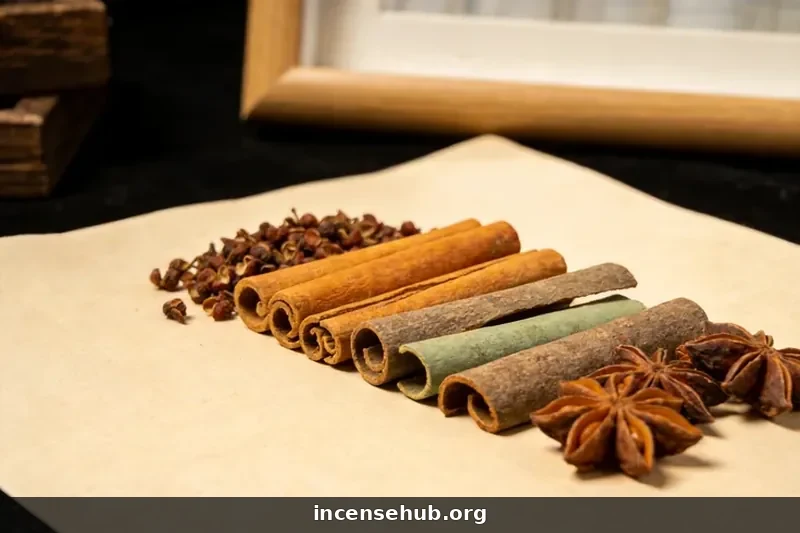
Direct answer: Anise (茴芹, huíqín) is the seed-fruit of Pimpinella anisum, a herbaceous plant of the carrot family (Apiaceae) whose small dried fruits carry the sweet, licorice-like anethole note. It is a Mediterranean-West Asian spice, distinct from fennel (小茴香) and star anise (八角/大茴香), and its Chinese name is a modern botanical term rather than a classical incense ingredient.
Key facts
| Chinese | 茴芹 (huíqín) — “anise”; cf. 洋茴香 |
| Botanical source | Pimpinella anisum (family Apiaceae) — the dried fruit |
| What it is | A dried aromatic seed-fruit, a spice |
| Aroma | Sweet, licorice, warm, spicy |
| Traditional role | Western culinary spice; anethole source |
Aroma profile
Direct answer: Anise is sweet and licorice-like, warm and spicy, driven almost entirely by the aromatic compound anethole. It is the purest, most concentrated “sweet-licorice” note of the 茴 group — cleaner and sweeter than fennel’s greener cast, and single-fruited rather than the star-shaped 八角.
Anise is sweet and licorice-like, warm and spicy, driven almost entirely by the aromatic anethole it shares with fennel and star anise. It is the purest, most concentrated “sweet-licorice” note of the three — cleaner and sweeter than fennel’s greener herbaceous cast, and single-fruited rather than the star-shaped 八角. In aromatics it reads as a warm, candied sweetness, a classic note in Western liqueurs, pastries, and incense-adjacent fragrance.
The register is worth pinning down against its two relatives. Anise’s sweetness is the “purest” of the three because the fruit is small, dense, and almost entirely anethole-driven; fennel carries a greener, more vegetal edge from its other constituents, and star anise — despite sharing the note — adds a warmer, more resinous body. This is why anise, not fennel or star anise, became the reference for the clean “licorice” note in Western flavor and fragrance.
Anise, fennel, and star anise (read this)
Direct answer: Three unrelated plants converge on the same molecule, anethole, and their Chinese names overlap confusingly around 茴. Anise is Pimpinella anisum (the Mediterranean seed-fruit); fennel is Foeniculum vulgare (the classical Chinese 茴香); star anise is Illicium verum (the star-shaped tree fruit). The shared sweetness is chemistry, not botany.
Three unrelated plants converge on the same molecule, anethole, and their Chinese names overlap confusingly around 茴:
- anise (茴芹) — Pimpinella anisum (Apiaceae), the small Mediterranean seed-fruit. This entry. Chinese 茴芹/洋茴香 is a modern botanical term.
- fennel (小茴香) — Foeniculum vulgare (Apiaceae), a different carrot-family plant, the 茴香 of classical Chinese cooking and 合香 formulas. Its own entry.
- 八角 / star anise (大茴香) — Illicium verum (Schisandraceae), the star-shaped fruit of an evergreen tree. Its own entry.
This page describes 茴芹 = anise, Pimpinella anisum. When a classical Chinese text or formula says 茴香, it means fennel (or star anise), not this Western anise; the anethole sweetness is the shared thread.
This three-way convergence is the single most useful fact about anise for anyone working with 茴-named materials: the shared name element 茴 records a shared smell, not a shared plant. A reader or formulator who treats 茴芹, 小茴香, and 大茴香 as interchangeable has collapsed three distinct botanical species into one aroma, and the classical incense record — which uses 茴香 for fennel — does not map onto this Western seed at all.
Botanical source and origin
Direct answer: Pimpinella anisum is an annual herb of the carrot family (Apiaceae), native to the eastern Mediterranean and western Asia, cultivated since antiquity. The part used is the small, ridged, seed-like fruit, whose anethole content gives the characteristic sweet licorice scent. It reached Chinese usage as a modern botanical term, not as a classical incense material.
Pimpinella anisum is an annual herb of the carrot family, native to the eastern Mediterranean and western Asia and cultivated since antiquity across the Mediterranean, the Middle East, and India. The part used is the small, ridged, seed-like fruit, whose anethole content gives the characteristic sweet licorice scent. Flora of China records the species as a cultivated introduction — an annual 10–50 cm tall, strongly aromatic, with small white flowers — consistent with its status as a crop plant brought into Chinese usage under the modern botanical name 茴芹 rather than through any classical incense record.
The name itself is a modern coinage: 茴芹 was built to give the Western spice a Chinese botanical label, distinct from the older fennel (茴香) that already occupied the 茴 slot in the classical vocabulary. This is the key provenance point — anise did not enter China as a 香材 with a history; it entered as a modern botanical and culinary name attached to an imported seed.
Chinese name and terminology
Direct answer: The name 茴芹 is a modern botanical coinage — 茴 (“the anethole-scented group”) + 芹 (“celery/carrot-family herb”) — not a classical term. It belongs to the modern Chinese vocabulary for imported aromatics, a different naming layer from the classical fennel (茴香) and star anise (大茴香).
The name 茴芹 (huíqín) is transparent and modern: 茴 marks the anethole-scented group, and 芹 marks the carrot-family (celery-like) herb. It is a modern botanical term, not a classical 香材 name. This matters for disambiguation because Chinese has a separate, genuinely classical vocabulary for the same aromatic register — fennel (茴香) and star anise (大茴香) — and 茴芹 sits outside that canon as a modern label for the Western seed. A reader who hears “茴” should not assume a classical 香材; the specific name must be pinned to the specific species, and for anise that species is Pimpinella anisum.
Why is it used in fragrance?
Direct answer: Anise is used as a sweet, warm, licorice-like accent and top note, not a classical Chinese incense material. Its anethole sweetness brightens and rounds sweeter blends, and it enters Chinese fragrance only as a modern crossover alongside other sweet aromatics — its role in the classical 合香 system belongs to fennel, not to this seed.
Anise’s role in fragrance is the role of a sweet spice accent: its concentrated anethole note brightens and rounds sweeter compositions, lending a clean, candied licorice warmth. In Western perfumery and flavoring this is a long-established use — anise scents liqueurs (anisette, ouzo, raki), pastries, and confectionery, and its note is a recognizable top-and-middle sweet accent. Its absence from the classical Chinese 合香 canon is the key point: in the historical Chinese system, the licorice-sweet register was served by fennel and star anise, not by this Western seed, which arrived only as a modern import.
How is it processed?
Direct answer: Anise is produced by harvesting the ripe fruit and drying it whole; the dried seed-fruit is the traded form, used whole or ground. Drying concentrates the anethole sweetness, and no extraction is required for the spice itself — anise oil, when produced, is steam-distilled from the dried fruit.
The ripe fruits are harvested and dried, producing the small, ridged, gray-green seed-fruit that is the traded form. Drying concentrates the anethole sweetness, and the material is used whole or ground like any seed spice. For essential-oil use, anethole is obtained by steam distillation of the dried fruit, but the spice itself needs no processing beyond drying. Because the aromatic is concentrated in a small, hard fruit, the whole seed keeps its scent far longer than pre-ground powder — a practical point for anyone dosing it into a blend.
What determines quality?
Direct answer: Anise quality turns on anethole content and freshness. A good anise is clean, dry, and strongly licorice-sweet on crushing, without a musty or woody off-note. Because the whole fruit retains its aroma longer than ground powder, whole seed is the reference form for checking quality.
The practical checks are: anethole content (a strong, clean licorice sweetness on crushing, not a faint or woody note), freshness (dry, aromatic fruit rather than stale, musty seed), and form (whole fruit retains its scent far longer than ground powder). The seed’s small size and hard coat are natural protectors of the volatile anethole, which is why whole anise keeps better than most ground spices — and why the aroma-on-crushing test is the standard quality check.
Common forms
Direct answer: Anise is traded as whole dried fruit and as ground powder; the whole fruit is the reference form, retaining its anethole aroma far longer than the ground spice. Anise essential oil is a separate, distilled product rather than the seed itself.
| Form | Typical use |
|---|---|
| Whole dried fruit | Culinary spice; the reference form, best shelf life |
| Ground powder | Blending and dosing; loses scent faster |
| Essential oil (anethole) | Fragrance and flavoring; a distilled concentrate |
The distinction between whole seed and powder is a shelf-life point, not a quality statement — the same fruit in different physical forms, with the whole form retaining its anethole far longer.
In Chinese and Western tradition
- Western spice: anise is a classical Mediterranean and Middle Eastern flavoring, used in liqueurs (anisette, ouzo, raki), pastries, and confectionery.
- Anethole source: anise shares its anethole sweetness with fennel and star anise — the shared aromatic that explains the overlapping 茴 names.
- Not a classical Chinese incense material: 茴芹 is a modern Chinese botanical term; the classical 茴香 of the 本草 and 香乘 tradition is fennel (小茴香), a different plant.
Traditional use vs modern evidence
Direct answer: The Western culinary and flavoring use of anise is unambiguous and well documented; its anethole content is established chemistry. There is no classical Chinese incense record for 茴芹, and no medical claim is made. The three-way 茴 disambiguation is the page’s core factual point.
- Traditional Use — anise as a Western culinary and flavoring spice; its anethole sweetness is shared with fennel and star anise.
- Historical Record — anise is documented in Western cuisine and flavoring; it has no classical Chinese incense record, and the Chinese name 茴芹 is a modern botanical coinage.
- Scientific Evidence — the botanical identity (Pimpinella anisum, Apiaceae) is established, and anethole is the established aromatic compound behind the licorice note. No clinical or medical efficacy claims are presented.
The Western culinary and flavoring use is unambiguous and well documented. We make no medical claims. The documented, non-medical facts are botanical identity, the Apiaceae placement, and the anethole sweet-licorice character — plus the three-way disambiguation that is the page’s core factual contribution.
Quality notes
Practical points:
- 茴芹 is anise (Pimpinella anisum); expect a sweet, licorice, warm, spicy scent, the purest anethole note of the 茴 group.
- Distinguish it from fennel (小茴香, Foeniculum vulgare) and star anise (八角, Illicium verum) — three unrelated plants sharing a name element and an anethole sweetness.
- It is a Western spice, not a classical Chinese incense ingredient; in incense it contributes a warm sweet-spice supporting note.
- Buy whole rather than ground — the whole fruit retains its anethole aroma far longer, and the crush test is the standard freshness check.
Anise vs fennel vs star anise
Direct answer: Anise, fennel, and star anise are three different plants — two in the carrot family, one in Schisandraceae — that converge on the same anethole molecule. Anise is the purest sweet-licorice seed-fruit; fennel is the greener classical Chinese 茴香; star anise is the warmer, resinous star-shaped fruit. Only the species separates them.
| Anise (茴芹) | Fennel (小茴香) | Star anise (八角) | |
|---|---|---|---|
| Botanical source | Pimpinella anisum | Foeniculum vulgare | Illicium verum |
| Family | Apiaceae | Apiaceae | Schisandraceae |
| Form | Small seed-fruit | Small seed-fruit | Star-shaped fruit |
| Character | Purest sweet licorice | Greener, herbaceous licorice | Warmer, resinous licorice |
| Classical Chinese status | None (modern term) | Classical 茴香 | Classical 大茴香 |
The three share the anethole register but are distinct species with distinct forms and characters — and only fennel and star anise belong to the classical Chinese vocabulary. See fennel, star-anise, and the material comparison matrix.
Summary
Anise (茴芹) is the seed-fruit of Pimpinella anisum, a carrot-family (Apiaceae) annual native to the eastern Mediterranean and western Asia. It is a sweet, licorice-like spice driven almost entirely by anethole — the purest anethole note among the 茴 group — and a Western culinary and flavoring material with no classical Chinese incense record. Its Chinese name is a modern botanical coinage, and its key sourcing point is the three-way disambiguation from fennel (小茴香) and star anise (八角), two unrelated plants that share the anethole sweetness and the 茴 name element.
FAQ
What is anise (茴芹)? Anise or aniseed, Pimpinella anisum, an annual herb of the carrot family (Apiaceae) native to the eastern Mediterranean and western Asia. Its small dried fruits carry the sweet, licorice-like anethole note, and it is a classical Western flavoring used in liqueurs, pastries, and confectionery.
Is anise the same as fennel? No. Anise (茴芹, Pimpinella anisum) and fennel (小茴香, Foeniculum vulgare) are different carrot-family plants. Both carry the anethole sweetness and share the 茴 name element, but anise is the Mediterranean aniseed with the purest licorice note, while fennel is the classical Chinese 茴香. Classical texts saying 茴香 usually mean fennel, not this anise.
Is anise the same as star anise? No. Anise (茴芹, Pimpinella anisum) is a small seed-fruit of the carrot family, while star anise (八角/大茴香, Illicium verum) is the star-shaped fruit of an unrelated evergreen tree. Both carry anethole, which is why they taste and smell alike and share the 茴 name.
What does anise smell like? Sweet and licorice-like, warm and spicy, driven almost entirely by anethole. It is the purest, most concentrated sweet-licorice note of the 茴 group — cleaner and sweeter than fennel’s greener cast, and single-fruited rather than the star-shaped 八角.
Is anise a classical Chinese incense ingredient? Not as 茴芹. The Chinese name 茴芹/洋茴香 is a modern botanical term for a Western spice; the classical 茴香 of the 本草 and 香乘 tradition is fennel (小茴香), a different plant. Anise contributes a warm sweet-spice note in modern aromatics but has no classical 香乘 incense role.
Why do anise, fennel, and star anise all taste like licorice? Because they all contain anethole, the aromatic compound responsible for the sweet licorice scent and flavor. The three are unrelated plants — carrot family, carrot family, and Schisandraceae respectively — but converge on the same aromatic chemistry, which is why their Chinese names overlap around 茴.
See also: fennel, star-anise, and the full scent guide.
Evidence & Sources
Botanical identity
Source: Pimpinella anisum in Flora of China · Pimpinella anisum on GBIF. Evidence type: Established.
Traditional Chinese use
Source: anise as a Western culinary spice (anethole source); 茴芹 is a modern Chinese botanical term, distinct from the classical 茴香 (fennel, 小茴香). Evidence type: Historically documented — Western culinary use; no classical Chinese incense role.
Authenticity / disambiguation
Source: 茴芹 (anise, Pimpinella anisum) vs 小茴香 (fennel, Foeniculum vulgare) vs 八角 (star anise, Illicium verum) — shared anethole, shared 茴 name. Evidence type: Practical screening.
Safety
Source: incense combustion produces smoke and particulate matter; burn in a well-ventilated space. Evidence type: Established.
Evidence status
| Layer | Status |
|---|---|
| Botanical identity | Established |
| Traditional use | Historically documented (Western culinary) |
| Authenticity test | Practical screening |
| Health claims | Not established |
Sources
Sources: botanical references on Pimpinella anisum and the anise-vs-fennel-vs-star-anise distinction. Anise is documented as a Western culinary spice; no medical claims are made. This is editorial knowledge content, not medical advice.