
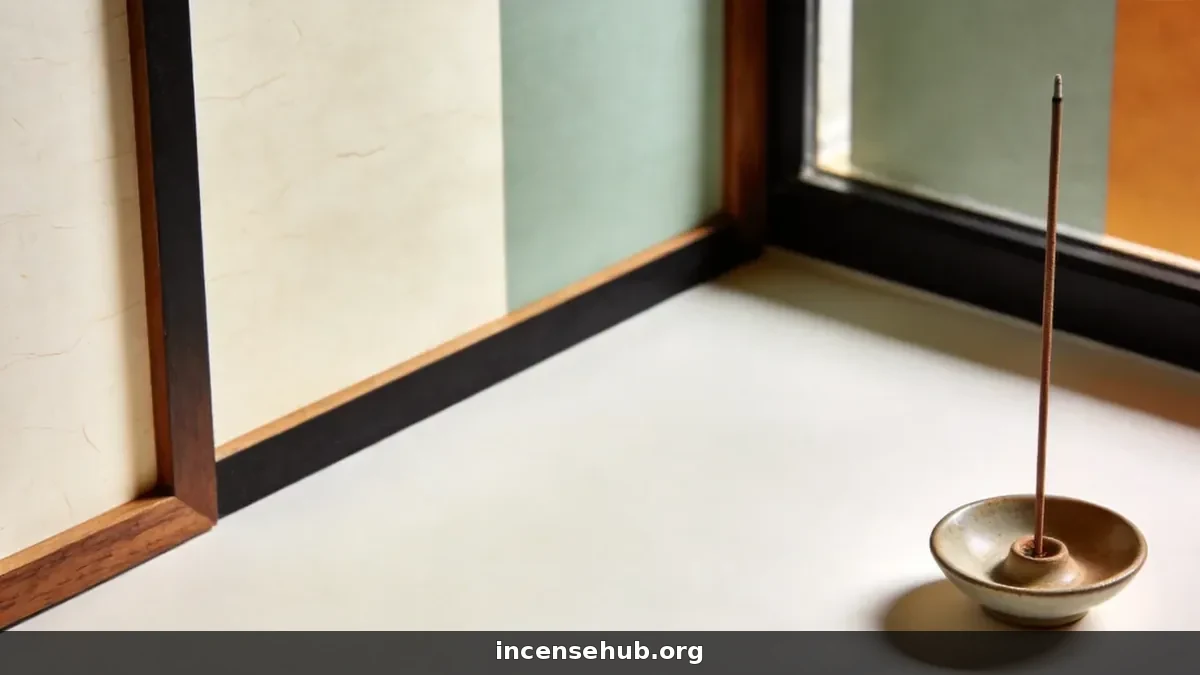
Direct answer: Choosing incense by intention means picking the atmosphere first and the material second. You decide what kind of hour you are trying to make — alert, settled, welcoming, quiet — and then choose a smell whose character points that way, plus a format whose length fits the hour. It is a mapping from purpose to aroma, not a claim that any fragrance produces a state of mind.
Key facts: Think of the range as a line with brightness at one end — citrus peel, frankincense — and density at the other, where agarwood and the heaviest woods sit; soft florals and dry cedars occupy the middle. Every adjective on this page describes an impression and a habit, never a bodily outcome. Length belongs to the object: roughly half an hour for a slim stick, an hour for a heavier one, a quarter of an hour for a cone, and hours for a coil.
Key facts
- Atmosphere is the decision; material is the execution. Most buyers invert this and shop by note name.
- Aroma families are more reliable than single notes. A family tells you how a scent behaves; a note name tells you what it is called.
- Format is part of the intention. A five-minute pause and a two-hour practice do not want the same object.
- Repetition is the mechanism. The same smell at the same hour becomes a cue; a rotating playlist of scents does not.
- No scent treats anything. The words used here describe impressions, not outcomes.
What “by intention” actually means
Direct answer: It is a design brief for an hour, written in smell — and like any brief, it works better when it is specific.
Consider two evenings. In one, you come home from a day of interruptions and want the room to feel settled before you cook. In the other, you have ninety minutes of work left and want the desk to feel like a place where work happens. The rooms are identical; the briefs are opposite. One asks for warmth and slowness, the other for clarity and edges.
An intention-led approach starts from that difference and works backwards. What is the hour for? How long is it? Who else is in the room? What is the air doing? Only then does the material question arise, and by that point it has become much easier, because most of the wrong answers have already been excluded by the brief.
What this approach refuses is the habit of buying a mood as a promise. A stick labelled “focus” is a stick someone decided to call that; the label is a marketing decision, not a finding. The reliable part is the pairing: a smell you associate with a particular activity, repeated in that activity, becomes part of how the activity feels. That effect is real, though it does not mean the fragrance is doing the work — the pairing is.
The map: purpose to aroma family
Direct answer: Five briefs cover most household use, and each one narrows the material choice to a family rather than a single note.
| The hour you want | Reach for | Character that does the work | Typical format |
|---|---|---|---|
| Alert, clear-headed work | Citrus peel, frankincense | Bright, dry, little sweetness | Slim stick, one work block |
| Settled evening, no rush | Sandalwood, cedar | Warm, soft, low contrast | Slim or standard stick |
| A room that welcomes people | Frankincense, cedar, sandalwood | Clean and room-filling without perfume | Standard stick, lit before guests |
| Practice with breath or posture | Sandalwood, cedar, frankincense | Steady, grounding, not loud | Stick matched to practice length |
| Quiet sitting, no agenda | Agarwood, sandalwood | Deep, slow, changing with heat | Stick or small coil |
Read the table as a set of directions rather than a set of rules. The rows describe what a family does well; they do not claim that any row will produce a mood in a person who is not already inclined toward it. A bright scent in a room where somebody is grieving is still a bright scent, and it may be the wrong brief entirely.
In practice, the column that decides most sessions is the last. Format is where intention usually collapses, because people choose the smell carefully and then light whatever is in the drawer — a coil for a ten-minute pause, or a cone for an hour of work. The material and the clock should be chosen together, since a scent that fades in twenty minutes cannot carry a two-hour session.
Reading the families as characters
Direct answer: Four characters cover the range, and knowing which one you are buying prevents most disappointments.
| Family | Behaves like | Strengths | Limits |
|---|---|---|---|
| Citrus and peel | A bright opening that fades quickly | Cuts heaviness; reads clean and awake | Short-lived; can smell like cleaning products |
| Resinous and clean (frankincense, myrrh) | Slow, dry, slightly austere | Fills a room without sweetness; ages well in storage | Can read churchy or cold to some noses |
| Soft woods (sandalwood, cedar) | Even, creamy, low contrast | Forgiving; blends with almost anything | Cheap stock smells of sawdust |
| Deep resins (agarwood, high-grade woods) | Heavy, changing, sometimes bitter | Rewards attention; carries a long session | Expensive, and a weak piece is a waste of money |
The table’s practical use is diagnostic. If a session felt wrong, the family usually explains why: a citrus stick chosen for a long evening will be gone before the evening is, and a deep resin chosen for a quick tidy-up will still be filling the room when you want it clear. Matching character to duration is the single most common fix.
Buying inside a family is easier than buying by note name, because suppliers describe families consistently and note names inconsistently. “Sandalwood” on a box can mean the wood, a blend built around it, or a fragrance compound that resembles it. “Soft woody” describes behaviour, and behaviour is what you are actually buying. The scent guide sets out the full spectrum with the individual materials.
Format is part of the brief
Direct answer: Duration, smoke volume and setup effort are choices about the hour, not about the scent, and they belong in the plan from the start.
| Brief | Format that fits | Why it fits | Where it fails |
|---|---|---|---|
| A five-minute reset between tasks | Cone | Spent before it becomes a presence | Dense plume in a small closed room |
| One focused work block | Slim coreless stick | Ends with the block | No grace if the block runs long |
| A full evening at home | Standard stick | Long enough to cover the hour | Core note arrives late in the burn |
| A long practice or a gathering | Coil | Unattended, continuous | Needs air movement or it accumulates |
| A deliberate ritual | Seal or trail | The pattern itself times the session | Setup demands a steady hand |
Two rules of thumb make this easier to apply. Choose the format whose burn ends at or just before the hour ends, so the object and the intention finish together. And choose the smallest smoke volume the room can carry, because a brief that fills the room with haze has replaced the atmosphere you wanted with a different one. The format comparison goes through the shapes one by one, and how to choose incense covers the buying sequence.
Building a cue on purpose
Direct answer: A scent becomes associated with an activity through repetition in that activity, which means the effect is built rather than purchased.
The mechanism is ordinary conditioning, and it needs three things to work:
you choose one smell and one activity → you pair them repeatedly, at the same time of day → the smell starts to arrive ahead of the activity, carrying the expectation with it → the pairing becomes self-reinforcing, because the cue makes the activity easier to start.
Break any link and the cue weakens. Rotating scents every evening gives the nose variety and gives the habit nothing to hold. Changing the hour means the cue has no time to attach to. Using the same scent for work and for winding down blurs the two, which is why a small collection works better as an assignment than as a menu.
Three practical notes from that reasoning. Keep the work scent and the evening scent strictly separate, even if you like one much more than the other. Let the cue attach to a short session first — ten minutes repeated is stronger than an hour attempted twice. And accept that the association is yours: a scent that anchors deep work for one person may be the smell of a grandmother’s house for another, and no chart can predict which.
Keeping a small collection
Direct answer: Three or four materials, each assigned to one hour, will out-perform a drawer of twenty that get rotated at random.
The logic is the same one that makes a cue work. A collection organised by assignment is a set of tools; a collection organised by variety is a series of one-offs. Most people who say they “love incense” and still have no reliable routine own too many boxes and have assigned none of them.
A workable minimum looks like this. One bright material for daytime focus — a citrus or a dry resin. One soft wood for the evening, which doubles as the neutral choice when you are unsure. One deeper resin for the occasional long sitting, bought in a small quantity because a little goes a long way. That is three purchases, three hours, three cues, and it covers nearly every ordinary week.
What to resist is the sampler trap: a box of twelve miniature scents, each burned once, none repeated. Sampling is a legitimate way to choose the three, and a poor way to run a practice, because nothing in a sampler gets paired often enough to become a signal. Buy the sampler to decide, then buy the three decisions.
Storage follows the same principle. Keep the assigned materials where the hour happens — the work stick near the desk, the evening stick near wherever you sit at the end of a day — because friction decides more habits than enthusiasm does. A stick that requires a trip to another room will be lit less often than one within arm’s reach, and a cue that is not lit does not attach to anything.
Where the map fails
Direct answer: Most intention failures are mismatches of duration, volume or context rather than failures of the fragrance itself.
| What went wrong | Likely cause | The correction |
|---|---|---|
| The scent vanished halfway | Format shorter than the session | Move one size up, or split the session |
| The room felt stuffy | Smoke volume above what the space can absorb | Shorter format, or move air through |
| The cue stopped working | Scent rotated, or the hour drifted | Fix one scent to one hour for a month |
| The session felt wrong but the smell was fine | Brief was never written down | Name the hour before choosing the material |
| Guests noticed the incense before the room | Dosed for the sitter, not for the visitor | Light earlier, and use less |
The last row is worth dwelling on, because it inverts a common assumption. The person who lights a stick adapts to it within minutes and stops registering the smell; a visitor arriving an hour later meets it at full strength. A room scented for the sitter is usually over-scented for everyone else. Lighting earlier and using less produces a room that smells like itself rather than like an incense shop.
The scenario pages
Direct answer: Each of the five briefs above has a page of its own, and the hub exists to send you to the right one rather than to replace them.
- Evening unwinding — the close of a day, with the routine framing rather than any sleep claim.
- Study and deep work — bright, non-distracting material for a block of concentration.
- Home ambiance — scenting a living space, including the ventilation arithmetic.
- Yoga and breathwork — steady, grounding material for a practice that has its own rhythm.
- Meditation — the sitting itself, and the idea of the burn as a clock.
Most buying mistakes happen at the boundary between two adjacent briefs, so read the page that matches your hour first. The others are worth reading later, because the boundaries between them are where most buying mistakes happen: a stick chosen for meditation and used for work is the same object in the wrong brief.
The author’s view
Position: “Intention” is the right frame and the most abused word in the category. The industry uses it to smuggle in outcome claims that the product cannot support.
Reasoning:
- The honest version is more useful anyway: a bright smell suits alert work and a warm one suits the end of a day, and most people already know which is which once they are asked.
- The ritual is the mechanism. Lighting something marks a beginning, and its going out marks an end; that structure is what makes a routine stick.
- Anything that promises a mood is selling the label rather than the material, and the material is the part you can actually evaluate.
Editorial position drawn from use, not a verified finding.
FAQ
Q: How do I pick incense for focused work?
Begin with the hour rather than the note. A work block wants low contrast and no sweetness, so citrus peel or a dry resin does the job, and a deep resin or heavy floral will pull the room the other way. Then match the length: a slim stick covers a single block, a standard stick covers a longer one. Light it at the start of the block, every time, and let the smell become the signal that work has begun. The study and deep work page takes the same reasoning further.
Q: Is there an incense that helps you sleep?
The phrase is a marketing construction, not a category. What a warm, quiet scent can genuinely do is belong to a routine: same smell, same hour, lights low, marking the point at which the day stops. A cue built that way is real and useful. Sedation is a different thing, and no stick supplies it. Put out whatever you light well before bed, and never leave a coal going in a room where somebody is asleep.
Q: Can one scent serve two different purposes?
It can, though the association will be weaker for both. A soft wood used for work and for winding down becomes a general marker of “indoor time” rather than a specific cue, which is fine if that is all you want from it. If you are trying to build a reliable cue for one activity, give that activity its own material and keep the other one separate. The chart on this page is a starting point, and personal association overrides it every time.
Q: Do these scent-to-purpose pairings come from tradition?
Only partly. The classical Chinese material set was organised around woods, resins and a defined herb list, and its use was bound up with ritual, medicine and status rather than with modern productivity categories. The pairing of citrus with alertness or sandalwood with settling is a modern reading of aroma character, and should be labelled as such rather than presented as inherited doctrine. Where a traditional claim is repeated on this site, it is marked as traditional belief rather than as fact.
Q: What if I dislike every scent in the family my brief points to?
Then the brief is wrong, not the chart. Aroma response is personal and often biographical: someone who grew up near a pine forest may find cedar comforting, and someone else may find it medicinal. Treat the family as a direction and the individual material as the choice. If nothing in the recommended family works, move to the neighbouring family rather than forcing a note you dislike — a scent you resent will not become a cue, no matter how well it matches a table.
Q: Does the room change which scent works?
Considerably. A small, warm, still room concentrates everything, so a material that reads soft in a hallway can become heavy in a bedroom. A large room with moving air dilutes, so the same stick reads faint. Since the point of an intention is the felt character of the hour, the volume of the space belongs in the decision alongside the material. The home ambiance page works through the arithmetic of room size and airflow.
Sources
The spectrum follows the scent guide, and each scenario page carries its own brief in detail. For the air question, the American Lung Association is the reference behind treating ventilation as part of the setup. The classical mappings trace to 香乘 (Xiang Cheng), readable via the Wikisource edition.
Related Resources
- Complete Scent Guide — the full spectrum, material by material.
- Which Incense Format Is Right for You? — shape, duration and smoke volume.
- Incense for Meditation — the sitting, and the burn-as-clock idea.
- How to Choose Incense — the buying sequence from brief to first box.
Natural next step: name your hour, then follow the page that matches it — evening unwinding or study and deep work are the two most people start with — and read the format comparison before buying anything.
Summary
- Intention-first buying means writing the brief — hour, length, room, company — before choosing a material.
- Five briefs cover most use; each points to a family rather than a single note.
- Families behave predictably: citrus fades fast, soft woods stay even, deep resins change as they heat.
- Format belongs in the brief, because a scent that ends early cannot carry the hour.
- Repetition builds the cue. Rotation supplies variety and gives the habit nothing to hold.