
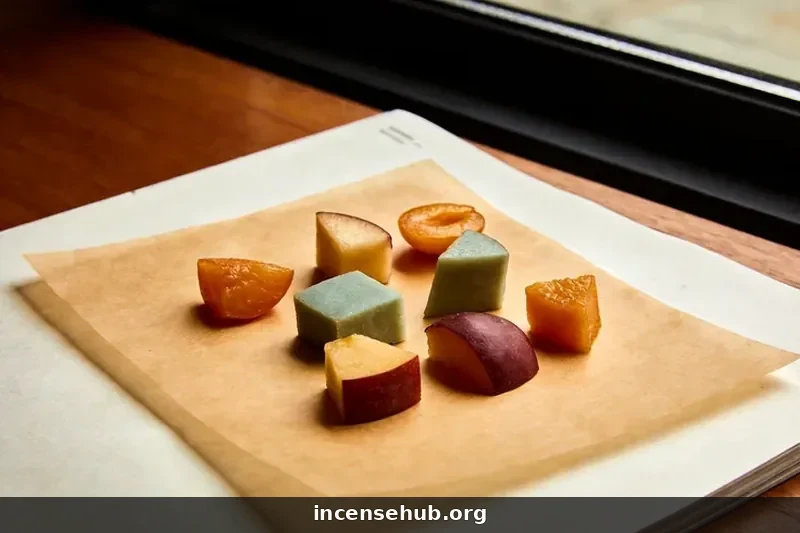
Direct answer: Litsea cubeba (山鸡椒, shānjījiāo) is the small, aromatic fruit of Litsea cubeba, a laurel-family (Lauraceae) tree native to southern China and Southeast Asia. It is the source of litsea cubeba (may chang) essential oil, with a bright, lemony-citrus, slightly spicy aroma. It is a modern crossover in fragrance rather than a classical incense material, and it shares a Chinese name with cubeb (荜澄茄), a different plant.
Key facts
| Chinese | 山鸡椒 (shānjījiāo) — “mountain chicken pepper” |
| Botanical source | Litsea cubeba (family Lauraceae) — the small fruit |
| What it is | A small aromatic fruit, not a wood or resin |
| Aroma | Citrus, lemony, spicy, faintly floral |
| Traditional role | Modern fragrance crossover; source of litsea cubeba oil |
Aroma profile
Direct answer: 山鸡椒 is bright and citrusy — lemony, clean, and slightly spicy, with a faint floral lift — often compared to lemongrass or lemon verbena. Its essential oil is a fresh, lemony top note in modern perfumery and aromatherapy; in incense it would read as a bright citrus accent, a modern addition rather than a classical material.
山鸡椒 is bright and citrusy — lemony, clean, and slightly spicy, with a faint floral lift. It is often compared to lemongrass or lemon verbena, and its essential oil is a staple of modern perfumery and aromatherapy as a fresh, lemony top note. In incense it would read as a bright citrus accent, a modern addition rather than a classical material. The lemony character is the defining feature — it is one of the few botanical sources of a clean, aldehydic-lemony note that does not come from citrus fruit itself, which is precisely why it crossed over into modern fragrance.
Botanical identity
Direct answer: Litsea cubeba is a small to medium evergreen tree of the laurel family (Lauraceae), native to southern China, Southeast Asia, and parts of the eastern Himalaya. The small, black, pepper-like fruit is steam-distilled to yield litsea cubeba (may chang) essential oil, valued for its lemony-citrus character. The laurel family also includes cinnamon and bay laurel.
Litsea cubeba is a small to medium evergreen tree of the laurel family (Lauraceae), native to southern China, Southeast Asia, and parts of the eastern Himalaya. The part used is the small, black, pepper-like fruit, which is steam-distilled to yield litsea cubeba essential oil (also called may chang oil), valued for its lemony-citrus character. The laurel family also includes cinnamon (Cinnamomum) and bay laurel (Laurus nobilis). See Litsea cubeba in Flora of China and Litsea cubeba on GBIF.
The family placement is the identification crux: Litsea cubeba belongs to the laurel family (Lauraceae), not the pepper family (Piperaceae), which is exactly why its shared Chinese name with cubeb (Piper cubeba) is a source of confusion (see below).
Chinese name and terminology
Direct answer: 山鸡椒 means “mountain chicken pepper” — a descriptive common name for the fruit of Litsea cubeba. Its fragrance identity today is better known through its essential oil, may chang / litsea cubeba oil, a lemony-citrus note; the Chinese name 山鸡椒 and the oil name may chang both point to this same laurel-family tree.
The name 山鸡椒 (shānjījiāo) is a descriptive common name — “mountain chicken pepper” — for the small, pepper-like fruit of Litsea cubeba. Its modern fragrance identity, however, is carried more by its essential oil, known as litsea cubeba oil or may chang oil, a bright lemony-citrus material. Both the botanical name and the oil name point to the same tree, but the two naming registers — a descriptive fruit name and a commercial essential-oil name — are worth keeping straight, especially because the fruit name overlaps with a different plant (see below).
The cubeb (荜澄茄) / Mountain Pepper (山鸡椒) confusion (read this)
Direct answer: 山鸡椒 (Litsea cubeba, Lauraceae) and 荜澄茄 (cubeb, Piper cubeba, Piperaceae) are different plants in different families, but Chinese materia medica has applied the name 荜澄茄 to both — a standing source of confusion. When a classical source says 荜澄茄, it may mean either plant; confirm which is meant.
山鸡椒 (Litsea cubeba) and 荜澄茄 (cubeb, Piper cubeba) are different plants, but Chinese materia medica has applied the name 荜澄茄 to both, which is a standing source of confusion:
- cubeb (荜澄茄) — Piper cubeba, a pepper-family (Piperaceae) spice vine native to Indonesia, with a sharp, peppery, camphoraceous bite. Its own entry, at cubeb.
- 山鸡椒 (this page) — Litsea cubeba, a laurel-family (Lauraceae) tree native to southern China, with a lemony-citrus aroma.
This page describes 山鸡椒 = Litsea cubeba = mountain pepper. When a classical source says 荜澄茄, it may mean either plant — confirm which is meant. The two are different species in different families, and the shared name is a documented disambiguation hazard rather than a botanical relationship.
Where does litsea cubeba come from?
Direct answer: Litsea cubeba grows across southern China, Southeast Asia, and parts of the eastern Himalaya, as a small to medium evergreen tree. Its small, black, pepper-like fruit — the aromatic part — is harvested and steam-distilled for its lemony oil.
Litsea cubeba is native to southern China, Southeast Asia, and parts of the eastern Himalaya, growing as a small to medium evergreen tree. The harvested part is the small, black, pepper-like fruit, which is steam-distilled to yield the lemony-citrus essential oil. This is a fruit-and-distillation supply chain, distinct from the dried-spice route of a true pepper: the value lies in the distilled oil rather than the dried fruit, which is a key difference from the cubeb it shares a name with.
Why is it used in fragrance?
Direct answer: Litsea cubeba is used in fragrance for its bright, lemony-citrus essential oil — a fresh, aldehydic-lemony top note in modern perfumery, home fragrance, and aromatherapy. It is a modern crossover, not a classical Chinese incense material, and it does not appear as a defining material in the 香乘 compendium.
Litsea cubeba’s fragrance use is entirely modern, built on its essential oil. The lemony-citrus oil is a fresh, aldehydic top note in modern perfumery, home fragrance, and aromatherapy — valued for a clean lemon character that does not come from citrus fruit. It does not appear as a defining material in the classical incense compendium 香乘, so its incense role is a modern addition rather than a classical one. The distinction matters for honesty of provenance: this is a modern fragrance material, not a classical incense material (香材). See how incense is made for the classical materials versus the modern essential-oil crossovers.
How is it processed?
Direct answer: Litsea cubeba is processed by steam-distilling the small, black, pepper-like fruit to yield the lemony-citrus essential oil (may chang oil). The oil — not the dried fruit — is the commercial product, which distinguishes this supply chain from that of a dried spice.
The processing is a distillation route: the small fruit is steam-distilled to yield the essential oil. This is the key processing fact — litsea cubeba is primarily an oil product, not a dried-fruit spice. The oil carries the lemony-citrus character, and it is the oil that enters perfumery and aromatherapy. For the reader, this means the relevant quality checks are on the oil (clarity, odor, chemotype) rather than on a dried fruit’s appearance.
What determines quality?
Direct answer: Litsea cubeba quality turns on the essential oil — its brightness, lemony-citrus clarity, and the dominant citral content that gives the lemon character. Because the product is an oil, the quality checks are on the oil, not on a dried fruit.
The quality points center on the oil, since that is the commercial product:
- Oil brightness — a clean, bright, lemony-citrus odor; a dull or off scent signals poor distillation or age.
- Citral content — the lemon character comes largely from citral (a mix of the isomers geranial and neral); a good oil is citral-forward.
- Clarity and freshness — clear, fresh oil, properly stored.
- Identity — confirm it is Litsea cubeba oil, not confused with lemongrass or another citrus-lemony oil.
These are oil-quality checks, consistent with a material whose value is a distilled essential oil rather than a dried plant part.
Common forms
Direct answer: Litsea cubeba is sold chiefly as a distilled essential oil (litsea cubeba / may chang oil); the dried fruit is a minor form. The oil is the commercial product — a lemony-citrus top note — while the fruit itself is the raw material for distillation.
| Form | Typical use |
|---|---|
| Essential oil (may chang oil) | Perfumery, home fragrance, aromatherapy |
| Dried fruit | Raw material for distillation |
The forms reflect the supply chain: the fruit is the raw material, and the oil is the product. For fragrance, the oil is the operative form.
In Chinese tradition
- Modern fragrance: 山鸡椒 is best known today as the source of litsea cubeba (may chang) essential oil, a lemony-citrus top note in modern perfumery and aromatherapy.
- Name overlap with cubeb: in Chinese materia medica the name 荜澄茄 has been applied to both cubeb (Piper cubeba) and 山鸡椒 (Litsea cubeba), a documented naming confusion.
- Not a classical incense material: 山鸡椒 does not appear as a defining material in the classical incense compendium 香乘; its fragrance use is a modern crossover.
Traditional use vs modern evidence
Direct answer: The modern essential-oil and fragrance use is documented. No medical claims are made. The documented, non-medical facts are botanical identity, the Lauraceae placement, and the lemony-citrus aromatic use — including the documented name overlap with cubeb.
- Traditional Use — the name 荜澄茄 has been applied in Chinese materia medica to both cubeb and 山鸡椒, a documented naming record; no classical incense role is claimed for 山鸡椒 itself.
- Historical Record — the 山鸡椒 / 荜澄茄 name overlap is a documented disambiguation point; 山鸡椒 does not appear as a defining 香乘 material.
- Scientific Evidence — botanical identity is established (Litsea cubeba, Lauraceae); the oil’s citral content (geranial/neral) is characterized. No clinical or medical efficacy claims are presented.
The documented, non-medical facts are botanical identity, the Lauraceae placement, and the lemony-citrus aromatic use — including the documented name overlap with cubeb.
Safety
Incense combustion produces smoke and particulate matter. Burn in a well-ventilated space, avoid inhaling concentrated smoke, and keep away from children and pets. Essential oils can be skin-irritating at high concentration; use as directed. This is editorial knowledge content, not medical advice. See our safety guide.
Summary
Litsea cubeba (山鸡椒, “mountain chicken pepper”) is the small aromatic fruit of Litsea cubeba (Lauraceae), source of the bright lemony-citrus essential oil may chang / litsea cubeba oil — a modern perfumery and aromatherapy top note, not a classical 香乘 material. Its key points are the 荜澄茄 name overlap with cubeb (Piper cubeba, a different plant in a different family) and the fact that it is an oil product, evaluated on oil quality rather than dried-fruit appearance.
FAQ
What is mountain pepper (山鸡椒)? The small, aromatic fruit of Litsea cubeba, a laurel-family (Lauraceae) tree native to southern China and Southeast Asia. It is the source of litsea cubeba (may chang) essential oil, with a bright, lemony-citrus, slightly spicy aroma, used in modern perfumery and aromatherapy.
Is Mountain Pepper (山鸡椒) the same as cubeb (荜澄茄)? Not always. 荜澄茄 properly refers to cubeb (Piper cubeba, Piperaceae), a peppery spice vine — but Chinese materia medica has also applied the name to 山鸡椒 (Litsea cubeba, Lauraceae). They are different plants in different families, so the material should be confirmed when the name appears. This page describes 山鸡椒 = Litsea cubeba.
What does Mountain Pepper (山鸡椒) smell like? Bright and citrusy — lemony, clean, and slightly spicy, with a faint floral lift. It is often compared to lemongrass or lemon verbena, and its essential oil is a fresh, lemony top note in modern perfumery.
Is Mountain Pepper (山鸡椒) a classical incense material? No. 山鸡椒 does not appear as a defining material in the classical compendium 香乘; its fragrance use is a modern crossover built on litsea cubeba (may chang) essential oil, a lemony-citrus top note rather than a classical burned material.
Where does litsea cubeba come from? From Litsea cubeba, a small evergreen tree of the laurel family (Lauraceae) native to southern China, Southeast Asia, and parts of the eastern Himalaya. The small, black, pepper-like fruit is steam-distilled for its essential oil. The laurel family also includes cinnamon and bay laurel.
Is litsea cubeba a dried spice or an oil? It is primarily an essential-oil product. The small fruit is steam-distilled to yield litsea cubeba (may chang) oil, and it is the oil — not the dried fruit — that enters perfumery and aromatherapy. This is a key difference from the cubeb it shares a name with, which is a dried peppery spice.
See also: cubeb (荜澄茄), citronella, how incense is made and the full scent guide.
Evidence & Sources
Botanical identity
Source: Litsea cubeba in Flora of China · Litsea cubeba on GBIF. Evidence type: Established.
Traditional Chinese use
Source: 山鸡椒 as the source of litsea cubeba (may chang) essential oil; the documented 荜澄茄 name overlap with cubeb (Piper cubeba). Evidence type: Historically documented — modern aromatic use; name disambiguation recorded honestly.
Authenticity / disambiguation
Source: 山鸡椒 (Litsea cubeba, Lauraceae) vs 荜澄茄 (Piper cubeba, Piperaceae) — different species sharing a Chinese materia-medica name. Evidence type: Practical screening.
Safety
Source: incense combustion produces smoke and particulate matter; burn in a well-ventilated space. Evidence type: Established.
Evidence status
| Layer | Status |
|---|---|
| Botanical identity | Established |
| Traditional use | Historically documented (modern) |
| Authenticity test | Practical screening (name overlap) |
| Health claims | Not established |
Sources
Sources: botanical references on Litsea cubeba and the 山鸡椒/荜澄茄 (mountain pepper vs cubeb) name distinction. 山鸡椒’s modern essential-oil use is documented; no medical claims are made. This is editorial knowledge content, not medical advice.