
Direct answer: Chuanxiong (川芎, chuānxiōng) is the aromatic rhizome of Ligusticum chuanxiong, an herb of the carrot family (Apiaceae) cultivated in Sichuan. It has a strong, herbal, spicy, slightly bitter aromatic-root character and is one of the best-known aromatic roots of Chinese materia medica. It is a different species from, and must be distinguished from, 藁本 (Ligusticum sinense).
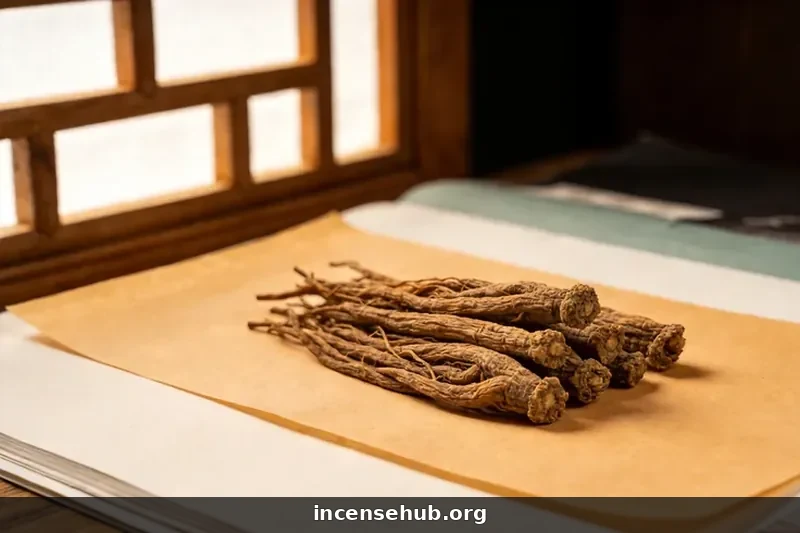
Key facts
| Chinese | 川芎 (chuānxiōng); classical name 芎藭 (xiōngqióng) |
| Botanical source | Ligusticum chuanxiong (family Apiaceae); syn. Conioselinum anthriscoides — the rhizome |
| What it is | An aromatic root, a Sichuan cultivar of the lovage group |
| Aroma | Herbal, aromatic, spicy, slightly bitter |
| Traditional role | Materia medica; distinguished from 藁本 (Ligusticum sinense) |
Aroma profile
Direct answer: Chuanxiong smells like a pungent, penetrating lovage root — herbal and spicy with a warm, slightly bitter edge — more medicinal and sharp than the sweeter, softer angelica note. It anchors a blend with an earthy, aromatic middle rather than a floral or resinous top.
川芎 has a strong, penetrating, herbal-spicy root aroma with a slightly bitter, warm edge — the pungent-sweet smell characteristic of the lovage/carrot-family roots. It is more medicinal and sharp than the softer sweet-herbal notes of angelica (当归), and it anchors a blend with an earthy, aromatic middle rather than a floral or resinous top. The aroma is concentrated in the rhizome, where the essential oil sits in the tissue; the scent reads “rooty” and medicinal, not green or floral, which is why it behaves as a middle-to-base aromatic rather than a bright opening note.
Botanical identity
Direct answer: Chuanxiong is the rhizome of Ligusticum chuanxiong (Apiaceae), a Sichuan-cultivated aromatic of the lovage group. Modern botanical databases treat the name as a synonym of Conioselinum anthriscoides — a nomenclatural shift that matters for sourcing documentation, because older and Chinese materia-medica sources still use Ligusticum chuanxiong.
Ligusticum chuanxiong is an aromatic perennial of the carrot family (Apiaceae), cultivated in Sichuan as the source of 川芎. Modern botanical databases treat the name as a synonym of Conioselinum anthriscoides; Flora of China records the lovage group under Ligusticum, where 藁本 (L. sinense) sits alongside other species. The Sichuan name 川芎 (“Sichuan lovage”) reflects its place of cultivation.
This nomenclatural instability is a real sourcing issue, not an academic footnote. A reader or formulator who looks up the material in one database finds Ligusticum chuanxiong, in another Conioselinum anthriscoides, and in a Chinese materia-medica manual simply 川芎. All three point to the same cultivated Sichuan root, but the divergence means the Chinese drug name — 川芎, not 藁本 — is the most reliable specifier across sources. See Ligusticum (genus) in Flora of China and Ligusticum chuanxiong on GBIF.
Chinese name and terminology
Direct answer: The name 川芎 means “Sichuan lovage” (川 = Sichuan, 芎 short for 芎藭, the classical lovage name). The Bencao Gangmu records the origin logic directly — “出蜀中者,為川芎” (“the one produced in Sichuan is called chuanxiong”) — so the name is a provenance marker that distinguishes the Sichuan root from lovage grown elsewhere.
The classical name for the lovage group is 芎藭 (xiōngqióng), under which the Bencao Gangmu (本草纲目), 草之三, records 川芎 as the Sichuan form: “出蜀中者,為川芎” — the one produced in Sichuan (蜀) is called 川芎. The name therefore encodes provenance, not just plant identity: it tells you where the root was grown, which in classical pharmacology was part of the identity claim. This is the same naming logic seen in other place-tagged Chinese aromatics, and it is why “chuanxiong” and “lovage” are not interchangeable in a sourcing conversation — the former carries the Sichuan-cultivation claim.
The chuanxiong (川芎) / ligusticum (藁本) distinction (read this)
Direct answer: 川芎 and 藁本 are closely related but distinct roots in the same lovage genus. 川芎 is Ligusticum chuanxiong (Sichuan lovage); 藁本 is Ligusticum sinense (Chinese lovage). They are recorded as separate adjacent entries in the Bencao Gangmu, and the distinction survives even though modern taxonomy shifts both toward Conioselinum anthriscoides.
川芎 and 藁本 are closely related but distinct roots in the same genus:
- 川芎 (chuanxiong) — the rhizome of Ligusticum chuanxiong, the Sichuan lovage. This entry.
- 藁本 (gaoben) — the root of Ligusticum sinense, the Chinese lovage. Its own entry, at ligusticum.
The Bencao Gangmu (本草纲目), 草之三, records them as separate adjacent entries — 芎藭 (with 川芎 as its Sichuan name) and 藁本 (the next item). The two are easily confused because modern taxonomy has shifted both toward Conioselinum anthriscoides, but Chinese materia medica keeps them distinct. This page describes 川芎 = Ligusticum chuanxiong, not 藁本. The practical consequence is that a reader should name the Chinese drug (川芎 vs 藁本) rather than relying on a shared genus or a shifting botanical synonym.
Where does chuanxiong come from?
Direct answer: Chuanxiong is a cultivated crop of Sichuan, in southwestern China, where it is grown as a field herb rather than wild-harvested. Its name records this geographic anchoring — it is a Sichuan agricultural aromatic, not a foraged wild root.
川芎 is fundamentally a cultivated material. Unlike many aromatic roots that are wild-harvested, 川芎 is grown as an agricultural crop in Sichuan, where the regional name and the cultivation practice are linked. This has a concrete implication for sourcing: it is a crop with agricultural seasonality and regional supply, not a wild-harvested botanical with the variability and conservation concerns that wild collection carries. The Sichuan identity is therefore simultaneously a provenance claim, a quality signal (the regional material being the named standard), and a documentation point — a reader should be able to confirm the Sichuan origin rather than accepting an undifferentiated “lovage root.”
Why is it used in incense?
Direct answer: Chuanxiong is used in incense not as a lead scent but as a medicinal-aromatic bridge — its pungent, spicy root character adds an earthy, herbal middle that supports sweeter or woodier aromatics. Its primary classical standing is in materia medica, so its incense role is secondary and structural rather than a defining 香材.
In the incense context, 川芎 occupies an interesting intermediate position. It is primarily a materia-medica root, not a lead incense material (香材) in the way agarwood or sandalwood are. But its strong aromatic character — pungent, herbal, spicy — gives it a genuine supporting role: it can lend an earthy, aromatic middle that anchors a blend and bridges sharper or sweeter materials. The key distinction to hold is that its incense use is derived from its medicinal-aromatic character, not from a classical incense-manual prominence. It is a root you might add for its herbal spine, not one you would build a formula around. For how such supporting aromatics function inside a blend, see hexiang (合香) blending.
How is it processed?
Direct answer: Chuanxiong is processed by digging the rhizome, cleaning, and drying — the aromatic value being concentrated in the rhizome rather than the aerial herb. There is no distillation step for the root form; only its essential oil (if required) would be extracted separately.
The processing of 川芎 is straightforward: the rhizome is dug, cleaned of soil, and dried, concentrating the essential oil that carries the pungent, spicy aroma. In its dried whole or sliced form it is a root commodity; ground, it becomes a powder that can be blended. Because its incense role is as a supporting aromatic, the practical processing question for a formulator is particle size and dryness — but, as with most botanical powders, the correct target depends on the formula, binder, and production line rather than any universal figure. The general grinding and blending mechanics sit within the wider how incense is made process.
What determines quality?
Direct answer: Quality in chuanxiong is driven by aroma intensity — a good root should smell strongly pungent, herbal, and spicy — plus cleanliness, dryness, and freedom from the wrong species (藁本). Provenance (Sichuan) and the correct drug name are the identification checks that sit above the sensory ones.
The practical quality checks are:
- Aroma intensity — the pungent, spicy character should be strong and immediate; a weak-smelling root is low-grade.
- Species and name — confirm it is 川芎 (Ligusticum chuanxiong), not 藁本 (Ligusticum sinense); the drug name is the reliable specifier.
- Provenance — the name itself claims Sichuan origin; a credible supplier should be able to state it.
- Cleanliness and dryness — free of soil, mold, and excess moisture, since these affect both storage and powder behavior.
None of these is a laboratory test; they are sensory and documentary screening. The single most useful check is the aroma, because in a material defined by its pungent root scent, the scent is the grade.
Common forms
Direct answer: Chuanxiong is sold as whole dried rhizome, sliced pieces, and powder. The whole and sliced forms suit storage and identification, while the powder suits blending; the same root in different physical states, not different materials.
| Form | Typical use |
|---|---|
| Whole rhizome | Storage, inspection, identification |
| Sliced pieces | Inspection, decoction, larger-scale handling |
| Powder | Blending into incense or herbal preparations |
The distinction between forms is functional, not a quality statement. For incense use, the powder is the operative form, and its particle size and moisture are the practical variables — the same handling considerations that apply to any botanical powder in a blend.
In Chinese tradition
- Materia medica: 川芎 is a major aromatic root in traditional Chinese materia medica. This is traditional materia-medica language, not modern clinical evidence.
- Naming: the Bencao Gangmu (本草纲目) explains the name 川芎 by origin: “出蜀中者,為川芎” — the one from Sichuan (蜀) is called 川芎.
- Incense: it is primarily a materia-medica root; its aromatic role in incense is secondary.
Traditional use vs modern evidence
Direct answer: The materia-medica record is traditional, not established clinical fact, and no medical claims are made here. The documented, non-medical facts are botanical identity, the Apiaceae placement, the Sichuan provenance, and the distinction from 藁本.
- Traditional Use — 川芎 in Chinese materia medica, recorded in the Bencao Gangmu (本草纲目) 草之三, with a strong aromatic-root character. Traditional materia-medica language, not modern clinical evidence.
- Historical Record — the naming record “出蜀中者,為川芎,” establishing the Sichuan provenance claim and the 川芎/藁本 distinction as adjacent classical entries.
- Scientific Evidence — the botanical identity is established: Ligusticum chuanxiong (Apiaceae), with GBIF treating the name as a synonym of Conioselinum anthriscoides. No clinical or medical efficacy claims are presented.
The documented, non-medical facts are botanical identity, the Apiaceae placement, and its distinction from 藁本.
Safety
Incense combustion produces smoke and particulate matter. Burn in a well-ventilated space, avoid inhaling concentrated smoke, and keep away from children and pets. This is editorial knowledge content, not medical advice. See our safety guide.
Summary
Chuanxiong (川芎) is the Sichuan-cultivated rhizome of Ligusticum chuanxiong (Apiaceae; syn. Conioselinum anthriscoides), a pungent, herbal-spicy aromatic root whose name records its provenance (“出蜀中者,為川芎”). It is primarily a materia-medica root, with a secondary, structural role in incense as an earthy, herbal middle. Its key identification challenge is the 川芎/藁本 distinction — related lovage roots that modern taxonomy has partly collapsed — which makes the Chinese drug name the reliable specifier for sourcing.
FAQ
What is 川芎 (chuanxiong)? The aromatic rhizome of Ligusticum chuanxiong (syn. Conioselinum anthriscoides), an herb of the carrot family (Apiaceae) cultivated in Sichuan. It has a strong, herbal, spicy, slightly bitter root aroma and is a major aromatic root in Chinese materia medica.
Is chuanxiong (川芎) the same as 藁本 (gaoben)? No — closely related but distinct roots in the same lovage group. 川芎 is Ligusticum chuanxiong (Sichuan lovage); 藁本 is Ligusticum sinense (Chinese lovage). The Bencao Gangmu (本草纲目) lists them as separate adjacent entries, and Chinese materia medica keeps them distinct even though modern taxonomy shifts both toward Conioselinum anthriscoides.
Why is it called Sichuan lovage (川芎)? The Bencao Gangmu (本草纲目) explains: “出蜀中者,為川芎” — the one produced in Sichuan (蜀) is called 川芎. The name records its place of cultivation, distinguishing the Sichuan root from lovage grown elsewhere.
What does chuanxiong (川芎) smell like? Strong, penetrating, herbal-spicy, and slightly bitter, with a warm edge — the pungent-sweet character of the lovage/carrot-family roots. It is more medicinal and sharp than the softer, sweeter angelica (当归) note, and it anchors a blend with an earthy, aromatic middle.
Is chuanxiong an incense ingredient? Primarily a materia-medica root. Its strong aromatic character can lend an earthy, herbal middle to a blend, but its classical role is in materia medica rather than as a lead 香材. It is documented separately from the related 藁本, which has its own incense formula appearances.
Why does chuanxiong have two botanical names? Because modern taxonomy has reclassified it. The name Ligusticum chuanxiong is used in older and Chinese sources, while GBIF and some modern databases treat it as a synonym of Conioselinum anthriscoides. This nomenclatural drift means the Chinese drug name 川芎 is the most stable specifier across sources — a point that matters for sourcing documentation.
See also: ligusticum (藁本), angelica-sinensis (当归), angelica (白芷), hexiang blending and the full scent guide.
Evidence & Sources
Botanical identity
Source: Ligusticum (genus) in Flora of China · Ligusticum chuanxiong on GBIF. Evidence type: Established (the GBIF record treats L. chuanxiong as a synonym of Conioselinum anthriscoides).
Traditional Chinese use
Source: the Bencao Gangmu (本草纲目), 草之三, records 芎藭 with 川芎 as its Sichuan name (“出蜀中者,為川芎”). Evidence type: Historically documented — materia medica; medicinal uses are traditional, not modern clinical evidence.
Authenticity / disambiguation
Source: 川芎 (Ligusticum chuanxiong) vs 藁本 (Ligusticum sinense) — related but distinct roots in the same genus. Evidence type: Practical screening.
Safety
Source: incense combustion produces smoke and particulate matter; burn in a well-ventilated space. Evidence type: Established.
Evidence status
| Layer | Status |
|---|---|
| Botanical identity | Established |
| Traditional use | Historically documented (materia medica) |
| Authenticity test | Practical screening |
| Health claims | Not established |
Sources
Sources: botanical references on Ligusticum and the Bencao Gangmu (本草纲目) 草之三 record of 芎藭/川芎. 川芎 is documented as the Sichuan lovage rhizome, distinct from 藁本; medicinal uses are treated as traditional, not established clinical fact. This is editorial knowledge content, not medical advice.