
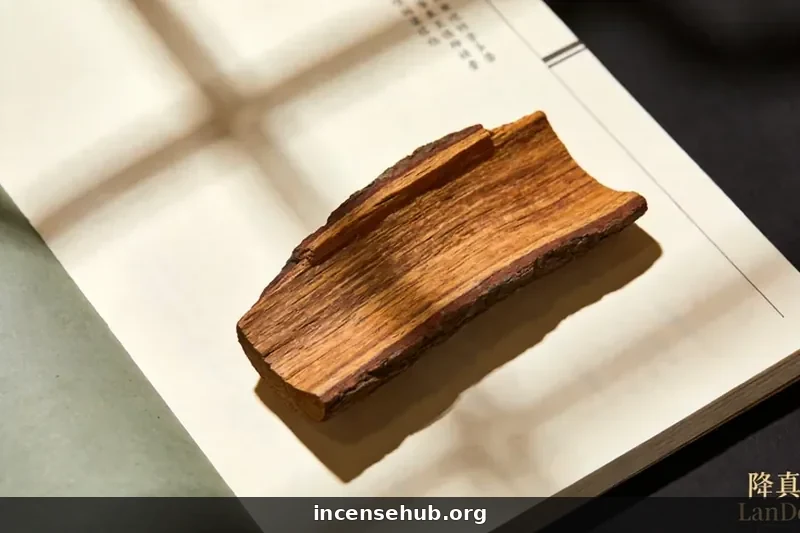
Direct answer: Jiangzhenxiang (降真香, jiàngzhēnxiāng) is the dark, resin-loaded core wood of a tree, and for centuries it was the fuel of Daoist altar rites, where its plume was said to climb without wavering and draw the immortals down. Because the word names that ceremony rather than a species, two unrelated trees now pass under it, and a label alone tells you nothing about which one you hold.
Key facts
| Question | Short answer |
|---|---|
| Written form | 降真香, read jiàngzhēnxiāng; old descriptive aliases 紫藤香 and 鸡骨香 |
| Plant behind the classical name | Acronychia pedunculata, 山油柑, a member of Rutaceae |
| Plant behind most modern stock | Dalbergia odorifera, 降香黄檀, a member of Fabaceae |
| What the material is | The inner, extractive-rich wood of the trunk — no bark, no root, no exudate |
| Scent | Dried-wood sweetness with resin underneath; thin on its own, fuller in mixture |
| Historic jobs | Altar fuel, a component of 合香 (hé xiāng) blends, materia medica |
| Sourcing risk | A change of species under a label that never changed |
| Trade grading | No published ladder; sellers improvise their own terms |
A ritual name, not a botanical one
Direct answer: 降真香 means roughly “the incense that brings the true ones down” — 降 (descend) + 真 (the true, the immortals) + 香 (incense). It names a ceremony, not a species, and a name built from a function can move from plant to plant while the function stays fixed.
The three characters are doing liturgical work. 降 is the verb for a deity descending into a prepared space; 真 is the class of beings — the “true ones” — who were invited; 香 is simply incense. Read together, the phrase is an instruction for an altar, not a description of a tree. The classical aliases are the opposite kind of name: 紫藤香 (“purple-vine incense”) and 鸡骨香 (“chicken-bone incense”) describe how the material looks — dark, fibrous, broken into bone-like fragments — and they survive in the literature alongside the ritual name.
That split matters for anyone trying to buy the material today. Names that encode appearance can be checked against the object in front of you. Names that encode a function cannot: the word stays true even when the plant underneath has changed. 檀香 (sandalwood) is anchored to a genus; 降真香 is anchored to a rite. One is a botanical label with a ritual use, the other a ritual label with a botanical problem.
The drift follows a pattern you can trace:
a ritual need creates demand for “the incense that brings the true ones down” → buyers specify the ritual word rather than a binomial → suppliers satisfy the word, and any resinous wood that burns well satisfies it → price competition rewards the cheaper wood → the classical species slowly leaves the market while the label stays in place.
No single step in that chain requires bad faith. Each step is locally reasonable, and the cumulative result is a name that has outlived its plant.
Editorial judgment: the lazy conclusion — that everything sold as 降真香 is a fraud — overstates the case. A trade-wide change of referent is not the same as a lie in each transaction. What a reader needs is not outrage but a working definition: “genuine” has two possible anchors here, the classical plant and the modern pharmacopoeial wood, and a seller who names neither has told you nothing.
How the name travelled through the record
Direct answer: The name survives in three layers: a Song anthology that collects older citations, a Ming compendium that fixes the aliases and the ritual description, and a modern pharmacopoeia that attaches 降香 to a different plant. Each layer is authoritative inside its own frame, and none of them is a species determination.
The Song Xiangpu (香譜) treats 降真香 in its second scroll and cites 《南州記》 and 《海藥本草》 — a geographical record and a medical materia medica — which tells you the compilers were aggregating older sources rather than describing a specimen they had collected. That is normal practice for Chinese materia medica, and it has a practical consequence: the further back a description reaches, the more likely it is describing a material and a use rather than a plant.
The Ming Xiangcheng (香乘) adds a different kind of information. It records the descriptive aliases 紫藤香 and 鸡骨香, the blending observation 得诸香和之则特美, and the altar line about smoke rising straight. These are craft observations — what the wood looks like, how it behaves in a mixture, what happens when it burns — and craft observations survive changes of trade better than botanical ones do, because they are tied to the object rather than to the name of the tree.
The modern layer is different in kind. A pharmacopoeia needs a defined drug that can be supplied in consistent quantity, and 降香 was pinned to a plant that could meet that requirement: Dalbergia odorifera. Once the pin was set, the two names ran in parallel — the ritual name carried the prestige, the pharmacopoeial name carried the definition, and commerce used whichever was convenient at the moment of sale.
The sequence explains the confusion without requiring anyone to have planned it:
an anthology cites older sources → the description stays at the level of material and use → craft aliases accumulate around the name → a pharmacopoeia pins the name to a supplyable species → trade applies the prestigious ritual name to the pharmacopoeial wood → a buyer holding the label cannot tell which layer it came from.
Editorial judgment: this is a documentation history, not a conspiracy. Three layers with three purposes produced one ambiguous word, and the ambiguity is now a sourcing problem rather than a scholarly one.
Two plants, two families
Direct answer: The classical material is the heartwood of Acronychia pedunculata (山油柑), a tree in the citrus family (Rutaceae). The modern material sold under the same label is usually Dalbergia odorifera (降香黄檀), a legume (Fabaceae). Nothing about the two woods is shared except the label and the habit of smouldering.
Acronychia pedunculata is documented in Flora of China as a shrub or small-to-large tree reaching 28 m, with elliptic to obovate leaf blades measuring 3.5–24.5 × 2–8.5 cm and a subglobose fruit 0.5–1.5 cm across. It ranges through southern China and Southeast Asia. The part that matters for incense is the heartwood, the resin-bearing inner wood that the classical manuals describe.
Dalbergia odorifera belongs to a completely different family. Its fragrant wood is the 降香 of the modern Chinese pharmacopoeia, and the same species also circulates in the rosewood furniture trade under separate names — a second commercial identity that puts additional pressure on the wood supply and gives sellers a reason to blur which material is being sold.
The Ming Xiangcheng (香乘) gives an anatomical description rather than a poetic one: 树心也 — “the heart of the tree” — beneath 外白皮厚八九寸, an outer white bark several inches thick. That is a description of a thick-barked timber tree with a distinct heartwood, and it fits the citrus-family species. It does not describe a legume, and no reading of the passage turns 降香黄檀 into the plant the classical authors had in hand.
Where the confusion becomes consequential: a blender who orders “降真香” for a reconstruction of a Song or Ming recipe believes they are buying one material and receives another. The recipe still burns. The result is not the recipe.
Naming traps, side by side
Direct answer: Most confusion around this material comes from treating descriptive names, ritual names and botanical names as if they belonged to the same category. They do not, and each category fails in its own way.
| Term you may see | What buyers often assume | What the record supports | Practical consequence |
|---|---|---|---|
| 降真香, unqualified | One plant, one material | A ritual name; two families circulate under it | Ask for binomial and family before anything else |
| 降香 | The same thing as 降真香 | The pharmacopoeial name carried by Dalbergia odorifera | Treat it as a separate material with its own specification |
| 降香黄檀 | A poetic name for 降真香 | The tree name of Dalbergia odorifera, a legume | A family-level mismatch with the classical plant |
| 紫藤香 | A vine-based incense | A descriptive alias for the wood’s appearance | Decorative, not diagnostic |
| 鸡骨香 | A guarantee of authenticity | A descriptive alias for bone-like fragments | Appearance, not identity |
| 山油柑 | An unrelated fruit tree | The Chinese name of Acronychia pedunculata | The classical plant, named plainly |
| 黄花梨 | A furniture wood with no relation | The rosewood trade name for the same species as 降香黄檀 | Explains why the wood is expensive and why substitution pays |
The pattern in that table is simple: the names that describe appearance or ritual are the ones that travel, and the names that describe a plant are the ones that get dropped. Aliases are also reused across the literature, so an alias on its own never identifies anything — it only tells you what someone thought the material looked like.
What “resinous heartwood” means in the tree
Direct answer: Heartwood is the inner wood that has stopped conducting water. As the living cells in it die, the tree deposits extractives into the tissue, and the wood turns darker, denser, less permeable and — in a minority of species — fragrant. The sapwood outside it does none of that.
A growing trunk is a plumbing system with a disposal problem. The outer ring, the sapwood, conducts water upward and stores starch; it is pale, permeable and chemically unremarkable. As the stem thickens, the inner wood is abandoned. Parenchyma cells die, and before they do they deposit extractives — resins, gums, tannins, coloured compounds — into the cell lumens and walls. Those deposits are what stop water movement, harden the tissue and, in some species, carry the aromatic material that makes the wood worth burning.
Two consequences follow for anyone buying the material.
First, heartwood is a fraction, not a promise. A trunk yields a dark core and a pale shell, and the ratio between them depends on the age of the tree, its growth rate and its site. A lot sold by weight that includes sapwood is partly paying for water-conducting tissue that will burn thin.
Second, the aromatic material is a deposit, not an even soak. Extractives sit in particular tissues in particular patterns. A piece can be dark on one face and pale on another, dense at the butt and light near the crown. That is why a photograph of a single cut face tells a buyer so little: it is one slice through a three-dimensional distribution.
The chain from tree to burner runs like this:
parenchyma cells age and die → extractives are deposited in walls and lumens → permeability falls and density rises → heat penetrates the piece more slowly → volatiles are released over a longer period → the burn is slower and quieter than a sapwood-rich piece would give.
A boundary on the usual shortcut: none of this means darker is better. Colour tracks extractives in general, and extractives include gums and tannins that contribute nothing to scent. A dark, gum-rich chip can burn dull; a moderately coloured piece from a well-resined part of the tree can outperform it. Colour is a hint about density, not a verdict about aroma.
Identification: what a label can and cannot prove
Direct answer: A trade name establishes nothing about species. Only a binomial plus its family, ideally backed by a voucher or an independent wood-anatomy check, narrows a lot to a plant — and only lot-level paperwork keeps that identification true when the shipment scales up.
Processed heartwood is a hard identification problem by construction. The diagnostic organs — leaves, fruit, flowers, bark — are gone by the time the material reaches a buyer. What remains is dense, resinous wood with colour and figure that vary within a species and overlap between species. A photograph cannot settle it; a smell test cannot settle it; a density reading narrows the field without naming the plant.
What can settle it is a chain of documentation. The table below is an editorial framework for reading that chain, not an industry standard.
| Evidence offered | What it actually establishes | What it leaves open |
|---|---|---|
| Trade name only (“降真香” or “降香”) | Nothing about the plant; the word covers two families | Everything |
| Chinese name plus harvest region | A probability, not an identity; both plants have overlapping ranges | Whether the wood matches the region claimed |
| Binomial from the seller | A testable claim, and a claim that can be checked | Whether the wood in the box is the wood named |
| Binomial plus family | Catches the common error of filing a legume under a citrus name | Still a paper claim until sampled |
| Voucher specimen or independent wood-anatomy report | The plant identity for that sample | Whether the shipped lot matches the sample |
| Lot-level documentation tied to the sample | Identity that survives scale-up | Nothing further is available |
The practical rule that follows: buy the specification, not the story. A seller who says “wild old material, very resinous, straight smoke” has described a mood. A seller who says “Acronychia pedunculata, Rutaceae, voucher from this lot” has made a claim you can test, and a claim you can test is worth more than a claim you cannot — even before you test it.
Two checks cost nothing and catch most of the traffic in mislabelled material. First, ask for the family, not just the species name: the substitution at the centre of this page is a family-level swap, and a seller who does not know which family their wood belongs to has not identified it. Second, ask whether the paperwork covers the lot or only a reference sample. Identity that lives in a photograph of a different shipment is not identity.
A boundary worth stating plainly: none of this means a documented lot is a good lot. Documentation answers “which plant,” and a poorly handled piece of the right plant can still be light, sapwood-heavy or musty. Species is the first question, not the only one.
Why the smoke was said to rise straight
Direct answer: The classical line 伴和诸香烧烟直上感引鹤降醮星辰烧此香妙为第一 describes smoke climbing straight in an altar rite and drawing cranes and stars down — a ritual observation recorded as ritual, not a measured property of one wood.
The claim is the most quoted thing about 降真香 and the most misused. Read as liturgy, it is exact: a still room, a single brazier at the centre, a resinous fuel bed, and a column of smoke that goes up without wandering. Read as a specification, it collapses, because the same column appears over any clean-burning resinous wood under the same conditions.
The physics is ordinary:
heat applied to the fuel bed → resin and wood pyrolyse → a plume loaded with fine particles forms → the hot plume is buoyant and rises in a coherent column while the surrounding air is still → any cross-draft, open door or ceiling fan shears the column into turbulence.
That chain explains both the classical report and its failures. Temple rooms were built for stillness; a modern living room is not. The observation was real. The attribution to a species was the unproven step, and it remains unproven.
Traditional belief, clearly labelled: the crane-and-star language belongs to the ritual frame. It is a statement about what the rite meant to its practitioners, and it should be preserved as such — not translated into a material property and sold as one.
Editorial judgment: the sceptical correction can go too far in the other direction. Saying “straight smoke is a myth” misses what the record actually preserves. The texts describe an event that a person could see; what they do not supply is a controlled comparison. The honest position is narrower: the event is plausible and the species-specific explanation is untested. For a reader rebuilding a rite, the controllable variables are the burner, the fuel bed and the air in the room — and those three decide the result far more than the label on the wood.
Reconstructing the rite: what the texts leave out
Direct answer: The classical lines record what the smoke was meant to do, not how to produce it. Fuel bed, burner shape, charge size, room air and timing are all unstated, and those are the variables that decide whether a column of smoke rises or wanders.
A rite is a procedure, and procedures fail when their parameters stay implicit. From the surviving text you can recover intent — smoke climbing straight, in the company of other aromatics (伴和诸香), and a ranking, 烧此香妙为第一, “burning this incense is the finest” — but you cannot recover the apparatus. Was the burner a bronze censer with a pierced lid, or an open brazier? Was the fuel a charcoal bed, a live coal, or a heated plate? Was the charge one piece or a heap? Was the setting an enclosed hall or an open terrace, and at what hour?
| Variable | What the record gives you | Why it changes the result | How to control it in a trial |
|---|---|---|---|
| Fuel bed | Unstated | A coal bed runs hotter than a plate and pyrolyses more material per minute | Fix one heat source and keep it constant across trials |
| Charge size | Unstated | A heap smoulders and smokes; a single chip releases a thin thread | Weigh each charge; compare equal masses, not equal volumes |
| Particle size | Unstated | Chips release slowly; powder releases fast and hot | Sieve and record the fraction used |
| Burner geometry | Unstated beyond ritual vessels | Depth and aperture shape the plume and shelter it from draught | Use the same vessel for every comparison |
| Room air | Implied stillness | A cross-draft shears any plume into turbulence | Close doors, stop fans, test in the same corner |
| Companion aromatics | 伴和诸香 — burned with other aromatics | The mixture changes both the scent and the smoke density | Trial alone and in blend, and judge them separately |
| Duration | Unstated | The first minutes read thin; the character accumulates | Record time to first clear note and total burn |
This is where most “it doesn’t work” reports come from. A reader lights a chip on a tea-light burner in a room with a ceiling fan, watches a thin wandering thread, and concludes the wood is wrong. The wood may be exactly right and the setup wrong. Change one variable at a time, and start with the air: the plume is the one part of the experiment you can actually see, which makes it the cheapest thing to diagnose.
Editorial judgment: a reconstruction that reproduces the scent but not the stillness has reproduced half the rite. The texts are explicit that the smoke’s behaviour carried the meaning; a modern room is the least faithful part of most reconstructions, and the easiest to fix.
Aroma: the quiet wood that carries a blend
Direct answer: The classical record is unusually candid about weakness. 烧之初不甚香 — “not very fragrant at first burning” — and then 得诸香和之则特美, “it becomes especially fine when the other aromatics harmonise with it.” Its smoke was called 气劲而远, powerful and far-carrying.
Three clauses, three different behaviours, and they are worth separating because buyers routinely collapse them into one marketing sentence.
The first clause is about time. A resinous heartwood holds much of its aromatic material in a form that releases slowly; the opening minutes of a burn read as thin, and the character accumulates rather than announcing itself. That is an interpretation of the classical wording, and it matches the ordinary behaviour of dense resinous woods on a heat source — but the texts do not measure it, and no figure should be attached to it.
The second clause is about company. This is the load-bearing claim in the whole record: 降真香 was valued as a component, not as a solo. In 合香 (hé xiāng), the blended-incense tradition, materials are assigned roles in a hierarchy borrowed from statecraft — 君 chief, 臣 minister, 佐 assistant, 使 guide — and a quiet resinous wood fits the structural end of that hierarchy rather than the top. The framework is described in our guide to the hexiang blending system. Assigning a material to a role is a design decision, not a chemical measurement, and it is best treated as craft knowledge.
The third clause is about reach. 气劲而远 describes smoke that travels — a quality of the plume, not of the scent in the bottle. It is the same observation that made the wood suitable for large altars and courtyards, where a subtle note at the burner still has to register at the far end of the space.
Put together, the three clauses describe a wood with low solo intensity, high blend value and strong smoke carriage. That profile explains why the material’s reputation is so poorly served by a sniff test at a market stall:
a quiet fuel bed releases volatiles slowly → the bright components of a blend dominate the first minutes → the resinous base fills in underneath as the top notes fade → the mixture reads as continuous rather than as a stack of separate smells.
Whether that counts as “fixing” a blend is a matter of vocabulary. What can be said without inventing anything is that a slow, low-intensity resinous wood changes the shape of a mixture over time, and that this is the property the classical authors were praising.
Grades: what actually varies inside a lot
Direct answer: There is no standardized grading ladder for 降真香 in open trade. What varies between lots is documentation, resin density, the proportion of sapwood and bark, piece uniformity, moisture, and — for powder — fineness and fines content.
Because no ladder exists, sellers invent vocabulary, and invented vocabulary is where money is lost. The table below sorts the attributes that can actually be observed or asked about, and says what each one changes at the burner. It is an editorial framework built for comparison, not a trade standard, and the “high end” column describes a direction rather than a grade name.
| Attribute | Stronger end | Weaker end | What it changes in use | How to check |
|---|---|---|---|---|
| Species documentation | Binomial plus family, lot-level | Trade name only | Whether you are burning the plant you think | Ask for the family and the lot reference |
| Resin density | Heavy for its size, dark, resin visible in cut faces | Light, pale, dry-looking | Burn duration and depth of scent | Weigh and compare equal volumes; cut a face |
| Sapwood and bark content | Heartwood only | Pale sapwood mixed in, bark fragments | Harshness, smoke volume, ash | Sort a handful by eye and by weight |
| Piece uniformity | Similar size and thickness | Mixed chunks and dust | Even burn across the bed | Spread a scoop on a tray |
| Moisture | Stable, dry to the touch, no cool feel | Damp, heavy, clumps in the bag | Smoke quality, mould risk, ignition | Feel, then weigh before and after drying |
| Powder fineness | Matched to the format | Either dust-fine or gravel-coarse for the wrong use | Heat, burn rate, aroma balance | Sieve a sample; compare to the recipe’s intent |
Two of these deserve emphasis because they are routinely confused with quality itself. Resin density is a real attribute, but it is not a synonym for “old” or “wild”; a dense piece of a cultivated tree is still a dense piece. Piece size is not a quality signal at all — it is a format decision. A large chunk burns slowly and unevenly on a heat bed; a small chip burns hot and fast. Neither is better, and a lot priced up for size alone is being priced for convenience.
Powder is a separate product with a separate logic. Grinding homogenises a lot, which hides variation — a useful property for a manufacturer who needs consistency and a dangerous one for a buyer trying to judge material, because the visual evidence disappears into the sieve. The fineness that suits a pressed stick is not the fineness that suits a heap burned on charcoal, and the difference shows up as heat at the coal rather than as scent in the room.
Sampling a consignment. A lot is not a sample. Take handfuls from the top, the middle and the bottom of the sack, and from more than one sack if the consignment is large, because fines settle downward and moisture collects at the edges. Spread the handfuls on a tray, sort them by colour and weight, and judge the mixture rather than the prettiest piece. If the seller sends a photograph of one handsome chunk, ask what the rest of the bag looks like — the difference between the photograph and the bag is where most disappointment lives.
Forms, and what each one is for
Direct answer: The material travels as heartwood pieces, chips and powder. It is a wood, not an oil, an absolute or a flowing resin — there is no exudate step in its production, and a liquid sold as 降真香 oil is a different product class made by a different process.
| Form | Best use | Trade-offs |
|---|---|---|
| Heartwood pieces or chunks | Altar braziers, long slow smoulder, display | Needs a heat bed; uneven if sizes are mixed |
| Chips and shavings | Measured single burns, blending trials | Dries quickly, generates dust, burns fast |
| Powder | 合香 sticks and cones, incense seals, kneaded blends | High surface area, hotter burn, shorter carry |
| Oil or extract (different product) | Not interchangeable with the wood | Different process, different aroma, no ritual equivalence |
The form decides the physics before the material gets a chance to. Grinding increases surface area, which speeds the ignition front, which raises the peak temperature at the coal, which pushes more material through pyrolysis per second. The result is a louder, harsher, shorter burn from the same wood:
finer particle size → more exposed surface → faster ignition front → higher peak temperature → sharper, smokier notes and a shorter burn.
That is why a recipe’s powder specification is a design decision and not a housekeeping detail. Substituting a fine powder for a coarse one in a formula that was built around slow release does not make the incense “stronger”; it makes it a different incense.
Processing, drying and storage
Direct answer: Processing is woodwork: separate the heartwood from sapwood and bark, cut or grind to the target form, dry to a stable moisture, rest, and store away from heat and damp. There is no extraction step, and the care that matters is the care taken with moisture.
The sequence is short and each step has a failure attached to it.
- Selection. The dark core is split away from the pale outer shell and from the heavy bark that the Xiangcheng mentions. This is where sapwood enters a lot if nobody is watching, and sapwood is the most common reason a cheap lot smells thin.
- Reduction. Cutting to chunks, chipping, or grinding to a specified mesh. Heat from the grinder is the hidden variable: fast grinding warms the powder and drives off the lightest volatiles, which is why a freshly ground sample can smell different a day later.
- Drying. Slow and shaded beats fast and hot. Moisture moves out of wood through a gradient, and a steep gradient means the outside shrinks before the inside does:
fresh cut → moisture gradient across the piece → outer layers dry and shrink first → the core holds its dimension → stress builds along the grain → checking and end-splits → dust and waste.
- Resting. A rested lot handles better and burns more predictably than one ground yesterday, because the moisture has equalised across the piece rather than sitting in pockets.
- Storage. Dry, dark, sealed, away from heat sources. Paper first, then a container, is kinder than a sealed plastic bag for anything not fully dry — the bag traps the moisture that the wood is still releasing.
The storage failure is worth spelling out because it is silent:
wood packed slightly damp → moisture trapped in the container → condensation on the cool side → surface mould → a musty note that grinding does not remove, only distributes.
A mouldy lot cannot be rescued by drying it out. The note is in the material, not on it.
Reading a specification sheet
Direct answer: A usable specification names the plant, the family, the part of the plant, the form, the particle size, the moisture and the lot. Anything less leaves the buyer to guess at exactly the variables that decide how the material burns.
Specifications are not bureaucracy; they are what turns a seller’s claim into something a buyer can check. For a material whose main risk is a change of species, the fields that matter are the botanical ones, and the physical fields come second because they can be measured on arrival.
| Field | Why it matters | What it looks like when missing |
|---|---|---|
| Binomial | Separates Acronychia pedunculata from Dalbergia odorifera | A trade name and nothing else |
| Family | Catches the family-level swap that the trade name hides | A legume described as a citrus, or no family at all |
| Plant part | Heartwood, whole wood, or wood with bark | “Wood” without a part, which usually means mixed |
| Form and mesh | Determines ignition behaviour and burn rate | “Powder” with no sieve basis |
| Moisture at packing | Predicts mould risk and burn quality | Omitted, or quoted at a different stage |
| Lot reference | Ties the paperwork to the shipment in the box | A certificate for a different consignment |
| Storage history | Explains musty notes that no drying will fix | Unstated, which is common |
A specification sheet earns its name when a contradiction on it is visible. If the binomial is Acronychia pedunculata and the family is listed as Fabaceae, one of the two is wrong, and the sheet has done its job before the wood is even opened. If the mesh is quoted without saying which sieve series was used, the number is decorative.
The physical fields need a baseline as well as a value. Moisture quoted as a percentage means little without knowing when it was measured — at dispatch, at packing, or on the day the sample was taken — because the number drifts with the weather and the container. Ask for the stage, and treat a sheet that does not name it as a sheet with a missing column.
A practical reading order: binomial and family first, because those cannot be fixed later; then part and form, because they decide what the material can be used for; then mesh and moisture, because they decide how it behaves; then lot reference, because it decides whether any of the above applies to what you received. A buyer who starts with aroma has started at the end.
Failure modes
Direct answer: The expensive failures are not the ones you can see. Species substitution, sapwood-heavy lots, cut powder and moisture problems all reach the burner looking normal, and each one fails in a different way.
| Failure | How it happens | Symptom at the burner | Prevention |
|---|---|---|---|
| Species swap | Trade name covers two families | Paperwork names a family that does not match the wood | Ask for binomial plus family and lot reference |
| Sapwood-heavy lot | Heartwood not separated properly | Thin scent, fast burn, pale ash, harsh smoke | Sort a sample by colour and weight |
| Cut powder | Inert or cheaper aromatic material ground in | Flat or inconsistent scent, separation in the bag | Buy powder from a lot you have seen as pieces |
| Over-dry material | Hot or fast drying | Shatters, dust, flash of heat then nothing | Feel and weigh; re-condition slowly |
| Under-dry material | Shipped too soon after processing | Hiss, wet smoke, mould risk in storage | Ask for moisture at dispatch, not at packing |
| Blend domination | Too high a proportion in a formula | The other materials disappear, or the blend flattens | Trial at low percentages before scaling |
| Ritual literalism | Judging the wood by smoke straightness in a draughty room | “It doesn’t work” when the room is the variable | Fix the burner and the air first |
| Format mismatch | Chunks specified for a pressed-stick formula, or the reverse | Poor compaction, uneven burn, crumb | Match particle size to the process |
The species swap is the most expensive because it is undetectable at the point of use. A sapwood-heavy lot announces itself in the first minute; a cut powder shows up as inconsistency across a batch; a swapped species can burn beautifully for years while the buyer believes they are working with the classical material. That is the asymmetry worth designing around: everything else can be caught by handling, and this one cannot.
Editorial judgment: the second most expensive failure is the one nobody lists — buying the wrong form for the intended use. A buyer who wants an altar material and receives powder has bought a different product, no matter how good the powder is.
A comparison trial you can run at home
Direct answer: Two lots can be compared without a laboratory if you control mass, heat, vessel and air, score blind, and record time as well as impression. The method will not identify a species; it will tell you whether two samples behave the same way.
Set the trial up before you light anything. Weigh equal masses — volume is a poor proxy, because a dense chip and a light chip of the same size are different amounts of fuel. Use the same vessel, the same heat source and the same corner of the same room, and remove draughts. Label the samples A and B on the bottom of their dishes so the person scoring does not know which is which, and ask two people rather than one: a single nose tires quickly and starts agreeing with itself.
Score four things, in this order. First, the time to the first clear note, counted from the moment the material reaches temperature. Second, the character of the opening minute. Third, the middle of the burn, when the resin is fully engaged. Fourth, the tail — what remains on the vessel after the visible smoke stops, which is often where a weak lot gives itself away. Write the scores down as you go; memory for scent is short and strongly influenced by the last thing smelled.
Three habits make the result more trustworthy. Burn a blank between samples — an empty vessel on the same heat — to reset the room. Keep the descriptions plain: “resinous, slightly sweet, thin at the start” carries more information than “deep, ancient, temple-like”, and the second phrasing will bias whoever reads your notes later. Repeat the pair on a second day, in the reverse order, because the first sample of a session is judged differently from the second.
What the trial cannot do is tell you which plant you have. Two different species can behave similarly on a heat bed, and the same species can behave differently depending on resin density and moisture. Treat the result as a behavioural fingerprint of the lot, not as an identification. Pair it with the paperwork described above, and the two together answer different halves of the same question.
Decision boundaries: when this wood is the right answer
Direct answer: 降真香 is the right material when the job is a ritual or a blend that needs a quiet resinous structural base. It is the wrong material when the job needs a solo note, a pharmacopoeial 降香, or a low-smoke indoor product.
| Situation | Is it the right choice? | Why |
|---|---|---|
| Reconstructing an altar rite from a text that names 降真香 | Yes, with the species documented | The role is ritual and the text specifies the material |
| Building a warm resinous blend that needs body | Yes | Low solo intensity, strong blend behaviour |
| Looking for a solo centrepiece aroma | Usually no | The classical record itself calls it faint alone |
| Needing pharmacopoeial 降香 | No — specify Dalbergia odorifera instead | The two names are not interchangeable |
| Building a reference collection of Rutaceae materials | Only with voucher-level evidence | Otherwise the sample proves nothing |
| Wanting a low-smoke indoor product | No | This is a format problem, not a material one |
The last row is the one most often got wrong. A reader who wants less smoke indoors does not need a different wood; they need a different delivery — a heated rather than combusted format, or less material. Changing species while keeping the same burning method changes the scent and leaves the particulate load roughly where it was.
For a small buyer, “documented” is a sliding scale. A hobbyist buying a hundred grams cannot commission a wood-anatomy report, and does not need to. What a small buyer can do is refuse the ambiguity: pick a seller who states a binomial and a family, keep the invoice with the sample, and write the date on the bag. A museum or a formulator working at scale has a different problem — a sample-level answer is not enough when the next shipment comes from another forest, so the paperwork has to travel with each lot. The right level of proof follows the size of the commitment, and the mistake in both cases is the same one: accepting a label as if it were evidence.
Safety
Any incense wood, burned, puts smoke and fine particles into the air; the species on the label does not change that. Work in a room with moving air, set the burner on a stable non-flammable surface clear of curtains and paper, and do not put your face into the plume. Keep both the stock and the lit vessel where children and animals cannot reach them. The old fumigation customs described on this page are recorded as historical practice and carry no health claim. Room-level detail sits in the safety guide.
降真香, agarwood and sandalwood: three different problems
Direct answer: All three are fragrant woods, and each fails in the market for a different reason. Agarwood is defined by an injury-induced resin process, sandalwood by a genus, and 降真香 by a disputed species behind a ritual name.
| Material | How the trade defines it | Where it goes wrong | The check that settles it |
|---|---|---|---|
| 降真香 | By a ceremony word older than any of its plant names | Two families circulate; paperwork often silent | Family and binomial on the lot documents |
| Agarwood (沉香) | By a resin response to wounding in Aquilaria | Resin added, wood treated, grades inflated | Whether the resin formed in the tree |
| Sandalwood (檀香) | By a genus, Santalum | The wrong species sold under a good name | Species, plus oil content in the heartwood |
The comparison is useful because it separates three verification problems that get talked about as one. With agarwood, the plant is known and the question is how the resin got there. With sandalwood, the genus is known and the question is which species. With 降真香, the question comes first: which plant is this at all. The other two materials are covered in their own entries: agarwood (沉香) and sandalwood (檀香).
FAQ
Is 降真香 the same thing as 降香? No. 降真香 is the classical name for the heartwood of Acronychia pedunculata, a citrus-family tree. 降香 in the modern pharmacopoeia is Dalbergia odorifera, a legume. The names have been used as if they were interchangeable, and that conflation is the single most important thing to check when sourcing.
What does it actually smell like? Woody, sweet and resinous, with the sweetness sitting closer to dried wood than to flowers. Burned alone it is faint at first — 烧之初不甚香 in the classical wording — and it develops rather than opens. In a blend it reads as body and continuity rather than as a top note.
Why is it tied to Daoism? Because the name is a liturgical instruction. 降真 means the descent of the “true ones,” and the classical record describes burning it in altar rites so the smoke rose straight and drew cranes and stars down (伴和诸香烧烟直上感引鹤降醮星辰). That is a record of ritual practice, and it is the reason the material’s reputation is religious before it is aromatic.
Is it a wood or a resin? A wood. Specifically a resinous heartwood — the inner, resin-bearing part of the trunk — not an exudate like frankincense and not a bark. The Xiangcheng describes the heartwood (树心也) sitting under a thick white outer bark. Anything sold as an oil or a flowing resin is a different product made by a different process.
Can I swap 降真香 powder for sandalwood powder in a stick formula? Not one for one. The two powders differ in density, resin content and burn behaviour, so a direct substitution changes how the stick compacts, how fast it burns and how the blend balances. Trial the swap in small steps — replace a fraction of the sandalwood, burn the result, and judge the stick rather than the powder. A blend built around sandalwood’s creamy top note will not be improved by a quiet resinous base at the same percentage.
Is a thicker piece better material? No. Thickness is a format property. It changes how the piece burns on a heat bed and how long it lasts, and it says nothing about resin density, species or handling. A thick piece of sapwood is still sapwood.
Summary
The material is easy to describe and hard to pin down. It is a dark, extractive-rich core wood, slow to give up its scent, valued for company rather than for solo display, and wrapped in a name that promises a religious experience instead of naming a tree. Under that name sit two plants from two families: a citrus-family species that the old manuals describe, and a legume that modern supply has largely substituted for it. Nothing in the appearance of a finished chip reveals which one you have.
What the record does settle is the character of the material: it opens quietly, works best in mixture, and carries in smoke. What the record does not settle is the species, and that is the question a buyer has to answer with documents rather than with a nose. Ask which family the wood belongs to, tie the answer to a lot, choose a form that suits the burn you intend, and keep the stock dry and dark. Those four habits decide more of the outcome than any claim printed on a bag.
Evidence & Sources
Which plant is which
Flora of China describes Acronychia pedunculata with the measurements used above: a habit reaching 28 m, blades 3.5–24.5 × 2–8.5 cm, a fruit 0.5–1.5 cm across; GBIF indexes the same taxon. Read those records as a description of a plant, and read the 降香黄檀 usage as a description of a market. They are different kinds of statement, and only the first one is botanical. Strength of claim: firm for the plant description, observational for the trade pattern.
What the old books contain
The Song Xiangpu handles 降真香 in its second scroll and cites 《南州記》 and 《海藥本草》; the Ming Xiangcheng carries the aliases 紫藤香 and 鸡骨香, the blend line 得诸香和之则特美, and the altar passage 伴和诸香烧烟直上感引鹤降醮星辰. Those are documents of practice. They tell you what was burned, how it was judged and what it was thought to do. Strength of claim: documented history; no clinical weight.
How firm the identification advice is
The evidence ladder and the spec-sheet fields are this page’s own construction. They organise questions a buyer can ask and state what each answer is worth; they do not substitute for a wood-anatomy examination by someone qualified to perform one. Strength of claim: editorial method.
Smoke and the room
Every incense wood, burned, emits smoke and particles, and the room’s air exchange governs exposure more than the species does. Strength of claim: established.
Evidence status
| Layer | Status |
|---|---|
| Botanical identity of the classical plant | Established |
| Identity of material in modern trade | Contested; two families in circulation |
| Traditional and ritual use | Historically documented |
| Blending behaviour | Classical record; craft knowledge |
| Health claims | Not established |
Sources
The two links above are the botanical backbone of this page. Everything quoted in Chinese — the aliases, the blend line, the altar passage — comes from the Song Xiangpu (香譜) and the Ming Xiangcheng (香乘). The overlap between 降真香 and 降香 is treated as a pattern in modern supply, not as a revision of either name. Old medicinal and fumigation customs are recorded as tradition; none of them is presented as clinical fact, and this page is editorial knowledge rather than medical advice.
Related Resources
- Agarwood (沉香) — the injury-resin wood, and a different authentication problem.
- Sandalwood (檀香) — a genus-anchored fragrant heartwood, useful as a contrast case.
- The hexiang blending system — how 君, 臣, 佐 and 使 roles are assigned in blended incense.
- Xiangpu and the classical incense manuals — where the 降真香 quotations in this article come from.
- Scent guide — the wider map of aroma families this wood sits inside.
- Incense safety guide — ventilation, smoke and burner placement.