
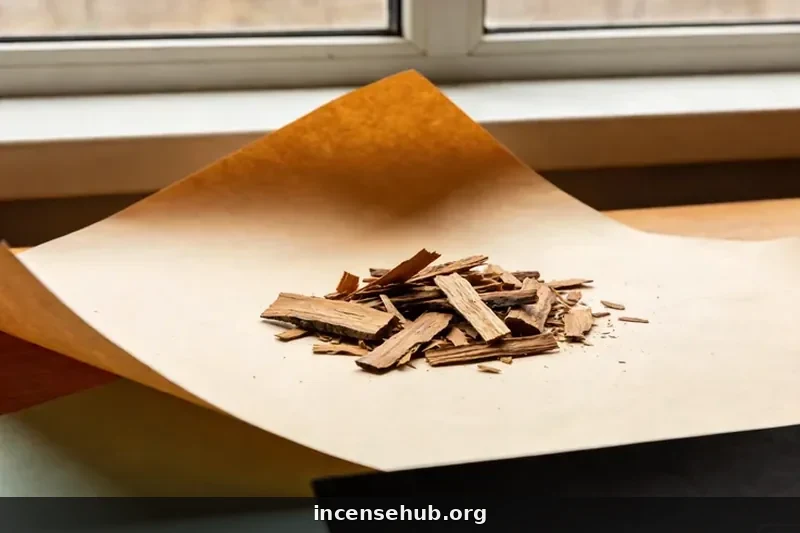
Data summary: Agarwood — chenxiang (沉香, “sinking fragrance”) in Chinese — is the resin-loaded heartwood of Aquilaria trees. It is not a species and not a sap: it is what the interior of a living tree becomes after injury, when the wood floods the damaged zone with aromatic resin over years or decades. The densest pieces sink in water, which is where the Chinese name comes from. The material anchors Chinese incense, Japanese kōdō, and the Arabic oud trade, and it is among the most frequently counterfeited aromatics sold today.
Key facts
| Field | Value |
|---|---|
| Chinese name | 沉香 (chénxiāng); also 沉水香 (chénshuǐxiāng), “sinking incense” |
| Botanical source | Aquilaria spp., family Thymelaeaceae; roughly 15–20 species |
| Main commercial species | Aquilaria sinensis (白木香) and Aquilaria malaccensis |
| What the material is | Resin-impregnated heartwood — a condition of the wood, not a species |
| Scent register | Woody, resinous, sweet, layered; opens in stages under gentle heat |
| Top grade | 奇楠 (qínán), sometimes rendered “kyara-grade” |
| Main buying hazard | Dyed, oil-soaked, injected, or unrelated wood sold under the name |
| Trade status | The genus is CITES-listed; wild supply is depleted |
Direct answer: Agarwood is a wound product. A healthy Aquilaria trunk is pale, light, and nearly odorless; the dark, heavy, fragrant wood exists only because the tree answered damage with resin.
The definition that prevents most mistakes
The useful correction is negative. Everyday speech says “agarwood trees,” which suggests a species you could plant and harvest like teak. The botanical reality is stranger: an untouched Aquilaria trunk looks like ordinary light hardwood and smells like nothing much. The substance buyers pay for is the tree’s defense response, accumulated in the heartwood after a wound, a fungal invasion, or both.
That distinction is not academic. It explains why supply cannot be expanded on demand, why the same species can produce material of wildly different density, and why the word “agarwood” on a label identifies a family of outcomes rather than a fixed grade. Two pieces from the same plantation, even the same tree, can differ by an order of magnitude in value.
The Chinese name records the oldest field test. 沉 means “to sink,” 香 means “fragrance,” and the compound names wood dense enough with resin to drop below the surface of water. The name is a grading claim built into the noun, which is one reason the vocabulary feels precise even when the material in front of you is not.
How a wound becomes agarwood
Direct answer: Injury or fungal attack triggers a defense cascade in the heartwood; resin accumulates around the damaged zone; years of accumulation darken and densify the wood; the result is agarwood.
The sequence matters because every quality argument later on the page traces back to it:
wound or fungal cue → defense signaling rises in the wood → sesquiterpene and chromone production switches on → resin fills the damaged vessels and fibers → the zone darkens, hardens, and gains scent → density and aroma increase with the years of accumulation.
A tree does not resinify on command. The response is local, uneven, and slow. A branch wound may produce a pocket of dark wood; a trunk wound may produce a larger column; an insect gallery may produce a thin resinous trace along the tunnel. This is why whole logs are not uniformly valuable and why carvers prize pieces with a visible resin pattern: the pattern is a map of where the tree was hurt.
The classical Chinese literature already organized formation by cause rather than by species. 香乘 (Xiang Cheng, compiled by 周嘉胄 in 1641) records four types: 熟结 (ripe-formed, where resin condenses and the surrounding wood decays away), 生结 (live-formed, where resin gathers after the tree is cut or wounded), 脱落 (fallen, where resin forms as dead wood decays), and 虫漏 (insect-bored, where resin forms inside insect tunnels). The four are not botanical categories. They are descriptions of the pathway that produced the resin, and they map onto what a modern buyer sees: wound-initiated material, decay-associated material, and insect-path material.
Age enters here. Resin-bearing wood is typically found in trees older than about twenty years, and the most dense material is associated with decades of accumulation rather than a single season. Plantation growers shorten the wait by wounding or inoculating farmed trees deliberately, which produces legal and renewable material but does not reproduce the slow, patchy history of an old wild tree. The difference is one reason wild and cultivated material occupy different price worlds.
Direct answer: The four classical formation terms describe how the resin arrived, not what species the tree was — which is why the same species can yield material of very different character.
The chemistry behind the staged scent
Direct answer: Agarwood’s fragrance comes from two large chemical families — sesquiterpenes and 2-(2-phenylethyl)chromones — whose molecules volatilize at different temperatures, so the scent unfolds in sequence rather than arriving as one note.
When the tree is stressed, defense hormones such as jasmonates rise and a battery of biosynthetic genes switches on. The mevalonate pathway supplies farnesyl diphosphate, which sesquiterpene synthases convert into a family of fifteen-carbon compounds; names that recur in the analytical literature include agarospirol, agarofuran, guaiene, and eudesmane derivatives. A parallel phenylpropanoid route produces the chromones, the ring compounds associated with the deep, lasting, sometimes medicinal-sweet heart of fine material.
The physical consequence is a boiling-point ladder. Small, light sesquiterpenes leave the wood at low warmth and read as the opening note. Mid-weight compounds follow as the temperature climbs and form the body. The heaviest fraction, including much of the chromone content, lingers and returns as the dry-down. A single chip therefore behaves like a small, slow composition rather than a scent sample.
That chemistry also explains why the material is easy to fake superficially and hard to fake well. Dye can imitate color; oil can add weight and a top-note smell; neither creates the spread of compounds that produces a staged dry-down. A fake often smells strongest at the start and then flattens, while genuine wood tends to open, deepen, and leave a residue of scent after the heat is removed.
The same logic sets the practical limit of any home test. A burn test or a water test observes the consequences of chemistry, not the chemistry itself. It can catch crude fraud and it can flag a suspicious lot, but it cannot certify species or origin. Laboratory analysis, where it is used, looks for marker compounds and for the absence of adulterant signatures; that is a different level of evidence from anything a buyer can do at a counter.
Aroma: top, body, and dry-down
Direct answer: Good agarwood smells woody and resinous at the base, sweet in a way that shifts with origin and grade, and — above all — changeable: it releases a top note, a body, and a dry-down as heat is applied.
Chinese practice names the three phases 头香 (top note), 本香 (body note), and 尾香 (dry-down). The labels are useful because they force a taster to wait. A cold chip sniffed for two seconds mainly reports the surface; a warmed chip reports the material.
Descriptor words vary by piece, but the reliable families are woody, balsamic, honeyed, leathery, and faintly camphoraceous. Fine material can also read floral or fruity in the opening, then turn earthy or animalic at the base. “Complex” in this context does not mean “strong.” It means several recognizable notes appear in sequence and the sequence lasts.
Origin and grade shift the balance. Hainan and Vietnamese material has long been treated in Chinese trade as a benchmark for sweetness and depth, while material from other regions can be drier, more resinous, or more overtly woody. These are tendencies, not rules, and the same region can produce both excellent and ordinary wood. The only honest way to rank two pieces is to warm them under the same conditions and compare the three phases side by side.
Direct answer: The three-phase structure is the practical definition of quality: a piece that opens, develops, and finishes is worth more than a piece that states one smell loudly and then dies.
Names across languages, and the trap inside them
Direct answer: 沉香, 沉水香, 伽楠, 棋楠, oud, jinkō, and kyara all refer to the same material family, but each name carries a different grading assumption — so the name alone never identifies species or grade.
The Chinese vocabulary distinguishes the ordinary material (沉香), the sinking grade (沉水香), and the summit grade (奇楠, also written 伽楠, 伽罗, or 棋楠). The Arabic “oud” (also oudh) became the dominant term in Western perfumery, where it often refers specifically to the distilled oil rather than the wood. Japanese uses jinkō for the wood and kyara for the top grade, a pairing that mirrors the Chinese distinction.
The trap is that these words travel through markets with different grading systems. A seller may use “oud” for a wood chip, an oil, or a blended fragrance accord; “kyara” may be used as a quality adjective rather than a claim about a specific piece; “sinking grade” may describe a density result or a price tier. None of these usages is necessarily dishonest, but each one asks the buyer to supply an assumption.
The practical rule is to translate every name into three questions: which species, which form (wood, powder, oil), and which grade by density or structure. A seller who can answer all three is speaking a trade language; a seller who repeats only the romantic name is reciting a label. The naming problem is worse for agarwood than for sandalwood because the top grade has a structural definition, not just a scent reputation, and because the oil market uses the same word for a different product.
Where it grows, and what that means for supply
Direct answer: Wild Aquilaria grows from southern China and Vietnam through Laos, Cambodia, Thailand, Malaysia, and Indonesia to Bangladesh and Assam; wild stands are depleted and CITES-listed, so most commercial material now comes from inoculated plantations.
The belt is broad but the premium origins are narrow in reputation. Hainan, Guangdong, Guangxi, and Yunnan in southern China, together with Vietnam, have historically supplied material that Chinese buyers treated as the reference point for sweetness and complexity. Malaysia and Indonesia are major sources of commercial and plantation material, and Bangladesh and Assam mark the western edge of the range.
Aquilaria sinensis is the species most associated with southern China; Aquilaria malaccensis is the main Southeast Asian commercial species and the one most often named in regulatory discussions. The genus sits on CITES Appendix II, which means international trade requires documentation. That status does not make all trade illegal; it makes paperwork part of the product. A supplier who cannot say whether material is wild or cultivated, or which species it is, is asking the buyer to carry a legal risk the supplier should have resolved.
Plantation supply changed the market’s shape. Inoculation lets growers induce resin in managed trees, producing predictable volumes of legal material at the lower and middle ends. It does not reproduce old-growth density or the particular depth that comes from decades of slow accumulation, and the best plantation lots are separated from ordinary ones by careful grading rather than by the word “plantation” itself. The result is a two-tier market with a wide, poorly documented middle, which is exactly where authentication problems concentrate.
Direct answer: Origin is a real signal and a weak guarantee: it tells you what a region can produce, not what this particular piece is.
The sinking grade and its limits
Direct answer: The classical Chinese system grades agarwood by resin density through a water test: 沉水 sinks, 半沉半浮 half-sinks, and floating material ranks lowest. The test measures density, not authenticity or origin.
| Grade | Chinese | What it indicates |
|---|---|---|
| Sinking | 沉水 (chénshuǐ) | High resin load; dense enough to sink |
| Half-sinking | 半沉半浮 (bànchénbànfú) | Moderate resin load; part of the piece floats |
| Floating | — | Low resin load; historically 黄熟香 |
The textual anchor is 香乘, which quotes earlier material: the knot in the heartwood that sinks when placed in water is called 沉水; the half-sinking grade is 栈香; the non-sinking grade is 黄熟香; and the classes number three — 沉, 栈, 黄熟. The passage is a grading system, not a chemical assay, and it has survived because density is easy to observe and hard to argue with.
Hard to argue with, not impossible to fake. Specific gravity can be engineered by soaking, injecting, or loading low-grade wood with resin or oil. A treated piece can sink while containing little of the compound range that makes good agarwood smell good. The water test is therefore a first screen and a ranking aid; it is not a certificate. The same caution applies to color: dark wood can be dyed, and pale wood can be genuinely aromatic.
Beyond density, the trade also sorts by origin, by resin color (green, black, yellow, and other tones), and by aroma character. These are market conventions rather than a single standardized system, and they overlap imperfectly. A piece can be sinking grade and still smell thin; a floating piece can be sweet and complex. That is why experienced buyers treat the water test as one column in a ledger, not as the verdict.
Direct answer: Sinking is a useful first question, never the last one; a dense fake is still a fake.
奇楠: the structural exception
Direct answer: 奇楠 (qínán) is the top grade because its structure differs, not merely because its scent is better: the fiber is so saturated with resin that it turns soft, pliable, and fragrant at room temperature.
Ordinary agarwood is described in the trade as 木包油 — “wood wraps oil” — hard wood carrying veins of resin. 奇楠 is 油包木 — “oil wraps wood” — the fiber itself is transformed until it can be shaved into curls and kneaded into pellets (削之成卷、捏之成丸). A good piece smells sweet even before heat is applied, which is one reason it is handled and displayed as much as it is burned.
The grade is subdivided by color into white, green, purple, yellow, and black. The ranking among those colors is disputed: some sources treat them as distinct grades, others as stages of aging or variation within one grade. The etymology of “qínán” is also uncertain. These are genuine open questions, not marketing mysteries, and a page that pretends otherwise is overselling its certainty.
For a buyer, the structural definition is more useful than the color hierarchy. Softness, pliability, the curl when shaved, and room-temperature scent are observable properties; a color name on a tag is not. The grade is rare enough that most material described as 奇楠 in casual trade is either mislabeled or a lesser piece promoted by association. Authentication at this tier deserves its own procedure, and the safe assumption is that the word is a claim to be tested rather than a fact to be accepted.
Direct answer: 奇楠 is defined by transformed structure — soft, pliable, fragrant unheated — and the color ranking around it remains contested market language.
Forms, processing, and what changes
Direct answer: Agarwood is sold as chips, powder, whole pieces and carvings, beads, and distilled oil. Chips suit warming, powder suits stick-making, whole pieces suit carving or collection, and oil is a separate distilled product.
| Form | What it is for | What to watch |
|---|---|---|
| Chips and slivers | Warming on charcoal or an electric heater | Even size; surface contamination; true density |
| Powder | Blending into sticks and cones | Mesh consistency; moisture; batch variation |
| Whole pieces and carvings | Beads, sculpture, display | Resin pattern; cracks; hidden filler |
| Distilled oil | Perfumery and scented products | Adulteration with synthetic accords; yield claims |
Processing starts with separation. Resin-bearing heartwood is cut away from pale sapwood, cleaned, and dried. Chips are cut to size; powder is ground; high-grade pieces are kept whole because carving or bead-making may realize more value than grinding. Oil is a different pathway: wood is distilled, usually with steam or water, and the condensate is collected. The oil is not “concentrated agarwood” in any simple sense — it is a distillate with its own composition, its own market, and its own adulteration problems.
Powder buyers face two variables that rarely appear on a label. Particle size changes how the powder packs, how air moves through a stick, and how the material releases scent during combustion. Moisture changes how it grinds, how it stores, and how a finished stick dries. Neither has one correct value: the right target depends on the binder, the other ingredients, and the production line. A mesh figure that works in one factory is not transferable to another, which is why a sample run against your own formula is worth more than a nominal grade.
Processing also changes aroma. Grinding exposes fresh surfaces and can lose light volatiles; heating during forming can shift the top note; aging after production can round the edges. A buyer who approves a raw chip has approved the raw chip, not the finished stick. The sensible sequence is to approve the raw material, then the blend, then the finished batch, because each stage can move the scent.
Direct answer: The form is a functional choice, not a quality ranking, but powder and oil add variables — mesh, moisture, distillation — that the wood form does not have.
What makes a lot good: a weighted view
Direct answer: Resin content is the core variable because it sets density, scent intensity, and endurance; origin, formation history, aroma character, and physical condition modify that core rather than replace it.
The factors are easy to list and hard to weigh. A workable order, offered as editorial judgment rather than a standardized formula, runs like this:
| Factor | Why it matters | How it misleads |
|---|---|---|
| Resin content | Sets density, scent strength, and burn/warm behavior | Density can be engineered; high resin does not guarantee fine aroma |
| Species and origin | Predicts the general scent family and legal status | A famous origin can be claimed for anonymous wood |
| Formation history | Wild, plantation, wound type, and age shape complexity | “Wild” is a story until documented; plantation can be excellent |
| Aroma character | Sweetness, complexity, and endurance decide enjoyment | A strong opening can hide a short, flat dry-down |
| Physical condition | Cleanliness, cracks, rot, and foreign matter affect yield | A beautiful exterior can conceal a hollow or treated core |
| Batch consistency | Determines whether a reorder will match the sample | A single good piece says nothing about the next shipment |
Resin content sits first because so much else follows from it. A dense piece usually has more aromatic material per gram, burns or warms longer, and carries more of the compound range that produces a dry-down. The catch is that density is the easiest property to fake, so the factor that matters most is also the one that most needs a second check.
Origin sits second for a different reason. It is a real signal — regions do have characteristic profiles, and legal status follows species and provenance — but it is a category, not a measurement. “Hainan” on a tag is a claim about a place; it does not tell you the age of the tree, the formation pathway, or the care taken in drying. The same is true of “wild.” These words are starting points for questions, not answers.
Aroma character is where the buyer’s own nose has the final say. The test is not whether the piece smells strong but whether it changes. A flat, loud opening that collapses into a burnt or soapy note is a warning; a quiet opening that deepens and lasts may be the better piece. This is why evaluation under gentle heat, in phases, is more informative than a quick sniff.
Batch consistency is the factor most often left out of buying guides because it is boring. For a manufacturer, it is the whole game: the second shipment has to match the first in mesh, moisture, density, and scent, or the finished product changes. A single exceptional lot that cannot be reordered is a sample, not a supply relationship.
Direct answer: Weigh the factors in order, but verify the first two with tests and the last with a reorder — because a claim about resin or origin is only as good as the evidence behind it.
Fakes: a field taxonomy
Direct answer: Agarwood fraud clusters into four families — dyed or oil-soaked white wood, unrelated woods treated with fragrance, oil-injected or boiled low-grade material, and mislabeled grades — and each family fails a different check.
| Fake family | How it is made | What it exploits | First check that catches it |
|---|---|---|---|
| Dyed white wood | Non-resinous Aquilaria wood soaked in oil and dyed dark | The assumption that dark color means resin | Cut or scrape a corner; color should follow resin veins, not coat the surface |
| Foreign wood | Unrelated timber (for example from Lauraceae or Burseraceae) scented with fragrance oil | The buyer’s inability to identify species | Species documentation; heat behavior; burn residue |
| Oil-injected or boiled | Low-grade wood loaded with resin or oil to add weight | The water test and the price-per-gram calculation | Density that is too uniform; oil weeping; a flat, perfumed smell |
| Grade inflation | Genuine but lower-grade wood sold as sinking or 奇楠 | The prestige of a grade name | Structural checks for 奇楠; density measured on a clean piece |
The dye family is the crudest and still works, because color is the first thing a buyer sees. Genuine resin darkens the wood along veins and vessel lines; dye tends to sit on the surface and in cracks. A fresh cut is more informative than the display face. The same logic applies to oil: genuine resin is integrated into the fiber, while added oil can bleed, feel greasy, or smell strongest at the surface.
The foreign-wood family is harder because the material may be sold as chips or powder, where species is invisible. A burn test helps: genuine agarwood tends to give white smoke with visible oil seepage and a sweet, resinous smell, while treated substitutes often give black smoke and a sharp “burnt wood” or perfume note. The test is practical screening, not laboratory proof, and it should be run on a small piece in a ventilated space.
The injection family defeats the water test directly. Loading low-grade wood with resin or oil raises density until it sinks, which is why a sinking result alone should never be treated as authentication. The tell is often uniformity: genuine pieces vary internally, while injected pieces can feel and look too even. Weight that seems high for the visible resin pattern is a reason to slow down, not a reason to celebrate.
Grade inflation is the quietest family. The wood may be genuine, the species may be correct, and the only lie is the tier. Sinking grade, wild origin, and 奇楠 are all claims that carry a price premium, and all three can be applied to material that does not meet the definition. The defense is structural and documentary: measure density on a clean piece, inspect 奇楠 for softness and pliability, and ask for the paperwork that supports a wild-origin claim.
None of these checks is sufficient alone. A lot that fails one may still be genuine; a lot that fails two is a reject. That rule is a heuristic, not a law, but it prevents the common mistake of building a purchase on a single reassuring signal.
Direct answer: The four fake families exploit four different assumptions — color, species, density, and grade — so a serious check has to test more than one of them.
A buying sequence that fails safe
Direct answer: Buy in a fixed order — application, legality, sample, reorder, price sanity — and let each step veto the next, so a bargain never overrides a missing document or a failed sample.
| Step | Question | Pass condition | Stop condition |
|---|---|---|---|
| 1. Application | What is this for: warming, stick-making, carving, or oil? | The form and grade fit the use | No clear use; buying a name alone |
| 2. Legality | Which species, which origin, wild or cultivated, and is CITES paperwork available? | Species and provenance can be named and documented | “Agarwood” with no species or origin |
| 3. Sample | Does a trial piece pass density, heat, and burn checks? | Aroma develops in phases; residue and smoke are clean | Flat, acrid, or perfumed; two check failures |
| 4. Reorder | Does the second lot match the first? | Mesh, moisture, density, and scent stay within tolerance | Drift in two or more fields |
| 5. Price sanity | Is the price consistent with the documented grade? | The price is explainable by species, grade, and form | A price far below the claimed tier |
The order is deliberate. Application comes first because the wrong grade for the use is a failure even if the material is genuine: a beautiful carving-grade piece may be wasted in a stick formula, and a consistent powder may be the wrong choice for a collector. Legality comes second because it cannot be fixed later. A missing CITES document is not a negotiating point; it is a reason to walk.
The sample step is where the sensory work belongs. Warm a sliver on a clean heater, note the top note, raise the temperature, note the body, then let it ride to the dry-down. Burn a second small piece if the material is intended for combustion. For powder, check mesh and moisture against the formula, not against a generic ideal. A sample that passes only because it was the best piece in the lot is not a sample of the lot.
The reorder step turns a purchase into a supply relationship. Record the lot: species, origin, wild or cultivated, density result, aroma notes, mesh, moisture, supplier, and date. When the next shipment arrives, compare against the record. A drift in one field is a prompt to retest; a drift in several is evidence of a different lot or a substitute. Memory will smooth over the difference; a written record will not.
Price sanity is last because it is the weakest signal. A low price can be a genuine bargain, a clearance, or a fraud; a high price can be expertise, rarity, or theater. The number only becomes meaningful after the first four steps have established what the material is. Used in reverse — price first, justification after — it is the mechanism by which most bad purchases happen.
Direct answer: The sequence works because each step is cheaper than the mistake it prevents; a sample costs far less than a shipment of the wrong grade.
Warming versus burning
Direct answer: Warming vaporizes aromatic compounds below combustion temperature, while burning pyrolyzes the wood itself; the first gives a clean, staged scent, the second adds smoke, tar, and char.
The physics is simple enough to explain in one chain:
gentle heat → volatile compounds leave the wood in order of boiling point → top note, body, and dry-down separate → a clean, changing scent; open flame → temperature passes ignition → cellulose and lignin break down → smoke and char dominate → the fine notes disappear under a burnt layer.
This is why the refined Chinese method is 隔火焚香 (géhuǒ fénxiāng), “incense across fire.” Charcoal is buried in a bed of ash, a thin plate of mica or silver is laid over it, and the chip rests on the plate. The material never touches flame. The ash bed buffers the heat, the plate spreads it, and the chip warms slowly enough for the phases to separate.
An electric heater does the same job with a dial. It is less atmospheric and more repeatable, which makes it the better tool for evaluation and the more convenient one for a small room. The mistake to avoid is turning the dial up to get “more scent.” Excess heat drives the material toward pyrolysis and produces the same burnt note as a flame, only more gradually.
Combustion is not wrong; it is a different use. Many people want a stick or a cone that burns and fills a room, and agarwood powder can serve that role in a blend. The point is to match the method to the material. A rare chip deserves gentle heat; an ordinary powder can go into a stick. Burning a top-grade piece is not a moral failure, but it spends a material designed for slow release in a format that hides its best behavior.
Direct answer: Heat control is the difference between analyzing a scent and destroying it; the same chip can give a clean progression or a burnt smear depending on the temperature curve.
Agarwood in a blend: the 君 seat
Direct answer: In the classical 君臣佐使 framework, agarwood usually takes the 君 (chief) role — it sets the identity of the blend — while supporting materials lift, round, and carry it.
Chinese compound incense, 合香 (héxiāng), was organized on a four-role scheme borrowed from pharmacy: 君 (jūn, chief), 臣 (chén, minister), 佐 (zuǒ, assistant), and 使 (shǐ, guide). The chief ingredient defines the composition; the minister supports it; the assistant corrects or modulates; the guide directs the effect or carries the fragrance. The scheme is a design language, not a recipe, and different manuals apply it with different degrees of literalism.
Agarwood in the 君 seat supplies a deep, resinous backbone. A small amount of sandalwood can act as 臣, softening the edges and adding creaminess. A spice such as clove can act as 佐, brightening the opening. A resin or a binder can act as 使, holding the blend together or carrying the scent through combustion. The proportions are formula-specific; there is no universal percentage, and any page that offers one without knowing the binder and the base is guessing.
The practical consequence is that a blend built on agarwood does not need much of it. The material’s tenacity and complexity spread a long shadow, which is why a premium wood can anchor a large batch and why the chief/minister logic resembles the modern perfumer’s idea of a base note carrying a composition. It also explains why a blend can smell like agarwood without containing much agarwood: the supporting materials are doing more work than the label suggests.
For a buyer, the framework is a reminder that “contains agarwood” is not a grade. The question is how much, in what role, and with what support. A stick with a trace of powder and a strong synthetic accord is not the same product as a stick built around a genuine chip, even if both can use the word.
Direct answer: The 君 role explains why agarwood is used in small amounts and why “contains agarwood” says nothing about how much or how well.
Agarwood and sandalwood side by side
Direct answer: Both are premium aromatic woods, but agarwood is a wound-formed resin wood with a deep, changing scent, while sandalwood is a naturally fragrant heartwood with a creamy, soft profile.
| Agarwood (沉香) | Sandalwood (檀香) | |
|---|---|---|
| What it is | Resin-impregnated heartwood formed after injury | Fragrant heartwood whose scent is present in the living tree |
| Botanical source | Aquilaria spp. | Santalum album |
| Formation | Wound or fungal trigger; years of resin accumulation | Heartwood develops with age; no injury trigger required |
| Aroma | Woody, resinous, sweet, layered, changing under heat | Creamy, sweet, soft, woody, relatively stable |
| Main use | Base anchor in blends; warming; carving | Base anchor; carving; daily incense |
| Buying risk | Heavy adulteration: dye, oil, injection, foreign wood | Species substitution and fragrance oil |
| Price signal | Extremely wide, with 奇楠 at the top | High for true S. album, lower for other species |
The two are complements rather than substitutes. Sandalwood is the gentler material: it gives a soft, creamy base that makes a room feel calm, and it is forgiving in blends. Agarwood is the deeper and more demanding material: it needs heat control to show its phases, and its price makes every purchase a risk calculation. A blend can use both, with sandalwood as the minister and agarwood as the chief, and the combination is one of the classical structures of Chinese incense.
The substitution risk differs in kind. Agarwood is faked by adding something to wood; sandalwood is faked by substituting a different species or by scenting a cheaper wood. Both are problems, but the checks are different: agarwood rewards density and heat tests, while sandalwood rewards species identification and a careful look at the grain and oil content. A buyer competent in one is not automatically competent in the other.
Direct answer: They are not rival versions of the same thing; sandalwood is a soft foundation, agarwood a deep and variable anchor, and the choice follows the blend rather than a ranking.
Traditional use, and the line around it
Direct answer: Chinese materia medica describes agarwood in traditional language such as “moving qi and relieving pain” (行气止痛) and “warming the middle” (温中). That is historical terminology, not modern clinical evidence, and burning incense is not a medical treatment.
The classical record matters for two reasons. It explains why agarwood carries so much cultural weight, and it explains why so many product pages drift into health claims. The traditional descriptions are part of the material’s history; they are not findings from controlled trials, and they should be labeled as traditional belief when they are mentioned at all.
What can be said without overreach: agarwood has a long record as a high-ranking aromatic in Chinese incense manuals; the sinking test is documented trade practice; and the resin’s chemistry — sesquiterpenes and chromones — is an active subject of study. What cannot be said: that burning agarwood treats, cures, or prevents any condition. The smoke is also a respiratory irritant for some people, which is a reason for ventilation, not a reason for a health claim.
This is one of the places where the editorial line matters most. A knowledge page can describe what a tradition says and what chemistry has found without collapsing the two into a promise. The useful sentence is “traditional sources describe it as…” followed by “modern evidence does not establish…”. That is not hedging; it is the difference between history and marketing.
Direct answer: Traditional use is real history and not medical proof; the page can describe the first and must not imply the second.
Supply, sustainability, and the plantation question
Direct answer: Wild agarwood is depleted and the genus is CITES-listed; plantation material is the renewable mainstream, but “plantation” is a production method, not a grade, and documentation is the buyer’s real protection.
The sustainability argument starts with biology. A tree that only produces resin after injury, and only in useful quantity after years, cannot be harvested like a crop. Wild collection removed mature trees faster than they could regenerate, and the regulatory response — CITES listing — made international movement a paperwork exercise. Plantation growing answers the supply problem by wounding or inoculating managed trees, which shortens the cycle and makes the material legal and traceable in principle.
The catch is that plantation material covers a wide range. A well-managed plot with mature trees and careful inoculation can produce dense, aromatic wood; a hurried operation can produce pale, lightly resined wood that carries the name but not the character. The word “plantation” therefore does not tell a buyer what they are getting. It tells them the material is unlikely to be wild, which is useful for legality and useless for quality.
Documentation is the practical lever. A credible supplier can name the species, the country or region of origin, whether the material is wild or cultivated, and the CITES status of the shipment. A supplier who offers only “agarwood” is not necessarily selling a fake, but they are asking the buyer to absorb the uncertainty. For a manufacturer, the documentation should travel with the lot and be recorded against the batch; for a collector, it is part of the object’s history.
There is an uncomfortable economic point underneath the sustainability story. The premium on wild material creates an incentive to mislabel plantation wood, and the premium on 奇楠 creates an incentive to promote lesser material. Regulation can make trade legal; it cannot make a label true. That gap is why authentication is not a separate topic from sustainability — it is the same topic seen from the buyer’s side.
Direct answer: The renewable option exists, but it does not dissolve the quality question; plantation is a supply category, and the buyer still has to verify the lot.
Storage and aging
Direct answer: Store agarwood cool, dry, dark, and away from strong odors; sealed glass or food-grade containers work well, and slow aging can round the scent, though improvement is not guaranteed.
The storage rules follow from the material. Resin-rich wood is porous enough to absorb neighboring smells and sensitive enough to lose light volatiles when exposed to heat and light. Sunlight, humidity, and a spice cabinet are all bad neighbors. A sealed glass jar in a cool cupboard is sufficient for most pieces; a food-grade polymer container is acceptable if the material is fully dry. Refrigeration is usually a mistake because condensation during temperature swings does more harm than the cold prevents.
Aging is the interesting part. Freshly cut or freshly dried material can smell green or closed. Over months and years, slow oxidation can soften harsh top notes and deepen the base, which is why collectors speak of letting a piece “settle.” The mechanism is plausible — oxygen reacts with some of the resin compounds, and the lighter fractions gradually change — but the outcome is not guaranteed. Some pieces improve; some hold steady; some lose a little brightness. The honest claim is that aging can change the scent, not that it always improves it.
Storage also affects the evaluation. A piece stored with a strong-smelling material may pick up that odor and read as more complex than it is. A piece stored too dry may crack. A piece stored in a hot place may lose its top note. When a sample arrives, let it rest in a clean container for a day or two before judging, so the smell of the packaging or the journey is not mistaken for the material.
Direct answer: Good storage is boring and protective; aging is a real but uncertain process, and no container can turn ordinary wood into a top grade.
What manufacturers actually need
Direct answer: A production buyer needs consistency before rarity: stable aroma, mesh, moisture, contamination control, and batch-to-batch matching matter more than a single exceptional piece.
The factory view is different from the collector view. A collector can buy one beautiful piece and be satisfied. A manufacturer has to make the next batch taste like the last one, which turns every purchase into a specification problem. The relevant questions are not “is this the best agarwood in the world” but “does this lot match the approved sample, and will the next lot match this one?”
Four variables carry most of the weight. Aroma consistency decides whether the finished product changes character between runs. Particle size decides how the powder packs, how the stick draws air, and how the material releases scent. Moisture decides how the powder grinds, how it stores, and how the formed stick dries. Contamination — dust, foreign wood, mold, or residual oil — decides whether the batch is saleable at all. None of these is visible in a photograph, and none is captured by a grade name.
The practical tool is a batch record. For each incoming lot, record the supplier, species, origin, wild or cultivated status, density result, mesh, moisture, aroma notes for the top, body, and dry-down, and the date. Keep a retained sample. When a new lot arrives, compare it against the retained sample and the record, not against memory. A drift in one field is a prompt to retest; a drift in several is a reason to reject.
The author’s view, offered as editorial judgment: for most incense makers, a documented mid-grade lot with stable behavior is a better commercial base than an irreproducible top grade. The top grade belongs in small, special runs where the story and the scent justify the cost. The line that pays the bills is built on consistency.
Direct answer: Consistency is the manufacturer’s version of quality; a lot that cannot be repeated is a sample, not a supply.
Misconceptions that cost money
Direct answer: Four beliefs recur often enough to name: density proves authenticity, sinking means wild, dark means agarwood, and a famous origin guarantees quality. Each one is false or incomplete.
The density myth is the most expensive. The water test measures mass per volume, and mass per volume can be engineered with oil, resin, or a denser foreign wood. A piece that sinks has passed one check; it has not proved its species or its aroma. Treating the test as a certificate is how injected wood finds buyers.
The wild-versus-sinking confusion is a category error. Sinking describes resin load; wild describes provenance. Plantation wood can sink if it is dense enough, and wild wood can float if its resin is thin. The two questions are independent, and a seller who conflates them is either confused or using one prestige word to borrow credibility from another.
The color myth is the simplest to avoid. Dark wood is not necessarily agarwood, and agarwood is not necessarily dark. Dye is cheap, and many unrelated woods are naturally dark. Color belongs with the other surface signals, not above them.
The origin myth is subtler. Hainan and Vietnam have produced celebrated material, and a genuine piece from either can be excellent. That does not mean every piece labeled with those names is excellent, or even from there. Origin is a category with a reputation; the piece in front of you still has to pass the density, heat, and burn checks.
The common thread is the substitution of one easy signal for a cluster of harder ones. Good buying is boring: it asks for documents, warms a sample, cuts a corner, and records the result. The myths are attractive because they promise a shortcut. There is no shortcut that survives contact with a determined faker.
Direct answer: Every misconception on this list replaces several checks with one, which is exactly the trade a fraudulent seller wants the buyer to make.
A short cultural history
Direct answer: Agarwood’s prestige is older than its botany: it moved through Chinese courts, Buddhist and Daoist ritual, Japanese ceremony, and Arabic perfumery, and each tradition built its own vocabulary around the same wood.
The Chinese record treats the wood as a luxury of the elite and a substance of ritual importance. It appears in incense manuals, poetry, and materia medica; the 香乘 compilation of 1641 is as much a cultural inventory as a technical one, listing grades, formation types, and the language a connoisseur was expected to command. The literati did not simply burn the wood. They compared pieces, argued about origins, wrote down which phase of the scent they preferred, and treated the whole exercise as a discipline of attention.
Japan inherited the practice through Buddhist channels and formalized it into kōdō, the “way of incense.” A kōdō gathering is closer to a listening session than to a perfume demonstration: small pieces are warmed on a mica plate over charcoal in ash, and participants describe what they smell, sometimes identifying woods blind. The vocabulary is deliberately restrained. The point is not to overpower the room but to notice change — the first warmth, the middle, the last trace — and to compare one piece against another in a shared, quiet setting.
The Arabic tradition took a different path. Oud became a cornerstone of perfumery, associated with hospitality, celebration, and personal adornment. The oil is worn on skin and cloth; the wood is burned in majlis settings; the market developed its own grading language and its own networks of traders. Where Chinese practice often favors indirect warmth and small pieces, Gulf perfumery embraces the oil and the richer, smokier presentation of the wood.
Three traditions, one material, and three different ideas of what “good” means. A Chinese collector may prize a quiet, layered dry-down; a Japanese practitioner may value subtlety and repeatability across a session; a perfumer may look for projection and tenacity in an oil. None of these is wrong. The confusion starts when a word from one tradition is used as a grade in another — “kyara” as a synonym for “best,” “oud” as a synonym for “wood,” “sinking” as a synonym for “genuine.” The cultural history explains the prestige; it does not simplify the grading.
There is also a quieter history of ordinary use. Agarwood was not only for courts. Smaller pieces, lower grades, and powder went into household incense, temple offerings, and medicine cabinets. The divide between the collector’s specimen and the everyday stick is old, and it explains why the market has always had a wide middle: material too good to discard, not good enough for the top shelf. That middle is where most buyers actually operate, and it is where the most careful grading is needed.
Direct answer: The three traditions created three vocabularies and three standards; a buyer who knows which tradition a seller is speaking can usually tell which claims are being made.
Regional reputations, and what they cannot tell you
Direct answer: Hainan and Vietnam carry the strongest reputations in Chinese trade, Malaysia and Indonesia dominate commercial volume, and Assam marks the western edge — but a regional name describes a possibility, not the piece in your hand.
Hainan has long been the reference point for sweetness and depth in Chinese writing about the wood. The island’s material was historically scarce, and scarcity plus reputation produced a premium that persists even when the actual supply is unclear. Vietnamese material, particularly from the central and southern forests, earned a parallel reputation for complexity and a lingering finish. These are trade reputations built over centuries, and they influence price as much as any measurable property.
The Southeast Asian mainland and archipelago tell a different story. Cambodia, Laos, Thailand, Malaysia, and Indonesia all produce material, and the commercial market depends heavily on Indonesian and Malaysian supply. Plantation development has been extensive in these regions, and the resulting wood ranges from pale and lightly scented to dense and genuinely fine. A regional label here is less a quality claim than a description of where the tree grew.
Assam and the eastern Himalaya mark the western limit of the range. The material is less discussed in Chinese trade literature than Hainan or Vietnam, but it exists, and it shares the general characteristics of the species complex rather than a single famous profile. Bangladesh and neighboring areas have their own histories of collection and trade.
What a regional name cannot tell you is age, formation pathway, resin load, or handling. A piece labeled “Hainan” may be a genuine old wild specimen, a plantation piece from a different region, or a piece that passed through a trader who used the name loosely. The same is true of “Vietnamese.” The reputation is a lead, not a finding. The practical response is to ask what the seller means by the name: species, region of harvest, or simply the style of scent the piece is supposed to resemble.
Regional reputation also changes with fashion. A origin that was celebrated in one century may be neglected in the next; plantation material from a region without a famous name can outperform a tired wild lot. The market is not a museum of reputations. It is a stream of lots, and each lot has to be judged on its own behavior under heat.
Direct answer: Use origin to generate questions, not to close them; the name on the label is a hypothesis, and the warmed chip is the test.
Teaching the nose
Direct answer: Sensory skill is trainable and mostly comparative: learn a small set of reference smells, then smell agarwood in phases against those references and write down what changed.
The first step is to build a reference shelf. Sandalwood gives a creamy, soft-woody baseline. Frankincense gives a bright, citrus-resinous lift. Myrrh gives a bitter, earthy balsamic weight. Camphor or borneol gives a cool, sharp top note. Clove gives a warm spice accent. A piece of dry cedar or a fresh pencil shaving gives a plain woody reference. These are not agarwood, and that is the point: they anchor words to smells so that a description is not just an adjective floating in air.
The second step is to smell the same piece at different temperatures. Start low and wait. The first impression may be faint, sweet, or woody; that is the top note. Raise the heat slightly and wait again. The body often brings a thicker, more balsamic quality, sometimes with a leathery or honeyed edge. Raise it once more, or let the heater cool, and the dry-down appears: the part that lingers after the heat is gone. Writing one or two words for each phase is enough. The record matters more than the poetry.
The third step is comparison. Two pieces warmed side by side teach more than either piece alone. Which opens faster? Which has the longer finish? Which turns bitter at high heat? Which smells sweet when cold? The differences are the vocabulary. A taster who can say “piece A opens with a green note and finishes leathery; piece B opens flat and finishes sweet” is already ahead of a taster who says “A is better.”
The fourth step is blind practice. Ask someone to label three pieces A, B, and C and warm them without telling you which is which. Try to match your notes to the pieces. The exercise is humbling, and that is useful. It exposes how much of a first impression is expectation. A collector who has never done this is vulnerable to a confident seller’s story; a collector who has done it knows how easily the nose is led.
There is a limit to what training can do. It cannot identify species, detect oil injection, or certify legality. It can tell you whether a piece has a staged scent, whether it collapses at high heat, and whether it is worth smelling again. Those are real skills, and they are the ones that make the technical checks meaningful.
Direct answer: Train comparison, not vocabulary; the words become useful only when they are tied to differences you have actually smelled.
Authentication beyond the home test
Direct answer: Laboratory methods can detect adulterants and sometimes confirm species, but they are a different level of evidence from a burn test, and a buyer should know what each method can and cannot establish.
The home tests are screening tools. A water test measures density. A burn test observes smoke, residue, and smell. A heat test observes the staged release of volatiles. These are useful because they are cheap and fast, and because crude fraud often fails them. They are limited because a determined faker can engineer density, add a convincing top note, and disguise the residue.
Analytical chemistry works differently. Gas chromatography can separate the volatile compounds in a sample and produce a fingerprint; mass spectrometry can help identify what the peaks represent. A laboratory can compare a sample against reference profiles and look for markers of a species or signs of an adulterant. The method is powerful, but it is not magic: the result depends on the reference library, the sample preparation, and the question being asked. A test designed to detect a specific adulterant will not necessarily detect a different one.
DNA methods can, in principle, identify the species in a wood sample, but wood is a difficult material. Processing, aging, and mixing can degrade or remove the DNA, and a result from one fragment may not represent the whole lot. A species identification is also not a grade identification: knowing that a piece is Aquilaria does not tell you whether it is dense, wild, or old.
Documentation is a third kind of evidence, and it is often the most practical. CITES permits, supplier declarations, harvest records, and chain-of-custody documents do not prove that a specific piece is what the label says, but they establish that the seller is operating within a legal framework and is willing to be specific. A missing document is a signal; a consistent set of documents is a basis for trust, not a substitute for testing.
The honest hierarchy runs from cheap and weak to expensive and strong: smell and density, then burn and heat behavior, then documentation, then laboratory analysis. Most buyers never need the last step. What they need is to know which step they are on and what it can support. A burn test that produces white smoke and a sweet residue supports “this is probably genuine wood.” It does not support “this is wild Hainan sinking grade.” The gap between those claims is where most disputes live.
Direct answer: Use the cheapest test that can answer your question, and do not let a laboratory result or a document carry a claim it was never designed to prove.
How plantations produce resin
Direct answer: Plantation growers induce the same defense response by wounding or inoculating managed trees, then wait years for resin to accumulate; the method is legal and renewable, but it does not guarantee a particular grade.
The basic technique is deliberate injury. Growers may cut, drill, or partially girdle the trunk; they may insert a fungal culture or a prepared inoculum into the wound; they may use a combination of physical damage and biological stimulation. The goal is to trigger the tree’s defense chemistry without killing it, so that resin accumulates in the damaged zone over a period of years.
The timing is the hard part. A tree needs to be old enough to have a substantial heartwood core, and the resin needs time to develop after treatment. Harvest too early and the wood is pale and lightly scented; wait too long and the tree may decline or the resin may be uneven. The best plantation material comes from mature trees, careful wounding, and a harvest schedule that respects the biology rather than the cash-flow calendar.
Inoculation is not a single method. Different growers use different fungi, different wound patterns, and different waiting periods, and the results vary accordingly. Some operations produce dense, dark wood with a genuine staged scent; others produce material that looks the part but smells thin. The word “plantation” describes the origin of the wood, not its quality. A buyer who treats it as a grade is making the same mistake as a buyer who treats “wild” as a guarantee.
Plantation supply has changed the economics of the middle market. It provides a legal, repeatable source that can be documented and shipped, which is valuable for manufacturers who need consistency. It also creates a new grading problem: how to distinguish a well-managed plantation lot from a poorly managed one when both carry the same species name. The answer is the same as for wild wood — density, heat behavior, aroma phases, and batch records — with the added question of whether the seller can describe the treatment and harvest schedule.
There is an environmental argument for plantation material, and it is not merely marketing. If the demand for agarwood can be met from managed trees, the pressure on wild stands falls. The argument is not perfect: plantation wood does not replace the oldest wild material, and demand for the top grade can still drive illegal collection. But for the ordinary and mid-grade market, plantation supply is the realistic renewable path, and a buyer who insists on wild material for everyday use is often paying for a story rather than a difference.
Direct answer: Plantation is a method, not a grade; the treatment and harvest schedule matter more than the label, and the lot still has to pass the same sensory checks.
From lot to market: the trade chain
Direct answer: Agarwood moves from grower or collector through grading, consolidation, distillation, and distribution, and value concentrates at the points where knowledge is most uneven.
The chain begins with the producer. A plantation harvests treated trees; a licensed collector works wild concessions; a smallholder sells a few pieces from a family plot. The first sale is often local and informal, priced by eye and reputation rather than by a written specification. This is where a great piece can enter the market cheaply, and where a buyer without knowledge can be taken.
The next link is grading and consolidation. A trader sorts pieces by density, color, shape, and scent, separates the carving-grade from the chip-grade, and assembles lots large enough for export. The grader’s skill is the value added: a good grader finds the dense pieces in a mixed sack and prices them accordingly; a poor one lets them go at the average price. This step is also where substitution can occur, because the person doing the sorting knows more about the material than the person buying the lot.
Distillation is a separate branch. Wood that is not suitable for carving or chips may be distilled for oil, and the oil market has its own buyers, its own grades, and its own adulteration problems. The yield matters: a low yield means many kilograms of wood for one kilogram of oil, which ties the oil price to the wood price. The distiller’s skill affects the scent, and different customers want different profiles — a perfumer may want projection, an incense maker may want a softer, more resinous note.
Export and distribution add documentation. CITES permits, phytosanitary certificates, customs declarations, and commercial invoices travel with the lot. A serious distributor keeps those documents linked to the batch, so that a buyer can trace a shipment back to a supplier and a region. A trader who cannot produce the paperwork is not necessarily selling illegal wood, but they are asking the buyer to accept a risk that should have been resolved upstream.
The retail end splits into three markets that barely overlap. The raw-wood market sells chips, powder, and whole pieces to incense makers and collectors. The oil market sells to perfumers and fragrance houses. The carving market sells beads, sculpture, and display pieces, where appearance can matter more than scent. A buyer who is expert in one market is not automatically expert in another; the grading language differs, the fraud patterns differ, and the price logic differs.
The chain explains why provenance is so hard to verify. Each handoff is a chance for a label to drift, and the final seller may be several steps removed from the person who first graded the wood. The buyer’s defense is documentation plus testing, and the manufacturer’s defense is a batch record plus a retained sample. Neither is perfect, but both are better than a story.
Direct answer: Value sits where knowledge is uneven, so the buyer’s job is to move the uncertainty down the chain: ask for documents, test the lot, and record what arrived.
Indoor air and the safety question
Direct answer: Burning incense produces smoke and fine particles regardless of how natural the material is; ventilation, distance from the face, and sensible duration matter more than the romance of the ingredient.
The safety issue is combustion, not agarwood specifically. Any material that smolders or burns releases a mixture of gases and particles, and fine particles are the fraction most often associated with respiratory irritation. A well-ventilated room, a source that is not directly under the nose, and a session that ends before the air becomes visibly hazy are reasonable precautions. People with asthma or other respiratory sensitivity should be especially careful, and no incense should be used as a substitute for medical care.
Indirect warming changes the exposure profile. When the wood is heated on a plate rather than burned, the material does not combust, so the smoke and tar are greatly reduced. That does not make the practice risk-free — volatile organic compounds are still released — but it is a different kind of exposure from a smoldering stick. A collector who warms small chips for a few minutes is not in the same situation as someone burning coils in a closed room for hours.
The “natural” label is not a safety guarantee. A natural resin can still produce irritating smoke; a synthetic fragrance can be less irritating than a natural one in a particular formulation. The relevant questions are how much material is burning, how long, in what volume of air, and with what ventilation. Those questions apply to every incense material on this site, not just agarwood.
Storage safety is a separate topic. Dry wood and powder are combustible, and a bag of fine powder near a heat source is a fire risk. Keep material away from open flame, store it in a closed container, and do not leave a heater unattended. The same care that preserves the scent also reduces the hazard.
Direct answer: The material’s prestige does not change the physics of smoke; ventilate, keep the session modest, and treat fine powder as a combustible.
What the page is, and what it is not
Direct answer: This is a compiled editorial account built from botanical references, a classical Chinese source, and documented trade practice; it is not original laboratory research, and its uncertain points are labeled rather than smoothed over.
The page synthesizes three kinds of material. Botanical references establish the genus, the species, and the regulatory status. The classical Chinese source establishes the grading vocabulary and the formation categories. Trade practice supplies the adulteration patterns, the sensory language, and the commercial logic. Where these sources agree, the page states the point plainly. Where they conflict, it flags the conflict — the ranking of the 奇楠 color grades and the etymology of the name are the two clearest examples.
The page does not claim to settle questions that the sources leave open. It does not offer a laboratory method as a home test, a price as a valuation, or a traditional use as a medical claim. It does not pretend that a single photograph can authenticate a piece, or that a seller’s reputation can substitute for a document. Those limits are not hedging; they are the difference between a useful reference and a sales pitch.
A reader who wants a simple answer can take the one-sentence definition and the buying sequence. A reader who wants to go deeper can follow the links to the grading guide, the authentication database, and the material comparison matrix. The page is designed to be useful at both levels, and to be honest about which level a given claim belongs to.
Direct answer: Treat the confident statements as sourced, the flagged statements as open, and the editorial judgments as opinions — that is the reading protocol the page is built for.
FAQ
Q: Does agarwood grow as a tree species?
No. The word names a state that several Aquilaria species can reach. A healthy trunk is pale, light, and almost scentless; the dark aromatic core appears only after damage or fungal invasion triggers a defensive resin response. That is why two pieces from one species can differ so much, and why “agarwood” on a tag is a family name rather than a grade.
Q: What makes the top grade so costly?
Time and uncertainty. The tree must be wounded, the resin must accumulate over years, and only a fraction of the resulting wood is dense enough to be worth much. Wild sources are depleted and regulated; the summit grade 奇楠 is rarer again. Fraud adds a further premium, because a buyer who wants a verifiable piece pays for the checking as well as the wood.
Q: How do I warm it without ruining the scent?
Keep the heat low and indirect. A chip on a mica plate over an electric heater, or over charcoal buried in ash, will release the top note first and then the body and dry-down as the temperature rises. A flame chars the wood and covers the fine notes with smoke. The same chip can give a clean progression or a burnt smear depending on how fast the heat climbs.
Q: Is “oud” a different material?
It is the Arabic name for the same resinous Aquilaria wood, though Western perfumery often uses “oud” for the distilled oil rather than the solid. The family is the same; the product form may not be. A seller offering “oud” should be asked whether the reference is to chips, powder, or oil, because the grading and the fraud patterns differ.
Q: Does a sinking piece prove authenticity?
No. The water test measures density, and density can be raised by soaking, injecting, or loading low-grade wood. A dense fake sinks as readily as a dense genuine piece. Use the test as a first screen, then warm a sample, burn a small chip, and ask for species and origin documents. One check is never enough.
Q: Can cultivated wood be good?
Yes, within limits. A mature, well-inoculated plantation lot can be dense and genuinely aromatic, and it is legal and renewable. It rarely matches the depth of old wild resin, and the variation between plantation lots is wide. Judge the lot on the heater, not on the word “plantation,” and ask for the treatment and harvest record if consistency matters.
Q: What is the difference between chips and powder?
The same wood, cut or ground. Chips are for warming, where the whole surface releases scent slowly. Powder is for blending into sticks and cones, where mesh and moisture decide how it packs and burns. Neither form is inherently superior; the use decides. A powder that works in one formula may fail in another, so test it against your own binder and base.
Related Resources
- Agarwood incense guide — how the wood behaves in a censer, a stick, and a cone.
- Agarwood grading guide — the density, color, and origin vocabulary in full.
- Qínán / kyara — the top grade and its Japanese terminology.
- Buying qínán without being misled — authentication for the summit tier.
- Incense powder & resin — how wood powder packs, burns, and releases scent.
- Incense authentication database — the screening logic for fakes.
- Incense substitution cross-reference — what passes for what, and how to tell.
- How incense is made — grinding, blending, and forming.
- Wholesale guide — the commercial sourcing side.
- Material comparison matrix — agarwood beside its aromatic neighbors.
- Sandalwood — the other reference wood of Chinese incense.
- Bletilla — a traditional binder often paired with wood powders.
- Scent guide — the fragrance vocabulary used across this site.
- Safety guide — ventilation and handling basics.
Sources
- Aquilaria sinensis in Flora of China — botanical identity of the Chinese species.
- Aquilaria malaccensis on GBIF — taxonomy and distribution of the Southeast Asian species.
- Aquilaria in the CITES species checklist — regulated trade status of the genus.
- 香乘 (Xiang Cheng) full text on Wikisource — classical grading and formation terminology.
Sources: this page synthesizes Chinese-language trade and specialist sources on 奇楠 grading and adulteration with botanical references for Aquilaria. The etymology of “qínán” and the ranking of the 奇楠 color grades remain disputed and are flagged as such. This is editorial knowledge content, not medical or investment advice.
Summary
Direct answer: Agarwood is resin-saturated heartwood formed by injury in Aquilaria trees, graded by density and structure, crowned by 奇楠, and surrounded by enough fraud that authentication belongs in every buying decision.
The material is a condition, not a species: a tree is wounded, defense chemistry switches on, resin accumulates over years, and the heartwood darkens, densifies, and gains a scent that opens in stages under heat. Chinese practice grades the result by density — sinking, half-sinking, floating — and treats the soft, pliable, room-temperature-fragrant 奇楠 as a structural exception above the ordinary scale. Chemistry explains both the appeal and the difficulty: a wide spread of sesquiterpenes and chromones produces the layered scent, and the same complexity is hard to fake convincingly.
The market adds a second layer of difficulty. Wild supply is depleted and CITES-listed, plantation material is the renewable mainstream but varies widely, and the price premium on rare grades supports a persistent counterfeit trade. The buyer’s defense is procedural rather than magical: ask for species and origin, test density on a clean piece, warm a sample and judge the phases, burn a small chip, and record the lot so a reorder can be compared. Sinking grade is a first question; it is never the last.
For incense use, agarwood is warmed rather than burned when the material deserves it, and used as a small, powerful fraction when it anchors a blend. The 君 role in 君臣佐使 explains why a little goes a long way. The commercial view is less romantic and more useful: consistency, documentation, and a repeatable sample beat a single exceptional piece. That is the difference between owning agarwood and building with it.