
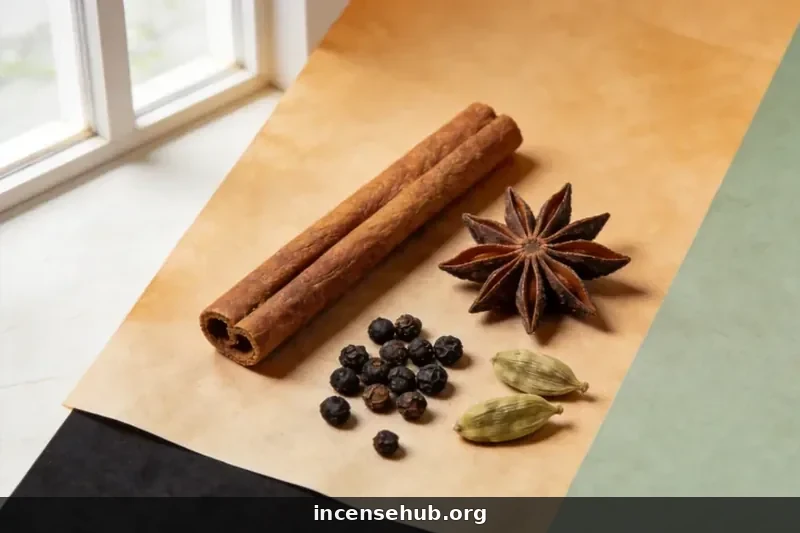
Direct answer: Dried ginger — 干姜 (gānjiāng) in Chinese — is the dehydrated rhizome of Zingiber officinale, the common ginger of the ginger family (Zingiberaceae), a tropical Asian plant now grown across the warm world. It is a warming, pungent spice whose sharp, faintly citrusy heat traces to gingerol and the plant’s essential oil, and in Chinese incense it serves as a sparing warming accent that lends a dry, penetrating heat to 合香 blends.
Key facts
| Field | Value |
|---|---|
| Chinese name | 干姜 (gānjiāng) — “dried ginger”; fresh ginger = 生姜 (shēngjiāng) |
| Botanical source | Zingiber officinale (Zingiberaceae) — the dried rhizome |
| Material class | A dried spice, not a wood or resin |
| Aromatic register | Spicy, pungent, warm, slightly citrusy |
| Traditional role | Warming spice accent in 合香 |
One species, two products
Direct answer: Dried ginger (干姜, gānjiāng) and fresh ginger (生姜, shēngjiāng) are the same Zingiber officinale rhizome handled two ways, and the drying step rewrites the chemistry — so the dried form runs hotter and more penetrating than the fresh one.
Ginger is best read as a single species that yields two products. The fresh rhizome (生姜) and the dried rhizome (干姜) come from the identical plant; what separates them is the drying. That step changes the chemistry and therefore the character, making 干姜 hotter and sharper than its fresh counterpart, and it is that dry, aromatic heat that earns dried ginger its seat in 合香. The distinction is not two plants but two processing states of one plant, a point the naming section below makes precise.
The gingerol-to-shogaol chemistry
Direct answer: Drying heats ginger enough to convert part of its pungent gingerol into shogaol, a sharper relative, and that conversion — not any change in the plant itself — is why the dried rhizome bites harder than the fresh one.
The chemistry is the heart of the material and it is worth laying out exactly. Fresh ginger’s pungency comes from gingerols, chiefly 6-gingerol, a molecule with a β-hydroxy ketone side chain. Apply drying — which means dehydration plus a period of mild warmth — and the gingerol sheds water to form shogaol, an α,β-unsaturated ketone that is both more pungent and more stable. The causal chain runs: fresh rhizome + drying → dehydration of the β-hydroxy ketone → conversion of 6-gingerol to 6-shogaol → a hotter, sharper, more penetrating heat. A second, related pathway, driven by cooking rather than drying, cleaves gingerol into zingerone, a sweeter, less fiery molecule — which is why cooked ginger reads warm and sweet while dried ginger reads hot. This chemistry, not folklore, is the reason 干姜 and 生姜 are treated as separate grades in traditional usage.
Botanical identity
Direct answer: Zingiber officinale is a perennial that grows from a creeping, aromatic rhizome, and Flora of China places it in the Zingiberaceae. The recorded measurements are pseudostems of 50–100 cm, lanceolate leaves of 15–30 by 2–2.5 cm, and a yellowish-green corolla with a labellum marked by a purple stripe and cream blotches; the useful part is the branched, fleshy rhizome, yellow inside.
Flora of China sets Zingiber officinale down as a rhizome-forming perennial, giving pseudostems 50–100 cm and sessile, lanceolate to linear-lanceolate leaf blades of 15–30 × 2–2.5 cm. The flower spike pushes up straight from the rhizome, and the bloom shows a yellowish-green corolla whose central labellum lobe carries a purple stripe and cream blotches. The working part is the branched, fleshy rhizome, yellow within and strongly scented. See Zingiber officinale in Flora of China and Zingiber officinale on GBIF.
The rhizome is the entire story here: a swollen, water-rich underground stem that concentrates the aromatic oil and the heat compounds. Unlike a wood or a resin, ginger’s value is stored in a fleshy organ that must be dried before it becomes the shelf-stable 干姜 material.
Chinese name and terminology
Direct answer: 干姜 (gānjiāng, “dried ginger”) and 生姜 (shēngjiāng, “fresh ginger”) name the same Zingiber officinale rhizome in its dried and fresh states, while the 姜 element also reaches across the ginger family to galangal (高良姜) and sand ginger (山柰), which are separate species rather than grades of the same plant.
The naming task splits in two:
- 干姜 versus 生姜: 干姜 is the dried rhizome and 生姜 the fresh rhizome of the same Zingiber officinale. They are one species in two processing states, and drying shifts the heat chemistry.
- The 姜 family versus the 姜 plant: the 姜 character also reaches across a whole family. 高良姜 (galangal, Alpinia officinarum) and 山柰 (sand ginger, Kaempferia galanga) belong to the same family as common ginger but are separate species, not grades of it. See galangal and sand ginger.
Where dried ginger comes from
Direct answer: Zingiber officinale is a tropical Asian plant of unknown native origin — Flora of China records it as cultivated, with the wild source unclear — now grown across China’s warm provinces and around the world, and it rides the culinary-spice trade, one of the largest-volume spice commodities there is.
Zingiber officinale is a tropical Asian plant whose original wild home is unrecorded; it is now cultivated worldwide. Flora of China lists it as grown across China’s warm provinces, running from Guangdong, Guangxi, Hainan, and Yunnan up through Sichuan, Hubei, and Shandong. Ginger ranks among the highest-volume spices traded anywhere, so dried ginger lands in the incense market as a commodity spice carrying an incense sideline — priced and sorted like a spice rather than a specialty aromatic.
Aroma profile
Direct answer: Dried ginger reads as spicy and pungent, a warm, dry heat resting on a faintly citrusy, resinous underlayer. The heat traces to gingerol, partly converted to the sharper shogaol during drying, which is why the dried form runs hotter than the fresh. Inside a blend it comes across as a warming spice.
The profile is pungent with a spicy core: a warm, dry heat resting on a faintly citrusy, resinous underlayer. The heat traces to gingerol, which partly converts to the sharper shogaol during drying. Within the ginger family it sits beside galangal (sharper, camphoraceous) and sand ginger (milder, more aromatic) while keeping its own warm, citrus-tinted character. Inside a blend it registers as a warming spice: a dry, aromatic heat that props up and brightens other spices without cinnamon’s or clove’s sweetness.
Why it enters incense
Direct answer: Dried ginger functions in incense as a warming spice accent inside 合香 blends, added in small quantities to supply a dry, penetrating heat that sharpens spice-forward formulas — a sparing supporting note, never a base and never a material burned alone.
Dried ginger’s incense role is a sparing spice accent:
- 合香 warming accent: 干姜 goes in at small doses to lend a dry, penetrating warmth to spice-forward blends, propping up and sharpening the other spices.
- Never the foundation: it is a supporting character that brightens and warms, not a material burned on its own as a complete fragrance.
合香 placement and the 君臣佐使 frame
Direct answer: Within 合香, dried ginger occupies the assistant (佐) tier of the classical 君臣佐使 scheme — an ingredient that moderates and sharpens rather than leads — because its heat is a seasoning, not a foundation.
The classical Chinese blending grammar runs on 君臣佐使: a chief (君) that leads, a minister (臣) that reinforces it, an assistant (佐) that harmonizes or tempers, and a guide (使) that steers the whole. Dried ginger fits the assistant tier naturally: a small dose of its dry heat sharpens a spice-forward blend without competing for the top of the pyramid. It never acts as the 君, because its character is supportive and its pungency, overdosed, turns a blend harsh. This framing is a compositional convention, not a measured fact.
How the rhizome is dried
Direct answer: Dried ginger is produced by drying the fresh rhizome — peeled or unpeeled — to a hard, shelf-stable state, and that drying step is what converts part of the gingerol into shogaol. Afterward it is used whole, sliced, or ground.
The decisive step is drying: the fresh rhizome is dried to a hard, shelf-stable state, and that drying is what turns part of its gingerol into the sharper shogaol. Afterward the material goes out whole, in slices, or ground. For powder, the same practical variables as any rhizome powder apply: particle size and moisture govern how the material packs, burns, and lets go of its aroma, and the correct target hinges on the formula. The grinding mechanics sit within the wider how incense is made process, and rhizome-powder behavior is covered in incense powder & resin.
Drying methods compared
Direct answer: The way ginger is dried — sun, shade, hot-air kiln, or more modern methods — changes how much gingerol converts to shogaol and how much volatile oil survives, so the drying method is a hidden quality variable, not a formality.
Drying is not one process but a family of them, and they do not produce identical results:
| Method | Heat and pace | Effect on the rhizome |
|---|---|---|
| Sun drying | Gentle, slow, weather-dependent | Mild conversion; retains more volatile oil |
| Shade drying | Cool, very slow | Least conversion; softer, fresher character |
| Hot-air kiln | Warm, controlled, faster | Stronger gingerol-to-shogaol conversion; hotter product |
| High-heat oven | Hot, fast | Maximum conversion but risks scorching and oil loss |
The trade-off runs through the whole table: more heat and speed → more gingerol converted to shogaol → a hotter, sharper rhizome, but also more volatile oil lost. A buyer who wants a sharp, penetrating heat favors the warmer methods; a buyer who wants the fresher, citrusy top favors the gentler ones. The method is rarely stated on a label, which is exactly why a pungency check at purchase matters more than the nominal name.
The ginger family, mapped
Direct answer: Dried ginger belongs to a large family of aromatic rhizomes and seeds — galangal, sand ginger, turmeric, and cardamom among them — that share a warm, camphoraceous family character yet are distinct species with distinct chemistries and uses.
Five members of the ginger family illustrate the spread:
| Material | Botanical source | Character | Chief chemical signature |
|---|---|---|---|
| Dried ginger 干姜 | Zingiber officinale, Zingiberaceae | Warm, pungent, slightly citrusy | Gingerol/shogaol; zingiberene |
| Galangal 高良姜 | Alpinia officinarum, Zingiberaceae | Sharp, camphoraceous, woody | Galangin; 1’-acetoxychavicol acetate |
| Sand ginger 山柰 | Kaempferia galanga, Zingiberaceae | Milder, more aromatic | Ethyl cinnamate; ethyl p-methoxycinnamate |
| Turmeric | Curcuma longa, Zingiberaceae | Earthy, bitter, coloring | Curcuminoids |
| Cardamom | Elettaria cardamomum, Zingiberaceae | Sweet, eucalyptus-cool | 1,8-cineole; α-terpinyl acetate |
They are distinct species in one family. See galangal, sand ginger, and the material comparison matrix for the general logic.
The chemistry of the ginger family
Direct answer: The ginger family’s aromas rest on a few chemical families — the pungent gingerols and shogaols of ginger, the coloring curcuminoids of turmeric, the cinnamates of sand ginger, and the cineole of cardamom — and naming those families is how a buyer tells the relatives apart.
Each relative leans on a different molecule. Ginger’s signature is the pungent pair gingerol and shogaol, backed by the essential oil zingiberene with its companions β-sesquiphellandrene and ar-curcumene. Turmeric’s is curcumin and its curcuminoid relatives, which stain everything they touch yellow-orange and read earthy rather than hot. Sand ginger’s is the cinnamates — ethyl cinnamate and ethyl p-methoxycinnamate — which give it a sweet, aromatic lift unlike ginger’s heat. Cardamom’s is 1,8-cineole with α-terpinyl acetate, a cool, eucalyptus-like sweetness carried in the seed pods rather than the rhizome. Galangal’s is galangin and 1’-acetoxychavicol acetate, sharp and camphoraceous. These are established chemistries, not trade lore, and they are what a lab report would actually show.
Adulteration and misidentification
Direct answer: Dried ginger is not a heavily faked aromatic — it is a cheap commodity — so its genuine risk is the 姜-family naming, the mix-up with galangal (高良姜) and sand ginger (山柰), which are separate species. Pinning down Zingiber officinale and the dried-versus-fresh qualifier settles it.
Dried ginger is a low-cost commodity spice, so fraud is not the same worry as with agarwood. The genuine risk is naming: the 姜 element spans galangal and sand ginger as well as common ginger, and 干姜 (dried) must be kept apart from 生姜 (fresh). Naming Zingiber officinale and the dried-versus-fresh qualifier settles the question.
What determines quality
Direct answer: Quality rests on a clean, firm, sharply aromatic rhizome whose pungency is intact — dried ginger should smell hot and bright when cut or warmed, never stale, soft, or fibrous, because a stale rhizome has already surrendered its heat. No standardized numerical grading exists.
The practical quality factors, in rough order:
- Scent and bite — a clean, sharp, warm aroma; the leading indicator, since the heat compounds are volatile.
- Density and firmness — a firm, dense rhizome holds its aromatics better than a soft, spongy one.
- Freedom from defects — no mold, no soil, no foreign matter.
- For powder — even particle size and moisture, measured against the specific formula.
Ginger carries no standardized numerical grading, which is itself a clue to its standing as a commodity spice rather than a specialty aromatic.
A quality-control checklist
Direct answer: A working QC checklist for dried ginger runs identity, dried-versus-fresh, pungency, and physical condition — because the species, the processing state, and the intensity of the heat are what actually determine whether a lot is fit for a blend.
For a purchaser building a repeatable specification, the checks are:
- Identity — Zingiber officinale (干姜), not galangal (高良姜) or sand ginger (山柰).
- Processing state — the dried form (干姜), since drying changes the heat chemistry.
- Pungency — hot and aromatic when cut or warmed; stale ginger has lost its heat.
- Condition — firm, dense, clean rhizome; consistent particle size for powder.
- Moisture — low enough to resist molding in storage, checked against the formula.
A sensory-evaluation method
Direct answer: Evaluating dried ginger sensibly means cutting or warming a piece and scoring its pungency, warmth, and citrus lift against a known fresh-dried reference — because intensity, not appearance, is the quality signal.
A repeatable, low-cost protocol for one person:
- Cut test — a freshly cut surface should release a sharp, warm, slightly citrusy aroma at once.
- Warm test — gentle warmth should intensify the heat without turning bitter or acrid.
- Pungency check — the material should bite on the tongue or the nose; a flat, stale piece has already lost its gingerol.
- Score on three axes — pungency, warmth, and citrus lift — rather than a single overall judgment.
This is a sensory practice, not a laboratory method, and it yields no published numbers — only a repeatable personal baseline.
A buying decision framework
Direct answer: For dried ginger, a buyer should confirm the species and the dried-versus-fresh state first, then check pungency by aroma, and treat intensity — not the name — as the signal, because ginger is a small-dose accent whose whole value is its heat.
The framework folds into four gates, applied in order:
- Gate 1 — Identity: Zingiber officinale, not a galangal or sand-ginger stand-in.
- Gate 2 — Processing state: dried (干姜), not fresh (生姜), since the chemistry differs.
- Gate 3 — Pungency: hot and aromatic; reject stale, fibrous, or flat material.
- Gate 4 — Dose logic: buy it as a small-dose accent, and judge value by intensity per unit, not by volume.
Storage and shelf life
Direct answer: Dried ginger keeps its heat longest when stored dry, cool, dark, and sealed, because its pungent compounds are volatile and degrade with moisture, warmth, light, and air — and a stale, faded rhizome is a rhizome whose whole point is gone.
The pungent chemistry of ginger is fugitive: gingerol and shogaol are volatile and degrade over time, and moisture, warmth, light, and air exchange all speed the loss. The practical rules are dry, cool, dark, and sealed — low humidity to prevent mold, low temperature to slow degradation, darkness to limit oxidation, and an airtight container to hold the volatile oil. There is no published shelf-life figure for dried ginger [need-source]; the observable signal is the pungency itself, which fades long before the material looks spoiled.
Supply chain and economics
Direct answer: Dried ginger is a low-cost commodity whose incense value is an afterthought of the culinary trade — its price is set by the spice market, not by incense demand — which makes it cheap, abundant, and subject to commodity quality swings rather than specialty scarcity.
The chain that shapes dried ginger runs: tropical cultivation at commodity scale → bulk drying and grading for the spice trade → wholesale distribution → a thin incense sideline that inherits the spice market’s price and quality. Because ginger is one of the largest-volume spices in the world, the incense buyer is a small passenger on a very large ship: the price is set by food demand, the grading is set by food standards, and the material’s quality swings with harvests, seasons, and storage conditions rather than with any incense-specific logic. The practical consequence is that correct identification and fresh, pungent condition — not price — are what an incense buyer actually controls.
Sourcing strategy
Direct answer: The sensible sourcing strategy for dried ginger is to buy it as a spice first and an aromatic second — from a spice supplier with turnover and freshness, not from a specialty-aromatic channel — because freshness is the whole game and the spice trade turns its stock fastest.
Dried ginger is best sourced where it moves fastest: a spice supplier with high turnover, not a specialty-aromatic channel with slow stock. Fast turnover means fresher material, and freshness is the entire game for a material whose value is a volatile pungency. The practical strategy: buy small lots often rather than large lots rarely, insist on the scientific name and the dried-versus-fresh qualifier, check pungency at receipt, and store the stock dry, cool, and sealed. A spice supplier who can state the harvest and drying method is worth more than an aromatic supplier who cannot.
Common forms
Direct answer: Dried ginger is sold as whole dried rhizome, sliced pieces, and ground powder — whole and sliced for culinary and traditional use and for inspection, powder for incense blending — the same material in different physical forms, not a quality distinction.
| Form | Typical use |
|---|---|
| Whole dried rhizome | Spice cooking, traditional use, inspection |
| Sliced pieces | Cooking, inspection |
| Powder | Mixed into incense sticks and cones |
The distinction is functional, not a quality statement. See incense powder & resin for how rhizome powder behaves in practice.
Turmeric, the coloring cousin
Direct answer: Turmeric — Curcuma longa, a fellow Zingiberaceae — is ginger’s earthy, bitter, staining relative, valued for its yellow curcuminoid pigments rather than for heat, and the two are frequently confused by newcomers even though their roles diverge completely.
The family tie is real but the characters are opposites. Turmeric’s rhizome is orange-yellow inside, dense, and built around curcuminoids — curcumin, demethoxycurcumin, and bisdemethoxycurcumin — the compounds that stain fingers, cloth, and curries yellow-orange. Its flavor runs earthy, bitter, and astringent rather than hot, because it carries almost none of the gingerol that gives ginger its bite. Where dried ginger supplies a dry, penetrating heat, turmeric supplies color and a musky, rooty depth. For an incense blender the practical point is the dye: a turmeric-heavy formula will tint a pale base yellow, a property dried ginger does not share.
Cardamom, the cool cousin
Direct answer: Cardamom — the seed pods of Elettaria cardamomum — is ginger’s cool, sweet, eucalyptus-scented relative, and its aroma comes from 1,8-cineole and α-terpinyl acetate, a profile utterly unlike ginger’s pungent heat.
Cardamom turns the family chemistry in a different direction. Green cardamom is sold as small, papery pods holding clusters of dark seeds; the aroma lives in the seeds and is dominated by 1,8-cineole and α-terpinyl acetate, which together read sweet, cool, and slightly eucalyptus-like. There is no gingerol heat and no pungency, which is why cardamom lands in sweet and floral blends while dried ginger lands in warm, spice-forward ones. Black cardamom (Amomum subulatum) is a different species again, dried over open fire to a smoky, camphoraceous character. The trio — ginger’s heat, turmeric’s color, cardamom’s cool sweetness — shows how one family can cover three opposite corners of the spice world.
The global ginger trade
Direct answer: Ginger is grown and traded at enormous commodity scale, with India, China, and Nigeria among the largest producers, and the dried form flows through the same bulk-spice channels that supply food processors — which is why an incense buyer inherits spice-market pricing and grading.
The scale is what matters. Ginger is cultivated across the tropics and subtropics, with India, China, Nigeria, Nepal, Thailand, and Indonesia among the leading producers, and it moves in bulk through the same ports, graders, and brokers that handle pepper, turmeric, and cinnamon. Dried ginger is a standard commodity lot — cleaned, sized, and graded for the food trade — and the incense market taps that stream rather than maintaining a separate one. The consequence for a buyer is already stated but bears repeating: price, quality, and availability all track the spice harvest, the weather, and the food market’s demand, not anything incense-specific.
The Zingiberaceae family, taxonomically
Direct answer: The ginger family (Zingiberaceae) is a large tropical clan whose familiar genera — Zingiber, Curcuma, Elettaria, Alpinia, Kaempferia — each carry a different aromatic strategy, and knowing the genera is how a buyer keeps the relatives straight.
The family map resolves the naming confusion. Zingiber holds the true gingers; Curcuma holds turmeric and its kin; Elettaria holds cardamom; Alpinia holds galangal; Kaempferia holds sand ginger; and Hedychium holds the ornamental ginger lilies. Each genus leans on a different chemistry — gingerol and shogaol in Zingiber, curcuminoids in Curcuma, cineole in Elettaria, galangin and acetoxychavicol acetate in Alpinia, cinnamates in Kaempferia — which is why a single Chinese character (姜) stretched across them causes so much confusion. The remedy is the scientific name, and the genus is the first word of it.
Ginger essential oil, in detail
Direct answer: Ginger’s essential oil is dominated by the sesquiterpene zingiberene with its companions ar-curcumene and β-sesquiphellandrene, plus a citrus note from citral — a profile that explains the warm, faintly citrusy base behind the pungent heat.
Separate the heat from the smell and the oil comes into focus. Steam-distilled ginger oil is built on zingiberene, the principal sesquiterpene, backed by ar-curcumene, β-sesquiphellandrene, and β-bisabolene; a smaller but important share goes to citral (geranial and neral), which supplies the lemon-like lift, and to camphene, which adds a dry, slightly piney note. Notice what is absent: gingerol and shogaol, the pungent molecules, are not volatile enough to distill, so the oil carries the aroma but not the bite. That split — oil for scent, gingerol for heat — is why a whole rhizome reads both warm and hot, while an isolated oil reads only warm.
Pungency as a sensation
Direct answer: Ginger’s heat is a chemical irritant effect, not a temperature: gingerol and shogaol activate the TRPV1 receptor, the same heat-and-pain channel that capsaicin in chili pepper fires, though ginger compounds are far milder — which is why dried ginger reads hot but never scorching.
The sensation is receptor chemistry. TRPV1 is a protein channel on sensory nerve endings that opens in response to heat or to certain molecules; capsaicin, the fiery compound in chili, binds it and produces the familiar burn. Gingerol and shogaol activate the same channel, but with much lower potency, so ginger reads as a warm, dry heat rather than a fire. This is also why dried ginger’s pungency can sting the nose when overdosed in a burning blend: the same receptor sits in the nasal lining, and a concentrated plume of shogaol is an irritant, not a perfume. The dose lesson follows directly from the biology.
Ginger on the spice routes
Direct answer: Ginger has moved along trade routes for millennia — recorded in the Mediterranean by classical writers and priced dearly in medieval Europe — and that long commercial history is why it arrived in China’s warm provinces as a settled crop rather than a curiosity.
Ginger’s travel history predates the incense question entirely. Classical Mediterranean authors knew it, and by the medieval period it was a costly, much-sought spice carried westward from Asia along the same routes that moved pepper and cinnamon. That deep trade history explains the present: a plant of tropical Asian origin, native range unrecorded, now naturalized into cultivation across southern China and the tropics, grown for food at commodity scale. For this page the history matters for one reason only — it is why ginger is a cheap, abundant, well-documented spice, and why its incense use is a small sideline to a very old and very large food trade.
The anatomy of a rhizome
Direct answer: Ginger’s useful part is a rhizome — a horizontal underground stem that sends up leafy pseudostems and flower spikes while storing water, starch, and the aromatic oil — and understanding that anatomy explains why drying, not the plant’s top growth, is the whole story.
The rhizome is a stem, not a root. It creeps horizontally beneath the soil, bears nodes and internodes like any stem, and stores water, starch, and the volatile oil that carries the scent. From it rise the pseudostems — tight bundles of overlapping leaf sheaths that look like stems but are not — and the short inflorescences whose bracts shelter the flowers. The rhizome is also where the water lives, which is why it must be dried to become shelf-stable 干姜, and why the drying step, not the leaf or the flower, is the axis on which the whole material turns.
Drying and its economics
Direct answer: Drying ginger is a matter of removing enough water to stop spoilage and trigger the gingerol-to-shogaol shift, and the energy cost of that drying is a real part of the commodity price — which is why faster, hotter methods exist and why they change the flavor.
The economics of drying follow the biology. A fresh rhizome is mostly water, and that water must come out — down to a moisture content low enough to halt microbial growth and enzymatic spoilage — before the material is stable enough to store and ship. The removal takes energy, and energy costs money, so producers face a trade-off: gentle sun or shade drying is cheap but slow and weather-dependent, while hot-air kilns are fast and predictable but cost fuel and push the gingerol-to-shogaol conversion further. The result is that “dried ginger” is not one product but a range, and the drying method is baked invisibly into the price and the pungency alike.
A reader’s checklist for this page
Direct answer: This page distills to a short sequence — confirm the species, confirm the dried form, then check the pungency — and a reader who carries away only that sequence has carried away the practical core.
Boiled down, the guidance is three steps with a caveat. Step one: pin the species as Zingiber officinale, because the 姜 name spans galangal and sand ginger. Step two: confirm the dried form (干姜), because drying rewrites the heat chemistry. Step three: check the pungency by cutting or warming a piece, because a stale, flat rhizome has already lost the heat that is its whole value. The caveat: buy it as a small-dose accent, and judge value by intensity per unit, not by volume or price. That sequence — species, dried form, then pungency — is the entire article in one breath.
Gingerol chemistry, deeper
Direct answer: Gingerol is not one molecule but a family — 6-, 8-, and 10-gingerol, named for their carbon chain lengths — and drying turns them into the corresponding shogaols, while cooking splits gingerol into the milder zingerone, so the plant’s heat is really a small system of interconverting molecules.
The pungent chemistry is a family, not a single compound. 6-gingerol, the most abundant, carries a six-carbon tail; 8-gingerol and 10-gingerol carry longer tails and read as slightly different heats. Drying dehydrates each into its matching shogaol — 6-shogaol, 8-shogaol, 10-shogaol — which are sharper and more stable. Cooking, by contrast, runs a retro-aldol cleavage that splits gingerol into zingerone, a gentler, sweeter molecule. A further relative, paradol, forms when shogaol is hydrogenated. The point is that “ginger heat” is a shifting equilibrium, and the drying-versus-cooking choice pushes that equilibrium in opposite directions — toward sharp shogaol or toward mellow zingerone.
Oleoresin, essential oil, and powder
Direct answer: Ginger reaches the blender in three forms that carry different fractions of the plant — the essential oil holds the aroma, the oleoresin holds aroma plus heat, and the plain powder holds everything — and the choice between them is a choice about how much heat to include.
The extraction route decides what survives. Steam distillation strips the volatile oil — the zingiberene, ar-curcumene, and citral — but leaves the non-volatile gingerol and shogaol behind, so the oil smells warm yet carries no bite. Solvent or CO₂ extraction yields an oleoresin, a thick concentrate that captures both the oil and the pungent resins. Plain powder is simply the dried rhizome ground whole, carrying aroma and heat together in their natural ratio. For a blend that wants warmth without fire, the oil is the tool; for one that wants the full warming accent, the powder is the honest choice; the oleoresin sits between, offering intensity with a dose.
Where ginger sits on the heat scale
Direct answer: Ginger’s pungency is modest on the absolute scale of spice heat — far below chili’s capsaicin and below black pepper’s piperine — and that modest heat is exactly why it works as a warming accent rather than a fire.
Placed beside its hotter cousins, ginger’s bite is gentle.
| Irritant | Source | Relative heat character |
|---|---|---|
| Capsaicin | Chili pepper | Fiery, long-burning |
| Piperine | Black pepper | Sharp, quick, biting |
| Gingerol / shogaol | Ginger | Warm, dry, penetrating |
| Galangal’s pungents | Galangal | Sharp, camphoraceous |
Gingerol and shogaol bind the same TRPV1 receptor as capsaicin but with far lower potency, so dried ginger warms rather than burns. That middle position is a feature, not a defect: a warming accent must heat a blend without overwhelming it, and a material that stung like chili would be unusable in the small doses ginger is meant to occupy.
The trigeminal dimension of smelling ginger
Direct answer: What a nose registers when ginger is burned heavily is two senses at once — the olfactory system reading the aroma, and the trigeminal system reading the pungency as an irritation — and the second channel is why overdosing stings rather than perfumes.
The nose runs two sensory channels. The olfactory nerve reads odor molecules as smell; the trigeminal nerve reads irritants — the burn of ammonia, the sting of strong spice — as a sharp, physical sensation. Ginger stimulates both: the volatile oil reaches the olfactory receptors as a warm, citrusy smell, while the shogaol reaches the trigeminal endings as a sting. In small doses the trigeminal component reads as a pleasant tingle; in heavy smoke it reads as an irritant. The distinction explains the dosing rule in physiological terms: keep the pungency in the tingle range, and the material perfumes; push it into the burn range, and it merely stings.
Ginger in the 本草綱目 frame
Direct answer: In the classical Chinese materia medica, ginger sits in the 本草綱目’s vegetable section (菜部), classified as a warming aromatic, and that classification is traditional language — not a clinical claim, and this page makes none.
The classical record places ginger among the foodstuffs. 本草綱目, the great Ming-era materia medica, files ginger under 菜部 — the vegetable section — and describes it in the language of warming and dispersing that traditional medicine used. That placement is historically documented and it anchors ginger’s dual identity as both food and traditional remedy. For this page the record matters only as context: it explains why ginger carries a “warming” label in Chinese usage, and it is cited as traditional language rather than as modern clinical evidence, which this page does not claim.
A buyer’s sensory vocabulary
Direct answer: Describing dried ginger precisely means borrowing perfumery’s frame — a citrus top, a warm-spice heart, and a faintly resinous base, with a short dry-down — so a buyer can name what they smell instead of stopping at “hot.”
Perfumery’s terms transfer cleanly. The top note is the first, volatile impression — for dried ginger, the lemon-like lift from citral. The heart note is the character that develops — the warm, pungent spice body. The base note is what lingers — the faintly resinous, woody tail. The dry-down is the late phase as the light compounds leave and the heavier ones stay; for ginger it is short, which is why the material reads as a brightening accent rather than a foundation. Two habits follow: rest the nose between samples, because pungency flattens the sense quickly, and compare side by side, because spice memory fades fast.
Comparative drying across the spice world
Direct answer: Ginger is dried much as its relatives are — sun, shade, kiln, or smoke — but the method that suits each rhizome differs, and the smoke-drying used for black cardamom shows how drying can be a flavor in its own right.
The drying choice is a flavor choice across the whole spice family. Turmeric is often boiled or steamed first, then sun-dried to set its color; galangal is sliced and sun- or kiln-dried like ginger; sand ginger is dried gently to preserve its delicate cinnamate aroma. Black cardamom is the instructive extreme: its pods are dried over an open fire, and the smoke becomes part of the spice’s character — proof that drying is never neutral. For dried ginger, the lesson is that “dried” is an underspecified word: the method sets the pungency, the oil retention, and the price, and a buyer who knows the method knows more than one who knows only the name.
What this material is not
Direct answer: Dried ginger is not a wood, not a resin, not a flower, and not a chili-level heat — four negatives that matter because each one corrects a misreading that would misplace it in a formula.
Four clarifications keep the material in proportion. It is not a wood or a resin; the useful part is a dried, fleshy underground stem. It is not a flower or a bark; there is nothing to harvest but the rhizome. It is not a fiery chili; its pungency is warm and dry, not scorching. And it is not a base material; it is a sparing accent whose whole value is a measured dose of heat. Each negative places the material where it belongs — as a supporting, warming spice in a blend, never the star.
A formulation thought experiment
Direct answer: Imagine a simple 合香 with sandalwood as the 君 and cinnamon as the 臣: a pinch of 干姜 as the 佐 supplies the dry, penetrating warmth that ties the sweet and woody halves together, and the dose is measured in single-digit percentages, not handfuls.
Reason through one hypothetical to fix the proportions in mind. Let sandalwood (檀香) lead as the 君 and cinnamon carry the sweet-spice body as the 臣; a small measure of 干姜 then acts as the 佐, its dry heat cutting through the sweetness so the blend reads warm rather than cloying. The dose that achieves this is small — think a low single-digit share by weight, adjusted against the formula’s sweetness — because ginger’s pungency is sharp and volatile. The thought experiment is not a recipe; it is a way of seeing why the material is always a seasoning, never the substance.
The buyer’s questions, restated
Direct answer: Every sourcing question on this page reduces to three — what species, which form, and how pungent — and a supplier who answers those three flatly is worth more than one who recites the ginger story at length.
Strip away the detail and three questions remain. What species? The answer should be Zingiber officinale, in Latin, not just 姜. Which form? Dried (干姜), not fresh (生姜), and — for powder — the particle size. How pungent? Hot and aromatic when cut, not stale or flat. A supplier who answers these three directly, and who can state the drying method and the harvest, is offering the only information that actually protects a purchase. Everything else on this page is elaboration of those three questions.
A glossary of ginger’s compounds
Direct answer: Ginger’s character reduces to a short list of named molecules — zingiberene for the warm base, citral for the citrus lift, gingerol and shogaol for the heat — and learning that list turns a vague “gingery” into precise, checkable descriptors.
A working glossary for the material:
- Zingiberene — the principal sesquiterpene, supplying the warm, slightly woody aroma base.
- ar-curcumene and β-sesquiphellandrene — companion sesquiterpenes that round out the warm body.
- Citral (geranial and neral) — the lemon-like top note.
- Camphene — a dry, faintly piney monoterpene note.
- 6-gingerol — the main pungent compound of fresh ginger.
- 6-shogaol — the sharper, more stable pungent formed when gingerol dehydrates.
- Zingerone — the sweeter, milder molecule formed when gingerol is cooked.
- Paradol — a pungent relative formed by hydrogenating shogaol.
The glossary’s value is diagnostic: a nose that can separate the citral lift from the zingiberene base is a nose that can tell a fresh-dried lot from a stale one.
The spice routes and their ports
Direct answer: Ginger traveled the Indian Ocean spice routes long before it was an incense ingredient — from the Malabar coast of India westward through the Red Sea and the Persian Gulf to Alexandria and Venice — and that seaborne history is why it became a settled crop across southern China rather than a local curiosity.
The route shaped the crop. Indian Ocean trade ran on the monsoon winds, whose seasonal reversal let sailing ships shuttle between the Malabar coast, the Arabian ports, and the Red Sea, feeding ginger and its kin westward to Alexandria and Venice. Ginger was among the spices that made those routes profitable, and its value in Europe kept it moving for centuries. The consequence for this page is indirect but real: a plant whose native origin is unrecorded, distributed by a millennia-old spice trade, arrives in the incense market as a settled, abundant commodity — a history that explains its low price and its food-market grading better than any incense-specific story could.
Ginger in food versus in smoke
Direct answer: Ginger behaves differently in the kitchen and on the ember because heat transforms its chemistry in opposite directions — cooking drives gingerol toward the sweeter zingerone and builds browned flavors, while incense warming releases the intact volatile oil and the sharp shogaol — so the same plant reads warm-sweet in food and hot-dry in smoke.
The two contexts pull ginger’s chemistry apart. In cooking, sustained heat runs the retro-aldol cleavage that turns gingerol into zingerone, and the high temperatures of frying or roasting add Maillard browning and caramelization, so cooked ginger reads warm and sweet. In incense, the goal is the opposite: gentle warming vaporizes the intact essential oil and releases the sharp shogaol without burning the tissue, so the material reads hot and dry. The same rhizome thus lands on two different characters depending on whether it is stewed or warmed — which is exactly why a cook and an incense blender describe the same root in different words.
The botany of the ginger flower
Direct answer: The ginger flower is built to the Zingiberaceae plan — a showy labellum formed from fused staminodes, a single fertile stamen, and a bracted inflorescence rising from the rhizome — and the flower’s structure, not the rhizome, is what botanists use to place the species.
The flower carries the family’s signature. Zingiberaceae blooms have a labellum — a prominent, petal-like lip formed from fused sterile stamens — which is the structure that carries the purple stripe and cream blotches Flora of China records for Zingiber officinale. Behind it sits a single fertile stamen, with the remaining stamens converted into the labellum and its side lobes, and the whole inflorescence rises from the rhizome wrapped in overlapping bracts. The rhizome may be the part that is harvested, but the flower is the part that identifies the species, and the two are connected by the same underground stem that anchors the entire plant.
The genus Zingiber beyond officinale
Direct answer: Zingiber is a genus, not a single plant — beyond the culinary Z. officinale it holds Z. zerumbet, Z. mioga, and others — and the existence of those relatives explains why the bare name “Zingiber” still needs the species epithet to be precise.
The genus extends well past the dinner table. Zingiber zerumbet, the shampoo or pinecone ginger, bears a conical, waxy inflorescence and is grown as an ornamental and for its aromatic sap. Zingiber mioga, the Japanese myoga, is grown for its edible flower buds and young shoots rather than its rhizome. Zingiber cassumunar, sometimes called plai, is a distinct aromatic used in Southeast Asia. Each is a different plant with a different use, and the lesson is the one this page has repeated: the genus name alone is a family label, and only the full binomial — Zingiber officinale — pins down the dried ginger of the spice trade.
The language of heat across traditions
Direct answer: Different traditions describe ginger’s warming character in different registers — Chinese usage speaks of a warming (温) quality, Ayurvedic classification treats it as heating in potency — and those labels are cultural descriptions of the same pungency, not competing scientific claims.
Heat is a shared descriptor with local vocabularies. Chinese usage groups ginger among the warming aromatics, and the traditional materia medica speaks of it in those terms. Ayurveda, the classical Indian system, classifies ginger as heating in its potency — ushna — and uses it accordingly. These are two traditional languages naming one physical fact: the pungency that gingerol and shogaol deliver. For this page the labels matter only as context; they are cited as traditional descriptions, not as modern clinical evidence, and no medical claim rests on them.
Ginger’s essential oil in industry
Direct answer: Ginger’s volatile oil is a commodity in its own right — used in beverages, flavorings, and fragrance — and that industrial demand sits alongside the food and incense uses, competing for the same rhizome harvest.
The oil has a life outside incense. Steam-distilled ginger oil flavors ginger ale and ginger beer, seasons baked goods and confectionery, and appears in fragrance and aromatherapy formulations. That industrial channel is a fourth buyer of the same harvest, alongside the fresh-produce market, the dried-spice market, and the incense sideline, and it means the oil’s availability and price track the broader spice economy. For an incense blender the practical note is small but real: the oil is the warm-aroma fraction without the heat, and it is a legitimate, consistent way to carry ginger’s scent into a formula where whole powder would add unwanted bite.
Storage chemistry, in detail
Direct answer: Dried ginger degrades through oxidation — its terpenes and pungent compounds slowly reacting with air — and that chemistry is why dry, cool, dark, sealed storage preserves the heat that warmth, light, and oxygen quietly destroy.
The degradation is chemical, not merely cosmetic. The terpenes that carry the aroma — zingiberene, citral — oxidize on contact with air, turning from bright and warm toward stale and flat; the pungent gingerol and shogaol are likewise vulnerable, losing their bite over time. Moisture invites mold, warmth speeds every reaction, and light drives photochemical breakdown. The four-part storage rule — dry, cool, dark, sealed — is therefore a direct answer to four specific enemies, and a buyer who stores ginger correctly is simply slowing the oxidation that otherwise spends the very compounds the purchase was meant to secure.
Crystallized and candied ginger, and why they differ
Direct answer: Crystallized ginger is a confection, not a spice: fresh rhizome cooked in sugar syrup until the sugar replaces much of the moisture, and it is the opposite of the dried 干姜 that incense uses — sweet, soft, and heat-muted, where 干姜 is dry, hard, and sharp.
The sugar step changes everything. Candied or crystallized ginger starts as fresh rhizome, is simmered in syrup, and is then rolled in sugar so that sucrose takes over where water was; the result is a sweet, chewy confection whose heat is blunted by the sugar and whose character is nothing like the hard, dry, sharply pungent 干姜 of the spice trade. The two share a name and a plant but are opposite products, and the distinction matters whenever a label or a supplier blurs them. For incense, only the dried, unsweetened rhizome is relevant.
The nose knows: telling ginger from galangal
Direct answer: Ginger and galangal can be told apart by a focused smell — ginger runs warm and citrusy, galangal sharp and camphoraceous — but only against a known reference, because the family resemblance is strong enough to fool a cold nose.
The discrimination is trainable. Ginger’s signature is a warm, faintly lemon-tinted heat; galangal’s is a sharper, cooler, camphor-and-pine character that sits higher and drier. Sand ginger is milder and more floral-sweet. The reliable way to learn the difference is comparison against known samples, side by side, until the citrus-warm versus camphor-sharp split becomes automatic — the same reference-training this page recommends for every identification task, because the nose needs a benchmark before any “this is ginger” judgment carries weight.
The etymology of “ginger”
Direct answer: The English word “ginger” descends a long chain — from Sanskrit śṛṅgavera through Greek zingiberis and Latin zingiber — and the scientific genus Zingiber preserves that ancient root, a reminder that the plant’s name traveled the same routes as its rhizome.
The name is a fossil of the trade. “Ginger” reaches English by way of Middle English and Old French, from Medieval Latin gingiber, which itself came from Latin zingiberi and Greek zingiberis; the trail ends at Sanskrit śṛṅgavera, traditionally glossed as “horn-shaped,” a nod to the rhizome’s knobby silhouette. The scientific genus Zingiber keeps that root in plain sight. The etymology matters only lightly here, but it is a tidy reminder that ginger’s words, like its spice, moved along the old routes from South Asia westward — the same routes the trade section above describes.
Galangal’s chemistry, in detail
Direct answer: Galangal’s sharpness rests on two quite different molecules — the pungent 1’-acetoxychavicol acetate and the flavonol galangin — neither of which is a gingerol, which is why galangal reads camphoraceous rather than warm like ginger.
Galangal does not share ginger’s heat chemistry. Its pungency comes largely from 1’-acetoxychavicol acetate (ACA), a molecule absent from common ginger, and its bitter, aromatic depth from galangin, a flavonol of the flavonoid family. The result is a sharp, camphoraceous, slightly medicinal character that sits high and dry rather than warm and citrusy. The contrast with ginger is the practical point: two rhizomes in one family, with the genus Alpinia leaning on acetoxychavicol acetate and galangin while Zingiber leans on gingerol and shogaol — which is exactly why a lab report, not a common name, is the reliable way to tell them apart.
Sand ginger’s cinnamates
Direct answer: Sand ginger (Kaempferia galanga) is defined by cinnamates — ethyl cinnamate and ethyl p-methoxycinnamate — sweet, aromatic esters that give it a floral lift unlike both ginger’s heat and galangal’s camphor.
Sand ginger’s signature is an ester, not a pungent. Ethyl cinnamate and ethyl p-methoxycinnamate are sweet, spicy, floral-aromatic compounds, and they give Kaempferia galanga — called kencur in Indonesia — a gentle, perfumed character that is milder and more aromatic than either ginger or galangal. The chemical divergence within one family is the theme again: ginger runs pungent, galangal runs camphoraceous, sand ginger runs floral, all from closely related plants. For a blender, that spread is an asset — it means the 姜 family can supply heat, sharpness, or sweetness depending on which species is chosen.
The ginger family in global cuisines
Direct answer: The ginger family feeds the world in ways that map onto its chemistry — Thai tom yum uses galangal’s camphor, Indonesian kencur uses sand ginger’s cinnamates, Indian cooking uses dried ginger’s heat, and Japanese cooking separates fresh ginger (shōga) from the flower-bud myoga — a culinary proof that the relatives are not interchangeable.
The cuisines are a living key to the family. Thai tom yum builds its fragrant heat on galangal’s camphoraceous sharpness, a role ginger cannot fill. Indonesian and Malay cooking reach for kencur — sand ginger — where a delicate floral note is wanted. Indian cooking uses both fresh ginger (adrak) and dried ginger (sonth) for warmth and bite. Japanese cuisine keeps fresh ginger (shōga) and the young shoots of Zingiber mioga (myoga) as separate ingredients with separate uses. Each tradition has sorted the family by chemistry, and the sorting is a reminder that the 姜 relatives are distinct materials, not synonyms — the exact point an incense buyer should carry back to the sourcing question.
What “officinale” means
Direct answer: The species epithet officinale marks a plant of recognized use — it descends from the Latin officina, the monastic storeroom or workshop where remedies were kept — and it is why so many culinary and medicinal plants, ginger among them, carry the label.
The epithet is a badge, not a description. In botanical naming, officinale (or its feminine form officinalis) attaches to plants long held in the officina — the workshop of a monastery or apothecary — where valued substances were stored and dispensed. Ginger’s full binomial, Zingiber officinale, therefore says two things at once: the genus Zingiber places it, and the epithet officinale records that it was a plant of practical, storeroom-worthy use. The naming convention reaches across the spice shelf — rosemary (Rosmarinus officinalis), sage (Salvia officinalis), and others carry the same marker — and it quietly confirms what the trade history already shows: ginger earned its Latin label as a useful, traded commodity.
Water activity and how drying preserves
Direct answer: Drying preserves ginger by lowering its water activity — the fraction of water actually available to microbes — below the threshold where mold and bacteria can grow, and that threshold, not dryness to the touch, is the real measure of shelf stability.
Preservation is a question of water activity (written aw), not merely wetness. Even a material that feels dry can hold enough free water for microbes if its water activity is too high; the practical thresholds are that most bacteria need an aw above roughly 0.91, most yeasts above about 0.88, and most molds above about 0.70. Drying a rhizome pushes its water activity down through those ranges, and below the mold threshold the material stops spoiling and becomes the shelf-stable 干姜 of the spice trade. The concept explains why drying is the defining step for ginger — it is not the removal of moisture for convenience but the removal of the free water that would otherwise let the rhizome rot.
The autoxidation problem in stored spices
Direct answer: Stored spices degrade by autoxidation — a self-propagating, free-radical reaction between their unsaturated oils and atmospheric oxygen — and that chemistry is the reason dried ginger fades and turns flat even when sealed away from pests.
Oxidation is the slow enemy. The terpenes and related oils in dried ginger carry carbon–carbon double bonds that react with oxygen in a chain reaction of three stages — initiation, where a free radical forms; propagation, where one radical breeds another; and termination, where two radicals meet and stop. The propagation stage is what makes autoxidation self-sustaining, and its products are the stale, flat notes that replace a fresh, warm aroma over time. Substances that interrupt the chain — antioxidants such as tocopherols — slow the process, which is why well-stored, fresh-dried ginger keeps its heat while old, air-exposed stock does not. The practical rule follows directly: minimize oxygen, light, warmth, and moisture, and the autoxidation that spends the aroma is slowed to a crawl.
In Chinese tradition
- Blended incense (合香): 干姜 acts as a warming spice accent, dosed small to lend a dry, penetrating warmth to spice-forward blends. Historical record — documented formula use.
- Culinary staple: ginger underpins a huge span of Chinese cooking, appearing fresh and dried across countless dishes. Historical record — documented culinary use.
- Materia medica: 干姜 appears in traditional Chinese medicine (本草綱目, 菜部) with described uses. Traditional use — traditional materia-medica language, not modern clinical evidence.
Traditional use versus modern evidence
Direct answer: The aromatic and culinary use of ginger is well documented, while its medicinal uses are traditional rather than established clinical fact, and this page makes no medical claims. What stands as documented, non-medical fact is the botanical identity, the Zingiber placement, the dried-versus-fresh split, and the warm, pungent aromatic role.
The evidence sorts into three buckets:
- Traditional use — 干姜 as a warming spice accent and culinary staple, plus its traditional materia-medica applications.
- Historical record — the 本草綱目 菜部 record of ginger and the documented formula use in 合香.
- Scientific evidence — the botanical identity of Zingiber officinale (Zingiberaceae) and the gingerol-to-shogaol chemistry are documented; no clinical or medical efficacy claim is made.
Safety
Burning incense releases smoke and fine particulate matter. Use it in a well-ventilated room, do not breathe in dense smoke, and keep it out of reach of children and pets. Dried ginger’s pungency can irritate the nostrils if burned in quantity; dose it lightly. This is editorial knowledge content rather than medical advice. See our safety guide.
What the author would flag
Direct answer: The misconception worth correcting is that dried ginger and fresh ginger are interchangeable — they are not, because drying rewrites the heat chemistry and shifts the whole character toward a hotter, more penetrating note.
Two editorial judgments stand out.
First, the dried-versus-fresh line is a chemistry line, not a convenience line. 干姜 is not simply dried 生姜; it is a chemically different product, because drying converts gingerol into the sharper shogaol. The myth to correct is treating the two as the same spice in different moisture states — they are one plant but two characters. The author’s view, not a verified fact.
Second, the boundary is the 姜-family naming. The 姜 element spans ginger, galangal, and sand ginger, which are distinct species. Unless the scientific name is pinned down, “姜” is a family label, not a material. The author’s view, not a verified fact.
Common mistakes
- Treating dried and fresh ginger as interchangeable. Drying converts gingerol to shogaol, shifting the character toward hotter and sharper.
- Confusing ginger with galangal or sand ginger. They are distinct 姜-family species.
- Burning it heavily. Ginger’s pungency can sting the nose; it is a sparing accent, not a base.
- Ignoring pungency. Stale, fibrous ginger has already lost the heat that is the whole point.
FAQ
Q: What is dried ginger (干姜)?
The dehydrated rhizome of Zingiber officinale, the common ginger of the Zingiberaceae, a tropical Asian plant now grown worldwide. It is a warming, pungent spice with a sharp, faintly citrusy warmth that traces to gingerol and the essential oil. In Chinese incense it is dosed sparingly as a warming spice accent within 合香 blends.
Q: What separates 干姜 (dried) from 生姜 (fresh)?
They are the same Zingiber officinale rhizome handled two ways. 生姜 (shēngjiāng) is the fresh rhizome; 干姜 (gānjiāng) is the dried one. Drying partly turns the heat compound gingerol into the sharper shogaol, so the dried form is hotter and more penetrating than the fresh. They are one species carrying two different characters, not two plants.
Q: How does dried ginger relate to galangal and sand ginger?
They are related but distinct gingers. 干姜 is Zingiber officinale; galangal (高良姜) is Alpinia officinarum; sand ginger (山柰) is Kaempferia galanga. The three carry a warm, camphoraceous family character from the Zingiberaceae, yet each stands as its own material with a dedicated page in this encyclopedia.
Q: What does dried ginger smell like?
Spicy and pungent, with a warm, dry heat resting on a faintly citrusy, resinous base. The heat traces to gingerol, partly converted to the sharper shogaol on drying — which is why the dried form runs hotter than the fresh. In a blend it reads as a warming spice that supplies dry, aromatic heat without cinnamon’s or clove’s sweetness.
Q: Why is dried ginger hotter than fresh?
Because drying partly converts gingerol — the chief heat compound of fresh ginger — into shogaol, a sharper, more penetrating molecule. The upshot is that 干姜 carries a more intense, dry heat than 生姜, even though both come from the same rhizome. That is why they are treated as distinct grades in traditional usage.
Q: How much dried ginger should a blend use?
Sparingly. Ginger is a warming accent whose pungency can sting the nose if burned heavily, so it is added in small quantities to sharpen a spice-forward formula rather than to lead it. It is a supporting note, not a base, and a little of its dry, penetrating heat goes a long way — the exact proportion is a formula decision, not a fixed number.
Sources
These two references document the botanical identity and distribution of Zingiber officinale, and they support the dried-versus-fresh distinction as a processing matter. They support no medical claim, and this page makes none. Ginger is documented as a warming spice; medicinal uses are handled as traditional, not established clinical fact.
Related Resources
- Galangal (高良姜) — the sharper, camphoraceous ginger-family relative.
- Sand ginger (山柰) — the milder, more aromatic ginger-family relative.
- Cinnamon — the sweet spice ginger brightens against.
- Material comparison matrix — the general logic for comparing aromatic materials.
- How incense is made — where rhizome grinding sits in the wider process.
- Incense powder & resin — the mechanics of rhizome powder in use.
- Scent guide — the full aromatic register this material sits within.
Summary
Dried ginger (干姜) is the dehydrated rhizome of Zingiber officinale, a Zingiberaceae perennial that Flora of China documents with pseudostems 50–100 cm and a yellowish-green bloom with a purple-striped labellum, grown worldwide. It is the same plant as fresh ginger (生姜), handled by drying — a step that converts gingerol into the sharper shogaol, so the dried form runs hotter. In Chinese tradition it is a culinary staple and a materia-medica warming aromatic, and in incense a sparing warming accent. Its chief identification risk is the 姜-family naming with galangal and sand ginger; in trade, correct identification and fresh, firm, pungent rhizome condition outweigh price.