
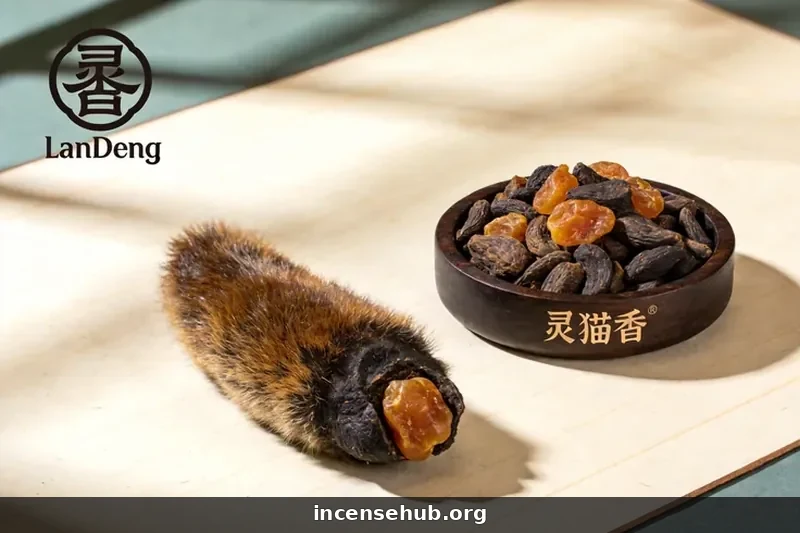
Direct answer: Civet (灵猫香, língmāoxiāng) is the scent secretion of civets, small carnivores of the family Viverridae, once prized in perfumery and 合香 as an animalic fixative. It is not a botanical material. Trade in the two source species is controlled under CITES Appendix III, and the modern fragrance industry works with synthetic civetone.
Key facts
| Name in Chinese | 灵猫香 (língmāoxiāng), literally “civet-cat fragrance” |
| Animal of origin | African civet (Civettictis civetta); small Indian civet (Viverricula indica) |
| Part used | Secretion from the perineal glands, aged and diluted |
| Scent family | Animalic, musky, sweet-warm after maturation; sharp and fecal when raw |
| Role in a formula | Fixative and accent, used at trace levels |
| Regulatory note | Both species on CITES Appendix III — India and Botswana respectively |
| Current substitute | Synthetic civetone, often paired with other musky materials |
| Editorial status | Documented as history and connoisseurship; not a sourcing recommendation |
What the material actually is
Direct answer: Civet is a secretion, not a plant part: an oily, strongly scented substance produced by glands near the tail base of civets and collected from the animal.
The first correction to make is categorical. Most of this encyclopedia deals with plants — woods, resins, roots, flowers, fruits — and the analytical habits that work for plants do not transfer neatly to an animal secretion. There is no harvest season in the botanical sense, no leaf or bark fraction, no essential oil obtained by distillation of plant tissue. There is an animal, a gland, a secretion, and a long history of human use.
The civets that produced the classical material are two species with different ranges. The African civet (Civettictis civetta) is a stocky, long-legged carnivore of sub-Saharan Africa, broadly distributed and unmistakable for its banded coat and facial markings. The small Indian civet (Viverricula indica) is a smaller, slighter animal of South and Southeast Asia, with a narrower body and a similarly nocturnal, solitary habit. Both belong to the Viverridae, the family that also contains genets and linsangs — a group of small, mostly nocturnal carnivores with a long history of being trapped, kept and traded for their scent.
The secretion itself comes from glands in the perineal region. In the living animal it is part of a scent-marking system: a chemical signal deposited on objects to mark territory or communicate reproductive state. That origin explains the odour’s character. A scent designed to persist on a branch or a stone, in sun and rain, must be chemically stable and slow to evaporate. The same properties that make it a good territorial marker make it a good fixative in a blend — persistence, low volatility, and a smell that clings.
The raw material is not pleasant. It is described as sharply animalic, fecal, and sometimes leathery, with an intensity that is difficult to compare to anything in the botanical cabinet. What perfumery valued was not that raw smell but its behaviour after aging and extreme dilution, when the sharp edges recede and a warm, sweet, musky roundness emerges. This transformation is the central fact of civet’s use, and it deserves its own section.
The word outlived the animal
Direct answer: “Civet” began as the name of an animal and its secretion; in modern fragrance it names a scent family, usually carried by synthetic civetone.
Linguistic drift is common in material names, and civet is a clear case. 灵猫香 is literal: 灵猫 is the civet, 香 is fragrance. The Chinese term names the animal and the product in one phrase, with no ambiguity. English “civet” works the same way etymologically, arriving through French and Italian from an Arabic term for the secretion.
Modern usage has separated the word from its source. A perfume described as having a “civet note” almost never contains civet. It contains one of the synthetic materials that reproduce the animalic-musky effect — most often civetone, the macrocyclic ketone identified as the principal odor compound of the natural secretion, produced industrially at fragrance-material scale. The note is real; the animal is absent.
That separation is not unique to civet. Musk underwent the same shift, and so did ambergris. In each case a material that was once scarce, animal-derived and trade-restricted became a scent category carried by synthetic chemistry. The category survived because the smell is useful; the material did not, because the supply was problematic.
For a reader, the practical rule is simple: treat “civet” on a modern label as a description of an odour, not a statement of provenance. A product that genuinely contains the animal secretion would be unusual, expensive, and — depending on jurisdiction — subject to trade controls. The label is not lying; it is using the vocabulary of perfumery, where materials are named for the effect they produce.
Aroma: raw, matured, and the dilution paradox
Direct answer: Raw civet is sharply animalic and fecal; matured and heavily diluted, it reads as warm, sweet and musky, and it works below the threshold of conscious recognition.
The paradox is the whole story. At full strength, the secretion is repellent to most noses — a concentrated animal note with a fecal edge. At a trace, in a blend, the same material reads as warmth, depth and skin-like sweetness. Nothing about the molecule has changed; only the concentration has. The nose interprets the same signal differently depending on how many molecules arrive.
This is not unique to civet, but civet is an unusually dramatic example. Many aroma compounds show a change of character across concentrations — the difference between a rose note at 100% and at 0.01% can be the difference between cloying and delicate. Animalic materials amplify the effect because their odour potency is high and their character is extreme at the top of the range.
Three stages are worth separating:
- Raw secretion → high concentration of odorants → fecal, sharp, ammoniacal edges dominate → not usable as a perfume material in this state.
- Aged secretion → slow chemical changes, including oxidation, soften the sharp fractions → the mass becomes rounder and sweeter → the material begins to smell like the classical civet of the texts.
- Diluted tincture → concentration falls by orders of magnitude → the animalic signal reads as warmth and depth → the material becomes a background rather than a statement.
The movement from stage one to stage three is the craft. It is also why a modern nose, smelling a synthetic civetone dilution, can recognize the family resemblance without ever having smelled the animal material: the synthetic reproduces the matured, diluted effect, not the raw secretion.
There is a useful caution here for anyone reading historical descriptions. A text that calls civet “fecal” and a modern perfumer who calls it “warm and skin-like” are not contradicting each other. They are describing different points on the same dilution curve. Without knowing the concentration, the adjectives are not comparable.
The fixative idea, examined
Direct answer: A fixative is a material that slows the evaporation of a blend and gives it body; civet was prized for this structural role, not for a loud scent of its own.
“Fixative” is one of the most repeated and least examined words in perfume writing. The basic idea is simple: a fragrance is a mixture of molecules with different volatilities, and the light ones leave first. A fixative is a material with low volatility that, added to the mixture, slows the overall loss of the more volatile components and extends the life of the composition.
The mechanisms are several and not fully agreed. A high-boiling material can act as a solvent or carrier, holding lighter molecules in a less mobile matrix. It can add its own long-lasting odour that masks the moment when the top notes have gone. It can change the way the mixture deposits on skin or paper. In practice, a perfumer judges a fixative by results: does the blend last longer, and does it smell more coherent at the end?
Civet’s fit for the role follows from its chemistry. The secretion is rich in large, slowly evaporating molecules, and its own odour is potent at low concentration. Add a trace to a blend and two things happen: the drydown gains a warm animalic base, and the whole composition feels more anchored. The effect is structural rather than decorative, which is why classical formulas use civet in tiny amounts rather than as a featured note.
The term is often overstated. A fixative does not stop evaporation, and it does not make a volatile top note permanent. It shifts the curve. A blend with civet still loses its opening; it simply loses it more gracefully, with a warmer floor underneath. Buyers who expect a fixative to “hold” a fragile floral note indefinitely are asking for something no material can deliver.
Fixatives compared: animal and vegetal
Direct answer: Not every fixative is animal-derived. Resins, balsams and dense woods do similar structural work, and comparing them shows what the animal materials actually contribute.
The word “fixative” is often used as if it belonged to animal materials alone. In practice, the perfumer’s and incense maker’s cabinet contains a range of materials that slow a blend down, and most of them are plants.
| Material | Type | Character | What it does in a blend |
|---|---|---|---|
| Benzoin | Resin | Sweet, balsamic, vanilla-adjacent | Adds a soft, long-lasting base |
| Labdanum | Resin | Amber, leather, honeyed | Rounds and extends a drydown |
| Sandalwood | Wood | Creamy, woody, faintly milky | Gives body and a steady base |
| Civet | Animal secretion | Animalic, musky, fecal when raw | Warms and anchors at trace levels |
| Musk | Animal secretion | Sweet, skin-like, powdery | Softens and extends |
| Castoreum | Animal secretion | Smoky, leathery, tar-like | Adds a leather note and tenacity |
The comparison clarifies the animal contribution. A resin adds sweetness and continuity; a wood adds body; an animal secretion adds warmth that reads as living rather than as plant. That “living” quality is difficult to reproduce with vegetal materials, which is why the animal notes survived so long in perfumery despite their cost and difficulty.
It also clarifies a substitution principle. If a formula needs duration, a resin or a wood may do the job without any animal material. If it needs the specific animalic warmth, a synthetic is the practical route. The mistake is to treat “fixative” as a single function and to assume that any fixative can replace any other. The functional overlap is real but partial.
For incense specifically, the vegetal fixatives have an advantage: they burn cleanly and predictably, and their smoke is part of the intended experience. An animalic material, natural or synthetic, adds a note that can turn harsh under combustion. That is a reason to test, not a reason to avoid the category.
The animal-fixative family
Direct answer: Civet belongs to a trio of classical animal fixatives: musk, civet and castoreum. Each is a different animal, a different secretion and a different character.
The comparison is the fastest way to place civet precisely, because the three materials are often discussed as if they were variations of one idea. They are not.
| Musk (麝香) | Civet (灵猫香) | Castoreum (海狸香) | |
|---|---|---|---|
| Source animal | Musk deer, genus Moschus | Civets, Civettictis and Viverricula | Beaver, genus Castor |
| Material | Pod secretion of the male | Perineal gland secretion | Castor sac secretion |
| Raw character | Animalic, sweet, leathery | Sharp, fecal, animalic | Leathery, smoky, tar-like |
| Matured character | Warm, skin-like, powdery | Warm, musky, sweet | Smoky, birch-tar, leather |
| Classical standing | The precious animal accent of court 合香 | A fixative of classical perfumery | A leather note in Western perfumery |
| Modern supply | Synthetic musks | Synthetic civetone | Synthetic castoreum accords |
The table makes the family logic visible. All three are animal secretions used at trace levels for warmth and tenacity. All three are trade-restricted or were historically unsustainably harvested. All three are now represented in modern perfumery by synthetic materials that reproduce the effect without the animal.
Within the trio, civet is the sharpest at full strength and the most transformed by dilution. Musk is the sweetest and the most skin-like; castoreum is the smokiest and the most leathery. A formulator choosing among them is choosing a texture: skin, animal warmth, or smoke and leather. That is a more useful way to think about the family than a hierarchy of rarity.
The Chinese record gives musk the central place in court 合香. Civet’s documented role is as a precious fixative in perfumery and personal scent, without the same density of named formulas. That difference in emphasis is worth noting, because it explains why the two materials occupy different positions in the literature. It is not a judgment on quality.
Ambergris and the limits of the comparison
Direct answer: Ambergris is a fourth animal material often grouped with the fixatives, but its origin, chemistry and trade history are different enough that the comparison only goes so far.
Ambergris is a waxy substance produced in the digestive tract of sperm whales and found floating or stranded on coasts. It is not a gland secretion in the same sense as civet, and its collection does not involve keeping an animal in captivity. That difference matters for the ethics discussion: ambergris is a beach-cast material, and its regulatory status varies by jurisdiction, but it does not carry the same captive-animal history.
Sensorially, ambergris is marine, mineral, faintly sweet and salty, with a dry, skin-like warmth. It is a fixative in the broad sense — it extends a blend — but its character is unlike the three land-animal materials. Grouping it with musk, civet and castoreum is useful for understanding the “animalic” category, and misleading if it implies a common supply chain or a common chemistry.
| Material | Origin | Collection | Character |
|---|---|---|---|
| Musk | Deer pod secretion | Historical hunting and farming | Sweet, skin-like, powdery |
| Civet | Civet gland secretion | Historical captive collection | Sharp, fecal, warm at dilution |
| Castoreum | Beaver castor sac | Historical trapping | Smoky, leathery, tar-like |
| Ambergris | Sperm whale digestive product | Beach-cast | Marine, mineral, salty-sweet |
The table’s value is to prevent a false equivalence. “Animalic” is a perceptual family, not a biological one. A reader who understands that will not assume that the ethics, the regulation or the chemistry of one material transfers to another.
For civet specifically, the comparison clarifies what is distinctive. Civet is the sharpest of the land-animal trio at full strength, the most transformed by dilution, and the one with the clearest history of captive production. Those three facts, taken together, explain both its former prestige and its modern disappearance.
君臣佐使 and where an animal note sits
Direct answer: In the classical 君臣佐使 framework, an animal fixative like civet works as a 佐 or 使 — an assistant or guide that supports the chief material rather than leading the formula.
君臣佐使 (jūn chén zǔ shǐ) is the classical Chinese formula logic: a chief material (君) defines the composition, minister materials (臣) support it, assistant materials (佐) modify or balance it, and guide materials (使) carry it through. The framework comes from materia medica and was applied to 合香, where it describes hierarchy rather than chemistry.
Placed in that framework, civet is rarely a 君. It has no floral or woody body to build around, and its odour at usable concentrations is a modifier rather than a theme. It sits in the 佐 or 使 role: a trace that rounds the chief material, extends the composition, and gives the drydown a warm base. A formula that made civet the chief would be a formula about animalic intensity, which is a narrow and difficult brief.
The framework is useful because it forces a formulator to ask what a material is doing. Is it defining the scent, supporting it, balancing it, or carrying it? Civet’s answer is almost always one of the last two. That is not a demotion. A guide material that makes the whole composition last longer is doing essential work, and the classical writers understood the role well enough to give it a name.
Two cautions follow. The first is that 君臣佐使 is a traditional framework, not a laboratory method; it describes relationships in a formula, not measured chemical effects. The second is that a trace material can be powerful out of proportion to its quantity. In a 合香 formula, the smallest ingredient can decide whether the blend smells coherent or muddy.
In Chinese tradition
Direct answer: 灵猫香 appears in classical Chinese perfumery as a precious animal fixative, and 灵猫 is recorded in the materia medica section of the Bencao Gangmu; its medicinal descriptions are traditional, not clinical.
The textual record for civet is thinner than for musk in the sources consulted here, and that thinness is itself informative. Musk appears across the 香乘 in named formulas with stated doses. Civet is described as a precious fixative — a substance valued for its fixative power and its lasting scent on clothing and in personal preparations — rather than as a standard ingredient in the court incense repertoire.
The Bencao Gangmu (本草纲目) places 灵猫 in its 獸部, the section on animals, and records traditional uses in the materia-medica idiom. That placement is a reminder that the classical Chinese relationship with the material was not purely olfactory: it was also medical, in the humoral and correspondences-based sense of the tradition. Modern readers should treat those descriptions as historical claims about what practitioners believed, not as evidence of efficacy.
The distinction matters for how the page is read. A statement like “灵猫香 was used in traditional medicine” is a statement about history. A statement like “civet has medicinal properties” is a claim about the world, and this page does not make it. The first belongs here; the second does not.
What the tradition does establish is the material’s cultural weight. A substance that appears in both the perfumer’s cabinet and the materia medica is a substance that mattered — expensive, traded, discussed and valued. That weight is worth documenting even when the material itself is no longer sourced.
Conservation status, read carefully
Direct answer: Both civet species are listed on CITES Appendix III — the small Indian civet by India and the African civet by Botswana — which means trade is controlled rather than banned outright.
CITES has three appendices, and the differences matter for how a material is discussed. Appendix I covers species threatened with extinction, and commercial trade is generally prohibited. Appendix II covers species that may become threatened unless trade is controlled, and permits are required. Appendix III is different: it lists species that a particular country has asked other Parties to help control, usually because that country regulates trade domestically and wants cooperation at the border.
That distinction is often flattened in popular writing, where any CITES listing is described as a ban. It is not. An Appendix III listing means that the exporting country has put the species on the list and that other Parties are expected to assist with documentation and control. It is a trade-control instrument, not a prohibition, and its practical effect depends on national law and enforcement.
| Species | Range | CITES listing | Listing Party |
|---|---|---|---|
| Small Indian civet (Viverricula indica) | South and Southeast Asia | Appendix III | India |
| African civet (Civettictis civetta) | Sub-Saharan Africa | Appendix III | Botswana |
The table is short because the documented facts are short. What it supports is a conclusion about sourcing: a material derived from these animals is not a simple commodity, and any serious discussion has to begin with the regulatory status rather than with the scent.
For a reader, the honest summary is this. Natural civet is a regulated animal product with a documented welfare history, and the modern market has largely moved to synthetic civetone. That is not a moral panic; it is a description of the supply chain. The rest of this page treats the animal material as history and the synthetic as the current reality.
Welfare and the case for the synthetic
Direct answer: Historical civet production kept animals in captivity to collect the secretion, a practice with serious welfare problems; synthetic civetone removes the animal from the supply chain entirely.
The welfare issue is not incidental to the material’s history; it is central to why the material disappeared. Civets are solitary, territorial carnivores, and keeping them in small cages for repeated gland collection conflicts with almost every aspect of their natural behaviour. The details vary by place and period, and this page does not need to rehearse them. The point is that the practice was a captive-animal industry, not a benign harvest of wild surplus.
That history is why the synthetic route matters. Civetone can be produced without an animal, at consistent quality, at a scale that meets demand, and without the regulatory burden of a CITES-listed wildlife product. The synthetic is not a compromise forced on perfumery by scarcity; it is a better supply chain by almost every measure except the romantic one.
There is a temptation, in writing about animal materials, to swing between two extremes: a lurid condemnation of the past or a nostalgic celebration of “the real thing”. Neither is useful. The historical material was real, it was valued, and it was produced in ways that are not acceptable now. The modern material is different, and it is better on the dimensions that matter for animals and for consistency. Both statements can be true at once.
For this encyclopedia, the practical position follows: document civet as history, explain the synthetic as the present, and do not present the animal material as something a reader should seek out. That is a sourcing position, not a health claim, and it is stated plainly so that no reader mistakes the page for a shopping guide.
Historical processing and the quality question
Direct answer: Historical civet was aged and diluted into a tincture; quality depended on maturity, and the grading questions of the past no longer apply to the synthetic material.
The processing sequence was short in outline and long in time. The secretion was collected, and then it was aged — sometimes for years — until the sharp, fecal edges softened. It was then diluted, often into alcohol, to make a tincture that could be dosed in small amounts. The aging step is the one that matters conceptually: the material was not used fresh, because fresh material was unpleasant and difficult to control.
Aging is a chemical process as well as a sensory one. Oxidation, esterification and the slow evaporation of the most volatile fractions all change the mixture. The result is a material that smells rounder and behaves more predictably in a blend. This is the same logic that applies to aged resins and to certain woods: time is an ingredient.
Quality grading in the historical trade turned on maturity and concentration. A well-aged, properly diluted tincture was the useful product; a raw or hastily aged secretion was not. There was no universal standard, and the judgments were sensory and local. That makes the historical grading literature difficult to compare across sources, and it makes modern claims about “grade” hard to verify.
The practical consequence today is that historical quality language is largely decorative. A modern product containing synthetic civetone is graded on the purity and consistency of the synthetic, not on the age of a secretion. A seller who talks about “aged civet tincture” is either describing a historical object or using romance as a sales device. The buyer’s question should be about the actual material, not the story attached to it.
Reading a historical formula that calls for civet
Direct answer: A historical recipe that lists civet is describing a tincture or a trace dose, not a handful of raw secretion; the units and the dilution are the parts that need interpreting.
Old formulas are not modern formulas with older words. They assume materials with different strengths, different purities and different preparations. A recipe that says “civet, one qian” is not telling a modern maker to weigh out a familiar substance; it is telling them that a prepared material, probably a tincture or a diluted paste, went in at a specified proportion.
The first interpretive step is to ask what physical form the ingredient had. In classical perfumery, civet was commonly used as a tincture — the secretion dissolved or macerated in alcohol — or as a diluted paste. Both are far weaker than the raw secretion. Reading the ingredient as “raw civet” and dosing accordingly would produce something wildly overdosed and unpleasant.
The second step is to ask what the unit means in context. Chinese recipes use units such as 钱 and 两, whose precise weights varied by period and place. A modern conversion to grams is an approximation, useful for proportion but not for exact reproduction. The ratios between ingredients are more reliable than the absolute weights, and even the ratios assume a consistent material.
The third step is to ask what the recipe is for. A court 合香 formula intended for slow burning has different constraints from a personal scent intended for skin. The same civet dose behaves differently in each. A maker reconstructing a formula should decide which use is being reconstructed before adjusting anything.
| Recipe element | What it probably means | What to do |
|---|---|---|
| “Civet” without qualification | A prepared tincture or paste | Assume dilution, not raw secretion |
| 钱 / 两 quantities | Period-specific units | Use ratios, not absolute conversions |
| “Aged” | Matured secretion | Treat as a sensory instruction, not a date |
| “To fix the blend” | A structural role | Dose at trace levels and judge the drydown |
The honest conclusion is that historical reconstruction is an exercise in informed approximation. That is not a reason to avoid it. It is a reason to describe the result as a reconstruction rather than as the original, and to resist the temptation to present a modern synthetic version as a faithful copy.
A reconstruction checklist
Direct answer: A defensible civet reconstruction states its source, its substitution, its dose logic and its intended use — four disclosures that separate a study from a pastiche.
Reconstruction work is easy to romanticize and hard to do well. The following checklist is a practical way to keep a project honest, whether the goal is a historical study, a museum display or a personal experiment.
Name the source formula. A reconstruction should point to a specific text, edition and passage. “Based on classical Chinese incense” is not a source; it is a mood. The source should be checkable by another reader, and any uncertainty about the reading should be stated.
State the substitution. If synthetic civetone replaces the animal secretion, say so, and say which accord was used. The substitution changes the smell, and a reader is entitled to know where the reconstruction departs from the source.
Explain the dose logic. Historical units are not directly convertible, and the physical form of the ingredient is uncertain. A reconstruction should explain how the dose was chosen: by ratio, by analogy with a documented formula, or by sensory adjustment. Each is defensible; silence is not.
Declare the intended use. A blend designed for burning has different constraints from one designed for a blotter. The same formula can be coherent in one format and harsh in the other. Stating the target format prevents a reader from judging the reconstruction against the wrong standard.
| Disclosure | Weak version | Strong version |
|---|---|---|
| Source | “A classical recipe” | Text, section, and edition named |
| Substitution | “Modern materials” | Specific synthetic and dose ratio stated |
| Dose logic | “Adjusted to taste” | Ratio reasoning or documented analogy |
| Intended use | Unstated | Burning, skin, or display specified |
The checklist is not bureaucracy. It is the difference between a claim that can be examined and a claim that can only be believed. For a material as heavily mythologized as civet, that difference matters.
Reading a modern label
Direct answer: On a modern product, “civet” almost always names a synthetic accord; the label tells you the scent family, not the origin of the material.
Labels are written to communicate an effect, not a supply chain. That is not dishonest, but it means the reader has to know what the words can and cannot mean.
| What the label says | What it usually means | What to check |
|---|---|---|
| “Civet” | Synthetic civetone or a musky accord | Ingredient list; IFRA-style allergen disclosure |
| “Animalic musk” | A synthetic musk with animalic character | The specific musk, if disclosed |
| “Natural civet” | Rarely accurate; potentially regulated | CITES documentation, if the claim is serious |
| “Vegan civet” | A synthetic accord, marketed by absence | Nothing — the absence is the claim |
| “Civet absolute” | Historically a tincture; now usually a synthetic base | The actual material specification |
The table is a decoding aid, not an accusation. “Vegan civet” is a perfectly coherent phrase in modern perfumery: it means the civet effect without the animal. “Natural civet” is the phrase that deserves scrutiny, because it asserts a supply chain that is heavily regulated and historically troubled.
For incense buyers, the same logic applies with an extra caution. A stick or cone described as containing civet is almost certainly using a synthetic or a botanical musky substitute, because the economics and the regulation of the animal material make genuine civet implausible in a mass-market product. That is not a scandal. It is the normal state of the modern supply chain, and it is better understood than suspected.
Substitution: what changes when the animal leaves
Direct answer: Synthetic civetone reproduces the warmed, diluted effect but not the full complexity of the aged secretion; the difference is one of nuance and consistency rather than of category.
Substitution is never a one-for-one swap, even when the molecules are related. Civetone is the principal odor compound of natural civet, and a synthetic version of it captures the core of the smell. What it does not capture is the minor fractions — the small amounts of other compounds that give the natural material its variability, its faintly fecal edge, and its particular way of aging in a blend.
In practice, the differences show up in three places. The opening of a blend with synthetic civetone is cleaner and more predictable. The drydown is more consistent from batch to batch. The nuance is narrower — the synthetic does one thing well, while the natural material did several things at once, some of them unpleasant.
| Dimension | Natural civet (historical) | Synthetic civetone |
|---|---|---|
| Core odour | Animalic, musky, sweet-warm | Animalic, musky, sweet-warm |
| Complexity | High; variable by batch and age | Lower; consistent |
| Raw sharpness | High; requires aging | Controlled by formulation |
| Supply | Regulated, welfare-sensitive | Industrial, unrestricted |
| Cost | Very high | Moderate |
| Reproducibility | Low | High |
The trade-off is familiar from many natural-to-synthetic substitutions: consistency and ethics improve, complexity and “character” narrow. Whether that is a loss depends on what the formulator needs. For a modern commercial fragrance, consistency is usually the priority. For a historical reconstruction, the natural material’s variability is part of the puzzle — and that is precisely why reconstructions are difficult and should be described as approximations.
For incense, the substitution changes the smoke as well as the scent. A synthetic civetone accord is designed for skin and alcohol; burning it may produce a different, sometimes harsher, smoke profile than the historical material. That is a practical point for anyone experimenting, and a reason to test small quantities rather than assume a direct translation.
What “natural” means for an animal material
Direct answer: “Natural” describes a source, not a safety grade; a natural animal secretion is a variable mixture, and a synthetic civetone is a single defined compound.
The natural-versus-synthetic conversation is usually conducted as a morality play, with nature on one side and chemistry on the other. For civet, the framing collapses almost immediately. The “natural” material is an animal secretion collected under conditions that raise welfare concerns; the “synthetic” material is a defined compound produced in a factory. Which one is cleaner, safer or more ethical depends entirely on which dimension is being measured.
Chemically, the natural secretion is a mixture. It contains civetone and a range of other compounds, some of which contribute to the characteristic smell and some of which are unpleasant. The mixture varies with the animal, the season, the diet and the handling. That variability is part of what perfumers of the past worked with, and part of what made the material difficult to use consistently.
Synthetic civetone is a single molecule. Its identity can be specified, its purity measured, and its behaviour in a blend predicted. That is a genuine advantage for manufacturing. The trade-off is that a single molecule cannot reproduce the full complexity of a mixture, so a synthetic accord usually combines civetone with other materials to approximate the natural effect.
| Question | Natural civet | Synthetic civetone |
|---|---|---|
| What is it chemically? | A variable mixture | A defined compound |
| Batch consistency | Low | High |
| Supply | Regulated animal product | Industrial |
| Welfare footprint | Animal-based | No animal input |
| Complexity of odour | High | Moderate, built up in an accord |
| Regulatory burden | CITES documentation | Standard chemical compliance |
The table points to a conclusion that is unfashionable in both camps: “natural” and “synthetic” are not quality labels. They are descriptions of a supply chain and a chemistry. A buyer who wants consistency and no animal input should prefer the synthetic. A historian who wants to understand the old material should study the natural mixture — while recognizing that it is not a product to source.
This is also the point at which the page’s editorial position becomes explicit. We treat civet as history: worth documenting, worth understanding, not worth reviving as a trade. The synthetic is the modern material, and it is better on the dimensions that matter today.
The connoisseurship question
Direct answer: Genuine civet is now so rare and regulated that most connoisseurship concerns the synthetic accords and the historical record, not the assessment of animal material.
Connoisseurship usually assumes access. For civet, access is the problem: the animal material is a regulated wildlife product with a troubled supply history, and the number of people who have smelled a well-aged authentic tincture is small. Most of what passes for connoisseurship online is really connoisseurship of synthetic accords, which is a legitimate pursuit but a different one.
What can be assessed today falls into three buckets. The first is the synthetic material itself: its purity, its consistency, and whether it reproduces the intended effect at the intended dose. The second is the historical record: what the texts say about preparation, dosing and use, and how those descriptions compare across sources. The third is the reconstruction: whether a modern formula built from historical principles produces a coherent result.
What cannot be assessed easily is authenticity. A seller offering “vintage civet” is asking the buyer to trust a chain of custody that is difficult to document and easy to fabricate. The CITES listing exists precisely because the material is controlled; a credible seller should be able to explain the paperwork. A buyer who cannot see that paperwork is not buying connoisseurship; they are buying a story.
| Claim | What would support it | What usually appears instead |
|---|---|---|
| “Authentic civet” | CITES documentation and provenance | A scent description and a high price |
| “Aged twenty years” | Storage records, sealed original container | A dark bottle and an assertion |
| “Perfume grade” | Specification and batch consistency | An adjective |
| “Reconstruction” | Named historical source and stated substitutions | A vague nod to tradition |
The table is not an accusation of fraud in any particular case. It is a description of the evidentiary gap that surrounds the material. For a reader, the safest posture is curiosity about the history and skepticism about the merchandise.
The language of animalic notes
Direct answer: The vocabulary of animalic perfumery — fecal, leathery, urinous, musky, warm — describes perceptual effects, not chemical components, and the terms overlap in ways that confuse beginners.
Descriptive language for animalic materials is imprecise by necessity. The nose reports similarity, not composition: a molecule smells “leathery” because it resembles something associated with leather, not because it contains leather. The vocabulary is a set of analogies, and analogies drift between speakers.
Four terms do most of the work. “Fecal” describes a sharp, nitrogenous, waste-like edge — the quality that dominates raw civet. “Leathery” describes a dry, tanned, slightly smoky character, more associated with castoreum. “Urinous” describes a sharp, ammoniacal note, often present in raw animal materials and in some synthetic musks. “Musky” is the broadest term, covering sweet, skin-like, powdery and warm effects that are hard to pin down and easy to recognize.
The overlap is real. A single material can be described as both fecal and musky, depending on concentration and the nose. That is not a contradiction; it is evidence that the terms describe different points on a perceptual map rather than distinct chemical categories. A writer who insists on one term per material is imposing precision the phenomenon does not have.
For buyers and formulators, the practical use of the vocabulary is comparative. “More fecal than musk, less leathery than castoreum” locates a material relative to references. “Warm animalic” alone locates nothing. The more specific the comparison, the more useful the description — and the more likely it is to survive translation between languages and traditions.
Training the nose on animalic notes
Direct answer: Animalic notes are best learned through diluted reference materials and side-by-side comparison, not through undiluted smelling or descriptive prose.
Animalic materials are difficult to learn from words alone. “Fecal” and “warm” sound like opposites, and a beginner reading both descriptions of the same material may conclude that one of them is wrong. The resolution is practical: smell the material at several dilutions and notice how the description changes.
A simple exercise uses three reference points: a synthetic civetone accord, a synthetic musk, and a synthetic castoreum accord. Each should be smelled on a blotter, in dilution, and at a distance. The civetone reference will show the animalic-musky core; the musk will show the sweet, skin-like register; the castoreum will show the smoky, leathery register. Smelling them in sequence makes the family structure obvious in a way that prose cannot.
The second step is to smell each one against a simple base — a drop of alcohol on paper, or a mild woody accord — and notice how the animalic note changes the base. A trace of civetone makes a plain woody blend feel warmer and more “lived-in”. A trace of castoreum makes it feel smokier and more leathery. The same base, two different animal notes, two different moods.
The third step is to smell the material at the edge of perception. Animalic notes are most useful below the threshold at which they are recognized as a separate smell. A blend in which the civet is obvious is usually overdosed; a blend in which it is felt but not named is usually right. Learning to detect that edge is the real skill.
Safety points are ordinary. Do not smell undiluted aroma chemicals directly from the container; use a blotter and keep the material at a distance. Work in a ventilated room. Keep reference materials labelled and out of reach of children and pets. The exercise is about discrimination, not intensity.
Perception and culture: why the same smell divides
Direct answer: Animalic notes are judged through association as much as through chemistry; the same molecule can read as warmth to one nose and as dirt to another.
Odour perception is not a neutral measurement. It is an interpretation, shaped by memory, culture and context. A smell associated with animals, bodies or waste can trigger rejection in one setting and be read as sophisticated warmth in another. The molecule does not change; the frame does.
This is especially visible with animalic materials. In a laboratory context, a diluted civetone reference is a technical sample. On a blotter in a perfumery, it is a building block. In a room, it is a background. In a description, it is a vocabulary problem. Each context supplies a different set of associations, and the same concentration can feel appropriate in one and offensive in another.
The cultural variable is large. Perfumery traditions differ in how much animalic warmth they treat as desirable, and incense traditions differ in how much smoke and animal character they expect. A material that is a classic in one tradition can be an acquired taste in another. That is not a failure of either tradition; it is evidence that olfactory preferences are learned.
For a writer, the practical lesson is to describe rather than to judge. “Animalic, musky, warm at dilution” is more useful than “good” or “bad”, because it gives the reader the information needed to decide for themselves. For a formulator, the lesson is to test in context. A material judged in isolation may behave differently in a blend, and a blend judged on paper may behave differently in a room.
There is a broader point about connoisseurship here. The ability to appreciate an animalic note is not a mark of superior taste; it is a matter of familiarity. Some people come to it through perfume, some through incense, some not at all. A knowledge page should make the material legible without implying that the reader ought to like it.
Civet in the room versus on the skin
Direct answer: An animalic note behaves differently when burned than when worn: smoke amplifies harsh fractions, while skin warmth and dilution round them.
Perfumery and incense share materials but not physics. On skin, a fragrance is warmed to body temperature, diluted by sweat and skin lipids, and released slowly over hours. In a burning incense, the material is heated to combustion, and the molecules that reach the nose are a different mixture — partly evaporated, partly oxidised, partly decomposed.
That difference matters more for animalic materials than for most botanicals. The sharp, nitrogenous fractions that read as fecal in raw civet are exactly the fractions that can turn acrid or harsh when burned. A dilution that smells warm and rounded on a blotter can produce a smoke that is thin, sharp and unpleasant. The reverse also happens: a material that seems dull on paper can gain presence in smoke.
The practical implication is that a civet accord developed for perfume cannot simply be transferred to an incense formula. The dose has to be re-tested, and the test has to be done in the final burning format. Small batches, a ventilated space, and a comparison against the same blend without the civet will tell a maker more than any amount of theoretical reasoning.
There is a further point about perception. In a room, an animalic note lingers in fabric and air; it is a background that accumulates. On skin, it evolves with body heat and disappears when the wearer washes. The same material therefore has a different social life in each context, and a formulator who ignores that difference will misjudge the dose.
Dosing a material that is smelled at a trace
Direct answer: Work from a dilute stock, record the dose as a percentage, and judge the result after the blend has rested — a powerful animalic material cannot be dosed reliably by the drop.
Small quantities are the practical difficulty with civet accords. A material that is effective at a trace is also a material that is easy to overdose by an order of magnitude, and weighing milligrams on a kitchen scale is not a realistic option. The standard solution is serial dilution: prepare a dilute stock of the material in a neutral carrier, then dose the stock rather than the neat material.
The method has three virtues. It makes the dose reproducible, because the stock concentration is known. It reduces weighing error, because a larger weight of a weaker solution is easier to measure than a tiny weight of a strong one. It limits exposure to the concentrated material, which is sensible for any aroma chemical.
| Step | What to do | Why it matters |
|---|---|---|
| Prepare a stock | Dilute the material in a neutral carrier at a stated ratio | Creates a measurable working concentration |
| Label | Record material, carrier, ratio and date | Makes the stock traceable months later |
| Dose by weight | Add the stock as a percentage of the blend | Keeps records comparable across batches |
| Rest | Let the blend sit before judging | Animalic notes settle and change |
| Compare | Test against the same blend without civet | Isolates the material’s contribution |
The resting step is the one beginners skip. A freshly mixed blend with an animalic material can smell sharp and disjointed; after a day or a week, the same blend may read as round and integrated. Judging immediately favours underdosing, because the harsh top dominates. Judging after rest gives a truer picture of the drydown.
The comparison step is equally important. A blend with civet and a blend without it, smelled side by side, tells you what the material is actually doing. Smelled alone, the blend tells you only that it smells like something. The difference between those two judgments is the difference between a formula and a guess.
Record-keeping is unglamorous and decisive. A notebook entry that says “civet, a little” is worthless six months later. An entry that records the stock ratio, the dose percentage, the date and the sensory result is a reusable piece of knowledge. For a material this powerful, the notebook is the real instrument.
Dilution arithmetic without mistakes
Direct answer: Percentage dilutions compound: a one-percent stock made from a ten-percent stock is not ten percent, and the arithmetic is the most common source of dosing error.
The arithmetic of dilution is simple, and that is exactly why it is easy to get wrong. A stock labelled “10%” contains one part material and nine parts carrier. Taking one part of that stock and adding nine parts carrier produces a 1% solution, not a 10% one. Each dilution step multiplies the concentration by the fraction used, and the fractions compound.
Two habits prevent most errors. The first is to work in ratios rather than in vague parts: state “one part stock to nine parts carrier” explicitly, and write it down. The second is to calculate the final concentration before mixing, not after. If a formula calls for 0.1% of the neat material and the working stock is 1%, the stock should be dosed at 10% of the blend — a figure that is easy to check and easy to record.
| Goal | Stock strength | Stock share of blend |
|---|---|---|
| 0.01% neat | 1% | 1% |
| 0.1% neat | 1% | 10% |
| 0.1% neat | 10% | 1% |
| 0.5% neat | 10% | 5% |
The table is illustrative, not a recommendation. Its purpose is to show the relationship: the weaker the stock, the larger the share needed to reach the same final concentration. A formulator who keeps that relationship in mind will catch most arithmetic slips before they reach a blend.
The other common error is confusing weight and volume. Percentage dilutions are usually prepared by weight for accuracy, and a formula written in weights should be dosed in weights. Mixing the two systems introduces an error that is small for some materials and large for others, and there is no reason to accept it when a scale is available.
Testing an accord in a simple blend
Direct answer: Test a civet accord against a plain base at three doses, in the format you intend to use, and compare the results blind; anything else measures the story rather than the material.
A single smell tells you little about how a material behaves. A comparison across doses tells you where it becomes useful and where it becomes obvious. The protocol below is deliberately simple, because complexity introduces its own errors.
Start with a neutral base. A dilute alcohol solution for a skin-style test, or a simple unscented incense base for a burning test. The base should be bland enough that the civet is the only variable. Prepare three samples at different doses — a trace, a moderate dose and an intentionally exaggerated dose — and label them in a way that hides which is which from the person judging.
Smell each sample at three moments: immediately, after an hour, and after a day. The immediate impression is dominated by the top; the later impressions show the drydown, which is where an animalic material does most of its work. Record a short note for each, using comparative language rather than adjectives alone.
| Moment | What to notice | What it tells you |
|---|---|---|
| Immediate | Sharpness, intensity, any fecal edge | Whether the dose is too high |
| One hour | Integration with the base | Whether the material is blending or sitting on top |
| One day | Warmth, persistence, any sourness | Whether the drydown is coherent |
The exaggerated sample is not waste. It shows the material’s failure mode, and knowing the failure mode makes the material easier to recognize in someone else’s blend. The trace sample shows the threshold, which is usually where the material is most useful.
Finally, repeat the test in the intended format. A skin test does not predict a burning test, and a blotter test does not predict either. The material has to be judged where it will be used.
Keeping a reference set
Direct answer: A small, labelled reference library of animalic dilutions is more useful than a large collection of bottles, because comparison is the only reliable way to judge a material.
The nose is a comparative instrument. It is poor at absolute measurement and good at spotting differences. That is why a reference set matters: it gives the nose a fixed point against which a new sample can be judged.
A practical reference set for this family is small. One dilution of a civetone accord, one of a musk, one of a castoreum, and perhaps one of a vegetal fixative such as benzoin or labdanum. Each at a stated concentration, each labelled with the date, each stored under the same conditions. Four or five references are enough to place most new samples.
The set should be reviewed periodically. A reference that has oxidised is worse than no reference, because it teaches the nose the wrong lesson. Smelling the set at the start of a session also calibrates the nose after a day of other smells, which is a small habit with a large effect on consistency.
The final advantage is documentary. A reference set with dates and notes becomes a record of the materials a maker has actually handled, not just read about. For a subject as prone to hearsay as animalic perfumery, that record is worth more than a shelf of unlabelled bottles.
Storage and stability
Direct answer: Dilute stocks of civetone should be kept cool, dark, tightly closed and labelled; the material oxidises and concentrates by evaporation, so an old stock is not the same stock.
A fragrance material changes in storage. The changes are slow, but they matter for a material dosed at trace levels, because a small change in concentration is a large change in effect. Three processes do most of the work: evaporation of the carrier, oxidation of the aroma molecules, and absorption of odours from the surroundings.
Evaporation is the simplest. A loosely closed bottle loses carrier over months, and the remaining solution becomes more concentrated. A stock that was prepared at one ratio may be significantly stronger a year later, which is why the date on the label matters as much as the ratio. A tightly closed bottle in a cool place slows the process; it does not stop it.
Oxidation is subtler. Oxygen reacts with many aroma molecules, and the products often smell flatter, sharper or more “off” than the original. Light accelerates the reaction, which is why amber glass and a dark cupboard are standard practice. A stock that has developed a sharp, sour or varnish-like edge should be discarded rather than adjusted; the change is not reversible by dilution.
Absorption is the third process, and it is easy to overlook. A concentrated aroma material in a shared cupboard can pick up notes from its neighbours, and a dilute stock in a plastic container can pick up the container itself. Glass, tight seals and separation from strong-smelling materials are the simple defences.
| Risk | Sign | Response |
|---|---|---|
| Carrier loss | Stock smells stronger than expected | Re-check the ratio; do not assume the old dose |
| Oxidation | Sharp, sour or varnish-like edge | Discard; dilution will not restore it |
| Light exposure | Colour shift, flattened top | Store in amber glass, away from windows |
| Odour pickup | Foreign note in an otherwise familiar stock | Move to glass and isolate |
| Labelling loss | Unknown ratio or date | Treat as unusable for precise work |
The practical routine is short. Label every stock with material, carrier, ratio and date. Keep the working stock small and the reserve larger. Store cool and dark. Smell the stock before each session, and compare it mentally with the last session. A material that has changed is not necessarily ruined, but it is no longer the reference it was.
What to do with an inherited bottle
Direct answer: Treat an unlabelled or vintage bottle as an unknown material: do not taste it, do not apply it neat, and do not assume the label is accurate.
Old bottles of animal materials turn up in estates, antique shops and inherited collections. They raise questions that a modern product does not: what is actually inside, how old is it, and is it legal to possess or trade?
The first rule is simple: an unknown substance is unknown. Do not taste it, do not apply it to skin undiluted, and do not heat it to see what it smells like. A vintage perfume bottle can contain materials that are now restricted, degraded or contaminated, and the romance of the object is not evidence of its safety.
The second rule is that provenance matters more than the bottle. A labelled commercial product with a batch code is one thing; a hand-written vial from an unknown source is another. If the material is claimed to be genuine civet, the CITES documentation question arises, and a private owner may not have it. That does not make the object illegal to own in every jurisdiction, but it does mean the owner should not assume it can be sold or shipped freely.
The third rule is to separate curiosity from use. An inherited bottle can be interesting as an object, a historical artefact or a study sample. It is not automatically a perfumery ingredient. A collector who wants to smell it can do so cautiously on a blotter at a distance; a maker who wants to use it should treat it as an unidentified material and set it aside.
The final point is ethical rather than technical. If the bottle is genuine animal civet, using it creates demand for a material that the modern trade has moved away from. Keeping it as an object is defensible; building a product around it is a different decision, and one that should be made with the welfare and regulatory history in view.
Four errors that keep circulating
Direct answer: The same four mistakes recur in nearly every popular account of civet: treating animal fixatives as one material, reading CITES as a ban, equating natural with safe, and reading a label as provenance.
The first error is category collapse. Musk, civet and castoreum are often described as variations of “animal musk”, as if they differed only in strength. They are different animals, different secretions and different sensory characters. A formulator who substitutes one for another without testing will get a different composition, sometimes a worse one.
The second is regulatory shorthand. “CITES-listed” is frequently written as “banned”, which is inaccurate for Appendix III and misleading for a reader trying to understand the trade. The listing is a control mechanism; its practical effect depends on the country and the product. Precision here is not pedantry, because the difference between a ban and a documentation requirement changes what a supplier can legally do.
The third is the natural-is-safe assumption. A natural animal secretion is a variable mixture that can carry contaminants, vary in strength and provoke reactions. A synthetic is a defined compound with a known profile. Neither is automatically safer; the relevant questions are dose, purity and handling. The assumption short-circuits those questions.
The fourth is label literalism. “Civet” on a modern product is a scent description, not a supply-chain statement. A buyer who reads it as provenance will overpay for a story, and a seller who encourages that reading is trading on confusion rather than on knowledge.
Each error has the same structure: a convenient shorthand replaces a distinction that matters. The correction is not complicated, but it has to be repeated, because the shorthand is memorable and the distinction is not.
What is documented and what is claimed
Direct answer: The animal source, the CITES listings and the historical use are documented; the medicinal descriptions are traditional; the modern fragrance material is synthetic.
| Question | Answer | Basis |
|---|---|---|
| What animal produces it? | Two viverrid species | C. civetta and V. indica |
| Is trade restricted? | Yes, under Appendix III | Listings by India and Botswana |
| How was it used? | As a fixative at trace doses | 合香 and perfumery records |
| Does it cure anything? | No established evidence | Traditional descriptions only |
| What is used now? | Synthetic civetone | Modern fragrance practice |
The layout is deliberately plain, because the page deals with a material that attracts strong claims in both directions. On one side, “natural” is treated as a guarantee of quality and safety; on the other, “animal” is treated as a guarantee of harm. Neither shorthand survives contact with the facts. The natural material was variable and often harsh; the synthetic is consistent and ethically simpler. The historical use was real; the medical claims are not established.
A reader who wants a single takeaway can use this: civet is a historical animal fixative whose modern identity is a synthetic scent family. Everything else — the CITES details, the welfare history, the dilution paradox — supports that sentence.
Safety and handling
Direct answer: The safety issues are the ordinary ones for a fragrance material — dilution, skin contact, and smoke if burned — plus the regulatory issues that attach to an animal product.
Synthetic civetone is a fragrance ingredient and should be handled in dilution, as perfumery materials normally are. Concentrated aroma chemicals can irritate skin and eyes, and repeated contact with undiluted material is a bad habit regardless of the specific substance. Keep the material away from children and pets, label containers clearly, and work in a ventilated space.
For incense, combustion produces smoke and particulate matter. Burn in a well-ventilated area, avoid inhaling concentrated smoke, and keep burning material on a stable, heat-resistant surface. A synthetic animalic note can be intense in smoke, and a small test batch is the sensible way to judge the effect before committing a larger quantity.
Regulatory questions are separate from safety questions. Genuine civet is a CITES-listed animal product, and any trade in it is subject to national law and documentation. This page does not provide legal advice; it simply notes that the material is not an ordinary commodity.
No medical claim is made for civet, natural or synthetic. This is editorial knowledge content, not medical advice.
FAQ
Is civet a plant? No. It is a glandular secretion of civets, small carnivores of the family Viverridae. That animal origin is the fact that shapes its conservation status, its welfare history and its modern replacement.
Is natural civet still used? Rarely, and under regulatory and welfare constraints. Both species are CITES Appendix III–listed, and historical collection involved captive animals. Modern fragrance uses synthetic civetone or musky substitutes instead.
What does civet smell like? Raw, it is sharply animalic and fecal. Aged and heavily diluted, it reads as warm, sweet and musky. The difference between those descriptions is concentration, not a different material.
Why is civet called a fixative? Because it slows the loss of more volatile components and gives a blend a longer, warmer base. The effect is structural: civet supports a composition rather than leading it.
Does civet appear in the 香乘? Less prominently than musk. It is better documented as a perfumery material and in the materia medica than as a standard court incense ingredient.
What is civetone? The macrocyclic ketone identified as the principal odor compound of natural civet. It is now produced synthetically and is the standard modern material behind a “civet” note.
Is civet vegan? The animal material is not. Synthetic civetone accords are, and a product marketed as “vegan civet” is describing the synthetic effect without the animal.
Can civet be reconstructed at home? A historical formula can be approximated with a synthetic civetone accord, but the result should be called a reconstruction rather than a reproduction. The original material is regulated, variable and difficult to document, and the substituted accord will differ in nuance.
Why do some descriptions call civet “fecal”? Because the raw secretion contains sharp, nitrogenous fractions that read as waste-like at full strength. At the trace levels used in blends, those fractions are diluted below recognition and the material reads as warm and musky instead.
Summary
Civet is a viverrid secretion with a double identity. As a raw material it is sharp, fecal and difficult; as a matured trace it is warm, musky and structurally useful. That transformation, achieved by aging and extreme dilution, made it a classical fixative in perfumery and 合香. The animal supply is now constrained by CITES Appendix III listings and by the welfare record of captive collection, and the fragrance trade has moved to synthetic civetone. What remains current is the word and the scent family; the animal material is history.
Related Resources
Read the animal materials as a family and the differences become obvious. Musk supplies the sweet, skin-like register; castoreum the smoky, leathery one; ambergris a marine, mineral counterpoint that comes from a different kind of supply chain altogether. The reasoning behind replacing animal materials with synthetics is set out in natural vs synthetic incense, and the structure of a formula in how incense is made. For the descriptive vocabulary used above, see the scent guide; for combustion and handling cautions, the safety guide.
Evidence status
| Check | Finding |
|---|---|
| What kind of material is it? | Animal secretion, not a plant product |
| Is the historical use documented? | Yes, in perfumery and 合香 sources |
| What is its trade status? | CITES Appendix III for both species |
| Are health claims supported? | No |
Sources
- Civettictis civetta (African civet) on GBIF — taxonomy and distribution of the African civet.
- Viverricula indica (small Indian civet) on GBIF — taxonomy and distribution of the small Indian civet.
- Viverricula indica in the CITES species checklist — the Appendix III listing and its documentation.
These references cover the two civet species, the CITES listings that govern their trade, and the synthetic civetone that replaced the animal material in modern fragrance. The page treats civet as a historical and connoisseurship subject rather than a material to buy. Traditional medicinal descriptions are reported as tradition, not as clinical evidence. Nothing here is medical advice.