
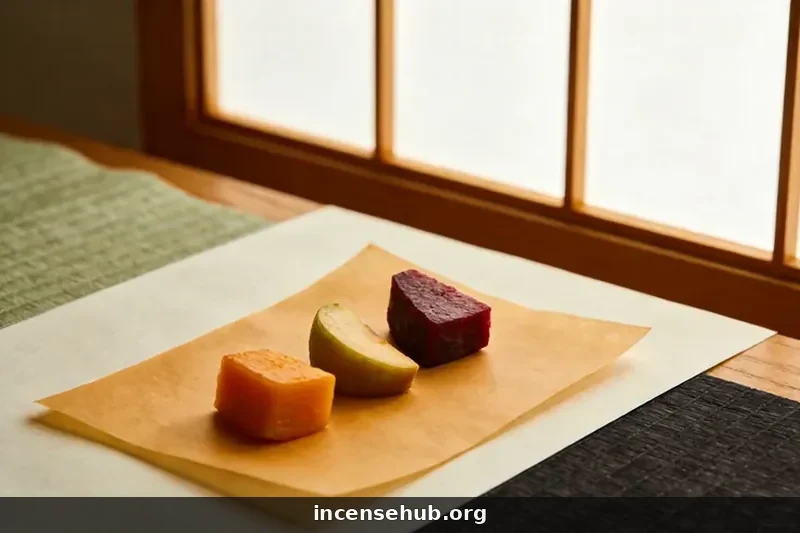
Direct answer: Citron (香橼, xiāngyuán) is Citrus medica, one of the oldest cultivated citrus, in the rue family (Rutaceae). It is a thick-rinded, intensely fragrant fruit grown for its aromatic rind rather than its juice, used in Chinese culture as a scholar’s-table offering (清供) and room-fragrance fruit. It is the parent species of the finger citron (佛手), and the two must be kept distinct.
Key facts
| Chinese | 香橼 (xiāngyuán) — also 枸橼 |
| Botanical source | Citrus medica (family Rutaceae) — the fruit |
| What it is | A fragrant citrus fruit, not a wood or resin |
| Aroma | Citrus, floral, sweet, slightly bitter |
| Traditional role | 清供 offering fruit; room fragrance |
Aroma profile
Direct answer: 香橼 is citrus and floral, with a sweet, lemony, slightly bitter rind scent that is more perfumed and complex than an orange, and more reserved than the finger citron’s exuberant floral lift. The fragrance lives in the thick, oil-rich rind, not the scant juice.
香橼 is citrus and floral, with a sweet, lemony, slightly bitter rind scent that is more perfumed and complex than an orange, and more reserved than the finger citron’s exuberant floral lift. The fragrance lives in the thick, oil-rich rind, not the scant juice. In a room it reads as a clear, elegant citrus, experienced by proximity and evaporation rather than by burning.
Like the finger citron, the citron is a “fragrance of presence” material — its rind slowly releases volatile oil, scenting a room by evaporation. But where the finger citron’s floral lift is exuberant, the citron’s is more reserved, with a slightly bitter, perfumed-complex edge that reads as more mature and less sweet.
The citron (香橼) / finger citron (佛手) relationship (read this)
Direct answer: 香橼 and 佛手 are the same species in different forms: 香橼 is Citrus medica, the parent species with a solid, fragrant fruit; 佛手 is Citrus medica var. sarcodactylis, whose fruit splits into finger-like segments. Both are grown for fragrant rind, not juice.
香橼 and 佛手 are the same species in different forms:
- citron (香橼) — Citrus medica, the parent species, a fragrant, thick-rinded, lemon-like fruit. This entry.
- finger citron (佛手) — Citrus medica var. sarcodactylis, a variety whose fruit splits into finger-like segments. Its own entry.
Both are grown for fragrant rind rather than juice, and both serve as 清供 and room-fragrance fruits. This page describes 香橼 = Citrus medica. When a source means the fingered form, it is describing 佛手. See finger citron.
Botanical source and origin
Direct answer: Citrus medica is one of the most ancient cultivated citrus, native to the foothills of the Himalaya and long grown across China, Southeast Asia, and the Mediterranean. It is also one of the ancestral species — alongside pomelo and mandarin — from which much of the cultivated citrus family descends.
Citrus medica is one of the most ancient cultivated citrus, native to the foothills of the Himalaya and long grown across China, Southeast Asia, and the Mediterranean. Its fruit is large, thick-rinded, and intensely aromatic, with relatively little pulp. Flora of China records the species (including the fingered form sarcodactylis); the citron is also the ancestor — alongside pomelo and mandarin — of much of the cultivated citrus family.
This ancestral status is the citron’s quiet distinction: it is one of the “parent” species of the whole citrus genus, which means a large part of the citrus family — lemons, limes, oranges, grapefruits — descends, in hybridization terms, from the citron. Yet in Chinese fragrance it remained a humble 清供 fruit, not a grand incense material — a reminder that botanical importance and aromatic importance are different things.
The citrus-family context (read this)
Direct answer: The citron sits at the root of the Chinese citrus-fragrance family: it is the ancestor species of the finger citron (佛手), the source of the name that the bergamot (佛手柑) borrows, and a distinct material from the modern lemon (柠檬). Names do not map one-to-one, and species must be specified.
The citrus family is crowded, and the citron is its root:
- citron (香橼) — Citrus medica, the ancient parent species. This entry.
- finger citron (佛手) — Citrus medica var. sarcodactylis, its fingered variety.
- lemon (柠檬) — Citrus × limon, a modern hybrid of the citron with the bitter orange. See lemon.
- bergamot (佛手柑) — Citrus bergamia, a different citrus whose Chinese name borrows 佛手. See bergamot.
The citron is the botanical anchor: the finger citron is its variety, and the lemon descends partly from it. But the names cross in confusing ways (佛手柑 ≠ 佛手), so a reader must specify the species, not rely on the name.
In Chinese tradition
- scholar’s-table offering (清供): 香橼 is a classic 清供 fruit, displayed for its fragrance and auspicious form.
- Room fragrance: its oil-rich rind scents a room by evaporation — a fragrance of presence, not combustion.
- Not a 香乘 incense ingredient: 香橼 does not appear in the classical incense compendium 香乘; its role is as a displayed fragrance fruit, not a burned incense material.
Traditional use vs modern evidence
Direct answer: The 清供 and room-fragrance use is well documented. We make no medical claims. The documented, non-medical facts are botanical identity, the Rutaceae placement, and the fragrant offering-fruit use.
- Traditional Use — 香橼 has described uses in traditional materia medica. Traditional materia-medica language, not modern clinical evidence.
- Historical Record — 香橼 as a scholar’s-table offering (清供) and room-fragrance fruit, documented as a cultural use.
- Scientific Evidence — the botanical identity (Citrus medica, Rutaceae) and its status as an ancestral citrus species are established. We present no clinical or medical efficacy claims.
The 清供 and room-fragrance use is well documented. We make no medical claims. The documented, non-medical facts are botanical identity, the Rutaceae placement, and the fragrant offering-fruit use.
Why is the citron used as a room fragrance?
Direct answer: The citron scents a room by evaporation from its thick, oil-rich rind — a “fragrance of presence” requiring no burning. It is displayed as a 清供 offering, where its clear, elegant citrus scent and its auspicious form are the point.
The citron’s role is the same as the finger citron’s: presence, not combustion. Its thick, oil-rich rind slowly releases volatile fragrance, scenting a room for days simply by sitting on a scholar’s table. It is a offering (清供) fruit, displayed for its fragrance and its form — and, like the finger citron, it is a non-combustible fragrance material, smelled in place rather than burned. The difference from the finger citron is subtle but real: the citron’s scent is more reserved and slightly bitter, where the finger citron’s is more exuberantly floral.
How is it used / processed?
Direct answer: The citron needs no processing for its primary use — it is displayed whole, and its rind scents the room by evaporation. Where a preserved form is wanted, the rind may be candied or dried, but the fragrance use is the fresh, whole fruit.
The processing is minimal, because the primary use is the whole fresh fruit:
- Display whole — the fresh fruit is placed on a table or offering stand, scenting the room by evaporation.
- Drying (optional) — the rind may be dried, with loss of volatile fragrance.
- Candying (optional) — the thick rind may be candied as a food.
There is no distillation or combustion step for the classical use; the citron’s fragrance is released by evaporation, and its processing is essentially “display it.”
What determines quality?
Direct answer: Quality is a matter of rind condition and fragrance: a fresh, intact, thick-rinded fruit with a clear, elegant, slightly bitter citrus scent. The oil-rich rind is the value, not the scant juice, and there is no standardized grading ladder.
The quality factors:
- Fragrance intensity — the strength and clarity of the citrus-floral rind scent; the rind’s oil is the value.
- Freshness — the volatile fragrance fades as the fruit dries; a fresh fruit is more fragrant.
- Rind condition — an intact, thick, oil-rich rind without damage or rot.
There is no standardized grading system; fragrance, freshness, and rind condition are the practical signals.
Common forms
Direct answer: The citron is used as the fresh whole fruit (for display and room fragrance), and less commonly as candied or dried rind. It is a display fruit, not a powder or oil.
| Form | Use |
|---|---|
| Fresh whole fruit | 清供 display; room fragrance |
| Candied rind | Food |
| Dried rind | Occasional, with reduced fragrance |
The whole fresh fruit is the fragrance form; the others are food or secondary uses. The citron is not a burned material or an essential-oil crop in the classical tradition.
Safety
Incense combustion produces smoke and particulate matter. Burn in a well-ventilated space, avoid inhaling concentrated smoke, and keep away from children and pets. This is editorial knowledge content, not medical advice. See our safety guide.
Summary
Citron (香橼) is Citrus medica, one of the oldest cultivated citrus and one of the ancestral species of the whole citrus family, grown for its thick, oil-rich, intensely fragrant rind rather than its scant juice. It is the parent species of the finger citron (佛手) and a classical scholar’s-table offering (清供) room-fragrance fruit, scenting a space by evaporation, never by burning. Its value is fresh, fragrant rind and honest non-combustion framing; its chief risk is a name shared across the citron, finger citron, and bergamot.
FAQ
What is citron (香橼)? The citron, Citrus medica, one of the oldest cultivated citrus, in the rue family (Rutaceae). It is a thick-rinded, intensely fragrant fruit grown for its aromatic rind rather than its juice, and used in Chinese culture as a 清供 offering and room-fragrance fruit. It is the parent species of the finger citron (佛手).
Is citron (香橼) the same as finger citron (佛手)? They are the same species in different forms. 香橼 is the plain citron (Citrus medica), and 佛手 is its fingered variety (Citrus medica var. sarcodactylis). Both are grown for fragrant rind rather than juice, and both serve as 清供 and room-fragrance fruits. Each has its own entry here.
What does citron smell like? Citrus and floral, with a sweet, lemony, slightly bitter rind scent that is more perfumed and complex than an orange, and more reserved than the finger citron’s exuberant floral lift. The fragrance lives in the thick, oil-rich rind rather than the scant juice, and it scents a room by evaporation rather than by burning.
Is the citron related to the lemon? Yes — the lemon (Citrus × limon) is a cultivated hybrid descended partly from the citron (Citrus medica), crossed with the bitter orange. The citron is thus one of the lemon’s ancestors, along with the pomelo and the mandarin for other citrus. They are distinct materials, but the citron is the older parent species. See lemon.
How is citron (香橼) used in Chinese culture? As a scholar’s-table offering (清供) fruit, displayed for its fragrance and auspicious form. Its oil-rich rind scents a room by presence and evaporation — a fragrance of display, not combustion. It does not appear in the classical incense compendium 香乘, so its role is as a displayed fragrance fruit rather than a burned incense material.
Is the citron eaten? Its fruit flesh is scant and not the point — the citron is grown for its thick, fragrant rind, which may be candied or used to perfume spaces, and the whole fruit is displayed for scent and symbolism. As one of the most ancient cultivated citrus, it is also an ancestor of much of the modern citrus family alongside pomelo and mandarin.
See also: finger-citron, lemon (柠檬), bergamot (佛手柑), orange-peel, grapefruit, quince, citrus incense and the full scent guide.
Evidence & Sources
Botanical identity
Source: Citrus medica in Flora of China · Citrus medica on GBIF. Evidence type: Established.
Traditional Chinese use
Source: 香橼 as a 清供 offering and room-fragrance fruit; no entry in the classical compendium 香乘. Evidence type: Historically documented — cultural use.
Authenticity / disambiguation
Source: 香橼 (Citrus medica) vs 佛手 (Citrus medica var. sarcodactylis) vs 佛手柑 (Citrus bergamia). Evidence type: Practical screening.
Safety
Source: incense combustion produces smoke and particulate matter; burn in a well-ventilated space. Evidence type: Established.
Evidence status
| Layer | Status |
|---|---|
| Botanical identity | Established |
| Traditional use | Historically documented (cultural) |
| Authenticity test | Practical screening |
| Health claims | Not established |
Sources
Sources: botanical references on Citrus medica and the citron-vs-finger-citron relationship. 香橼 is documented as a 清供 and room-fragrance fruit; no medical claims are made. This is editorial knowledge content, not medical advice.