
Direct answer: Chenpi (陈皮) is the dried, matured skin of a mandarin — Citrus reticulata — and Xinhui in Guangdong is the district against which the trade judges it. Years in store strip away the sharp oil of fresh zest and leave a darker, bittersweet, tea-like scent that cooks, tea drinkers, and a few blenders prize.
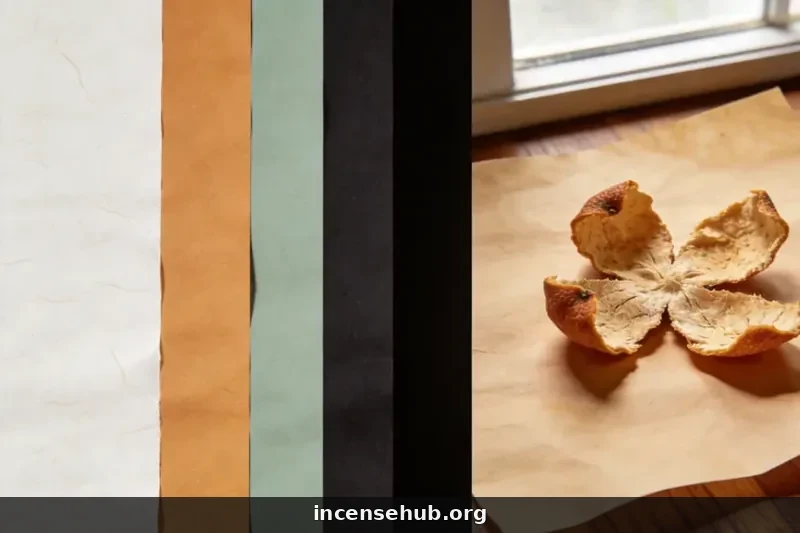
Key facts
| Name | 陈皮 (chénpí), “matured rind”; the raw form is 橘皮 (júpí) |
| Species | Citrus reticulata, a tangerine of the rue family |
| Type | Stored rind — neither timber nor fresh zest |
| Smell | Citrus and dried fruit over wood and tea |
| Uses | Cantonese kitchen, teahouse, traditional medicine, scent work |
| Benchmark | Xinhui (新会), Guangdong; protected regional name |
Key Takeaways
- The word means matured rind, and the maturing — not the fruit — is what makes the product.
- Two things set the price: the district where the fruit grew, and the years in storage.
- Fresh zest is loud and fleeting; matured rind is quiet, dark, and bittersweet.
- In scent work it is a helper note, softening heavy woods and resins rather than leading.
- Both price drivers are easy to overstate, so the buyer’s job is checking rather than choosing.
The Botany Behind the Peel
Direct answer: Chenpi comes from Citrus reticulata, the mandarin or tangerine — a small rue-family tree whose rind separates cleanly from the flesh.
| Feature | What the references record |
|---|---|
| Foliage | Single-leafleted; lance-shaped to broadly oval |
| Blossom | Petals seldom over 1.5 cm; stamens numbering 20 to 25 |
| Fruit | Pale yellow through orange and red to carmine; oblate to nearly round |
| Rind | Thin to thick, lifting away from the flesh with little effort |
| Season | Flowers April to May; fruit October to December |
| Range | Cultivated across southern China below the Qin Ling line |
The rind is the commercial point. A peel that tears away in clean sections can be dried intact, inspected, stored, and sold as a whole piece; a fruit that clings to its skin yields fragments. That property explains the premium on whole pieces and the discount on broken material.
The description rests on the Flora of China treatment and the GBIF record for the species, both listed under Sources.
Xinhui, and Why a Place Name Carries Weight
Direct answer: Rind is made across southern China, but Xinhui in Guangdong is the benchmark, and its name is protected. Origin is the first thing a serious buyer checks.
| Factor | Why it matters |
|---|---|
| District | Xinhui’s soil, climate, and local 茶枝柑 tangerine give the reference character |
| Protected name | A geographical indication turns reputation into something enforceable |
| Price effect | Benchmark rind commands a premium that other districts cannot match |
| Limit | A protected name is a claim, not a guarantee for a particular packet |
The reason is not mysterious: a district with particular conditions and a locally adapted cultivar produces rind with a deeper, more complex bittersweet middle than rind grown elsewhere. Whether one attributes that to terroir, cultivar, or processing tradition, the market has settled on Xinhui as the reference and prices follow the consensus.
A useful way to hold the two variables together: origin sets the ceiling on what a lot can become, and age moves it toward that ceiling. A young Xinhui piece can outrank an old piece from a district with no standing, because the starting material has more to give. That is editorial judgment rather than a laboratory finding, and it matches how the trade prices the two.
From Fruit to Aged Peel
Direct answer: Fruit is opened, the rind is dried, and the pieces are stored for years. Only the waiting is passive.
| Step | What happens | What goes wrong |
|---|---|---|
| Opening | Rind cut into large sections, traditionally a three-way cut | Torn rind dries unevenly and grades lower |
| Drying | Water removed, usually in sun | Too much heat gives a flat, stewed note |
| Storage | Pieces held for years in dry conditions | Damp brings mould; heat drives off aroma |
The three-way cut is not decoration. Sections that dry at an even rate keep their shape and survive storage; torn edges curl and crack, and a cracked lot loses value before it has aged at all. Drying follows the same logic: the aim is to remove enough water to keep the rind stable without cooking the aromatic structure.
Nothing is distilled, extracted, or concentrated. The whole rind is the product, pith included, and the storage step is where the value sits. Methods vary between workshops — some turn the stock, some keep it sealed, some use breathable containers — so a declared age describes a process in general terms rather than a fixed protocol.
What Aging Does to the Material
Direct answer: Storage drives off part of the light citrus fraction, concentrates what is left, and lets browning darken the rind. The result smells lower, sweeter, and more like tea than like fruit.
Run the sequence. Fresh rind holds a large share of volatile aromatic compounds → those evaporate slowly in store → the heavier, less volatile fraction gains proportion → browning deepens the colour → the scent moves from sharp zest toward dried fruit, spice, and tea.
Two things follow from that sequence. The change is gradual and cumulative, which is why age is sold in bands rather than exact figures. And the change has a limit: at some point the rind has surrendered most of what made it interesting, and more storage adds darkness without adding character. Where that limit falls depends on the starting material and the conditions, not on a universal number.
Water is the other half. Rind that takes on moisture can support mould, and a musty note is the clearest evidence that storage failed. A well-kept piece smells clean and sweet at twenty years; a badly kept one can turn in a single damp season. The trade treats storage as part of the product for exactly that reason.
The Aroma, Layer by Layer
Direct answer: Matured rind reads in three layers — a soft citrus top, a bittersweet middle, a woody-tea floor — and the balance shifts with age and district.
| Layer | What it smells of | When it shows |
|---|---|---|
| Top | Clean citrus oil, slightly oily | First, especially when crushed |
| Middle | Bittersweet citrus, dried fruit, faint spice | As the piece warms or brews |
| Floor | Wood, old tea, a dry finish | Last, and longest in a warm blend |
Young rind is dominated by the top; older rind can seem quiet until it is warmed or bruised. The middle carries the material’s identity — the register of marmalade or strong orange tea rather than sugar. The floor is why chenpi can sit beside woods without vanishing, and fresh zest has no floor at all: it ends where the top note ends.
For a blender, the practical reading is that usefulness depends on which layer survives the application. Brief high heat favours the top; slow warmth favours the middle and floor. Buying an old, costly piece to use where only the top escapes wastes both material and money.
The Age Ladder
Direct answer: Chenpi trades by year bands rather than a formal grade, and the bands track colour, scent, and typical use. They are market labels, not a regulatory standard.
| Stated age | Colour | Scent character | Where it usually goes |
|---|---|---|---|
| Under a year | Pale, still bright | Sharp, oily, close to zest | Barely chenpi; sold as 橘皮 |
| One to three years | Amber, darkening | Citrus softening, a little spice | Everyday cooking and tea |
| Three to five years | Deep amber | Warm, sweet-spicy, tea edge | Cooking, tea, blending |
| Five to ten years | Dark brown | Rounded, bittersweet, tea-like | Tea and premium cooking |
| Ten years and beyond | Very dark, brittle | Deep, mellow, dried fruit and spice | Collecting and premium use |
The table maps a direction, not a ruler. A five-year lot kept badly can present worse than a three-year lot kept well, and one workshop’s “ten-year” may follow a different counting convention from another’s. Bands are useful because they describe a trajectory; they are unreliable as a measurement.
That gap between label and reality is the central fact of the age trade. Age is a claim about the past, and the past does not travel in the packet. What travels is colour, condition, and scent — three signals that correlate with age without proving it.
Fresh Zest and Aged Peel Are Different Materials
Direct answer: Zest is a bright, volatile top note. Matured rind is darker, lower, bittersweet, and woody at the base. Neither substitutes for the other in a pot or a blend.
| Property | Fresh mandarin zest | Matured chenpi |
|---|---|---|
| Colour | Bright orange | Amber to near-black |
| Dominant scent | Sharp, oily citrus | Bittersweet citrus over wood and tea |
| Volatility | High; fades fast | Lower; releases slowly |
| Behaviour on heat | Flashes off early | Holds a base note longer |
| Culinary role | Finish and lift | Background depth |
| Price | Low | Scales with district and years |
Substitute zest for chenpi and the dish smells brighter and shallower. Substitute zest in a blend and the top note vanishes within minutes. Go the other way — old rind where fresh zest is wanted — and the result loses lift and reads heavy.
The English phrase “orange peel” collapses both, which is how the confusion spreads. A translated recipe may say orange peel when it means the matured article, and a reader following the English words can end up with the wrong ingredient without ever noticing a choice was made.
Chenpi Among the Citrus Peels
Direct answer: Chenpi is one of several citrus-peel materials used in Chinese cooking and incense, and the family members are different species with different aromas. They are not interchangeable.
| Material | Botanical source | Character |
|---|---|---|
| Chenpi (陈皮) | Matured Citrus reticulata rind | Deep, bittersweet, tea-like |
| Pomelo peel (柚皮) | Citrus maxima rind | Bittersweet, floral-woody, thick white pith |
| Citron peel (香橼) | Citrus medica | Lemony, floral, fragrant skin |
| Buddha’s hand (佛手) | Citrus medica var. sarcodactylis | Intensely floral; rind only, no juice |
| Bitter orange (苦橙) | Citrus aurantium | Dry, bitter, marmalade edge |
| Litchi husk (荔枝壳) | Litchi chinensis fruit wall | Fruity-sweet, faintly floral |
Two of these deserve a note. Pomelo peel is the material chenpi is most often compared against, and the comparison is instructive: pomelo brings a thicker pith and a floral-woody lift, while chenpi brings the aged bittersweet depth. Litchi husk is not a citrus at all — it is the pericarp of a fruit in the soapberry family — yet it appears in classical incense lists alongside citrus peels because it behaves like one on heat.
The useful rule is to read the botanical name before the trade name. A blend recipe that says “citrus peel” has not told you which species, and the difference between a mandarin peel and a pomelo peel is larger than the difference between two grades of the same material. See pomelo peel and litchi husk for the individual treatments.
Forms: Whole, Broken, Powdered
Direct answer: The material sells as intact pieces, broken sections, and powder. Intact pieces are the reference form; the others are convenience grades with less to inspect.
| Form | What it is | Typical use | Trade-off |
|---|---|---|---|
| Whole piece | Intact dried rind, often the three-way cut | Cooking, tea, display, grading | Best for inspection; bulky |
| Broken sections | Fragments of intact rind | Cooking, tea, blending | Cheaper; harder to judge origin |
| Powder | Ground rind | Seasoning, blends, convenience | Convenient; uninspectable |
An intact piece carries information the other forms destroy: colour, thickness, oil content, cleanliness. A buyer can hold it against the stated age and judge whether the two agree. Once the rind is broken or ground, those signals are gone and only the seller’s word remains.
For blending, powder is the practical form because it measures and mixes easily. The cost is that powder is also the easiest form in which to pass cheap rind off as expensive. A blender who cares about provenance buys whole pieces and grinds them, or buys powder only from a source that can trace the lot.
Where Chenpi Sits in an Incense Blend
Direct answer: Chenpi is a supporting note in warm spice-and-wood blends. It adds a softened, dried-fruit citrus that rounds off heavier materials without the sharpness of fresh zest.
The material is far better known for cooking and tea than for incense, and that reputation is accurate. It appears in blends rather than as a solo burn, and it appears in small amounts, because its bittersweet character can dominate a delicate composition. Think of it as a bridge: it connects the sweetness of resins to the dryness of woods, and it gives a blend a fruit note that does not read as candy.
In the classical Chinese framework of 君臣佐使 (chief, minister, assistant, guide), chenpi usually takes an assistant or guide role. It is not the material a composition is built around; it is the material that makes the chief note read more clearly. That framing is traditional rather than scientific, but it captures the practical behaviour well: a small amount changes the shape of a blend, and a large amount flattens it.
The culinary parallel is exact. In a braise, a piece of chenpi is not there to make the dish taste of orange; it is there to round off the meatiness and give the sauce a longer finish. In a blend, the same logic applies to the aroma. The note is a modifier, not a headline.
How the Note Behaves on Heat
Direct answer: On heat, chenpi releases its remaining citrus top first, then the bittersweet middle, then a woody base. The order is why the material works in slow, warm applications and disappoints in fast, hot ones.
Follow the chain. Warm peel gently → the lightest aromatic compounds volatilise first → the top note arrives → continued heat drives off the middle fractions → the bittersweet character peaks → further heat leaves the woody base and then, if pushed, a scorched note.
That sequence has two practical consequences. The first is that chenpi rewards a low, steady heat source, where each layer has time to appear. The second is that a high, fast heat source collapses the sequence: the top and middle arrive together, the base scorches before it can be appreciated, and the blend reads harsh.
For a stick or a coil, the material is usually ground and blended, so its behaviour depends on the binder and the burn rate as much as on the peel. For loose powder on a heater, the peel’s own sequence is easier to observe, and it is the best way to learn how much the material can give before it turns.
A Quality-Control Checklist for Buyers
Direct answer: Five checks cover most of what a buyer can verify without a laboratory: origin documentation, stated age against appearance, colour evenness, aroma cleanliness, and physical condition.
| Check | What good looks like | What should stop you |
|---|---|---|
| Origin | A named district and a traceable supplier | “Xinhui” as a bare word with no documentation |
| Age | The stated bracket matches colour and aroma depth | A very dark peel with a thin, sharp smell |
| Colour | Even amber-brown to dark brown, natural variation | Patchy, grey, or uniformly painted-looking |
| Aroma | Clean, bittersweet, tea-like, no mustiness | Damp, mouldy, or flat sawdust notes |
| Condition | Intact, dry, flexible-not-brittle pieces | Sticky surfaces, soft spots, heavy breakage |
The order matters less than the combination. A single failed check is a reason to ask a question; two failed checks are a reason to walk away. The aroma check is the most informative and the least fakeable, which is why it deserves the most attention.
One caution about colour: a very dark piece is not automatically old. Darkness can come from age, from the starting fruit, from storage conditions, or from treatment. Reading it as a proxy for age is reasonable only when the other checks agree.
How Origin and Age Get Misrepresented
Direct answer: Four commercial risks dominate — origin substitution, age inflation, zest sold as chenpi, and re-humidified stock — and all four are label problems rather than safety problems.
| Risk | What happens | How it shows |
|---|---|---|
| Origin substitution | Rind from outside Xinhui sold as Xinhui | Appearance can be close; price gap is the motive |
| Age inflation | Young rind sold as older stock | Darkness accelerated by storage or treatment |
| Zest confusion | Ordinary dried peel sold as chenpi | Bright, thin smell instead of deep bittersweet |
| Re-humidified stock | Damp rind dried again and sold as sound | Flat or musty note; texture soft in places |
None of these makes the material dangerous in the way contaminated food would be. They are integrity problems, and they yield to the same tools: a supplier who names the source, a sensory check, and the willingness to reject a lot that does not smell right.
Storage and the Slow Decline
Direct answer: Keep the rind dry, dark, and away from strong smells. Damp is the enemy that matters most, and a single wet season can undo years of careful storage.
The routine is short. Use a clean container that closes well → store it away from light, heat, and the cooker → check periodically for softness or a musty smell → air it briefly if it feels damp, then reseal. Stability matters more than any particular container: a lot that cycles between damp and dry deteriorates faster than one held steadily.
Sealed and breathable containers each have a cost. A sealed jar keeps out humid air and kitchen odours but also traps moisture that was already in the rind; a breathable container avoids that trap but exposes the material to the room. In a humid climate the sealed jar with regular inspection is usually safer; in a dry climate breathable storage is more forgiving.
Age is not indefinite improvement. A peel held twenty years in good conditions is a different material from one held twenty years in a damp cupboard, and the difference cannot be recovered. That is the argument for buying from a source whose storage can be described rather than merely whose age can be claimed.
The Economics of Patience
Direct answer: The price reflects two scarce things — a named district and years in store — and both are expensive to guarantee and easy to overstate.
Most crops sell in the season they are picked. Chenpi sells years later, so someone carried the inventory, the spoilage risk, and the storage cost throughout. That carrying cost sits inside the price of old rind and explains why the curve is steep rather than linear.
The district premium rests on a different scarcity: Xinhui is a limited area, and the rind carrying the name is a small share of total mandarin output. Buyers pay for a differentiated raw material whose difference shows in the cup.
The implication is blunt. Very cheap “old” chenpi is a contradiction — either the years are overstated, the district is overstated, or the storage was poor. Price cannot prove quality, and a figure far below the market for the claimed category is information worth acting on.
Tasting and Smelling: A Workable Method
Direct answer: Evaluate chenpi the way a tea taster evaluates leaf: look first, smell dry, then smell and taste after a short infusion. The sequence separates appearance, aroma, and flavour, and it prevents one strong impression from dominating.
Look. A whole piece should be intact, dry, and evenly coloured within its natural variation. Patchiness, grey patches, or a sticky surface are reasons to look further.
Smell dry. Crush a small piece between the fingers and smell it. Young peel gives a sharp citrus lift; older peel gives a lower, sweeter, tea-like note. A musty or damp smell ends the evaluation.
Infuse briefly. A short steep in hot water releases the middle layer — the bittersweet citrus that defines the material. Taste for depth and length: a good peel leaves a lingering, clean finish, while a poor one goes flat quickly or turns bitter in the wrong way.
Compare. The method is most useful as a comparison between two or three samples, not as an absolute judgment. Set a young Xinhui peel beside an older one and the direction of aging becomes obvious; set a Xinhui peel beside an unknown-origin peel and the origin difference shows in the middle layer.
In the Kitchen and the Teacup
Cantonese cooking treats chenpi as a background material. It goes into soups, braises, and congee in small pieces, valued for rounding off richness rather than for pronounced orange flavour. Added early, it lengthens the finish; added late, it keeps a brighter top note.
In tea it is brewed alone or with pu-erh. The peel’s bittersweet character cuts the earthy weight of aged tea, and the tea gives the peel a structure it lacks alone. Proportion decides the result: too much and the cup turns bitter, too little and it disappears.
The same material appears as 九制陈皮 (jiǔzhì chénpí), a preserved sweet-savoury snack. That form is a reminder that chenpi is a food first; its use in incense is a small extension of a much larger culinary life.
Traditional Use, and the Evidence Line
Direct answer: Chenpi has a long record in Chinese cooking and materia medica, where it is described in traditional language for digestive support and for “regulating qi” (理气). That record is historical, and it is not modern clinical evidence.
Make the line explicit. Household cooking, teahouse practice, and the materia medica literature all record the material, and that record is cultural history rather than experiment. Research on citrus flavonoids such as hesperidin and nobiletin sits mostly in preclinical territory — cells and animals, not people.
We describe the culinary and cultural record because it is genuine and because it explains the material’s standing. We make no claim that chenpi prevents or treats any condition, and traditional descriptions belong in the category of traditional belief, not medical guidance.
Food status and burning are separate questions. Eaten, the rind is an ordinary food ingredient with a long history. Burned, it emits smoke like any combustible, and that calls for the usual precautions rather than special ones.
Safety and Smoke
Direct answer: Chenpi is a food-grade material, and burning it produces smoke and particulate matter like any other incense ingredient. Burn in a well-ventilated space and keep the session modest.
The safety point is not about the peel’s toxicity; it is about combustion. Any material that smoulders releases particles and gases, and a small room with closed windows concentrates them. The practical habits are ordinary: ventilate, keep the source away from flammable surfaces, and do not leave a burning material unattended.
For readers who want the general framework, the site’s safety guide covers ventilation, heat sources, and handling. The specific material does not change those rules.
Mistakes That Cost Money
- Buying the word, not the material. “Chenpi” on a packet is a claim about process, and process is the easiest thing to overstate.
- Assuming older is always better. A poorly stored old peel can be worse than a well-kept younger one.
- Ignoring origin. Xinhui sets a ceiling that age cannot lift a non-benchmark peel above.
- Buying powder for provenance. Powder is convenient and uninspectable; whole pieces are the form that carries evidence.
- Storing in the kitchen cupboard. Heat, light, and cooking odours are the three things the material should avoid.
Three Ways to Use the Material
Direct answer: Cooking, tea, and incense each want a different age and form, and matching the grade to the job matters more than buying the oldest piece on the shelf.
| Use | Age that suits | Form | What matters most |
|---|---|---|---|
| Braises, soups, congee | Three to ten years | Whole piece, added early | Depth and cleanliness; the piece is a background note |
| Tea, alone or with pu-erh | Five years and up | Whole or broken section | A bittersweet middle with no mustiness |
| Incense blending | Three years and up | Powder, or whole piece ground at home | Dryness, cleanliness, and a low, steady aroma |
| Preserved snack | Any food-grade age | Processed | Flavour balance rather than aroma depth |
The pattern is that the kitchen tolerates a wider range than the teacup, and the teacup tolerates a wider range than the blending bench. A young peel with a bright top note can be excellent in a braise and disappointing in a blend, because the heat of cooking drives off exactly the fraction a braise wants and a heater also drives off. An older peel with a strong base can be dull in a quick stir-fry and superb in a slow soup, because the base needs time to show.
The practical consequence is that “best” is not a property of the peel alone. It is a match between the material and the application, and the most expensive piece is often the wrong purchase for the job in front of you.
Reading a Single Piece by Hand
Direct answer: A whole piece carries information that no label can supply — thickness, surface texture, flexibility, and the state of the cut edge — and a minute of handling is worth more than a paragraph of description.
Start with the surface. A well-aged peel has a dry, slightly leathery feel and a surface that shows the dimpling of the oil glands. The colour should be deep but not uniform, with lighter and darker passages that follow the shape of the piece rather than sitting in patches. A painted or stained piece tends to look flat, with colour that fills the depressions instead of following them.
Then flex it gently. A sound piece bends a little before it creases. A piece that snaps immediately is either very old or overdried, and a piece that feels soft or cool in the hand has probably taken on moisture. Neither is necessarily ruined, but both change how the material should be stored and used.
Finally, look at the cut edge. The three-part cut leaves a clean line where the peel was opened, and the thickness of the rind is visible there. A very thin rind dries quickly and ages quickly; a thick one holds more pith and more water. Neither is better in the abstract, but the difference tells you what to expect from the piece in storage.
When Storage Goes Wrong
Direct answer: Most chenpi failures are storage failures, and they announce themselves through texture, smell, and colour before they become visible mould.
| Symptom | Likely cause | What to do |
|---|---|---|
| Soft or cool-feeling patches | Moisture uptake | Dry in shade, isolate from the rest, re-check in a week |
| White or green fuzz | Mould | Discard the affected pieces; do not blend them |
| Musty, cellar-like smell | Damp storage | Air the lot, replace the container, re-assess |
| Brittle, dusty pieces | Over-drying or great age | Handle gently; use for powder rather than whole-piece display |
| Faded, flat aroma | Oxidation past the useful point | Use sooner; the material is not unsafe, just tired |
| Sticky surface | Re-humidified stock | Treat as a handling problem and question the source |
The order of checks is deliberate. Texture catches moisture before mould does, smell catches damp before it becomes visible, and colour catches treatment before it misleads a buyer. A lot that fails the first check should not be tasted or blended until it has been dried and re-examined.
The container question returns here. A sealed jar protects against humid air and kitchen odours, but it also holds any moisture that was already in the peel. A breathable container avoids that trap but exposes the material to the room. In a humid climate, the sealed jar with a periodic inspection is usually the safer default; in a dry climate, breathable storage gives more margin for error.
Chenpi Beside Other Aged Products
Direct answer: Chenpi belongs to a family of foods whose value comes from controlled time — aged pu-erh, aged vinegar, cured meat — and the comparison shows what aging can and cannot do.
| Product | What time changes | What time cannot fix |
|---|---|---|
| Chenpi | Water loss, oxidation, colour, aroma depth | Poor starting rind or damp storage |
| Aged pu-erh | Microbial and enzymatic transformation | A weak leaf or bad humidity control |
| Aged vinegar | Acidity mellows; colour and body deepen | A flawed fermentation |
| Cured meat | Salt and drying firm the texture | Poor hygiene or a bad cure |
The shared logic is that time is a processing step, not a delay. A young pu-erh is not an inferior version of an old one; it is a different drink, and the same holds for chenpi. Aging changes balance and adds depth, and it does not rescue weak starting material.
The difference lies in what changes. Tea aging is driven largely by microbial and enzymatic activity, which is why humidity and air matter so much. Rind aging is closer to slow drying and oxidation: water leaves, volatiles evaporate, browning proceeds, and the remainder concentrates. That is why chenpi tolerates dry storage better than tea does, and tolerates damp far worse.
Building a Blend Around a Modest Note
Direct answer: Chenpi is easy to overuse in a blend, and the fix is to treat it as a seasoning rather than an ingredient — a small amount that changes the shape of the composition.
| Blend role | Amount | What it does | What goes wrong if increased |
|---|---|---|---|
| Accent | A trace | Lifts a resin or wood without announcing citrus | Turns the blend into a fruit composition |
| Bridge | Small | Connects a sweet top to a dry base | The middle becomes muddy |
| Base modifier | Moderate | Adds a bittersweet floor under lighter materials | Dominates and flattens the top notes |
| Lead note | Large | Reads as a citrus-forward blend | The material’s bitterness takes over |
The table is a way of thinking rather than a recipe. The exact amount depends on the concentration of the peel, the heat source, and what else is in the blend, and none of those can be settled on paper. What the table does settle is the direction of error: when in doubt, use less, because a blend that is too quiet can be adjusted and a blend that is dominated by chenpi usually cannot.
The same logic explains why chenpi pairs well with resins and poorly with delicate florals. A resin has the weight to sit under the peel’s bittersweet middle; a light floral does not, and the peel’s base note covers it. The material is a good citizen in a heavy blend and a poor one in a light blend, which is a statement about compatibility rather than quality.
Mandarin, Tangerine, and the Naming Problem
Direct answer: English uses “mandarin,” “tangerine,” and “orange” loosely, and the looseness hides which fruit a packet came from. The Chinese trade is more exact, and the exactness is worth borrowing.
In English, a small loose-skinned citrus is a mandarin or a tangerine depending on the shop, and the same fruit may appear as a clementine or a satsuma elsewhere. Botanically these sit close together and the naming has never been stable.
What matters for chenpi is narrower: the rind must come from a citrus whose peel separates cleanly, dries well, and develops the bittersweet depth the trade expects. A label naming a district and a cultivar is more useful than one naming a fruit. “Mandarin peel” describes a family; “Xinhui 茶枝柑” describes a place and a type, which is a claim that can be checked.
So read the Chinese name and the district before the English fruit word. 陈皮 with a named district is a specific product; “dried orange peel” is a category that contains it and much else.
How the Piece Is Used in Cooking
Direct answer: In the kitchen chenpi is a flavouring agent, not an ingredient — a small piece, added at the right moment, that changes a dish’s finish without making it taste of orange.
Preparation is simple: rinse the piece, soak briefly if it is stiff, and scrape the white pith away if a cleaner bitterness is wanted. The pith carries much of the bitter load, so removing it shifts the balance toward the aromatic outer rind.
Timing does the rest. Added at the start of a long braise, the piece dissolves into the background and lengthens the finish; added near the end, it keeps more top note and reads brighter. In soup it usually goes in early with the aromatics; in a quick dish it may be steeped separately and the liquid used.
Quantities are small by design. A thumbnail-sized piece can perfume a pot for four, and doubling it does not double the effect — it moves the dish from rounded to medicinal. The same lesson applies in blending: the material is potent out of proportion to its modest appearance.
The Preserved Snack, and What It Reveals
Direct answer: 九制陈皮 (jiǔzhì chénpí) is the same rind processed into a sweet-savoury snack, and its existence says something useful about how the culture treats the material.
The snack is chewy, salty-sweet, and strongly citrus, with a long finish that sits between candy and condiment. It is made by repeatedly treating the rind — the name refers to a multi-stage process — and the result is a completely different experience from the dried piece used in a soup. The aroma is still there, but it is folded into sugar, salt, and texture.
Two things follow. The first is that chenpi is not a precious substance kept apart from daily life; it is a pantry material that spans the medicine shelf, the soup pot, and the sweet shop. The second is that processing can move the material a long way from its dried form without destroying its identity. A snack, a tisane, and a braise are three expressions of one ingredient.
For a buyer, the snack is a useful reference point for the aroma. Someone who knows how 九制陈皮 tastes already knows the bittersweet citrus signature, and can recognise it in a drier, less sweet form.
A First Purchase, Step by Step
Direct answer: Buy small, buy whole, buy from a seller who names the district, then compare two samples before buying more.
- Start small. A single lot tells you little; two lots tell you a great deal.
- Buy whole pieces. They can be inspected; powder cannot.
- Ask for the district. A named place is checkable; a country is not.
- Compare side by side. Same cup, same water, same steep, two materials.
- Store properly. Sealed, dark, cool, and checked monthly.
Comparison is the step buyers skip. One piece in isolation has no reference point; two pieces side by side make the difference between young and old, or between districts, immediately obvious. Even a modest pairing — a three-year and an eight-year from the same seller — teaches more than any description.
A first purchase is calibration, not a verdict. The buyer who notes what they bought, how it smelled, and how it behaved in the pot learns faster than one who simply buys the most expensive piece available.
What the Buyer Is Actually Choosing
Direct answer: Most chenpi decisions come down to a handful of trade-offs, and separating what each choice changes from what it leaves alone keeps the purchase honest.
| Choice | What it changes | What it leaves alone |
|---|---|---|
| Older versus younger | Scent depth, colour, price | The species; both come from the same fruit |
| Xinhui versus elsewhere | Aromatic ceiling and price | Edibility; both are food-grade rind |
| Whole versus powdered | Inspectability versus convenience | Where the material grew |
| Sealed versus breathable storage | Moisture risk and odour pick-up | The years already accumulated |
| Kitchen versus teapot | Which aromatic fraction you notice | The need for clean, dry storage |
| Dried versus snack form | Sugar, salt, and texture | The underlying rind |
Read down the middle column and the pattern is that money buys depth and documentation, not safety or species. Read down the right column and the pattern is that the material’s identity survives most of these choices. The two columns together are why a buyer can spend a little and still get something sound, provided the storage was right.
Terms That Appear on a Label
Direct answer: A handful of Chinese terms cover most of what a chenpi label is trying to say, and recognising them is faster than decoding an English description.
| Term | Literal sense | What it signals |
|---|---|---|
| 陈皮 | Matured rind | The aged product, as opposed to fresh rind |
| 橘皮 | Tangerine rind | The raw, un-aged material |
| 新会陈皮 | Xinhui matured rind | A district claim, protected by geographical indication |
| 茶枝柑 | Tea-branch mandarin | The local cultivar most often named for Xinhui peel |
| 九制陈皮 | Nine-process rind | The preserved snack, not the dried cooking material |
| 理气 | Regulate qi | Traditional materia-medica language, not a clinical claim |
The useful discipline is to separate the terms that describe the material from the terms that describe a claim. 陈皮 and 橘皮 describe what the goods are. 新会 and 茶枝柑 describe where they came from. 九制 describes a different product made from the same starting point, and 理气 belongs to traditional belief rather than to a label’s factual content.
Cooking Applications at a Glance
| Dish type | When the piece goes in | What it contributes | What to avoid |
|---|---|---|---|
| Clear soup | Early, with the aromatics | A long, quiet finish | Too much turns the broth bitter |
| Braise | Early, whole piece | Rounds off richness | Leaving the pith on adds bitterness |
| Congee | Early, shredded | Warm citrus against starch | Overpowering in a small pot |
| Stir-fry | Late, as a steeped liquid | A bright top note | Direct high heat scorches the rind |
| Tea | Short steep, alone or with pu-erh | Cuts earthiness | A long steep turns bitter |
| Snack | Ready-made | Sweet-savoury chew | It is not a substitute for dried rind |
Defects and What They Suggest
| What you see | What it usually means | What to do |
|---|---|---|
| Soft, cool patches | Moisture has entered the lot | Dry in shade, isolate, recheck in a week |
| Brittle edges that snap | Very dry or very old material | Handle gently; grind it for blending |
| Faded, dusty scent | Past its aromatic peak | Use in cooking rather than in tea |
| Sticky surface | Poorly dried or re-humidified stock | Question the source before buying more |
| Grey or green patches | Mould | Discard the affected pieces |
| Uneven colour | Mixed lots or uneven drying | Judge by scent, not by appearance |
Chenpi on the Heater
Direct answer: On a warm plate, chenpi behaves as a three-stage note — a citrus lift, a bittersweet middle, a woody floor — and the dose that flatters a blend is smaller than most people expect.
Start low and small. A pinch of ground rind on a plate set below combustion gives off its remaining oil first: a bright, marmalade-like lift that reads clearly against resin. As the plate warms through, the bittersweet middle arrives and the blend gains a dried-fruit roundness. The woody floor comes last, and it is the first thing to scorch if the heat climbs.
The failure mode is easy to recognise. Push the plate and the three stages collapse into one loud, slightly bitter puff — the same material that seemed precise a moment earlier now reads crude. That is why the same rind can flatter a slow session and ruin a hot one.
Pairing follows the same logic. Sweet, balsamic resins take a trace without losing their identity. Dry woods with a bitter edge can turn harsher when the rind’s bitterness stacks on top. Light florals are the least forgiving: a blossom note disappears under a middle-heavy citrus, and what remains reads like potpourri.
Dose by weight rather than by eye. Years of water loss concentrate the aromatic load, so a pinch that looks trivial beside a resin tear can carry an entire blend. Weigh the first attempt, note the plate setting, and change one variable at a time — the second attempt will then tell you something.
What Pairs Well, and What Does Not
| Partner | What chenpi adds | Risk |
|---|---|---|
| Sweet resins (benzoin, soft myrrh) | A citrus lift over balsamic warmth | Too much turns the blend fruity |
| Dry woods (lean agarwood, sandalwood) | A bridge between sweet and bitter | Bitterness stacks and reads harsh |
| Warm spices (cinnamon, clove) | A dried-fruit middle | The blend becomes a cold-weather cliché |
| Light florals | Very little; the middle covers them | The floral disappears entirely |
| Green or herbal notes | A surprising marmalade edge | Mismatch reads as a mistake |
The pattern in the table is that chenpi sits comfortably with materials that already have weight, and poorly with materials that depend on airiness. It is a grounding note, not a lifting one, and asking it to lift a delicate composition is asking for the wrong job.
Climate and Condition
Direct answer: Where a lot is stored decides how fast it changes and which failure it is most likely to meet, and the two variables that matter are moisture and temperature.
| Storage climate | Effect on the rind | What to watch |
|---|---|---|
| Cool and dry | Slow, even change; colour deepens steadily | Over-drying, brittle edges |
| Warm and dry | Faster water loss; top notes fade early | Flat scent, dusty surface |
| Cool and humid | Slow drying, higher mould risk | Soft patches, cellar smell |
| Warm and humid | Rapid deterioration | Sour notes, insect damage |
| Coastal air | Salt and damp on the surface | Packaging failure, surface mould |
The table is a way of predicting failure rather than a set of rules. A cool, dry room is the easiest place to keep a lot sound; a warm, humid one demands sealed containers and frequent checks. What a buyer cannot do is store the material the way the seller did unless the seller says what that was, which is why the storage question belongs in the purchase conversation rather than in the pantry.
The practical adaptation is simple. In a humid climate, seal the container and inspect monthly; in a dry one, use a breathable container and inspect quarterly. In both cases, keep the material away from the kitchen’s steam and from anything with a strong smell, because rind picks up odours readily and never gives them back.
A Buying Conversation, Start to Finish
Direct answer: The most useful thing a buyer can do is ask four questions in order and listen for what is not said. The answers matter less than whether the seller can give them at all.
“Which district?” A seller who names Xinhui without hesitation may be repeating a label; one who names a village, a workshop, or a cooperative is describing a supply chain. Neither answer proves anything, and the difference in specificity tells you how close the seller stands to the material.
“Which year was the fruit picked?” This is the question that separates age claims from age arithmetic. A lot dried in one year and stored since then has a straightforward history; a lot described only as “ten-year” has a number without a starting point. The gap between picking and storage is where claims blur.
“How has it been kept?” Sealed or breathable, coastal or inland, turned or undisturbed — the answer predicts condition better than the declared age does. A ten-year lot in a damp room can present worse than a five-year lot in a dry one.
“Can I see the piece I am buying?” Photographs of the actual lot, not a stock image, are a small test with a high failure rate. A seller who cannot produce one is selling a category rather than a consignment.
Listen for the fourth answer especially. Many sellers will answer the first three from a script and stumble on the fourth, because the first three describe the product and the fourth describes the stock. The distinction is practical: the product is what the market says chenpi is, and the stock is what will arrive in the post.
What Changes in the Cup
Direct answer: Brewing exposes the middle and floor of the rind, and the variables that matter are water temperature, steep time, and proportion — not the theatrics.
A short steep at just below boiling gives the bittersweet middle without much of the woody floor. A longer steep pulls the floor forward and adds a drying finish. That is why the same piece can taste bright in one cup and heavy in the next, and why a buyer testing a new lot should fix the parameters before judging it.
Proportion does the rest. A small piece in a large pot reads as a background warmth; the same piece in a small cup reads as a statement. The material is concentrated by years of water loss, so the useful dose is smaller than the appearance of the piece suggests.
Blending with tea follows the same logic. With an aged pu-erh, the rind’s bitterness can cut the tea’s earthiness, and the tea’s structure keeps the citrus from floating free. The proportion decides whether the result is a partnership or an argument. A common failure is treating the rind as the main event and the tea as a base; the reverse usually works better.
There is a practical test worth doing once. Brew two cups from the same lot — one at a short steep, one at a long one — and taste them side by side. The difference tells you where the material’s useful range sits, and that range is what you are buying when you buy age.
Packaging, Post, and the Condition of the Arrival
Direct answer: Rind travels badly when it travels damp, and the condition of the parcel on arrival is part of the material’s history, not a separate concern.
A sound parcel is dry, rigid enough to protect the pieces, and sealed against humidity. Vacuum packing is common for export because it removes air and holds the material still; the trade-off is that a vacuum bag hides the condition of the contents until it is opened. A seller who packs loosely in paper is betting on a short journey and a dry climate.
On arrival, open the parcel away from steam and check three things in order: smell, feel, and colour. A musty smell is the one defect that cannot be corrected; soft patches mean moisture has entered; colour that does not match the declared age is a reason to ask rather than to reject immediately.
The condition of the arrival also sets the storage clock. Material that has picked up moisture in transit needs to be dried gently and inspected before it goes into long storage, because sealing damp rind in a jar is the fastest way to lose a lot. That is the one point where the buyer’s handling matters as much as the seller’s.
Comparing Two Lots Without a Laboratory
Direct answer: A side-by-side comparison of two lots, run the same way twice, teaches more than any single tasting and costs nothing but attention.
Set the comparison up properly. Use two identical cups, the same water temperature, the same steep time, and the same quantity of rind → the only variable left is the material → whatever difference appears belongs to the lot, not the method. That control is what separates a comparison from an impression.
Then run three passes. First, smell the dry pieces: the younger lot usually leads with citrus oil, the older with dried fruit and tea. Second, brew short and taste: the middle note shows here, and a lot with a hollow middle will taste thin even if its dry smell was promising. Third, brew long and taste again: the floor arrives, and a lot that turns harsh or drying at this stage is telling you its limit.
Write down what you find. The notes do not need to be elaborate — a line on colour, a line on the short steep, a line on the long one — and after a few comparisons the pattern becomes obvious. Buyers who keep notes stop relying on the label, because they have their own record of how the material behaves.
The method has an obvious limit. It compares lots to each other, not to an absolute standard, so a comparison between two poor lots will simply rank them. That is still useful: knowing which of two mediocre pieces is better is the practical question most buyers actually face.
Buying at Three Budgets
Direct answer: A small budget, a middle budget, and a large budget should each buy a different thing — and none of them should buy “the oldest available.”
At the low end, buy soundness rather than depth. A younger piece from a named district, stored well, will outperform an older piece of unknown origin that has been kept badly. The cheapest useful purchase is a small quantity of whole pieces with a clear district and a modest age, bought to learn what the material smells like rather than to impress anyone.
At the middle, buy a comparison. Two lots from the same seller, three to five years apart, will teach more than a single expensive piece, because the difference between them is the thing you are trying to understand. The middle budget is the only one where comparison is affordable, and comparison is the fastest route to a working palate.
At the high end, buy documentation. Once the price is high enough that a mistake matters, the questions change: not “does this smell good” but “can the seller describe the district, the year, and the storage, and can I verify any of it.” A high price paid for a documented lot is a purchase; a high price paid for a beautiful photograph is a gamble.
The pattern across all three budgets is the same: pay for information before paying for age. Information is what lets the next purchase be better, and age without information is just an expensive guess.
What a Good Lot Smells Like at Each Stage
Direct answer: The smell of a sound lot changes in a predictable direction with age, and knowing the direction is more useful than memorising any single descriptor.
Young rind, one to three years, still carries a bright citrus edge. It smells of the fruit with the volume turned down: orange oil, a little green, a faint bitterness underneath. This is the stage where the material is easiest to recognise and hardest to mistake for something else.
Middle age, three to ten years, is where the bittersweet middle takes over. The citrus is still there but it has softened into dried fruit, and a tea-like note begins to appear underneath. The piece smells rounder and quieter than the young material, and it holds its character longer when warmed.
Old rind, ten years and beyond, smells low and persistent. The top note is thin or absent until the piece is crushed or heated; what dominates is dried fruit, old tea, and a woody floor. A very old piece can seem almost scentless in the jar and then open dramatically on a warm plate, which is one reason a cold sniff is a poor test of old material.
The direction matters because it gives a buyer a way to check an age claim. A piece sold as old but smelling bright is probably younger than claimed; a piece sold as young but smelling of nothing but tea and wood is probably older, or has been stored warm for a long time. Neither inference is proof, and both are useful.
A Note on Quantity and Pace
Direct answer: The material is used in small amounts, and buying in small amounts is not a compromise — it is the correct match for how it behaves.
A household that cooks with chenpi a few times a month will use a handful of pieces in a year. A tea drinker who brews it weekly will use more, but still in pieces rather than kilos. A blender uses grams at a time. The quantities are small because the material is concentrated: a thumbnail-sized piece can carry a pot, and a teaspoon of powder can carry a blend.
That has two consequences for buying. First, a large quantity of a single lot is usually a mistake unless the lot has been tasted and trusted; variety matters more than volume. Second, storage capacity should set the purchase size. Rind that sits in a warm cupboard for years is not aging well; it is deteriorating slowly, and buying more than can be stored properly simply accelerates the loss.
The pace of use also shapes what to buy. Someone who cooks with it weekly can justify a larger quantity of a mid-age lot; someone who opens the jar twice a year is better served by small quantities of several ages, bought fresh as needed. The material rewards attention more than inventory.
The point of keeping notes is not bureaucracy. A buyer who records what a lot smelled like when opened, how it behaved in a short steep, and whether it improved or faded over a year has built something no seller can copy: a personal baseline. After three or four lots, the vocabulary stops being abstract. “Bittersweet” becomes a specific memory, “musty” becomes a specific warning, and the difference between an old piece and a warm-stored young one stops being a guess.
A last practical note on the comparison habit: it compounds. Two lots compared once give one insight; the same two lots revisited six months later show which of them changed and which merely seemed to. That second reading is where most of the learning happens, and it costs nothing beyond a labelled jar and a line in a notebook.
FAQ
Q: What is the difference between orange peel and chenpi?
Chenpi is tangerine rind that has been dried and held for years, traditionally in Xinhui, Guangdong. English “orange peel” covers three different things — fresh zest, ordinary dried rind, and this matured product — which is why the Chinese pair is clearer: 橘皮 for the raw rind, 陈皮 for the matured goods. Time strips the volatile brightness and builds a bittersweet, tea-like depth, so the two behave differently in a pot and in a blend, and neither substitutes cleanly for the other.
Q: Is chenpi used in incense?
Yes, as a helper note in warm blends of spice and wood, usually in small quantity. Its matured character lends a softened, dried-fruit citrus that rounds off heavier materials without the bite of fresh zest. Cooking and tea remain its main occupations, so it appears less often than timber, resin, and flowers, and a buyer is far more likely to meet it inside a composition than as a single named material.
Q: What does chenpi smell like?
Fresh tangerine rind is bright and sharp. The matured version is darker and quieter: a bittersweet citrus middle over a woody, tea-like floor. That shift is the whole point of the process — the volatile top note recedes and the deeper fractions gain proportion. A sound piece smells clean and sweet, never damp or cellar-like, and crushing or warming it releases considerably more than a cold sniff suggests.
Q: How long is chenpi aged?
Anywhere from one year to thirty or more, and older lots fetch higher prices. Traditional practice holds that older is better, though storage conditions can matter more than the calendar. Age is normally declared in years or bands — “three-year,” “ten-year” — and it drives value more than any other single variable. Counting conventions differ between workshops, so the declared figure is an approximation rather than an audited measurement.
Q: Where does the best chenpi come from?
Xinhui (新会) in Guangdong is the reference district, and its rind carries a geographical indication. Local soil, climate, and the 茶枝柑 tangerine are credited with the deep bittersweet character the trade looks for. Rind from other districts is generally rated lower, though sound material does come from elsewhere. A serious buyer reads the district before reading the year.
Q: Should I prefer an older peel or a Xinhui peel?
They answer different questions. The district fixes the ceiling a lot can reach; the years move it toward that ceiling. So a young Xinhui piece can beat an old piece from a district with no standing. Settle the origin first, then use age to choose within it, and check both against scent and appearance rather than trusting the printed claim.
Sources
Direct answer: Identity comes from Flora of China and GBIF records for Citrus reticulata. The Xinhui benchmark and the year bands are trade convention, and the materia-medica language is historical rather than clinical.
The plant account above is drawn from the Flora of China entry, checked against GBIF for range and naming. Neither reference grades or prices the material; the district benchmark and the year bands are market convention, set out here as usage rather than as an official scheme. Older medical descriptions are quoted as historical material, with no therapeutic effect implied.
Evidence status
| Layer | Status |
|---|---|
| Botanical identity | Settled by reference works |
| Traditional use | Recorded in historical sources |
| Commercial grading | Market usage |
| Authenticity screening | Field rules of thumb |
| Laboratory confirmation | Needs analytical work |
| Health claims | No clinical basis |
Sources: references on chenpi (Citrus reticulata rind, Xinhui geographical indication, year bands) and its traditional use. Medicinal claims are treated as traditional or preclinical. This is editorial knowledge content, not medical advice.
Related Resources
Direct answer: Pomelo rind and litchi husk are the nearest materials in the peel family, the citrus guide supplies the aromatic context, and the wholesale and scent guides cover sourcing and vocabulary.
- pomelo peel — the thick-pithed citrus rind most often set beside chenpi.
- litchi husk — a pericarp from another family, used in classical scent work.
- citrus incense guide — where this mellow citrus note sits in the wider palette.
- wholesale guide — the sourcing frame for goods priced by origin and time.
- scent guide — the aromatic language this material belongs to.
Summary
Chenpi is matured tangerine rind, and the maturing is what separates it from the zest on the fruit. Xinhui in Guangdong is the reference district, backed by a geographical indication and a local tangerine variety; the year bands, from one to thirty-plus, describe a direction of change rather than a precise grade. Fresh zest is bright and volatile, while the matured rind is dark, bittersweet, and tea-like, with a woody floor that survives heat. The kitchen uses it to round off richness, the teapot uses it to cut earthiness, and scent work uses it as a helper note between resins and woods. Origin inflation and age inflation are the two commercial risks, and both give way to documentation and a careful nose. See the citrus incense guide for the aromatic context.