
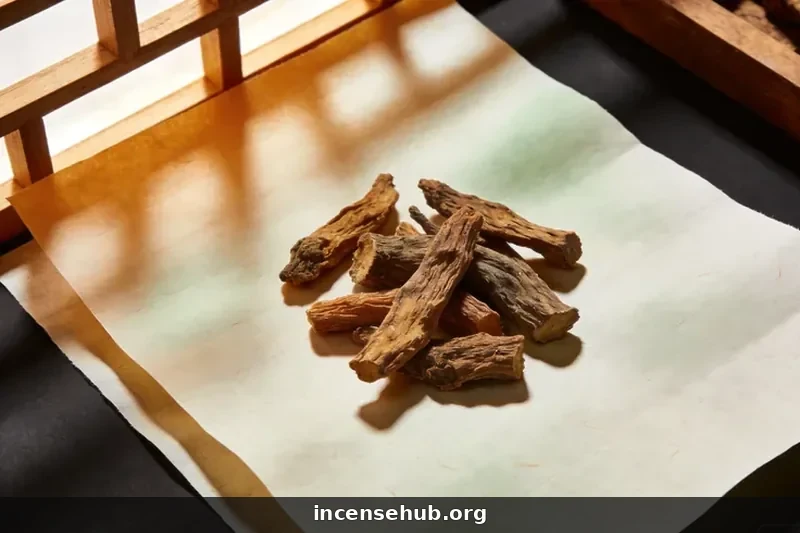
Direct answer: 莪术 (ézhú) is the dried underground stem of a ginger-family plant, Curcuma zedoaria, with Chinese material usually assigned to the closely related Curcuma phaeocaulis. It is warm, earthy, and camphoraceous, rather bitter, and only a minor presence in classical incense — a prepared corrective rather than a scent in its own right.
Key facts
| Chinese term | 莪术 (ézhú) |
| Plant family | Zingiberaceae (the ginger family) |
| Botanical name | Curcuma zedoaria, cf. Curcuma phaeocaulis |
| Part used | Dried rhizome — an underground stem, not a root |
| Scent | Earthy, camphoraceous, warm, slightly bitter |
| Classical role | Prepared minor ingredient in incense formulas |
| Main confusion | 姜黄 (turmeric) and 郁金 (aromatic turmeric) |
Direct answer: Of the three Curcuma rhizomes that are routinely mixed up, this is the most strongly medicinal and the least fragrance-like. It earns its place in a formula by correcting and grounding, not by smelling beautiful on its own.
What 莪术 is, in one paragraph
Curcuma is the genus that gave the world turmeric, and its members share a basic architecture: a fleshy rhizome creeping just under the soil, leaves rising from it, and a flowering spike that appears at the right season. The rhizome is a stem, not a root. It stores starch, carries buds at the nodes, and branches into finger-like lobes. Cut one open and you find a firm, starchy interior, often paler than the vivid orange of culinary turmeric.
The plant behind 莪术 is native to South and Southeast Asia. The name Curcuma zedoaria has long been the standard designation in Western botanical literature, while Chinese treatments of the domesticated material most often use Curcuma phaeocaulis. The two are close relatives, and the practical point for a buyer is that the trade name points at a group of similar rhizomes rather than at a single clone. The Flora of China entry for Curcuma phaeocaulis is the reference for the Chinese material, and the GBIF record for Curcuma zedoaria fixes the older name.
The part that reaches the market is the dried rhizome: whole, sliced, or ground. It is not a wood, not a resin, and not a bark. That matters for how it burns. A rhizome is starchy and dense, and when it burns it produces a heavier, more acrid smoke than a resin or a heartwood. The aroma has to be coaxed out rather than released by gentle warmth.
A rhizome, not a root
Direct answer: A rhizome is a stem that lives underground. It has nodes, buds, and scale leaves, and it branches into finger-like lobes. That anatomy, not folklore, explains why the material dries the way it does and burns the way it does.
Look at a fresh piece and the signs are there. Rounded nodes sit at intervals along the body, each with a dormant bud. Faint rings mark where scale leaves once attached. The branches end bluntly rather than tapering to a root tip. Cut across the body and the interior is firm and starchy, pale yellow to greyish, with a darker rim where the outer layers were. There is no woody core, no resin canal, and no grain in the timber sense.
Those absences explain the burn. Starch and water, not resin and fibre, are what the heat meets. A starchy body smoulders into a heavier smoke, and the aromatic fraction has to be carried on top of it. This is the physical reason the material works as a background note and fails as a solo scent.
Drying changes the picture. A well-dried piece loses most of its water, hardens, and shrinks slightly around the nodes. A badly dried piece keeps moisture in the thickest part, and that is where mould begins, long before anything shows on the surface. Break a suspect piece open: a clean snap and a dry, mealy interior are good signs; a soft centre, a sour smell, or a dark ring are not.
Size is a poor guide. Large rhizomes are not automatically better, and small ones are not automatically inferior. What matters is that the piece is mature enough to be dense and dry enough to keep. A thin, wrinkled rhizome that rattles in the hand has usually been stored too long or dried too hard.
The genus in brief
Direct answer: Curcuma is a tropical Asian genus of rhizomatous herbs. It includes turmeric, aromatic turmeric, zedoary, and many plants with no commercial role at all. The genus is diverse, the names are old, and identification by name alone is unreliable.
Members of the genus share a body plan. A fleshy rhizome sits at or just below the soil surface, often branched and sometimes brightly coloured inside. Leaves rise in a tuft, each with a long sheath at the base. The inflorescence is a spike of tubular flowers, usually emerging from the side of the pseudostem rather than the tip. Some species flower before the leaves appear, which makes the flowering specimen hard to match to a leafy one.
That diversity is the reason the market names are messy. A single genus supplies a spice, several medicines, a dye, and a range of ornamentals, and the same plant can carry different names in different regions. When a supplier says “zedoary”, the word may point at one species, a group of related species, or whatever was available that season.
For a buyer, the practical response is not to master the taxonomy. It is to accept that the name is a starting point and that the physical sample carries the rest of the evidence. Cut surface, weight, aroma, and the behaviour of the smoke tell you more about the piece in your hand than the label on the bag.
Cultivation adds another variable. Rhizomes grown in different soils and harvested at different ages differ in starch content and aromatic load, even within a single species. A well-grown piece and a poorly grown piece can look similar and behave differently, which is why experienced buyers ask about the source rather than only the species.
Three rhizomes, one counter
Direct answer: 姜黄 (Curcuma longa) is the culinary turmeric grown for yellow colour; 郁金 (Curcuma aromatica) is a medicinal aromatic rhizome; 莪术 is the zedoary group. They look alike, smell related, and are routinely confused — which makes species identification the first job, not the last.
The confusion is not a beginner’s mistake. Classical sources themselves sometimes blur the three, and modern retail labels often use the names loosely. A buyer who does not separate them can end up with the wrong material and no obvious sign of the error.
| 莪术 (zedoary) | 姜黄 (turmeric) | 郁金 (aromatic turmeric) | |
|---|---|---|---|
| Botanical name | Curcuma zedoaria / C. phaeocaulis | Curcuma longa | Curcuma aromatica |
| Cut surface | Pale yellow to greyish | Deep orange-yellow | Yellow, aromatic |
| Dominant note | Camphoraceous, bitter, medicinal | Warm, earthy, culinary | Camphoraceous, aromatic |
| Primary use | Traditional medicine; minor incense | Food colouring and spice | Traditional medicine; aromatic oil |
| Classical trace | A processing instruction | Culinary and dye use | Aromatic-oil record |
Read the table as a set of tells rather than a taxonomy lesson. The cut surface is the quickest visual check: a deep orange interior points to turmeric, while a paler, starchier interior is more consistent with 莪术 or 郁金. The nose then separates the last two, since 郁金 carries a cleaner aromatic lift and 莪术 leans bitter and heavy.
A caution belongs here. Colour and aroma are screening tools, not proof. Rhizomes vary with age, cultivar, and drying, and a photograph proves very little. When the material matters, the binomial on the paperwork matters more than the appearance in the bag.
Reading the name
Direct answer: 莪术 is a plain materia-medica name. It carries no colour word and no fragrance word, unlike 姜黄 (“ginger-yellow”) or 郁金 (“aromatic gold”). The plainness is a clue: this names a medicinal rhizome, not a perfume.
Chinese plant names often advertise something — a colour, a smell, a season. 姜黄 announces its yellow. 郁金 announces gold and fragrance. 莪术 announces nothing in particular; it is a name attached to a drug in the materia medica, and the plant’s identity is learned rather than read off the label.
That small philological point has practical weight. A material whose name advertises fragrance tends to be sold as fragrance. A material whose name advertises medicine tends to be sold as medicine, with all the claims that follow. 莪术 belongs to the second category, and its appearance in incense is as a prepared additive — a background note, not a headline.
What the old recipe actually says
Direct answer: The Ming compendium Xiangcheng (香乘) records 莪术 only in a processing instruction: boil it in vinegar, soak it out in salt water, grind it, and combine it with honey and licorice paste into cakes. That is the record of a material being tamed before use.
The line reads:
莪术醋煮過用鹽水浸出…為末蜜和同甘草膏為餅
Translated plainly: the rhizome is boiled in vinegar, steeped out in salt water, reduced to powder, and mixed with honey and a licorice paste to form cakes. There is no description of its scent, no ranking among aromatic woods, no instruction to burn it alone. What survives is a procedure.
That absence is informative. A material that is showcased in a formula tends to leave behind a description of its character. A material that is corrected tends to leave behind a recipe. 莪术 left a recipe.
Three readings follow, and they are editorial interpretations rather than certainties.
The processing is the identity. Vinegar-boiling and salt-soaking are not cosmetic steps. They alter the rhizome before it enters a blend, and a material treated this way is being moderated rather than displayed.
Rank is visible in the verbs. “Boil”, “soak”, “grind”, “mix” describe preparation for use by someone else. A principal scent might be described by how it smells and where it comes from; this one is described by what must be done to it.
The cake is a dosing form. Honey and licorice make a paste that can be divided into cakes, which is a way of standardising a small, potent addition. The form implies a small dose.
None of this proves that 莪术 was unimportant in absolute terms. It shows that in this recipe tradition, it played a supporting role, and the text preserves the support rather than the star.
Why the processing is the point
Direct answer: Vinegar, salt, honey, and licorice each do a job: heat and acid modify the pungent volatiles, salt water draws out water-soluble material, and the sweet binders make a dividable dose that masks bitterness. The result is a gentler, more controllable additive.
Take the steps in order.
Vinegar-boiling. Heat drives off some of the most volatile, sharp-smelling compounds, and an acid medium changes the chemistry of what remains. In practical terms, the rhizome comes out less pungent and less acrid than it went in.
Salt-water soaking. Water dissolves sugars, salts, and some water-soluble bitters. Soaking pulls material out of the rhizome and into the liquid, which is then discarded. The effect is a further softening of the harsh edge.
Grinding and binding. The prepared rhizome is ground fine and mixed with honey and a licorice paste. Honey is a humectant and a binder; licorice is sweet and slightly mucilaginous. Together they make a paste that holds together, tastes sweeter than the raw rhizome, and can be divided into repeatable cakes.
The logic is the logic of correction:
raw rhizome, sharp and bitter → heat and acid reduce the pungent top → salt water leaches out water-soluble harshness → sweet binders mask what is left → a small, dividable dose enters the formula as a background note.
Whether the classical practitioner would have described it in these terms is doubtful. The sequence of steps, though, points at exactly this outcome, and the outcome is consistent with the material’s later reputation as a minor, prepared addition.
One boundary matters. “Processed” does not mean “inert.” A vinegar-boiled rhizome still carries aromatic material; it is gentler, not empty. Treating the prepared form as though it had no character is as wrong as treating the raw form as though it could be used freely.
How it behaves in a censer
Direct answer: 莪术 burns warm, earthy, and camphoraceous, with a bitter edge that grows if the dose is high. It is a background corrector, not a scent to burn alone, and its smoke is heavier than a resin’s.
Three mechanisms explain most of what a maker notices.
The starch problem. A rhizome is a storage organ, packed with starch. Starch burns, and burning starch produces a heavier, more acrid smoke than burning resin or wood:
starchy rhizome → more smouldering plant mass per gram → heavier smoke with a toasted, sometimes acrid tail → the aromatic note has to compete with the smoke → a small dose reads as warmth, a large dose reads as scorch.
This is why the material is dosed sparingly. It is not that the aroma is weak; it is that the smoke around it gets in the way.
The bitterness problem. Bitterness carries into smoke. A trace can give a blend an adult, grounded quality — the same logic that makes a bitter herb useful in cooking. Past that trace, the bitter note sits on the finish and refuses to leave:
small dose → bitter edge rounds the sweetness → blend feels grounded → larger dose → bitterness dominates the dry-down → florals are masked → the formula turns muddy.
The camphor problem. The camphoraceous lift is the most volatile part of the rhizome. It arrives early and leaves early, which means the material contributes an opening accent as well as a background weight. A maker who wants the camphor note has to accept that it will not last; a maker who wants the bitter base has to accept that it will.
The ash problem. A starchy rhizome leaves more ash than a resin or a clean heartwood. Ash is not a fault in itself, but a heavy ash load changes the way the stick burns near the end: the coal can go out, or the last third can turn harsh as the mineral fraction dominates. A blend that includes a significant share of rhizome often needs a little more attention to the burn than one built on woods alone.
Watch the last third of a test stick. The opening tells you what the aromatic fraction does; the finish tells you what the structure does. A stick that smells pleasant for two minutes and sour for the rest has a structural problem, and adding more of the aromatic material will not solve it.
In the 君臣佐使 (chief, minister, assistant, guide) vocabulary of Chinese incense, this is an assistant at most. It corrects and grounds; it does not lead. A formula built around 莪术 would be a formula built around a corrective, which is a category mistake rather than a bold choice.
Dosing a corrective
Direct answer: A corrective is judged by what it changes in the blend, not by how much of it you can smell. Start with the smallest amount that alters the finish, and stop before the bitterness reaches the front.
The logic of dosing a material like this differs from the logic of dosing a main note. A main note is built up until it carries the composition. A corrective is added until the composition behaves differently, then held there.
A practical sequence for a maker testing it:
- Make a base you understand. A simple resin or wood blend with no bitter element, mixed in a small batch.
- Add a trace. A pinch of milled rhizome, far below what intuition suggests, worked through evenly.
- Compare side by side. Burn the base and the modified version in the same session, in the same room, at the same distance. Memory is a poor control.
- Increase only if nothing changed. If the finish is still flat, add a little more. If the bitterness has arrived at the front, you have gone too far.
- Record the number. Whatever the dose was, write it down with the batch. The next revision will need it.
The reason for the caution is that bitterness accumulates. Two small additions made an hour apart do not feel like one larger addition; the palate adapts, and the second addition lands on a tired nose. A formula that tastes balanced at the bench can read harsh the next morning.
There is also a structural limit. A corrective cannot fix a formula that has no structure to correct. If the base is thin, adding a bitter rhizome will make it thin and bitter, not deep. The material adjusts a composition that already works; it does not rescue one that does not.
A test batch, step by step
Direct answer: Test the material in a simple base, in small batches, with a written record. The point is not to find a perfect dose but to learn how the rhizome behaves before it enters anything you care about.
A protocol that works for a home bench:
Materials. A base powder you know well — a soft wood or a simple resin blend — plus the milled rhizome, a binder, water, and a scale that reads small increments. A notebook is not optional.
Batch size. Small enough that a failure costs little. Three or four sticks is plenty for a first trial.
The control. Make a batch with no rhizome. This is the reference, and without it the comparison is guesswork.
The additions. Make three batches at increasing levels: a trace, a little more, and a clearly larger dose. Keep everything else identical, including the water and the drying time.
Forming and drying. Form the sticks the same way, dry them in the same place, and wait the same number of days. A difference in drying will read as a difference in formula.
The panel. Burn one stick of each, in the same room, on the same day, with a break between. Note the opening, the middle, and the finish separately. Bitterness usually shows at the finish first.
The record. Write down the batch weights, the dose, the drying days, and the impression. A formula is only repeatable if the record is.
What the trial usually reveals is that the material has a narrow useful window. Below it, nothing happens. Above it, the finish turns bitter and the blend loses the lift that made it interesting. The window is not wide, and it sits lower than most people expect.
Three mistakes that ruin a test
Direct answer: Changing two things at once, judging from the jar instead of the burn, and over-dosing because the raw material smells mild. Each one produces a confident conclusion that the evidence does not support.
Changing two variables. A new rhizome and a new binder in the same batch is not a test; it is a guess with extra steps. Keep everything except the variable you are studying. If the binder had to change because the powder behaves differently, run a control with the old material and the new binder before drawing conclusions about the rhizome.
Judging from the jar. Raw rhizome smells earthy and mild, and it is tempting to assume the burn will be mild too. It will not. Heat concentrates some impressions and adds smoke to all of them. A material that seems shy in the jar can be assertive in the censer, and the reverse is also true. The only reliable reading is the burn.
Over-dosing. Because the raw smell is modest, the first instinct is to add more. That instinct is usually wrong. A corrective works at a level where the nose barely registers it in isolation; its effect is on the blend, not in the spoon. Add less than feels sufficient, then compare against the control.
A fourth mistake is subtler: testing on a day when the nose is tired. Bitterness is easy to miss when the palate is already fatigued, and a blend that seems balanced at the end of a long session can be harsh the next morning. Test early, test briefly, and keep the control stick for a second opinion.
Judging rhizome quality
Direct answer: Check identity first, then condition, then preparation state. A clean, firm, well-dried rhizome with the expected camphoraceous-bitter profile is what you want; mould, softness, and dust are disqualifying.
Identity. Which of the three Curcuma rhizomes is in the bag? This is the decisive question, and it is answered by a combination of cut surface, aroma, and paperwork.
Condition. The rhizome should be firm and dry, not soft or spongy. Broken surfaces should be clean, not powdery with mould. A musty smell is a fail, whatever the label says.
Cleanliness. Soil, sand, and fibrous root remnants are common. A little is normal in a dried agricultural product; a lot suggests rough handling.
Preparation state. Raw rhizome and vinegar-processed rhizome behave differently. If a recipe assumes one and the supplier provides the other, the formula will drift.
Aroma. Warm, earthy, camphoraceous, slightly bitter. A flat or dusty smell suggests age; a sharp chemical smell suggests something else entirely.
There is no formal grading system for this material in the incense trade, and the names on offer are descriptive rather than standardized. That makes the buyer’s own senses and a reliable supplier more important than any certificate.
Forms and preparation states
Direct answer: The rhizome moves as whole dried pieces, slices, powder, and — historically — as honey-and-licorice cakes. Whole and sliced forms keep better; powder is convenient but fades faster; the cake is a classical dosing form rather than a retail product.
| Form | What it is | Best use | What to watch |
|---|---|---|---|
| Whole dried rhizome | Intact, cleaned pieces | Long storage; grinding to order | Internal mould; insect damage |
| Sliced rhizome | Cross-sections, dried | Inspection; small batches | Over-drying; dust |
| Powder | Milled rhizome | Blending | Adulteration; loss of aroma |
| Prepared cakes | Vinegar-boiled, salt-soaked, bound with honey and licorice | Classical formula work | Rarely available; hard to verify |
The whole form is the safest purchase because it is the easiest to inspect. You can see the cut surface, smell the broken end, and check for mould inside the piece. Powder hides all of that.
The cake form is interesting precisely because it is almost extinct in commerce. It survives in the textual record as evidence of how the material was handled, not as a product a modern buyer is likely to encounter. Treat any modern “classical cake” claim with caution; the recipe is documented, but the commercial continuity is not.
Working with the powder
Direct answer: Milled rhizome is hygroscopic, dusty, and easy to over-dose. Sieve it, store it small, and weigh it rather than spooning it.
Grinding at home is possible but fiddly. A dried rhizome is hard and fibrous, and a domestic grinder tends to produce a mix of fine dust and coarse fragments. Sieving the result gives two fractions: a fine powder that disperses evenly through a blend, and a coarse fraction that can be re-ground or used where a slower release is wanted.
Freshly ground material smells stronger than material ground weeks ago. That is not a reason to grind everything at once; it is a reason to grind in small amounts and keep the whole rhizome for storage. The whole piece has less surface area and loses its aromatic fraction more slowly.
Weighing matters more than it sounds. A rhizome powder is light and fluffy, and a spoonful can vary by a large factor depending on how settled the jar is. A small scale removes that variable from the formula, and the record becomes meaningful.
Dust control is a practical concern. The powder is fine enough to hang in the air, and inhaling it is unpleasant and unnecessary. Work gently, use a shallow dish, and avoid tipping the jar from a height. A damp cloth under the work surface catches what settles.
The powder also clumps in humid weather. A clumped powder does not blend evenly, and an uneven blend produces sticks that vary from one to the next. Break up clumps before mixing, and store the jar with a desiccant if the room is damp.
Drying and spoilage
Direct answer: Most spoilage happens before the rhizome reaches you. Slow or uneven drying leaves moisture in the thickest part, and that is where mould starts. A dry, hard, clean-smelling piece is the whole standard.
Drying is not a single moment. A freshly lifted rhizome is mostly water, and the water has to leave without cooking the aromatic fraction or trapping moisture in the core. Thin slices dry faster and more evenly than whole pieces, which is why sliced material is common in trade. Whole pieces dry slowly and need turning, and a thick lobe can stay damp inside long after the surface feels dry.
The failure modes are consistent:
- Surface-dry, core-wet. The outside looks and feels finished, the inside is not. Break the piece and look.
- Case-hardening. Fast heat seals the surface while the centre remains moist, which is an invitation to mould.
- Over-drying. The piece becomes brittle and dusty, and the aromatic top is driven off along with the water.
- Re-wetting. A dry rhizome left in humid air takes water back, and the cycle of wet and dry is worse than a single slow drying.
Insects are the other problem. Dried rhizomes are food, and a warm, dark cupboard is a good place to be food. Periodic inspection catches the early signs: fine dust at the bottom of the jar, small holes, or a web of silk. A batch with live activity should be discarded rather than salvaged, because the damage is not only physical; the insects and their waste change the smell.
A simple storage regime covers most of it. Whole pieces in a sealed jar, out of light, in a cool cupboard, checked every few months. Powder in a smaller jar, used within a season. Nothing exotic is required, and nothing exotic compensates for a rhizome that was badly dried in the first place.
Buying and storing
Direct answer: Buy whole rhizome when you can, from a supplier who names the species, and store it dry, dark, and sealed. Powder is a convenience that costs shelf life.
The purchase sequence is short.
- Ask which species. Curcuma zedoaria or C. phaeocaulis for 莪术; anything else is a different material.
- Ask whether it is raw or processed. The two behave differently in a formula.
- Inspect the cut surface. Pale and starchy is consistent with 莪术; deep orange suggests turmeric.
- Smell it. Camphoraceous and earthy, with a bitter edge. Flat or musty is a fail.
- Buy the smallest quantity that covers the work. This is not a material most makers use by the kilo.
Storage follows the usual rules for dried botanicals. Moisture is the enemy: a rhizome that picks up humidity can grow mould inside, where you cannot see it until the piece is broken. Keep it in a sealed container, out of sunlight, away from strong-smelling materials, and inspect it periodically. Whole pieces outlast powder by a wide margin.
Labels and claims
Direct answer: Labels on this material tend to describe a tradition rather than a specification. “Medicinal grade”, “wild”, and “aged” are words with histories, not standards, and none of them tells you what is in the bag.
A short guide to the phrases a buyer is likely to meet.
“Medicinal grade.” There is no single authority behind the phrase in the incense trade. It usually means the seller believes the material is fit for a materia-medica context, which may reflect real care or may reflect nothing more than packaging.
“Wild-crafted.” Some material is collected from wild populations; much is cultivated. The word describes an origin story, and it does not by itself indicate better quality. A well-grown rhizome handled carefully can beat a wild one handled badly.
“Aged.” Dried rhizomes do change with time, but aging is not automatically improvement. Aromatic material can fade, and starch can absorb neighbouring smells. Age is a variable to ask about, not a virtue to assume.
“Classical preparation.” The vinegar-and-salt method is documented, but continuity of practice is hard to verify. A seller who can describe the steps concretely is more convincing than one who uses the phrase as a seal.
“Pure.” For a milled rhizome, purity means no added starch, no other Curcuma, and no foreign matter. It is a claim about composition, and it is only as good as the supplier’s word.
The general rule for this material is the same as for any minor ingredient: the claims matter less than the sample, and the sample matters less than the supplier’s willingness to be specific. A short conversation about species, processing, and drying tells you more than a paragraph of adjectives.
If you cannot get 莪术
Direct answer: There is no true substitute, but there are materials in the same bitter-camphor register. Calamus and asarum both carry a sharp, earthy quality that can play a similar corrective role at low dose.
Substitution in incense is always a compromise. The point is not to find a molecule that matches; it is to find a material that does the same job in the formula without wrecking the rest of it.
Calamus (菖蒲) is a rhizome with a camphoraceous, slightly bitter character. It is brighter and more aromatic than 莪术, and it tends to sit further forward in a blend. Use less, and expect the opening to change more than the finish.
Asarum (细辛) is a small, pungent root with a sharp, warming quality. It is more aggressive than 莪术 and less earthy, and it can dominate a delicate blend if handled carelessly. It is a material for the smallest doses.
Either can stand in for the corrective function, and neither reproduces the exact profile. A maker who substitutes should expect to re-tune the dose and to lose some of the grounded, starchy quality that the rhizome contributes. That is the nature of substitution: the job can be done, the material cannot be copied.
The better answer, if the formula depends on 莪术, is to find a reliable supplier of the actual rhizome. Minor ingredients are cheap relative to the labour of reworking a formula around a substitute.
The evidence question
Direct answer: The botanical identity and the classical processing record are documented. The medicinal uses are traditional language, not established clinical fact, and this page makes no medical claims.
| Layer | Status | What it means |
|---|---|---|
| Botanical identity | Established | Curcuma zedoaria / C. phaeocaulis, Zingiberaceae |
| Classical incense use | Historically documented | A prepared minor ingredient in a Ming recipe |
| Processing method | Historically documented | Vinegar boil, salt soak, honey-licorice binder |
| Aroma character | Descriptive | Earthy, camphoraceous, warm, bitter |
| Medicinal efficacy | Not established | Traditional belief, not clinical evidence |
| Smoke safety | Established risk | Combustion produces particulate matter |
The distinction between “recorded” and “proven” is the heart of this section. A Ming recipe tells us what people did. It does not tell us that the material treats anything. Traditional Chinese medicine describes 莪术 in its own vocabulary of warming and moving; that vocabulary is a historical system of explanation, not a set of tested outcomes.
For a reader, the practical significance is simple. Use the material for its aroma and its craft history if that interests you. Do not use it, or any incense, as a substitute for medical care, and do not accept a seller’s health claim as evidence of quality. The two questions — does it smell right, and does it cure something — are unrelated.
Safety
Incense combustion produces smoke, fine particulate matter, and carbon monoxide. A rhizome-heavy blend can produce a heavier smoke than a resin blend, so ventilation matters more, not less. Burn in a moving-air space, avoid inhaling concentrated smoke, and keep lit material away from children and pets.
This page is editorial knowledge content, not medical advice. Nothing here should be read as a recommendation to ingest, apply, or use 莪术 for a health condition. The site’s safety guide covers the general principles.
FAQ
What is zedoary (莪术)? The dried rhizome of a ginger-family plant, Curcuma zedoaria, with Chinese material usually assigned to Curcuma phaeocaulis. It is warm, earthy, and camphoraceous, with a bitter edge, and it appears in classical incense as a prepared minor ingredient rather than a principal scent.
Is 莪术 the same as turmeric? No. Turmeric is Curcuma longa, grown for its deep orange rhizome and used as a spice and colouring. 莪术 is a different species in the same genus, with a paler interior and a more medicinal, camphoraceous profile. They are relatives, not substitutes.
Why is 莪术 boiled in vinegar before use? The classical processing note prescribes it. Heat and acid soften the sharp, pungent character of the raw rhizome, and a salt-water soak draws out water-soluble harshness. The result is gentler and easier to dose — a prepared corrective rather than a raw material.
Does 莪术 have a place in modern incense? As a background note, yes, in small amounts. Its camphoraceous opening and bitter base can ground a sweet or resinous blend. It is not a material to build a formula around, and it is not pleasant burned alone.
Is 莪术 safe to burn? Burning any plant material produces smoke and particulate matter, and this rhizome is no exception. Use ventilation, avoid concentrated smoke, and keep it away from children and pets. Medicinal claims are traditional language, not established evidence, and this page makes no medical recommendation.
Sources
Two reference records anchor the botanical identity. The Flora of China treatment of Curcuma phaeocaulis describes the Chinese material and its place in Zingiberaceae; the GBIF record for Curcuma zedoaria fixes the older binomial and its distribution. The classical processing note comes from Xiangcheng (香乘), a Ming compendium of incense lore, and is quoted here in its original wording.
The three-way distinction among 姜黄, 郁金, and 莪术 is standard trade and botanical knowledge, presented as identification guidance rather than as a laboratory finding.
Related resources
- Turmeric — 姜黄, the culinary rhizome and colouring material.
- Aromatic turmeric — 郁金, the third rhizome in the confusion.
- Material comparison matrix — where the Curcuma rhizomes sit against other materials.
- Scent guide — the wider map of incense aroma families.
Summary
莪术 is the dried rhizome of the zedoary group, Curcuma zedoaria with Chinese material under Curcuma phaeocaulis. It is the most medicinal and least fragrance-like of the three commonly confused Curcuma rhizomes, and its classical record is a processing instruction rather than a description of its scent: vinegar-boil, salt-soak, grind, and bind with honey and licorice into cakes. That procedure is the evidence of its minor, corrective rank. It is a background note in incense, not a lead, and its medicinal reputation belongs to traditional language rather than established clinical fact.