
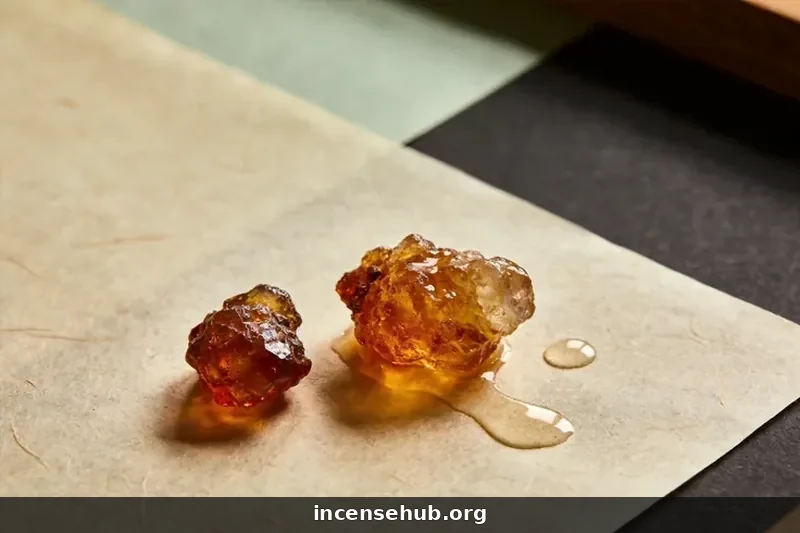
Direct answer: 枫香脂 (fēngxiāngzhī) is the hardened balsam of Liquidambar formosana, a Chinese tree in the sweetgum family, burned for a low sweet-resinous warmth that sits under a blend instead of leading it. The species is Chinese, the genus is shared with the Turkish storax tree, and the trade history is tangled enough that the binomial matters more than the label.
Key facts
| Tree name | 枫香 (fēngxiāng) |
| Resin name | 枫香脂 (fēngxiāngzhī) |
| Older label | 白胶香 (báijiāoxiāng), an older name meaning “fragrant white gum” |
| Species | L. formosana — Altingiaceae |
| Part used | Wound exudate — no timber, no root, no leaf |
| Scent | Warm, resinous, sweet, balsamic; faint until warmed |
| Response to heat | Softens, melts, smokes, chars |
| Look-alikes in trade | Storax (苏合香), frankincense (乳香), pine resin |
| Textual record | Xiangcheng (香乘), Ming dynasty |
| Claim status | Aromatic material; no health claim is made here |
Three words on a label, and what each one promises
Direct answer: 枫香 names the tree, 枫香脂 names the resin that is actually traded, and 白胶香 is an older literary name for that same resin. A label that stops at 枫香 leaves the part unspecified; the longer word is the one worth looking for.
The Chinese naming here is layered rather than sloppy. Botanists needed a term for the organism, traders needed a term for the exudate, and the classical pharmacopoeia preferred a third, more poetic option. 白胶香 — best rendered as “fragrant white gum” — is the label the Ming Xiangcheng (香乘) uses, and the same text records a Buddhist transliteration, 须萨析罗婆, from the Golden Light Sutra. That second name is a useful reminder that the material moved along textual and religious routes as well as along trade routes.
For anyone buying, the practical reading is simple. When a listing says 枫香脂, the seller is naming the part with fragrance value. When a listing says only 枫香, the part is left open, and the wood of the tree is not the thing you want in a burner.
English adds a second layer of vagueness. “Sweetgum” is a common name shared across the genus, and readers in North America will usually attach it to the American species rather than the Chinese one. A label in English that says “sweetgum” without a binomial has told you the genus and nothing else. Ask for Liquidambar formosana if the Chinese origin is what you are after, and accept that the answer may be a shrug.
枫 in Chinese: one character, two trees
Direct answer: The single character 枫 covers maple-type trees in ordinary Chinese, while 枫香 is a fixed compound naming the sweetgum — a different genus that happens to share the character. The overlap is linguistic, not botanical.
Used alone, 枫 usually points toward maples (Acer), and the autumn-leaf imagery that clings to the character in poetry belongs to that reading. 枫香 is a set phrase, and the 香 (“fragrant”) is the part doing the distinguishing work: it marks a tree whose interest lies in its balsam rather than its foliage.
This matters for anyone searching Chinese-language listings. A search on 枫 alone will surface maple wood, maple-leaf ornament and syrup alongside sweetgum resin, because the character is shared. A search on 枫香 narrows to the sweetgum and its products, and a search on 枫香脂 narrows again to the resin. The three searches describe three different shelves.
Translation adds a second distortion. English keeps “maple” and “sweetgum” apart as separate words for separate genera, so a literal rendering of 枫香 can emerge as “maple fragrance” — a phrase that names no traded material at all. When a listing reaches you through translation, treat the English as a paraphrase and go back to the binomial before anything else.
One character in the resin’s name carries a quiet hint about handling. 脂 in Chinese normally means fat or grease, and in material names it marks an exudate that behaves like one — soft, meltable, faintly greasy to the touch — rather than a wood, a leaf or a mineral. 枫香脂 is named for physical behaviour as much as for origin, and the name predicts the workshop problem: the lump will soften in a warm hand long before it ever meets a flame.
The tree behind the resin
Direct answer: The tree is a tall deciduous member of the sweetgum family, Liquidambar formosana, recorded by Flora of China from sunny ground and montane forest at 500–800 m across a wide belt of southern and central China, with outlying stands in northern Vietnam, Laos and Korea. Only the wound exudate is useful to incense.
The botanical record is compact enough to tabulate, and the figures below come from Flora of China rather than from any merchant’s description:
| Feature | Recorded form |
|---|---|
| Habit | tree to 30 m; bole occasionally 1 m across |
| Bark | grey-brown |
| Leaf | broadly ovate, three palm-like lobes on three veins, glandular-serrate edge |
| Male flowers | short spikes |
| Female head | 24–43 florets |
| Fruit cluster | globose, 3–4 cm wide, ripe July–September |
| Flowering window | March–June |
| Range | Zhejiang, Jiangsu, Anhui, Fujian, Jiangxi, Hubei, Sichuan, Guizhou, Guangdong, Hainan, Taiwan; also northern Vietnam, Laos, Korea |
The determinations behind those entries, and the fuller descriptions, are in Flora of China and the GBIF record.
That range is worth pausing on, because it shapes the commercial picture. A tree distributed across eleven Chinese provinces and three neighbouring countries is not a botanical rarity. Scarcity is not what limits supply of 枫香脂 the way it limits agarwood or true sandalwood. What limits supply is sorting: separating clean exudate from bark and grit, and keeping the material apart from resins that look like it.
Taxonomy has shifted under the name, and a spec sheet may carry either version. Older classifications placed the genus in Hamamelidaceae; current treatments put it in Altingiaceae. The change reflects a reassessment of family relationships, not a reassessment of the plant, and a supplier quoting the older family is not describing a different tree.
A wound, then a slow cure
Direct answer: The resin is a repair response, not a harvest of wood — bark is cut → the tree pushes out a balsamic exudate to close the injury → air and time thicken it → the mass sets into tears or a soft lump → collection and drying produce 枫香脂.
Each link in that sequence leaves a trace in the material you receive. Because the exudate is produced to seal a wound, it comes out soft and pliable and only later firms up, which is why a single lot can hold glassy fragments, sticky lumps and half-cured smears at the same time. Because the path is through bark, small pieces of bark and surface grit travel with it. Because curing depends on air and time rather than on a kiln, the degree of cure varies from piece to piece, and the colour varies with it.
None of this is a defect in the tree. It is what a tapped balsam looks like before someone sorts it. A well-graded lot has had that variability reduced by hand; a poorly graded one has not, and the difference shows up as much in the burner as in the bag.
The handling consequence is straightforward. This material is worked by warming and melting, not by the milling route used for woods and roots. The wider logic of that split is set out in incense powder & resin.
Reading a spec sheet for a resin
Direct answer: A usable spec names the species, the plant part, the region and the cure in words. Anything shorter describes a category rather than a lot, and a category cannot be inspected.
Eight fields carry the weight, and each closes one gap. Binomial and plant part settle identity: the species is written out, and the fraction shipped is the balsam, never the timber. Region and cure settle handling, since where the stock was gathered and whether it arrives as glassy tears, a leathery mass or a cooled block decides how it portions, keeps and burns. Grade wording, lot identity, packaging and failure terms settle accountability — a stated range beats a single shade, a lot number is what makes a retained fragment traceable, and return terms agreed before the first shipment are worth more than goodwill afterwards.
What a spec sheet cannot carry is the two things that decide the purchase: how the material smells when warmed, and how it behaves under heat. Those live in the sample. A thorough spec plus an unrepresentative sample is a worse position than a thin spec plus a good sample, because the paperwork invites confidence the material has not earned.
Verification: what paperwork can close, and what it cannot
Direct answer: A document can bind a seller to a description; it cannot confirm that the description fits the sack in front of you. Paper is the record you fall back on when something goes wrong, and a retained fragment is the evidence that gives the record force.
| Evidence | What it establishes | What stays open |
|---|---|---|
| Invoice line naming the binomial | the seller’s written commitment to a species | whether the shipped material matches the line |
| Harvest region stated in writing | a claim about where the stock was gathered | whether this lot came from that region |
| Photograph of the sorted stock | appearance at one moment, under one light | cure depth, buried debris, behaviour on heat |
| Sealed, dated fragment kept back | what the delivered lot actually was | anything about the following delivery |
| Burn note written on receipt day | behaviour on your own equipment | species identity, which heat cannot settle |
Substitution survives documentation because the two travel on separate tracks. The material is repacked, the label is reissued, the description stays internally consistent while the contents change, and a buyer comparing documents against documents finds no contradiction anywhere. The chain is: goods are consolidated → the paperwork is re-cut to match the new packaging → the description remains true of the category and false of the sack → heat is the first test that touches the material rather than its description → retention is what lets you run that test later instead of immediately.
That last link is the one buyers skip. A sealed, dated fragment from each delivery costs almost nothing and settles arguments that would otherwise rest on memory. The boundary is worth drawing plainly: a changed lot does not mean bad faith. Harvests shift, sorting staff change, a supplier swaps one sub-source for another, and most of that is ordinary. Retention is not an accusation prepared in advance; it is the difference between a disagreement resolved with a fragment and one resolved with an opinion.
Pairing logic: what sweetgum sits well beside
Direct answer: Pair it by function rather than by aroma family. A warm balsam earns its place beside dry woods and sharp spices, and loses it beside another heavy balsam.
The cassia formula is worth reading as a template rather than a recipe: one meltable carrier, one powdered character. That two-part structure repeats across 合香 practice, and it explains why the resin works where it does. A dry woody material reads drier without a softening agent under it; a sharp spice reads one-dimensional without something round beneath it. Sweetgum supplies the roundness in both cases and asks for very little in return.
Three pairings follow from that logic, and one warning:
- With dry, creamy woods. The resin softens the dry edge and adds a warm hum below the wood’s own tone. It does not add sweetness to a wood that is already sweet; it thickens what is there.
- With sharp spices. Cassia is the documented case, and the principle generalises: a spike softened at the base reads longer and less harshly. The spice still leads; it simply stops jabbing.
- With bright resins, sparingly. A little sweetgum under frankincense takes the glare off without killing the lift. Overdo it and the brightness goes altogether — the same property that makes the material useful makes it easy to misuse.
- Not with another heavy balsam. Benzoin plus sweetgum plus storax produces a sweet mass with no articulation: each material rounds the others until nothing has an edge. Editorial judgment, offered as such, but it is the most common blending mistake with this family.
Pairing rules are heuristics, and the only test that counts is a small trial blend burned on the same heat source you intend to use. A pairing that reads well on paper can collapse in the bowl, and a pairing that looks odd on paper is sometimes the one that works.
The smell, described without borrowed adjectives
Direct answer: Warm, sweet, balsamic, with a resinous body and very little top-note brightness — closer to a soft balm than to a sharp turpentine. Cold, the lump gives almost nothing; warmth is what releases it.
A cold piece is a poor ambassador for the material. Held to the nose at room temperature, good 枫香脂 reads as faintly sweet and slightly dusty, and a buyer who judges it there may walk away from sound stock. Warm it gently and the balsam opens: the sweetness rises first, then a rounder resinous weight settles behind it, and the whole thing stays low and soft rather than lifting.
Place it beside its neighbours and the character sharpens. Benzoin is sweeter and more confectionary, with a vanilla-like softness that sweetgum does not have. Storax is richer and more spicy-balsamic, with a honeyed edge. Pine resin is sharper and more terpenic, closer to solvent than to balm. Frankincense is brighter, with a citrus-woody lift that sweetgum lacks. Those are comparisons of impression, not measurements, and different lots will bend them.
The classical record arrives at the same conclusion from a different angle: 枫香 resembled 乳香 closely enough that Li Shizhen, quoted in the Xiangcheng, judged heat to be the only separator. A balsam that can fool the eye for frankincense is, by that fact, a warm resinous note — not a floral, not a green.
Three burn results and what each one says
Direct answer: Read a burn in three parts — how the piece moves, what the smoke looks like, what is left behind — and trust the combination rather than any single sign.
Three patterns cover most of what a buyer will meet:
- Slumps early, smokes pale, smells sweet then resinous, leaves little residue. Consistent with a clean balsam. The fade from sweet to resinous is normal and not a defect; the aromatic fraction is finite and it leaves when it leaves.
- Holds its shape, then darkens and turns acrid, with a bitter edge in the smoke. Usually heat running ahead of the material, or a piece carrying a heavy charring load. Retest at lower heat before judging the lot, because the first result may describe the burner rather than the resin.
- Spits, crackles, leaves grit. Loading — bark, mineral matter, or both. The aromatic yield will be low and the note will be short, whatever the cold smell promised.
The discipline that makes these readings worth anything is holding heat constant across comparisons. Change the coal, the distance or the piece size between two samples and the comparison describes the setup, not the resins. Two lots judged on the same heater, at the same distance, with pieces of similar size, will tell you more than two lots judged on different days with different equipment.
Where it lands in a blend
Direct answer: At the base, in a supporting role, at a small proportion — sweetgum rounds the seam between a dry wood and a sharp spice and adds a warm hum underneath. It is a poor choice as the leading note.
The Xiangcheng preserves a working ratio: two measures of clear 枫香 softened over heat, one of cassia powder stirred through (“通明枫香二两,火上溶,间桂末一两,入香内搅匀”). Read it as a division of labour rather than a recipe. The resin is the medium that carries the spice, not the subject of the blend.
In the 君臣佐使 (chief–minister–assistant–guide) vocabulary of Chinese 合香, this is assistant territory. An editorial reading, not a rule from the text: a chief material defines the blend, a minister supports it, an assistant smooths it, and a guide lifts it. Sweetgum smooths. Put it in the chief position and the result is a soft, rounded, slightly inert smoke with nothing to hold the attention.
What it actually does to a mixture is subtract edges. A dry woody blend with a harsh spice note reads rounder with a little melted resin in it, and a resin-heavy blend reads softer with sweetgum than with pine. That is a modest, reliable contribution, and it is the reason the material has stayed in use.
Proportion follows role. Enough to round, not enough to name: if a taster can pick out sweetgum before picking out the chief material, the balance has tipped and the blend has become a balsam with guests. Editorial rule of thumb, and a deliberately loose one — the right quantity is whatever leaves the chief material recognisable.
Running a fair comparison between two lots
Direct answer: Compare two lots on one heat source, with pieces of similar size, twice each — otherwise the comparison measures your equipment and your expectations rather than the resin.
Nothing in the trial is clever, which is the point:
Keep the heat fixed. One source serving both samples — the same heater, or coal of the same grade. Swap burners mid-test and the result describes the swap.
Match the pieces. Two portions of comparable bulk. A larger piece cooks harder, and a trial between unequal pieces is void.
Run each lot twice. A single burn produces a curve; the repeat tells you whether that curve belongs to the material or to the moment.
De-identify the samples. Let a second person mark A and B and hold the key. A resin carrying a reputation is a resin you will judge with your expectations.
Record four facts while they are fresh. How quickly the piece slumps, the tint of its smoke, the note at its steadiest stretch, and the look of what remains. An hour later, memory has already flattened the differences that mattered.
What the results mean depends on which observations move together. If A slumps sooner, smells sweeter through the plateau and leaves little behind, while B holds its shape and turns acrid, that is a material difference and worth acting on. If the two behave almost identically under heat and differ only in cold smell, the cold difference is more likely surface contamination — dust, handling, storage — than a difference in the resin itself.
The limit of the method deserves stating. This protocol ranks two lots against each other; it does not name a species. Identification still comes from the paperwork, and a burn test can only tell you that a lot is not what it claims to be, never that it is.
Cross-map: sweetgum among the balsamic resins
Direct answer: The balsamic resins differ mainly in sweetness, spice and brightness, and sweetgum sits toward the warm-and-soft corner — useful as a rounding agent, weaker as a solo note.
| Resin | Dominant character | Behaviour under heat | What sweetgum does beside it |
|---|---|---|---|
| Benzoin | sweet, vanilla-like, soft | melts readily, sweet smoke | adds warmth and resinous body, loses the confectionary edge |
| Storax (苏合香) | rich, cinnamon-balsamic, honeyed | softens fast, heavy sweet smoke | softens and rounds, gives up spice |
| Frankincense (乳香) | citrus-woody, bright, resinous | pops and runs, white smoke | sweetens and dulls the lift |
| Pine resin | sharp, terpenic, coniferous | runs quickly, acrid smoke | smooths the solvent edge, adds balm |
| Sweetgum (枫香脂) | warm, sweet, balsamic, low | softens slowly, sweet then charred | the reference point for the column |
Read the last column as a substitution guide rather than a ranking. If a blend calls for benzoin and the jar is empty, sweetgum will cover the warm-sweet gap but not the vanilla; if a blend calls for storax, sweetgum will cover the balsamic body but not the spice. Substitution works at the level of function, and function here means which gap in the mixture gets filled.
Two of the neighbouring entries are covered on this site in more detail: benzoin and styrax-resin.
Three names traded for one another
Direct answer: Sweetgum, storax and frankincense are three different things, and the confusion is commercial rather than botanical — two of them share a genus, and the third is the expensive one they get passed off as.
| Label says | Actual species | Origin | Classically | First check |
|---|---|---|---|---|
| 枫香脂 / sweetgum | L. formosana | China, Korea, Laos, northern Vietnam | native balsam; recorded as an adulterant | species on the paperwork |
| 苏合香 / storax | Liquidambar orientalis | Asia Minor | imported balsam | genus plus origin |
| 乳香 / frankincense | Boswellia species | Arabia, Horn of Africa | high-value import | burn test, then price logic |
The pattern in that table is the interesting part. The two Liquidambar resins are close relatives and easy to confuse by name, yet the historical substitution ran between sweetgum and frankincense, which are not close relatives at all. Relatedness predicts confusion in a catalogue; it does not predict confusion in a sack. What predicts that is appearance, availability and the value gap between the two ends of the trade.
A buyer who internalises this stops treating “is it related to storax?” as the important question. The important questions are: which species, from where, and does it behave like the species it claims to be under heat.
Sorting a lot: what the eye and the nose can settle
Direct answer: Start with clarity, then stop trusting it — the translucent, tidy, fragrant tear is the one the old text praises, but hue tracks cure and cleanliness, not identity.
| What you see | What it usually means | What to do |
|---|---|---|
| Translucent, pale, glassy tears | well cured, low debris — the “通明” grade the Xiangcheng names | keep as the reference sample |
| Soft, pliable, strongly aromatic mass | sound resin, incompletely cured | store cool and sealed; portion cold |
| Opaque, brownish, mottled lumps | oxidation, age, or surface contamination | burn a small piece before committing |
| Bark fragments, grit, dull colour | low resin content, poor sorting | expect a low yield and a dirty burner |
| Pale and glassy but scentless when warmed | identity or quality in doubt | ask for species and provenance; test by heat |
The common misconception runs the other way from the table. Buyers often assume that a dark, aged-looking lump must be the more mature and therefore the better material. Darkening is at least as likely to mark oxidation or contamination as it is to mark age, and no classical source grades 枫香 by darkness. Clarity plus a clean warm scent is the durable signal; colour alone is not.
That is a judgment boundary worth stating plainly. Clear resin does not prove the species, and cloudy resin does not disprove it. Clarity tells you about cure and sorting. Species tells you what you are burning. The two checks answer different questions, and a lot can pass the first while failing the second.
Reading a Ming compilation as evidence
Direct answer: The Xiangcheng (香乘) is a Ming-dynasty compilation that gathers earlier remarks and recipes rather than reporting tests, so its statements are strong evidence of trade practice and weak evidence of chemistry.
The distinction shapes how the classical material should be used. An anthology of this kind collects names, formulas, quotations and remarks from earlier writers, and its authority comes from transmission rather than experiment. When the text attributes the adulteration warning to Li Shizhen, we are reading a compiler’s selection from a physician-pharmacist’s observation — second-hand, and about a market rather than a laboratory.
What survives is operational rather than doctrinal: the material had a trade name of its own, it appears inside formulas with counted quantities, and merchants treated it as interchangeable with frankincense in the sack. Detail of that kind outlives the theory built on top of it.
What the text cannot establish is equally clear. It cannot tell you whether a given lot today is genuine, what the resin’s chemistry is, or whether any of the medicinal language attached to the material in older sources corresponds to an effect. Quoting an old text is not endorsing it. The parts worth carrying forward are the parts that can still be tested — the proportion, and the burn.
The adulteration file, read as trade evidence
Direct answer: A Ming text preserves a blunt trade warning: 枫香 could be mixed into frankincense, and only heat exposed the mixture — advice that still describes the failure a buyer has to guard against.
The record is specific. Quoting Li Shizhen, the text gives “乳香,今人多以枫香杂之,惟烧时可辨” — frankincense in his day was routinely extended with 枫香, and flame was the one decisive check. A second line widens the net: “枫香、松脂皆可乱乳香,但枫香微白黄色,烧之可见真” — pine resin and 枫香 both served as stand-ins, and 枫香’s pale yellow cast showed itself once the piece was lit.
The arithmetic only works one way: a cheap substance goes into an expensive one, never the other way round. The record therefore implies a value gap between an imported aromatic and a native balsam, and it implies that the visual difference between them was small enough to survive a merchant’s inspection. Both implications are inferences from the practice itself, not recorded prices.
What follows for a modern buyer is a habit rather than a fact. A frankincense offer priced well below the going rate deserves one burned fragment before it deserves belief. The test costs a fragment; the mistake costs the batch.
Why heat separates what the eye cannot
Direct answer: Appearance is a surface property; aroma is a chemical one. Two resins can share colour, shine and lump shape while their volatile fractions differ, so heat is the only cheap test that reaches the difference.
The chain runs like this: two resins look alike → the eye has no further signal to use → heat drives volatiles off at rates set by each resin’s own mixture → melt behaviour and smoke character diverge → the nose reads the divergence before the eye can → the buyer who never applies heat never gets the signal.
In practice the observations are unglamorous. Watch how fast the piece slumps: a resin that runs almost at once is telling you something different from one that holds its shape and then collapses. Watch the smoke: colour and density carry information, and a sudden dark plume usually means the piece is charring rather than releasing aroma. Smell the edge of the plume, not its centre. Look at what remains: a gritty residue points at mineral or bark loading, a clean ash at a cleaner resin.
None of this is a laboratory method, and it does not identify a species with certainty. It is a screening step — cheap, repeatable, and good enough to catch the failure the classical text warns about.
Melting, not grinding
Direct answer: 枫香脂 is a thermoplastic balsam, so it smears and clogs in a grinder at room temperature — chill it to make it brittle if a powder is needed, or melt it and blend warm as the classical formula does.
The physical reason is simple. A balsamic resin softens as it warms, and a grinder generates warmth at the cutting edge, so the material deforms instead of shattering. The result is a sticky film on the blades and a lump that has absorbed heat without reducing in size.
Two routes work. The cold route: chill the resin until it is brittle, work quickly in small batches, and sieve at once. The warm route: melt gently and stir powdered aromatics into the melt, which is exactly the operation the Xiangcheng describes with cassia. The warm route costs volatiles — heat that melts the resin also drives off the aromatic fraction — so it rewards short exposure and low temperature.
A workshop note that is not in the classical text: melted resin sets hard on cooling, and a blend that was stirred warm will not re-powder evenly. Decide the final form before you melt anything.
At the bench: habits for a sticky material
Direct answer: Work cold, portion small, and keep resins away from the tools used for powders. A balsamic resin contaminates a mortar the way oil contaminates a cloth, and the residue keeps releasing scent.
Four habits cover most of the difficulty:
- Chill before portioning. A cold piece snaps cleanly. A warm piece stretches, sticks to the blade and takes ten minutes to coax off.
- Use a warm blade, not a warm block. Warming the knife or spatula cuts without heating the whole lump, which keeps the aromatic fraction where it belongs.
- Keep a separate mortar. Powdered woods and spices pick up resin film, and a mortar that has held balsam will season the next batch whether you want it to or not.
- Label the portions. Two lots of the same species can differ enough in cure and clarity that a blind comparison is worthless. A date and a source line on the jar is the whole method.
There is a judgment boundary in the last habit. Labelling is not bureaucracy for its own sake; it is what lets you tell a bad lot from a bad batch later. A blend that failed because the resin was dirty and a blend that failed because the proportions were wrong look identical a month afterwards, unless the jars were marked.
Three retail forms, and what each one hides
Direct answer: The same balsam reaches buyers as loose tears, as a melted block, or already worked into a paste — and each form trades inspection value for convenience in a different way.
| Form | What it makes easy | What it hides | Fits whom |
|---|---|---|---|
| Loose tears | inspecting piece by piece | little, though the sorting labour becomes yours | buyers who grade their own stock |
| Melted block | predictable portioning, no crumbs | where the melt came from; debris can sit inside it | repeatable production blends |
| Ready paste | immediate use, stable texture | the resin’s share, and the quality of everything else | small trials, gifts |
A block is a claim about an average; a tear is a claim about itself. That is the whole trade-off. Anyone who needs consistency buys blocks and gives up the ability to see what went in; anyone who needs to know what they have buys tears and spends an afternoon with a knife and a cool room.
The judgment boundary worth keeping: uniform does not mean good. A block can be perfectly uniform and thoroughly poor, and the manufacturing step that made it uniform is the same step that removed the evidence.
Two ways to burn it
Direct answer: A charcoal disc gives a fast, hot, smoky release; an electric heater gives a slower, cleaner, longer one. The choice is a trade between intensity and air quality, and neither route removes the need for ventilation.
| Method | Heat profile | Smoke | Control | Suits |
|---|---|---|---|---|
| Charcoal disc bedded in sand | high, immediate | heavy, visible | coarse — the coal does not dial down | short, full sessions, outdoor or well-ventilated |
| Electric heater | low, gradual | light | fine — temperature is adjustable | long, quiet sessions indoors |
On charcoal, a small piece melts fast and releases a strong burst, and the same heat that releases the aroma also pushes the resin toward char. On a heater, the piece warms slowly and the note arrives in stages, with far less visible smoke. The heater is the better instrument for judging a lot, because it lets the material speak before it burns.
The caveat does not move. Any resin burned produces smoke and fine particles; a low-smoke method lowers the dose and does not remove it. Small portions, a ventilated room, and no inhalation of concentrated smoke — the wider guidance is in safety.
What the smoke is, and why method changes it
Direct answer: Heat turns the aromatic fraction into vapour; whatever fails to burn cleanly leaves as soot and fine particles. Method changes how much of that reaches the room, not whether it happens.
The general picture runs: heat enters the piece → the volatile fraction vaporises → vapour meets air and either burns or escapes → incomplete burning produces soot and fine particles → those particles form the visible plume → the plume is what reaches a room’s air.
That chain explains why the two methods behave so differently. A charcoal disc delivers a lot of heat at once, so the resin vaporises faster than the surrounding air can burn it, and a dense plume results. A heater holds the material below the point of vigorous burning, so more of the aromatic fraction leaves as vapour and less becomes soot. One route is not cleaner than the other in kind — it is slower, and slower means less soot per minute.
Portion size belongs in the same chain. A large piece insulates itself, heats unevenly and smokes harder at the edges while the centre is still cold. Small pieces heat through, release evenly and stop when they are done. The practical rule that follows is unglamorous and effective: use less material than feels satisfying, and ventilate the room as though the smoke were the point — which, for anyone in the room, it is.
Across a session: arrival, peak, decline
Direct answer: A piece of sweetgum does not release evenly — it opens slowly, holds for a while, thins into a resinous tail, then chars — and planning around that curve beats loading on more material.
The sequence runs: gentle heat → the outer surface softens → volatiles begin to leave → sweetness climbs → the note steadies for a stretch → the volatile fraction thins → a flat resinous tail remains → continued heat turns that tail to char and acrid smoke.
Most of the useful decisions sit inside that curve. The plateau is where a blend should be judged, because it is the only stretch that represents the material rather than its warm-up or its decline. The tail is where a session should end, since nothing follows it but smoke. Reaching for a fresh piece restarts the curve; adding material to a spent piece mostly adds char, because the old piece is already past the point where flavour lives.
This is why the same resin can seem generous in one session and thin in another. The difference is usually timing, not quality — a judgment that saves a lot of unnecessary re-ordering.
Keeping it: cool, sealed, and slightly boring
Direct answer: Store sweetgum cool, sealed and away from flame. Warmth → the surface softens → dust and grit adhere → the clean outer face is lost → you either trim the loss or burn the dirt.
The chain is the whole story of resin storage. A balsamic mass left in a warm room slowly slumps, and a sticky surface collects whatever is in the air. Once grit is embedded, cleaning it out costs material, and burning it costs the note.
Sealing does double duty. It keeps dust off, and it keeps the resin from sharing a cupboard with anything strongly scented, which a balsam will happily absorb over months. A cool, dark, sealed jar is unglamorous and correct.
Portion cold. A chilled piece breaks cleanly and can be weighed without smearing the scale, which matters if a blend is being repeated and the proportions have to hold.
Tradition, and the edge of what this page will claim
Direct answer: Old texts treat 枫香脂 as something to burn and to perfume with, and that is the whole of the claim made here. Where those sources drift into healing language, it is marked as traditional belief — quoted as history, never as proof of effect.
| Question | What is settled |
|---|---|
| Which plant is it? | L. formosana, Altingiaceae — documented |
| What do the old texts say? | Historical text, not a trial record |
| Can a lot be screened? | Yes — heat, slump, smoke, residue |
| Is it used aromatically? | Yes, in 合香 and perfumery practice |
| Does it treat anything? | No claim made here; none established |
The distinction is not pedantry. A material can be a genuine, well-documented incense ingredient and still have no demonstrated therapeutic action, and the two facts do not contradict each other. Where older sources describe 枫香脂 in medicinal terms, those passages are quoted as traditional belief. Where they describe it as an aromatic material, in formulas and in trade, that is the part this page relies on.
The checklist, in the order that saves money
Direct answer: Resolve the species first, then the form, then clarity, then aroma, then heat — in that order, because each step can invalidate the one before it and the cheap checks come first.
| Step | The question to ask | What a failure looks like |
|---|---|---|
| Species | Is L. formosana on the paperwork? | “sweetgum” with no binomial, or a shrug when asked |
| Fraction | Is this the bark exudate rather than timber? | wood chips sold under a resin name |
| Condition | Pale, translucent, little loose debris? | opaque, gritty, dull-surfaced lumps |
| Scent | Faint cold, rounder and sweeter warmed? | silence at both temperatures |
| Heat | Does it slump, smoke and finish as expected? | acrid within seconds, or spitting fat |
| Repetition | Does the second delivery behave like the first? | a different material in the same bag design |
How a sweetgum purchase goes wrong
Direct answer: Most failures are identity failures or cure failures, and both announce themselves early if the material is warmed before the order is confirmed.
| Symptom | Likely cause | What to do |
|---|---|---|
| “Frankincense” at an implausible price, pale and soft | possible substitution with a native balsam | burn a fragment; compare slump and smoke |
| Sweet cold, acrid within seconds of heat | overheating, or heavy charring load | lower the heat, use a smaller piece, re-test |
| Lumps fused together in the bag | warmth in transit | cool, re-bag, treat as a handling issue not a quality one |
| Pale glassy pieces with no scent when warmed | identity or cure in doubt | request species and provenance before purchase |
| Dark, mottled, gritty mass | oxidation plus debris | test before use; expect a low aromatic yield |
The pattern across those rows is that almost nothing is settled by looking. Colour and shine are the easiest things to photograph and the least informative things to inspect. Warmth, slump and smoke are harder to fake and cheaper to check.
Editorial view: this is a sorting problem, not a rarity problem
Direct answer: 枫香脂 is a widely distributed native balsam whose commercial difficulty comes from resemblance, not from scarcity — so the buyer’s job is disambiguation, and the label is the least reliable part of the transaction.
Two things follow from the record. The first is that the material’s reputation was made partly by imitation. It appears in the Xiangcheng as a substance that could be passed off as frankincense, which tells us it was available, plausible and cheap relative to the import. A material with that profile is always going to be described by comparison rather than on its own terms.
The second is that the comparison cuts both ways. Being close to frankincense is a hazard for the buyer and an asset for the blender: the same warmth that lets it deceive a careless merchant lets it round a blend that frankincense would make too bright. The property is neutral; the intent behind it is not.
Our position, stated as editorial judgment: buy 枫香脂 by species name, grade it by clarity and smell, confirm it by heat, and stop treating “sweetgum” as a sufficient description of anything.
What would move us off that position is worth stating, because a view that cannot be revised is just a preference. A published analysis of how the volatile fraction changes across visually distinct grades would let a buyer judge by chemistry instead of by eye; a documented grading standard with stated criteria would do the same work more cheaply. Neither appears in the material we have read. Until one does, disambiguation stays the useful skill and the burn stays the useful test.
Summary
One material, three labels: 枫香 names the tree, 枫香脂 the balsam that weeping wounds leave behind, 白胶香 the older term preserved in the Ming Xiangcheng (香乘). The species behind it is Liquidambar formosana of Altingiaceae, common across a broad Chinese range, related by genus to the storax tree of Asia Minor and unrelated to Boswellia. Burned, it gives warm sweetness with a balsamic body and little lift — a rounding agent low in a blend, judged on clarity, odour and heat behaviour rather than on a trade name. Medicinal wording in old sources is recorded here as traditional belief, and no health claim follows from it.
FAQ
How is sweetgum different from storax? Same genus, different jar. 枫香脂 is tapped from L. formosana in China; 苏合香 (storax) comes from L. orientalis, a tree of Asia Minor. Kinship explains the confusion and settles nothing: the two diverge in origin, scent weight and behaviour under heat, and a label naming either one is making a species claim you can test.
Is it a resin or a wood? An exudate, in every incense context — 枫香脂, taken from bark. The timber of the same tree has no fragrance role in a burner. English listings that stop at “sweetgum” mean the resin in practice, since that is the fraction anyone trades, though the word itself leaves the part open.
What does it smell like when warmed? Nearly mute cold; soft and sweet once heated. What arrives is balsamic weight sitting under a low resinous hum, with the bright top end simply absent. Beside benzoin it lacks the vanilla, beside frankincense the citrus lift. Treat it as a base note, because that is the only register it occupies.
Did sellers really pass 枫香 off as frankincense? Documented, not legendary. The Xiangcheng (香乘), quoting Li Shizhen, records “乳香,今人多以枫香杂之,惟烧时可辨” — the cut was habitual and flame was the tell — and names pine resin as a second stand-in, with 枫香 showing a faint yellow-white cast. Five centuries later the same test catches the same trick.
Can sweetgum resin be ground into a powder? Only awkwardly. Friction warms the balsam before the blades can break it, so you end up with a film on the grinder and a lump that has changed shape without shrinking. Chill it brittle for small batches, or follow the classical route and melt it, accepting that heat spends part of the aromatic fraction.
Is American sweetgum the same material? No, and the shared name is the trap. Several Liquidambar species answer to “sweetgum”, the North American one included, so a common-name label identifies a genus and stops there. Ask for Liquidambar formosana when the Chinese balsam is what you want.
How should it be kept? Cold, dark, sealed, clear of flame. Warmth softens the outside; a soft outside gathers grit; grit is either cut away or burned. Portion while cold, so the piece snaps instead of smearing.
The near neighbours each have their own entry — styrax-resin for storax, then benzoin, borneol and frankincense — and the scent guide sets out how base and top notes are arranged.
Sources
Botanical descriptions follow Flora of China and the GBIF taxonomic record. The classical passages, including the adulteration warnings and the cassia formula, are quoted from the Ming Xiangcheng (香乘). Family placement follows current treatments; older sources may list Hamamelidaceae. Everything on this page concerns an aromatic material; nothing on it is medical advice.