
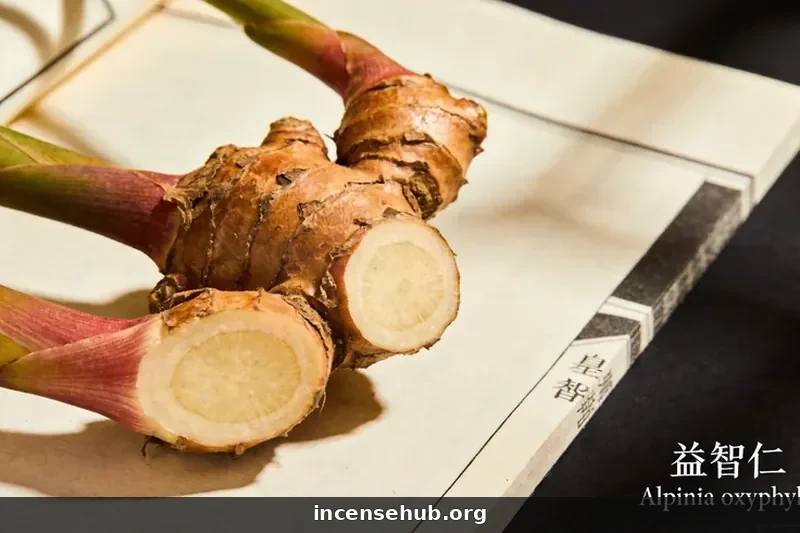
Direct answer: Oxyphylla (益智仁, yìzhì rén) is the dried fruit of Alpinia oxyphylla, a ginger-family (Zingiberaceae) perennial native to southern China, Hainan, and northern Vietnam. It is a warm, spicy, camphoraceous seed-like fruit used in traditional medicine and recorded as a minor aromatic in classical incense formulas — the Ming Xiangcheng (香乘) lists 益智仁 among the ingredients of the inner-court sachet 内苑蕊心衣香.
Key facts
| Chinese | 益智仁 (yìzhì rén) — “benefit-the-mind seed” |
| Botanical source | Alpinia oxyphylla (family Zingiberaceae) — the dried fruit |
| What it is | A dried spice fruit, not a wood or resin |
| Aroma | Spicy, warm, camphoraceous, slightly sweet |
| Traditional role | Materia medica; minor classical aromatic |
Aroma profile
Direct answer: 益智仁 is warm and spicy with a camphoraceous, slightly sweet edge — in the ginger-family register alongside galangal and the cardamoms, but with a gentler, more rounded pungency. It reads as a warm spice accent, adding a soft, pungent warmth to a blend rather than leading it.
益智仁 is warm and spicy with a camphoraceous, slightly sweet edge — in the ginger-family register alongside galangal and the cardamoms, but with a gentler, more rounded pungency. It reads as a warm spice accent, adding a soft, pungent warmth to a blend rather than leading it. Its primary place is traditional medicine, where it is valued more for its described properties than for its scent.
The register is worth pinning within the ginger family: where galangal (高良姜) is sharp and penetrating, and the cardamoms (草豆蔻, 白豆蔻) are aromatic and slightly cooling, 益智仁 sits in a gentler, warmer, more rounded place — a soft camphoraceous pungency with a faint sweetness. This is the character of a supporting spice: present to warm and round a formula, not to define it.
A ginger-family seed (read this)
Direct answer: 益智仁 belongs to the Alpinia genus of the ginger family (Zingiberaceae), a group of warm, camphoraceous aromatics that share a family resemblance. It is Alpinia oxyphylla (the dried fruit); galangal is Alpinia officinarum (the rhizome); katsumadai is Alpinia katsumadae (another seed). The other Alpinia materials are distinct species.
益智仁 belongs to the Alpinia genus of the ginger family (Zingiberaceae), a group that includes several warm, camphoraceous aromatics that share a family resemblance:
- 益智仁 (this page) — Alpinia oxyphylla, a warm spice fruit used in materia medica.
- galangal (高良姜) — Alpinia officinarum, the spicy galangal rhizome. Its own entry.
- katsumadai (草豆蔻) — Alpinia katsumadae, another ginger-family seed. Its own entry.
This page describes 益智仁 = Alpinia oxyphylla. The other Alpinia materials are distinct species.
This family grouping is the page’s disambiguation anchor: the Alpinia genus supplies several warm, camphoraceous aromatics that are easy to conflate, but they differ by species and by the plant part used — 益智仁 is the fruit of A. oxyphylla, galangal is the rhizome of A. officinarum, and katsumadai is the seed of A. katsumadae. The shared ginger-family warmth is the resemblance; the species and part are the distinction.
Botanical source and origin
Direct answer: Alpinia oxyphylla is a ginger-family (Zingiberaceae) perennial native to southern China, Hainan, and northern Vietnam. The part used is the dried fruit, which contains the aromatic seed. Flora of China records the species with pseudostems 1–3 m tall and a white labellum with red stripes.
Alpinia oxyphylla is a ginger-family (Zingiberaceae) perennial native to southern China, Hainan, and northern Vietnam. The part used is the dried fruit, which contains the aromatic seed. Flora of China records the species — pseudostems 1–3 m tall, with lanceolate leaves and a white labellum marked with red stripes — placing it firmly in the ornamental-and-aromatic ginger alliance. The genus Alpinia includes other aromatic species — galangal (Alpinia officinarum) and katsumadai (Alpinia katsumadae) — and the wider ginger family includes the cardamom group (Amomum) and turmeric group (Curcuma).
Chinese name and terminology
Direct answer: 益智仁 (yìzhì rén) means “benefit-the-mind seed” — 益智 (“benefit the mind”) + 仁 (“kernel/seed”). The name is a materia-medica coinage, reflecting the fruit’s traditional reputation for the “mind,” and it belongs to the medicinal vocabulary rather than the incense 香材 canon.
The name 益智仁 is descriptive and medicinal: 益智 (“benefit the mind”) + 仁 (“kernel/seed”), recording the fruit’s traditional materia-medica reputation. This is a medicine-name, not an incense-name — it reflects the described properties of the fruit in the 本草 tradition, where 益智 was valued as a warming aromatic with a reputation for the “mind.” The name thus signals the material’s primary identity: 益智仁 is a materia-medica fruit that appears in incense only as a minor, secondary ingredient in sachets and blends.
Why is it used in incense and medicine?
Direct answer: 益智仁 is primarily a materia-medica fruit, valued for its described warming properties, and it appears in classical incense only as a minor aromatic — a sachet ingredient, not a burned material. Its warm, camphoraceous character adds a soft spice accent, but its incense role is secondary to its medicinal one.
益智仁’s primary identity is medicinal: it is recorded in traditional Chinese medicine as a warming aromatic, and its value there is for its described properties rather than its scent. In incense it appears only as a minor aromatic — the Xiangcheng lists it among the ingredients of the inner-court sachet 内苑蕊心衣香 (a wearable sachet of 藿香、益智仁、白芷 and others), which is a scenting application rather than a burned 合香 material. So the honest framing is: a materia-medica fruit with a small, documented sachet role, whose warm camphoraceous character makes it a soft spice accent rather than a lead.
How is it processed?
Direct answer: 益智仁 is produced by harvesting the fruit and drying it whole; the dried fruit, with its aromatic seed, is the traded form, used whole or lightly crushed. No extraction is required — the material is a dried fruit, and its warm, camphoraceous character is present in the dried seed.
The fruit is harvested and dried whole, producing the dried, seed-bearing fruit that is the traded form. The material is used whole or lightly crushed, and its warm, camphoraceous character is present in the dried seed. Processing is a drying step, not an extraction — the dried fruit is the reference form, and there is no distillation or refinement beyond it. For medicinal or aromatic use, the dried fruit or its seed is the working material.
What determines quality?
Direct answer: 益智仁 quality turns on the soundness and aromatic freshness of the dried fruit. Good material is whole, dry, and warm-spicy-camphoraceous on crushing, without a musty or hollow note; the seed within the fruit is the aromatic part.
The practical checks are: soundness (whole, dry fruit rather than broken or musty material) and aromatic freshness (a warm, spicy, camphoraceous character on crushing, not a stale or hollow note). The seed within the fruit is the aromatic part, so the crush test — releasing the seed’s scent — is the standard quality check. As with most dried spice fruits, freshness is the primary quality driver.
Common forms
Direct answer: 益智仁 is traded as the whole dried fruit and as the separated seed, used whole or crushed. The whole fruit is the reference form; the seed within it is the aromatic part.
| Form | Typical use |
|---|---|
| Whole dried fruit | The reference form; used whole or lightly crushed |
| Separated seed | The aromatic part, for blending and dosing |
The whole fruit and the separated seed are the same material at different stages — the seed carries the warm, camphoraceous aroma.
In Chinese tradition
- Materia medica: 益智仁 is recorded in traditional Chinese medicine, classically described as a warming aromatic. This is traditional materia-medica language, not modern clinical evidence.
- Classical sachet: the Ming-dynasty Xiangcheng (香乘) lists 益智仁 among the ingredients of the inner-court sachet 内苑蕊心衣香 (藿香、益智仁、白芷…) — a wearable sachet, not a burned material.
- Minor spice: 益智仁 is a lesser-used warm spice in Chinese cooking and spiced blends.
Traditional use vs modern evidence
Direct answer: The traditional-medicine and minor aromatic use of 益智仁 is documented; medicinal uses are traditional, not established clinical fact, and no medical claim is made. The page’s core factual point is the Alpinia disambiguation — 益智仁 is the fruit of A. oxyphylla, distinct from galangal’s rhizome and katsumadai’s seed.
- Traditional Use — 益智仁 as a warming materia-medica aromatic and a minor sachet ingredient in classical incense.
- Historical Record — the Xiangcheng lists 益智仁 among the ingredients of the inner-court sachet 内苑蕊心衣香 (藿香、益智仁、白芷…).
- Scientific Evidence — the botanical identity (Alpinia oxyphylla, Zingiberaceae) is established. No clinical or medical efficacy claims are presented.
The traditional-medicine and minor aromatic use is documented. Medicinal uses are traditional, not established clinical fact, and we make no medical claims. The documented, non-medical facts are botanical identity, the Zingiberaceae placement, and the warm-spice character — plus the Alpinia genus disambiguation.
Quality notes
Practical points:
- 益智仁 is the dried fruit of Alpinia oxyphylla, a ginger-family spice — distinguish it from galangal (Alpinia officinarum) and katsumadai (Alpinia katsumadae), related Alpinia species.
- Expect a warm, spicy, camphoraceous, slightly sweet character, gentler than galangal’s sharp pungency.
- In incense it is a minor warm accent, appearing in sachets and blends rather than as a leading material.
- The seed within the fruit is the aromatic part; judge quality by the crush test.
The Alpinia genus: oxyphylla vs galangal vs katsumadai
Direct answer: 益智仁, galangal, and katsumadai are three different Alpinia species supplying different plant parts. 益智仁 is the fruit of A. oxyphylla; galangal is the rhizome of A. officinarum; katsumadai is the seed of A. katsumadae. They share the ginger-family warmth but are distinct species and parts.
| oxyphylla (益智仁) | Galangal (高良姜) | Katsumadai (草豆蔻) | |
|---|---|---|---|
| Botanical source | Alpinia oxyphylla | Alpinia officinarum | Alpinia katsumadae |
| Part used | Dried fruit | Rhizome | Seed |
| Character | Warm, rounded, camphoraceous | Sharp, penetrating | Aromatic, cardamom-like |
| Primary role | Materia medica | Culinary + aromatic | Culinary + aromatic |
The three share the Alpinia genus and the ginger-family warmth, but differ by species and plant part. See galangal, katsumadai, and the material comparison matrix.
Summary
益智仁 (yìzhì rén) is the dried fruit of Alpinia oxyphylla, a ginger-family (Zingiberaceae) perennial native to southern China, Hainan, and northern Vietnam. It is a warm, spicy, camphoraceous, slightly sweet spice fruit used primarily in traditional medicine, with a documented minor role as a sachet ingredient in the Xiangcheng (the 内苑蕊心衣香). It is the fruit of A. oxyphylla, distinct from the rhizome of galangal (A. officinarum) and the seed of katsumadai (A. katsumadae) — the Alpinia genus’s false-friend trio.
FAQ
What is sharp-leaf galangal (益智仁)? The dried fruit of Alpinia oxyphylla, a ginger-family (Zingiberaceae) perennial native to southern China, Hainan, and northern Vietnam. It is a warm, spicy, camphoraceous, slightly sweet seed-like fruit used in traditional medicine and recorded as a minor aromatic in classical incense formulas.
What does oxyphylla (益智仁) smell like? Warm and spicy with a camphoraceous, slightly sweet edge — in the ginger-family register alongside galangal and the cardamoms, but gentler and more rounded. It reads as a warm spice accent, adding a soft pungency to a blend rather than leading it.
Is oxyphylla (益智仁) the same as galangal? No, though both are in the Alpinia genus. 益智仁 is Alpinia oxyphylla (the dried fruit); galangal (高良姜) is Alpinia officinarum (the rhizome). They share the ginger-family warm, camphoraceous character but are distinct species used for different parts.
Does oxyphylla (益智仁) appear in classical incense? Yes, as a minor ingredient. The Ming-dynasty Xiangcheng (香乘) lists 益智仁 among the ingredients of the inner-court sachet 内苑蕊心衣香 (藿香、益智仁、白芷…) — a wearable sachet rather than a burned material.
Where does oxyphylla (益智仁) come from? From Alpinia oxyphylla, a ginger-family perennial native to southern China, Hainan, and northern Vietnam. The part used is the dried fruit, which contains the aromatic seed. The Alpinia genus also includes galangal and katsumadai.
What does the name oxyphylla (益智仁) mean? “Benefit-the-mind seed” — 益智 (“benefit the mind”) + 仁 (“kernel/seed”). It is a materia-medica coinage reflecting the fruit’s traditional reputation, and it signals that 益智仁 is primarily a medicinal material with only a minor sachet role in incense.
See also: galangal, katsumadai, and the full scent guide.
Evidence & Sources
Botanical identity
Source: Alpinia oxyphylla in Flora of China · Alpinia oxyphylla on GBIF. Evidence type: Established.
Traditional Chinese use
Source: the Ming-dynasty Xiangcheng (香乘) lists 益智仁 among the ingredients of the inner-court sachet 内苑蕊心衣香 (藿香、益智仁、白芷…). Evidence type: Historically documented — aromatic use; medicinal uses are traditional, not modern clinical evidence.
Authenticity / disambiguation
Source: 益智仁 (Alpinia oxyphylla) vs 高良姜 (Alpinia officinarum, galangal) vs 草豆蔻 (Alpinia katsumadae) — distinct Alpinia species. Evidence type: Practical screening.
Safety
Source: incense combustion produces smoke and particulate matter; burn in a well-ventilated space. Evidence type: Established.
Evidence status
| Layer | Status |
|---|---|
| Botanical identity | Established |
| Traditional use | Historically documented |
| Authenticity test | Practical screening |
| Health claims | Not established |
Sources
Sources: botanical references on Alpinia oxyphylla and the Ming-dynasty Xiangcheng (香乘) record of 益智仁 in the 内苑蕊心衣香 sachet. 益智仁’s traditional-medicine and minor aromatic use is documented; medicinal uses are treated as traditional, not established clinical fact. This is editorial knowledge content, not medical advice.