
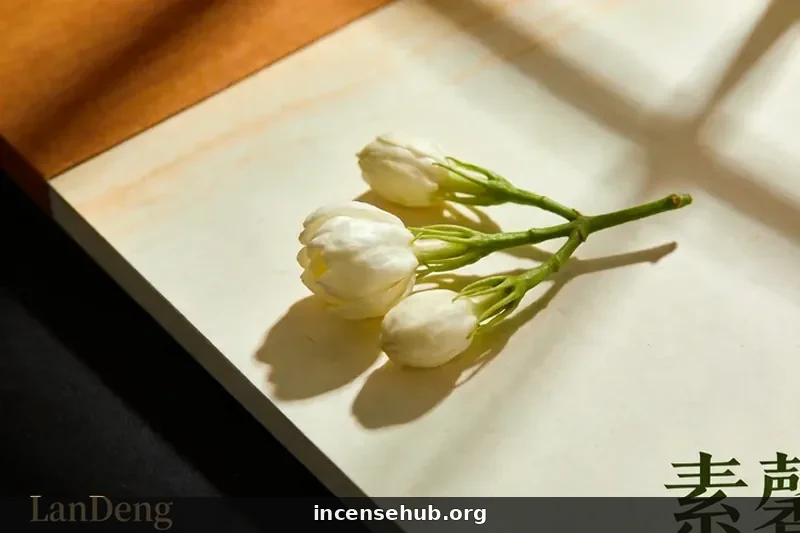
Direct answer: Jasmine grandiflorum (素馨, sùxīn) is the blossom of Jasminum grandiflorum, a scrambling evergreen climber in the olive family (Oleaceae) whose large, white, intensely fragrant flowers open at night. It is the reference jasmine of Western perfumery and the chief source of commercial jasmine absolute, and it appears in the classical compendium 香乘 listed beside its relative 茉莉 (Jasminum sambac). The two are separate species, so a label that reads only “jasmine” leaves the material underspecified.
Key facts
Direct answer: The essentials are a flower, not a wood or resin; an Oleaceae climber named Jasminum grandiflorum; a sweet, heady, indolic white-floral register; a 香乘 record that pairs it with 茉莉; and a fixed, practical distinction between the perfumery jasmine and the tea jasmine.
| Attribute | Value |
|---|---|
| Chinese name | 素馨 (sùxīn) — also 素馨花 |
| Botanical source | Jasminum grandiflorum (family Oleaceae) — the flowers |
| Material type | A flower, not a wood or resin |
| Aroma register | Sweet, floral, heady, green |
| Traditional role | Perfumery jasmine; incense flower (香乘) |
| Primary confusion | 茉莉 (Jasminum sambac), the tea jasmine |
One name, two flowers
Direct answer: The English word “jasmine” labels a genus of dozens of Jasminum species, not a single material. Two of them matter most to fragrance — 素馨 (Jasminum grandiflorum), the heady perfumery flower, and 茉莉 (Jasminum sambac), the fresh tea-scented flower — and the two are not interchangeable.
The genus is broad, and the two species at its fragrant centre are distinct plants with distinct jobs. The roster that matters here:
- 素馨 (Jasminum grandiflorum) — the “Spanish / Poet’s / royal jasmine,” larger blossoms, the classic Western perfumery jasmine and the principal source of jasmine absolute. This entry.
- 茉莉 (Jasminum sambac) — the tea-scented jasmine, the flower behind jasmine tea and a separate fragrant tradition (see jasmine).
The classical record places the two side by side, and that placement is itself the evidence of their difference: 香乘 enters 素馨 and 茉莉 as distinct flowers in the same formulas (心字香 and the ten-flower 逗情香). A single recipe that lists both would be redundant if they were one material. This page covers 素馨 = Jasminum grandiflorum; where a source means 茉莉, it is describing Jasminum sambac.
Botanical description
Direct answer: Jasminum grandiflorum is a scrambling evergreen shrub of the olive family (Oleaceae), native to South Asia and widely cultivated in warm regions including southern China. Its flowers are larger than those of J. sambac, white, salverform, and powerfully fragrant, unfolding after dusk. It is the principal source of commercial jasmine absolute and concrete.
The plant climbs and scrambles rather than standing upright. Flora of China records the species (素馨花) as a scandent shrub 2–4 m tall, with pinnately compound leaves and white, salverform flowers — a narrow tube opening into a flat, five-lobed face — and describes it as native to Arabia, widely grown in warm and tropical countries for its fragrant blossoms. The night-opening habit is the biological fact that governs the entire supply chain, because the scent is fullest just after the petals unfold. See Jasminum grandiflorum in Flora of China and Jasminum grandiflorum on GBIF.
The scheduling of the flower sets the material’s economics. Blossoms that open after dusk → scent peaking in the early hours → a pre-dawn hand harvest → a short picking window repeated daily → a raw material priced on labor and timing rather than on years of growth. A resin or a wood accumulates value over decades; a jasmine flower spends its whole aromatic capital in a single night, and the trade is built around catching that night.
Aroma profile
Direct answer: 素馨 is intensely sweet and white-floral, with a heady, almost indolic depth that is richer than 茉莉’s tea-like sweetness. In its natural absolute form it carries a warm, animalic undercurrent beneath a green-floral top; commercial jasmine notes are usually rendered cleaner and brighter.
The flower’s scent has weight. It opens sweet and white-floral, but the sweetness is freighted with a heady, near-narcotic fullness that a tea-fresh jasmine never reaches. In the natural absolute, a warm, faintly animalic undertone sits under the green-floral top, and that undertone is what gives the material its opulent, sensual character rather than a merely pretty one. Commercial jasmine accords, by contrast, are typically cleaned up and brightened, because the full natural note is too heavy for many product briefs.
That profile fixes the flower’s place in a composition. 素馨 is a heart-note flower that fills the middle of a blend and pulls it toward richness and romance, where 茉莉 reads fresher and more delicate. The two are not two grades of one scent; they push a blend in different directions.
The indolic note, and the mechanism behind it
Direct answer: The indolic note is the sensory core of the 素馨-versus-茉莉 distinction. Indole is a nitrogen-bearing compound that, in trace amounts, lends white florals their warm, animalic, almost narcotic undertone; in larger amounts it reads as faecal. The causal chain runs from trace indole in the flower to the heady, opulent signature that perfumery tames.
Indole is the molecule that carries the difference, and its behavior is dose-dependent in a way that matters. At very low concentrations it reads warm, floral, and faintly animalic — the note that gives jasmine, tuberose, and orange blossom their sensual depth — while at higher concentrations it turns fecal and unpleasant. The chain that governs this material runs: trace indole in the flower → a warm animalic undertone beneath the sweet floral → the “heady, opulent” signature → a note perfumery tames or brightens because an excess tips into the unpleasant. 素馨 holds that indolic depth, which is what separates the perfumery flower from the tea flower, and it is why commercial accords so often scrub it clean.
Around the indole sit the molecules that round out the absolute: benzyl acetate and linalool supply the sweet-green floral top, while jasmone and methyl jasmonate contribute the deeper, tea-like facets. The layered structure — a bright sweet opening over a warm indolic body — is what makes the natural absolute read richer and more dimensional than a flat synthetic “jasmine” note.
The chemistry of jasmine absolute, in more depth
Direct answer: Jasmine absolute is a complex natural product built around a few dominant molecules — benzyl acetate, benzyl alcohol, linalool, and indole — supported by jasmone, methyl jasmonate, and a host of trace compounds that together give the absolute its full, dimensional character. The complexity is why the natural material resists simple substitution by a single molecule.
The absolute’s composition is a lesson in how natural fragrance differs from a single aroma chemical. Benzyl acetate, a sweet, fruity-floral ester, is usually the single most abundant component, and it carries the bright, green-sweet opening. Linalool adds a clean floral freshness. Indole contributes the warm, animalic depth. Beneath these sit jasmone and methyl jasmonate, which supply the deeper, tea-like and green facets, along with a long tail of minor compounds — farnesene, phytol, isophytol, and traces of others — whose combined effect is a richness no single molecule can reproduce.
That complexity has a commercial consequence. A “jasmine” built from benzyl acetate alone reads thin and one-dimensional, a flat approximation of the opening with none of the body. The natural absolute’s value lies in the full orchestra of trace compounds, and a buyer evaluating the material is partly evaluating that complexity — whether the note is round and layered or flat and thin.
The author’s view, not a verified fact: the compound profile of Jasminum grandiflorum absolute described here is drawn from general accounts of jasmine-absolute chemistry rather than from a measured analysis of a specific commercial lot, and the relative proportions of individual compounds vary from crop to crop.
素馨 versus 茉莉: the decision table
Direct answer: 素馨 and 茉莉 are two distinct Jasminum species with different scent character — 素馨 is the headier, larger-flowered perfumery jasmine, 茉莉 the fresher, tea-scented one. The table below is the quick reference for keeping them apart.
| 素馨 (J. grandiflorum) | 茉莉 (J. sambac) | |
|---|---|---|
| Flower | Larger, more intensely fragrant | Smaller, tea-scented |
| Character | Heady, indolic, opulent | Fresh, tea-like, delicate |
| Perfumery role | Jasmine absolute / concrete source | Tea-scenting jasmine |
| Classical record | Listed in 香乘 (心字香, 逗情香) | Listed in 香乘 (alongside 素馨) |
The two are distinct species with distinct registers, entered separately in the classical record. See jasmine, osmanthus, and the material comparison matrix.
Jasmine among the white florals: osmanthus, rose, tuberose
Direct answer: 素馨 is best fixed by reading it against the other heavy florals — osmanthus, rose, and tuberose. Against osmanthus it is richer and more indolic; against rose it is sweeter and less dewy; against tuberose it is a near relative that shares the indolic register but leans greener and lighter.
The heavy-floral shelf is crowded, and each member earns its place by different chemistry. A comparison table sets the contrasts in order:
| Material | Botanical source | Aroma register | Position in a blend | How it relates to 素馨 |
|---|---|---|---|---|
| 素馨 (J. grandiflorum) | Oleaceae climber | Heady, indolic, sweet white floral | Heart | The reference point |
| Osmanthus (桂花) | Osmanthus fragrans (Oleaceae) | Fruity-apricot floral | Heart | Sweeter and rounder, apricot-leaning; no indolic weight |
| Rose (Rosa × damascena) | Rosaceae shrub | Rich, dewy, deep floral | Heart | Fuller-bodied and rosy, built on citronellol and geraniol rather than indole |
| Tuberose (Polianthes tuberosa) | Asparagaceae | Creamy, indolic, narcotic | Heart to base | The closest cousin; shares the indolic depth but reads heavier and creamier |
The table’s lesson is that 素馨 and tuberose are the two indolic heavyweights, while osmanthus and rose are sweet in different, non-indolic ways. Osmanthus is fruity-apricot and round, the friendliest of the group; rose is dewy and rosy, its sweetness carried by citronellol and geraniol; tuberose is 素馨’s nearest relation, equally narcotic but creamier and more unctuous. A formulator who wants the heady white-floral register reaches for 素馨 or tuberose; one who wants a friendlier floral reaches for osmanthus or rose.
A short history of jasmine in perfumery
Direct answer: Modern jasmine perfumery descends from the Grasse industry of southern France, which perfected two ways of capturing the flower’s scent — the slow fat-based method of enfleurage and the later solvent extraction that yields concrete and absolute. The same flower is now grown for extraction across India, Egypt, Morocco, and elsewhere in the warm belt.
The historical arc is instructive because it explains why jasmine absolute exists in its present form. In the Grasse region of Provence, perfumers developed enfleurage, a cold method in which freshly picked flowers were laid on sheets of purified fat that slowly absorbed their scent; the scented fat, or pomade, was then washed with alcohol to recover the fragrance. Enfleurage was gentle but labor-intensive, and it was eventually overtaken by solvent extraction, in which the flowers are washed in a volatile solvent to yield a waxy concrete, then washed again with alcohol to produce the liquid absolute. That absolute is the form in which 素馨 reaches the modern perfumer.
The growing map has since widened well beyond Grasse. India is a major producer of J. grandiflorum for the jasmine trade; Egypt grows large acreages for both concrete and the domestic flower market; and Morocco, Italy, and other warm-climate producers contribute as well. The flower is the same, and the chemistry is the same; what varies by region is the yield, the labor cost, and the character of the resulting absolute.
Sourcing and geography
Direct answer: 素馨’s commercial heartland is warm South Asia and the Mediterranean — chiefly India, Egypt, and the historic Grasse region of southern France — where the flowers are grown in quantity for extraction into absolute and concrete. The plant reaches China’s warm south as a cultivated flower rather than a wild one.
The species’ native range is South Asia, and Flora of China records it as introduced and widely cultivated in warm and tropical regions for its fragrance. The commercial map follows the warmth: India grows J. grandiflorum on a large scale for the jasmine trade, Egypt farms substantial acreages for both concrete and the fresh-flower market, and Grasse built its historic perfumery reputation in part on the flower grown there. Southern China also cultivates it, which is how it enters the classical Chinese record at all.
The sourcing lesson is that 素馨 is a cultivated, region-specific flower, not a wild-harvested one. Its availability tracks the warm-climate growing season and the local extraction infrastructure, so a buyer sourcing the material is really asking two questions: where the flowers were grown, and where they were turned into absolute.
Supply chain and economics
Direct answer: Jasmine absolute is among the most labor-intensive products in perfumery, because the flowers must be hand-picked at dawn and extracted within hours, and a kilogram of absolute represents an enormous number of individual blossoms. The material is priced on labor and flower weight, not on plant rarity.
The economics are set by the flower’s biology. Each bloom opens at night and sheds its scent within a day, so the harvest is a daily, hand-picked, pre-dawn operation repeated across the whole flowering season. The picked flowers move quickly to extraction, because the volatile content begins to fall the moment they are gathered. That labor intensity — night-opening flowers → scent at its peak just after dawn → hand picking within a narrow window → immediate transport to the extractor → a yield of absolute measured in grams per ton of flowers — is why jasmine absolute is among the more expensive floral materials despite the plant itself being easy to grow.
The supply chain therefore has two distinct grades. The fresh flower is cheap per blossom but useless unless processed immediately; the absolute and concrete concentrate that scent into a stable, shippable form at a high labor cost. The gap between the perishable flower and the shelf-stable concentrate is the whole economic structure of the material.
Storage and shelf life
Direct answer: Jasmine absolute and concrete are relatively stable concentrates that should be stored sealed, cool, and dark; the fresh flower is effectively un-storable and must be processed within hours. The storage problem, in short, belongs to the flower, not to the concentrate.
The two forms have opposite storage stories. The fresh flower is a perishable: picked bloom → volatiles declining from the moment of harvest → a flower that is scentless within a day or two → no practical storage window → processing must be immediate. The absolute and concrete, by contrast, are concentrates in which the scent compounds are already captured, and they keep for years if sealed against air, held cool, and shielded from light, which can degrade the indolic and jasmone fractions over time.
The practical rule follows. A buyer never stores fresh 素馨 flowers as an incense material — they are processed on site or bought already converted. The absolute and concrete are the storeable, tradable forms, and they follow the standard concentrate rules: airtight, cool, dark, and kept away from heat that would drive off the more volatile top notes.
Quality-control checklist
Direct answer: Quality control for 素馨 runs as a gated list — species, form, character, and purity — and a lot that fails any one check should be rejected, because the checks are sequential: a correctly named but flat “clean” jasmine is likely the wrong species or a thinned product.
The checks, in the order they should be run:
| Step | Question | Pass signal | Fail signal |
|---|---|---|---|
| 1. Species | 素馨 or 茉莉? | Jasminum grandiflorum (素馨), heady | Jasminum sambac (茉莉) or an unstated species |
| 2. Form | Flower, absolute, or accord? | The form matches the intended use | A form that does not serve the recipe |
| 3. Character | Heady and indolic? | Warm, animalic depth beneath the sweet floral | Flat, merely “clean,” or tea-like note |
| 4. Purity | Clean floral, not diluted? | A full, rich note with no off-odor | A synthetic or thinned product |
The order is the point. Species comes first because “jasmine” is a genus, not a material; form comes second because flower, absolute, and accord serve different purposes; character and purity come last because they only mean anything once the species and form are settled. The indolic depth is the tell — its absence signals either the tea jasmine or a cleaned-up substitute, and neither is the perfumery material.
How to evaluate a sample
Direct answer: Jasmine absolute should be evaluated on a scent strip or a gentle warmth, not in the bottle, because the full indolic body unfolds only as the concentrate evaporates. The signal to look for is the warm, animalic undertone beneath the sweet floral — its absence means the wrong material or a thinned one.
The evaluation method follows the material’s structure. A concentrate in the bottle smells dense and compressed; it needs dilution and time to reveal itself. The working sequence is: place a small amount on a scent strip or warm it very gently, let it open for a few minutes, and smell in stages — first the sweet-green top, then the deepening indolic body, then the dry-down. The signature to confirm is the warm, almost animalic undertone that appears in the heart of the evaporation.
A comparative step sharpens the verdict. Set the 素馨 absolute beside a known 茉莉 (sambac) material, and the difference becomes immediate: 素馨 reads heavier and more sensual, 茉莉 fresher and more tea-like. A sample that stays flat and merely “clean” across the whole evaporation is probably not the perfumery jasmine — it is the tea jasmine, a synthetic, or a diluted product. The test is not about intensity alone; it is about confirming that the indolic character is actually present.
A buying decision framework
Direct answer: The buying decision for 素馨 reduces to a short gate sequence — specify the species, match the form to the use, confirm the indolic character, and verify purity — because “jasmine” spans two species and three forms, and a spec that skips these steps lands on the wrong material.
A formulator or sourcing buyer can run the decision as four questions in order:
- Species first. Jasminum grandiflorum (素馨) for the heady perfumery note, Jasminum sambac (茉莉) for the tea-fresh note. The word “jasmine” spans both.
- Form second. Fresh flower, absolute/concrete, or accord? Each serves a different purpose and none is interchangeable with the others.
- Character third. Heady and indolic, or fresh and tea-like? Expect the indolic depth from the perfumery jasmine.
- Purity fourth. For the absolute, a clean, rich floral note rather than a synthetic or diluted substitute.
The framework’s value is that it blocks the two classic buying errors at once — ordering the tea jasmine when the perfumery jasmine is wanted, and ordering an accord when the recipe needs the natural concentrate. Each error lands on a material that is botanically plausible and aromatically wrong.
Two mechanism chains, laid out
Direct answer: Two causal chains explain most of what a buyer needs to know about 素馨 — one for why the flower is so expensive, and one for why the indolic note separates it from 茉莉 — and each chain ends in a sourcing or specification rule.
The first chain is agronomic and economic. The flower’s scent is a nightly event: night-opening blooms → scent peaking just after dawn → hand picking within a narrow window → immediate transport to extraction → a concentrate measured in grams per ton of flowers → an absolute priced on labor, not plant rarity. The chain terminates in the rule: buy 素馨 as a concentrate or process the flowers on site, never stockpile fresh blooms.
The second chain is chemical and sensory. A single compound behaves differently at different doses: trace indole in the flower → a warm animalic undertone beneath the sweet floral → the heady, opulent signature → a note perfumery tames because excess indole turns unpleasant → the presence or absence of that depth is the 素馨-versus-茉莉 tell. Both chains point the buyer to the same pair of questions: what species, and what form.
Role inside a 合香 (héxiāng) blend
Direct answer: Within the classical Chinese blending framework of 君臣佐使 — chief, minister, assistant, and guide — 素馨 functions as a minister or heart-note assistant: a rich floral body that supports the theme rather than leading it. It anchors the middle of a blend and pulls it toward opulence.
The 合香 system assigns each ingredient a structural role: the 君 (chief) states the theme, the 臣 (minister) reinforces it, the 佐 (assistant) corrects and harmonizes, and the 使 (guide) leads and clears. A heady heart-note flower like 素馨 lands naturally in the 臣 or upper-佐 position — it lends a full, opulent floral body that supports a woody or resinous theme without displacing it.
That placement explains why 素馨 appears in the classical recipes as a paired flower rather than a headlining 香材. In 心字香 and 逗情香 it sits beside 茉莉 and other flowers, contributing richness while the formula’s identity comes from elsewhere. A formulator who understands the 君臣佐使 ladder uses 素馨 for depth in the middle of a blend — the moment the top notes have cleared and the base has yet to dominate — and never asks it to carry the whole composition.
Processing: solvent extraction and the classical 蒸香
Direct answer: 素馨’s flowers are processed by picking the freshly opened blooms and, for perfumery, extracting them into jasmine absolute or concrete by solvent extraction, because the flower’s scent is too delicate for steam distillation. The classical Chinese method was different: steaming the flowers to capture their scent (蒸香).
The two processing routes reflect two goals. Perfumery uses solvent extraction — the picked flowers are washed in a volatile solvent such as hexane, yielding a waxy concrete, which is then washed with alcohol to produce the liquid absolute. Solvent extraction is chosen because steam distillation’s heat would destroy the delicate jasmine scent. The classical Chinese method was gentler still in intent: sources describe steaming 素馨 and other fragrant flowers to capture their scent (蒸香), a low-heat approach suited to the flower’s fragility.
The shared constraint is the flower’s delicacy. Night-opening flowers → scent peaking just after opening → picking timed to that peak → extraction that avoids destructive heat → a full floral note preserved. Whether the route is solvent or steam, the rule is the same: catch the flower at its peak and treat it gently, because jasmine’s scent will not survive rough handling.
Forms the material comes in
Direct answer: 素馨 is traded as fresh flowers (for classical scenting), as jasmine absolute and concrete (for perfumery), and as a fragrance accord (in compounds). The absolute is the commercial reference form; the fresh flower is the classical scenting form.
| Form | Typical use |
|---|---|
| Fresh flowers | Classical scenting (蒸香) and display |
| Jasmine absolute / concrete | Solvent-extracted perfumery concentrate |
| Fragrance accord | The jasmine note rendered in compounds |
The absolute is the perfumery reference form; the fresh flower is the classical material, and the accord is a convenience form. Each maps to a different register: the fresh flower to classical scenting, the absolute to fine fragrance, the accord to commercial products where the natural cost is too high.
Jasmine in tea versus jasmine in incense
Direct answer: The two jasmines divide the two uses cleanly. The tea jasmine 茉莉 scents jasmine tea by scenting the leaves with fresh flowers; the perfumery jasmine 素馨 is extracted into absolute for fragrance. A recipe that wants a tea-fresh floral should not reach for the perfumery flower, and vice versa.
The two species have sorted themselves into two industries by their scent character. 茉莉, with its fresh, tea-like sweetness, is the flower that scents jasmine tea — the classic method lays fresh flowers over the tea leaves so the leaves absorb the fragrance, a gentle process well suited to a delicate floral. 素馨, with its heady, indolic richness, is too heavy for that job and went instead into perfumery, where its opulence is extracted into absolute for fine fragrance.
The division is a practical guide. A formulator looking for a fresh, delicate jasmine should reach for 茉莉; one looking for a rich, opulent jasmine should reach for 素馨. The word “jasmine” bridges both, but the two industries — tea and perfume — have already drawn the line between them, and a blender should respect it.
In Chinese tradition
- Incense flower: 素馨 is recorded in 香乘 as a flower for incense and scenting — for example, in 心字香 (番禺人作心字香 用素馨茉莉半开者) and in the ten-flower 逗情香 recipe.
- Scenting method: classical sources describe steaming 素馨 and other fragrant flowers to capture their scent (蒸香).
- Perfumery: globally, 素馨 is the archetypal jasmine of fine fragrance, distinct from the tea jasmine.
Traditional use versus modern evidence
Direct answer: The aromatic and incense use of 素馨 is documented in classical and modern perfumery records, and its botanical identity is established. No medical claim is made. The page’s core factual point is the 素馨-versus-茉莉 distinction.
The evidence separates into three buckets:
- Traditional Use — 素馨 as a classical incense and scenting flower, paired with 茉莉 in 香乘 formulas.
- Historical Record — 香乘 lists 素馨 and 茉莉 as distinct flowers (心字香, 逗情香); the classical scenting method was steaming (蒸香).
- Scientific Evidence — the botanical identity (Jasminum grandiflorum, Oleaceae) is established. No clinical or medical efficacy claim is presented.
The line this page draws is the boundary between a documented aromatic and an unverified effect. The incense use is well attested in the classical record and in modern perfumery practice; the species identity is established. Nothing here treats 素馨 as a remedy, and the documented facts are botanical and aromatic rather than medical.
Evidence status
| Layer | Status |
|---|---|
| Botanical identity | Established |
| Traditional use | Historically documented |
| Authenticity test | Practical screening |
| Health claims | Not established |
Common mistakes
- Treating “jasmine” as one material. 素馨 and 茉莉 are different species with different characters, and the genus spans both.
- Expecting the tea jasmine from the perfumery jasmine. 素馨 is heady and indolic, not tea-fresh.
- Reading a flat “clean” jasmine as the perfumery grade. The indolic depth is the tell; its absence signals the wrong material or a thinned product.
- Ignoring the form. Fresh flower, absolute, and accord serve different purposes and are not interchangeable.
- Stockpiling the fresh flower. The blooms shed their scent within a day, so the flower is processed on site, never stored as a material.
What the author would flag
Direct answer: The misconception to correct is that “jasmine” is one scent — it is not. The perfumery jasmine and the tea jasmine are different species with different characters, and a formula that treats them as interchangeable will land wrong.
Two editorial judgments stand out, and both are judgments rather than verified fact.
First, the indolic tell. The gap between 素馨 and 茉莉 is not subtle — it is the presence or absence of the warm, animalic indolic depth. A flat, merely “clean” jasmine is usually not the perfumery flower; it is either the tea flower or a thinned product. The indolic undertone is the tell, and its absence is a signal to look closer.
Second, the boundary is species, not style. To say a blend “uses jasmine” without naming the species says almost nothing, because the two flowers push a scent in opposite directions — 素馨 toward opulent and romantic, 茉莉 toward fresh and delicate. Unless the species is pinned down, the note is unspecified.
The author’s view, not a verified fact.
FAQ
Q: What is 素馨 (suxin)?
The blossom of Jasminum grandiflorum, a scrambling Oleaceae climber whose large white flowers carry an intense fragrance. It is the classic Western perfumery jasmine and a principal source of jasmine absolute, and it is entered in the classical compendium 香乘 beside its relative 茉莉 (Jasminum sambac).
Q: How does Spanish jasmine (素馨) differ from jasmine (茉莉)?
They are two separate Jasminum species. 素馨 is Jasminum grandiflorum — bigger flowers, headier and more opulent, the perfumery jasmine. 茉莉 is Jasminum sambac — the tea-scented flower used for jasmine tea. 香乘 lists them as distinct flowers (in 心字香 and 逗情香), and each has its own entry here.
Q: What does Spanish jasmine (素馨) smell like?
Intensely sweet and white-floral, with a heady, almost indolic depth richer than 茉莉’s tea-like sweetness. The natural absolute carries a warm, animalic undercurrent beneath a green-floral top; commercial jasmine notes are usually rendered cleaner and brighter. In a blend it reads opulent and romantic.
Q: Is Spanish jasmine (素馨) used in perfumery?
It is the archetypal jasmine of Western fine fragrance and the principal source of commercial jasmine absolute and concrete. Its large, night-opening white flowers are picked for their intense scent and processed into absolute and concrete. In Chinese incense it appears as a flower material in 香乘, often paired with 茉莉.
Q: What is the “indolic” note people mention about jasmine?
It is the warm, animalic undertone that comes from trace amounts of indole in the flower. In small doses indole gives white florals their heady, almost narcotic richness; in large doses it turns unpleasant. 素馨 carries that indolic depth, which is what separates the opulent perfumery jasmine from the fresher tea jasmine — and why commercial accords so often clean it up.
Q: Why should I specify the jasmine species when sourcing?
Because “jasmine” names a genus, not a material. 素馨 (Jasminum grandiflorum) and 茉莉 (Jasminum sambac) are different species with different scent characters — heady and indolic versus fresh and tea-like — and they are not interchangeable. A spec that names the species avoids the underspecification the word “jasmine” invites.
See also: jasmine, osmanthus, and the full scent guide.
The night harvest: a labor profile
Direct answer: Jasmine is harvested by hand in the hours around dawn, because the flower opens at night and its scent peaks just after the petals unfold. The picking is delicate, repetitive, and entirely manual, which is the root of the absolute’s cost.
The harvest is a study in manual precision. Pickers move through the rows in the early morning, selecting only the buds that have just opened — neither the tight buds of the day before nor the spent blooms of the previous night — and plucking each by hand into a cloth or basket. The work cannot be mechanized, because a machine cannot distinguish a bud at peak scent from one that is not, and the flower’s fragility rules out any rough handling. The picked blooms are then rushed to the extractor, since the scent begins to fade from the moment of picking.
The labor profile explains the price. A kilogram of jasmine absolute represents a vast number of individual blossoms, each one picked by a single human hand at a single moment in the day. The material is expensive not because the plant is rare — it grows readily across the warm belt — but because the harvest is an accumulation of millions of small, timed, manual acts.
Enfleurage, concrete, and absolute: the three captures
Direct answer: Three techniques have been used to capture jasmine’s scent — enfleurage, which absorbs it into fat; solvent extraction, which yields the waxy concrete; and the alcohol wash that turns concrete into the liquid absolute. Each step trades gentleness against efficiency, and the absolute is the modern standard.
Enfleurage is the oldest of the three. Fresh flowers were laid on trays of purified fat, which slowly absorbed the volatile scent over a day or more; the fat, charged with fragrance, was then washed in alcohol to release a concentrated pomade extract. The method was extraordinarily gentle — no heat at all — but so slow and manual that it survives today mostly as a historical curiosity.
Solvent extraction replaced it by trading a little gentleness for a great deal of efficiency. Flowers are washed in a volatile solvent, which strips the scent into a waxy mass called concrete; that concrete is then washed in alcohol, and the alcohol is evaporated to leave the liquid absolute. The chain runs: fresh flowers → solvent wash → concrete (a waxy concentrate) → alcohol wash and evaporation → absolute (the liquid concentrate) → the form perfumers buy. The absolute is the modern reference form precisely because it balances yield against the flower’s delicacy.
Jasmine absolute yield and cost in numbers
Direct answer: Jasmine absolute is measured in grams per ton of flowers, because the flower’s scent is held in a small fraction of its weight. That yield ratio is the single number that explains why the absolute is costly and why the fresh flower is useless as a storeable material.
The yield figures tell the whole economic story at a glance. Jasmine flowers are mostly water, and the scent compounds they carry are a tiny fraction of the fresh weight, so extraction produces only a few grams of absolute from a very large quantity of blossoms. The exact ratio shifts with the crop, the weather, and the extraction method, but the order of magnitude is fixed: thousands of flowers, and many kilograms of fresh bloom, for a single gram of absolute.
That ratio is the material’s whole commercial identity. It is why the absolute is priced the way it is, why the fresh flower has no storage value, and why the trade is organized around immediate, on-site extraction rather than the shipment of fresh blooms. A buyer who understands the yield understands everything that follows: the cost, the perishability, and the reason the concentrate is the form that moves in commerce.
The botanical family Oleaceae: jasmine among its kin
Direct answer: Jasmine belongs to the olive family (Oleaceae), a household that also holds the olive tree, the privets, lilac, and the other fragrant genus osmanthus. The family placement is useful because it groups jasmine with osmanthus while separating it from the rose, which sits in a different family entirely.
Oleaceae is a mid-sized family of trees and shrubs best known for the olive, but it contains a number of fragrant genera beyond it: Jasminum (jasmine), Osmanthus (osmanthus and the fragrant tea-olive), Syringa (lilac), and Ligustrum (privet). Jasmine and osmanthus are therefore botanical cousins, which is part of why they share a sweet-floral register and are so often compared — both are Oleaceae climbers or shrubs with small, powerfully scented flowers.
The family placement also sharpens the contrast with rose. Rose sits in Rosaceae, a completely different family, and its scent chemistry — citronellol, geraniol — is likewise different from jasmine’s benzyl acetate and indole. The family names are a quick map of the floral shelf: jasmine and osmanthus together in Oleaceae, rose apart in Rosaceae, and the scent differences follow the family lines more often than not.
A wider floral field: champaca, ylang-ylang, gardenia
Direct answer: 素馨 belongs to a broader class of heady white florals that also holds champaca, ylang-ylang, and gardenia. Reading it against that wider field fixes its place — jasmine is the sweetest and most floral of the group, where champaca is tea-spicy, ylang-ylang is banana-sweet and slightly rubbery, and gardenia is creamy and green.
A comparison table against the wider white-floral field completes the picture:
| Material | Botanical source | Aroma register | How it differs from 素馨 |
|---|---|---|---|
| 素馨 (J. grandiflorum) | Oleaceae climber | Heady, indolic, sweet white floral | The reference point |
| Champaca (Magnolia champaca) | Magnoliaceae tree | Tea-like, spicy, apricot | Tea-spicy and drier, less indolic |
| Ylang-ylang (Cananga odorata) | Annonaceae tree | Banana-sweet, slightly rubbery | Sweeter in a banana-custard way, not floral-indolic |
| Gardenia (Gardenia jasminoides) | Rubiaceae shrub | Creamy, green, mushroom-tinged | Creamier and greener, with a distinct fungal facet |
The table’s lesson is that “heady white floral” is a broad register, and each member earns its place by a different chemical signature. Champaca is tea-like and spicy; ylang-ylang is sweet in a banana-custard direction; gardenia is creamy and green with a mushroom nuance. 素馨 is the sweetest and most conventionally floral of the set, its indolic depth the signature that distinguishes it from the others’ fruity, creamy, or spicy characters.
Burn behavior on an incense heater
Direct answer: On a gentle heat source, jasmine absolute releases its sweet heady note in stages — a green-floral opening, then the indolic body, then a fading dry-down — and it suits low-temperature heating rather than direct combustion, where the delicate floral is lost to the smoke.
The physical behavior mirrors the aromatic structure. A drop of jasmine absolute on a scent strip or a low-temperature heater unfolds in sequence: the light benzyl-acetate and linalool fraction evaporates first, giving the sweet-green opening; then the indole and jasmone body rises, giving the warm, animalic heart; then the heaviest fractions fade slowly. That staged evaporation is why the material is best appreciated on a heater or a strip, where each layer can be caught in turn.
Burned directly in a stick, much of that layered opening is lost, because a light floral concentrate volatilizes quickly and is overtaken by the smoke while the base materials dominate the burn. The practical conclusion is that jasmine is a gentle-warmth ingredient — best as a heart-note dressing in a blend where the woods and resins do the real burning, or on a heater where its stages can unfold.
A working blend sketch
Direct answer: A simple illustrative formula shows where 素馨 belongs: a heart-note share of jasmine absolute in a blend built on a wood base and a resin heart, where it lends an opulent floral body without competing with the base.
As an illustration — not a prescription — picture a vertical stack: a sandalwood base for warmth and persistence, a resin heart such as benzoin for sweetness and body, and a middle share of 素馨 absolute for the heady floral core. The jasmine would sit at the heart of the blend, where its indolic richness can fill the gap between the opening notes and the base, while the woods and resins anchor the burn.
The sketch makes the role concrete. A blend that leads with jasmine — making it the largest share — would be dense and cloying, because a heady indolic floral cannot sustain a long burn on its own. A blend that places it at the heart gets the opulence and loses nothing. The proportion is the lesson: a supporting heart share, never the whole composition.
Questions to put to a supplier
Direct answer: A buyer should press a supplier on three concrete points — species, form, and character — because the answers decide whether the material is the perfumery jasmine or a tea jasmine, a substitute, or a thinned product.
The three questions, and the answers that matter:
- “Is this Jasminum grandiflorum (素馨), not Jasminum sambac (茉莉)?” The correct answer names the species. A vague “it’s jasmine” is a warning sign.
- “Is this absolute, concrete, or an accord?” The form must match the intended use; a supplier who cannot say which is selling a convenience product, not a specified material.
- “Does it carry the warm, indolic depth, or is it a clean, bright note?” The indolic depth is the tell that separates the perfumery flower from the tea flower or a synthetic.
A supplier who answers all three precisely is selling a specified material. A supplier who stalls on any of them is selling “jasmine” in the generic sense, and the buyer should treat the two as different purchases.
Where 素馨 sits in the taxonomy of 香材
Direct answer: In the traditional ordering of incense materials, 素馨 belongs to the 花 (flower) class alongside other blossoms, standing apart from the 木 (wood), 根 (root), 树脂 (resin), and 果 (fruit) classes. Its place in that taxonomy is the first clue to how it behaves in a blend.
The classical ordering of 香材 groups materials by plant part and origin: 木 for woods such as sandalwood and agarwood, 根 for roots such as costus and vetiver, 树脂 for resins such as frankincense and myrrh, 果 for fruits and seeds, and 花 for flowers such as this one. Each class behaves differently in a blend — woods and resins anchor, roots fix, flowers lift and fill the heart. 素馨’s membership in the 花 class is what makes it a heart-note floral: flowers are volatile and sweet, and their scents open a composition and then yield to the heavier materials.
The classification also places jasmine and osmanthus together at a glance. Both sit in the 花 class, which is why they are compared so often; the difference between them is then a matter of species and chemistry, not of class. The taxonomy narrows the field, and the species name finishes the identification.
Across incense traditions
Direct answer: Chinese 合香 treats 素馨 as a paired heart-note flower in the 君臣佐使 ladder, a rich floral body that supports the theme; the Japanese kōdō tradition, organized around woods, would regard so heady a flower as a seasoning at the edge; and Western perfumery reads it as a core jasmine absolute. The role is the same everywhere — rich, heady, and deferential to the base.
The three traditions assign the flower the same function in different vocabularies. Chinese 合香 slots it into the 君臣佐使 structure as a minister or heart-note assistant — a flower that fills the middle and supports a woody or resinous theme. The classical Japanese kōdō practice, built around agarwood and other woods, would treat a heady flower as a seasoning at the very edge of the art, a garnish rather than a subject of appreciation. A Western perfumery frame reads it as a core jasmine absolute, the heart of countless fine fragrances.
The consistency is the point. Across all three frameworks the material does one job: it contributes a rich, heady, sweet floral body and then defers to whatever sits beneath it. Its value is in the middle of a blend, never at the centre of a wood appreciation.
A short glossary of terms used on this page
Direct answer: A handful of technical terms recur throughout this entry, and a short definition list keeps them pinned down: 香材, 合香, 君臣佐使, absolute, concrete, enfleurage, and indole.
- 香材 (xiāngcái) — an aromatic material, the general term for an incense ingredient.
- 合香 (héxiāng) — blended incense, and the classical art of combining aromatics by structure rather than by simple mixing.
- 君臣佐使 (jūn-chén-zuǒ-shǐ) — the chief–minister–assistant–guide framework that assigns each ingredient a structural role in a blend.
- Absolute — the liquid concentrate produced by washing a concrete with alcohol and evaporating it; the reference form for jasmine.
- Concrete — the waxy mass produced by washing flowers in a volatile solvent, an intermediate step toward the absolute.
- Enfleurage — the historical cold method of absorbing a flower’s scent into purified fat.
- Indole — the nitrogen-bearing compound whose trace amounts give white florals their warm, animalic undertone.
The seasonal calendar of jasmine
Direct answer: Jasmine is a warm-season flower whose harvest follows a seasonal rhythm — blooming through the hot months and pausing in the cold — so the absolute’s availability and character track the growing season of its region rather than holding steady year-round.
The plant flowers through the warm part of the year, with the exact window shifting by latitude and climate. In the tropical and subtropical growing regions the bloom stretches across many months, while in cooler Mediterranean sites it contracts to the high-summer peak. The scent itself also varies with the season: flowers picked in the warmest, driest weeks tend to carry the fullest indolic body, while cooler-season blooms can read lighter and greener.
The calendar matters to a buyer in two ways. First, the supply of fresh material is seasonal, so the absolute is produced in annual batches that carry the character of their harvest year. Second, the same flower can smell subtly different from one season to the next, so a formulator working with a new batch should re-evaluate rather than assuming it matches the last one. Jasmine is a crop, not a constant, and its scent follows its season.
Why the flower opens at night
Direct answer: Jasmine opens after dusk because it is pollinated by night-flying moths, and its strong scent is the signal that draws them. The night-opening habit is therefore a reproductive adaptation, and it is the same habit that forces the pre-dawn harvest.
The biology explains the supply chain. Night-blooming flowers are typically pollinated by moths and other nocturnal insects, and they use two signals to attract them: a pale, light-reflecting color and a powerful scent released after dark. Jasmine’s white, salverform flowers and its intense evening fragrance are both parts of that adaptation — the plant advertises to moths when the moths are flying, and it holds its scent back through the day when its pollinators are absent.
The consequence for the harvest is direct. Night-opening flowers → scent released after dusk → pollinators active at night → the scent peaking in the early hours → a harvest timed to dawn, not to the daytime. The entire labor structure of the jasmine trade — the pre-dawn picking, the rush to the extractor — is a downstream effect of the plant’s relationship with a moth.
Jasmine absolute and its fixative role
Direct answer: Jasmine absolute is prized not only for its scent but for the way it holds and rounds out a composition, because its heavier fractions — indole, jasmone, and the higher-molecular-weight trace compounds — slow the evaporation of the lighter notes around it.
In perfumery, a fixative is a material that stabilizes a composition by slowing the evaporation of the more volatile notes, and jasmine absolute plays that role incidentally. Its lighter fraction (benzyl acetate, linalool) evaporates early, but its heavier fraction (indole, jasmone, methyl jasmonate, and the trace heavier compounds) lingers and carries the scent forward, giving the whole blend a longer, rounder dry-down. That dual character — a bright opening and a persistent body — is part of why jasmine appears in so many accords, even where it is not the headline note.
The practical point is that jasmine is more than a floral top note. It is a heart material with a built-in fixative quality, and a formulator who uses it only for its opening sweetness is using half the material. The full value comes from the body it lends the dry-down, which is what separates the natural absolute from a thin synthetic “jasmine” accord.
The market for jasmine: absolute versus accord versus synthetic
Direct answer: Jasmine reaches the market in three quality tiers — the natural absolute, the semi-synthetic accord, and the fully synthetic compound — and they differ not just in price but in the richness of the note. A buyer should know which tier a supplier is quoting, because the three are not interchangeable.
The tiers are separated by how much of the natural flower’s complexity they capture. The natural absolute carries the full orchestra of compounds — benzyl acetate, indole, jasmone, methyl jasmonate, and the long tail of traces — and reads round and dimensional. A semi-synthetic accord combines some natural material with synthetic fillers, capturing the main note but thinning the body. A fully synthetic compound reduces jasmine to a handful of aroma chemicals, reproducing the opening but not the depth.
The buying lesson is that price tracks the tier. The absolute is the most expensive and the richest; the synthetic is the cheapest and the thinnest; the accord sits between. A formulator should match the tier to the job — absolute for a fine fragrance or a high-grade incense, accord for a mid-range product, synthetic for a cost-driven brief — and should never accept a synthetic at an absolute’s price.
A note on the name 素馨
Direct answer: The name 素馨 (also 素馨花) joins 素 (“plain, white, unadorned”) with 馨 (“fragrance”), a pairing that evokes the white flower’s pure, unadorned scent. It is a distinct name from 茉莉 (Jasminum sambac), and the two do not overlap in the classical record.
The characters carry the flower’s identity. 素 means plain, white, or unadorned, and 馨 means fragrance, so the name reads roughly as “plain fragrance” — a description of the white bloom’s pure, uncomplicated scent rather than a reference to any person or place. It stands apart from 茉莉, whose own name has a different origin and a different flower behind it. The two names track two species, and the classical record keeps them separate.
For a reader the naming is a disambiguation tool. Meeting 素馨, one should read the heady perfumery jasmine; meeting 茉莉, the tea-scented jasmine. The names are the first clue to the species, and the distinction they mark is the single most important fact on this page.
Reading a chromatographic profile
Direct answer: For the buyer who wants to go beyond the nose, a gas-chromatography profile of jasmine absolute identifies its dominant compounds — benzyl acetate, linalool, indole, jasmone — and confirms both identity and the absence of dilution. The instrument is the rigorous check that backs up the organoleptic one.
The profile is a fingerprint. Gas chromatography separates the absolute’s components by volatility and identifies them by mass, so a profile of genuine jasmine absolute will show benzyl acetate as a large peak, with linalool, indole, jasmone, and methyl jasmonate in characteristic proportions, followed by the trace tail of heavier compounds. A profile that lacks the indole peak, or that shows a suspiciously clean few compounds, flags a synthetic or a thinned product.
The practical conclusion is that the instrument confirms what the nose suggests. A buyer who suspects a lot is not genuine jasmine can settle the question with a profile, but the instrument is expensive and rarely needed for a material whose quality is evident to an experienced nose. The profile is the backstop, not the first resort.
The cultivated plant and its propagation
Direct answer: Jasminum grandiflorum is a cultivated crop raised by cuttings, trained on trellises or wires, and harvested for its flowers across a warm belt that now spans several continents. The plant is easy to propagate, which is why its value lies entirely in its flowers rather than in the plant itself.
The plant is propagated vegetatively, by rooting cuttings, because that is how growers preserve a flower of known quality — seed-grown plants vary, while a cutting is a clone of its parent. The vines are trained on wires or trellises to keep the flowers within reach of the picker’s hand, and the plant is pruned and fertilized to push a heavy flush of bloom through the warm season. The cultivation is not difficult, which is the whole point: J. grandiflorum grows readily, so its market value rests on the flowers it produces and the labor of gathering them, not on any scarcity of the plant.
That ease of cultivation has a commercial consequence. Because the plant is abundant and cheap to grow, there is little incentive to counterfeit it at the botanical level; the realistic risks are substitution (the wrong species) and dilution (a thinned absolute or a synthetic passed as natural). A buyer’s scrutiny should therefore fall on the product’s identity and richness, not on any question of whether the plant is genuine — the plant is easy; the product is where the risk lives.
A final buying checklist, condensed
Direct answer: The whole buying decision for 素馨 can be compressed into a single ordered list — species, form, indolic character, purity, and freshness — and a lot that clears all five is a specified, usable material.
The condensed checklist:
- Species — Jasminum grandiflorum (素馨), not Jasminum sambac (茉莉).
- Form — absolute, concrete, fresh flower, or accord, matched to the intended use.
- Indolic character — the warm, animalic depth is present, not scrubbed clean.
- Purity — a full, round note, not a thin synthetic or a diluted product.
- Freshness — the concentrate has been stored sealed, cool, and dark, and still reads rich on a strip.
Run the list in order, because each step depends on the one before it. Confirming the species is meaningless if the form is wrong; judging the indolic character is meaningless if the wrong species is in hand; and so on down the list. A material that clears all five checks in sequence is exactly what the buyer set out to purchase, and a material that trips any single step should be set aside, because the checks are not independent — a mistake early in the list poisons everything after it.
The flower in the classical record, read closely
Direct answer: The 香乘 entries that name 素馨 do so as one flower among several in a formula — in 心字香, the heart-character incense, and in the ten-flower 逗情香 — which shows that the classical writers treated it as a distinct, paired floral ingredient rather than a synonym for jasmine at large.
The two recipes are worth reading for what they imply about the flower’s standing. 心字香 (xīn zì xiāng), the “heart-character” incense, was made at 番禺 (Panyu) using half-opened 素馨 and 茉莉 — the phrase 番禺人作心字香 用素馨茉莉半开者 — a pairing that names both species together as the floral heart of the blend. 逗情香, the ten-flower recipe, likewise assembles a roster of blossoms in which 素馨 holds a place among its peers. In both, the flower is a component among components, not a stand-alone subject.
That placement is the classical version of the point this page makes throughout: 素馨 is a distinct species with a distinct register, valued as a floral body inside a larger formula, and the record treats it as such. A reader who meets 素馨 in a classical recipe is meeting the heady perfumery jasmine in its historical role — one flower among the flowers, paired with 茉莉 and standing apart from it.
Sources
The botanical identity rests on the Flora of China treatment of Jasminum grandiflorum (素馨花) and the GBIF species record, and the classical incense use rests on the 香乘 record of 素馨 as a flower material in 心字香 and 逗情香. The 素馨-versus-茉莉 distinction is drawn from those same references. No medical claims are made here; this is editorial knowledge content, not medical advice.
Related Resources
- jasmine — the tea-scented 茉莉 (Jasminum sambac) against which 素馨 reads as the headier perfumery species.
- osmanthus — the fruity-apricot Oleaceae flower that is the sweeter, non-indolic contrast to 素馨.
- scent guide — how heady white florals like 素馨 are placed and balanced within a blended incense.
- material comparison matrix — the side-by-side reference for placing 素馨 among other aromatics.
Summary
素馨 (sùxīn), jasmine grandiflorum, is the flower of Jasminum grandiflorum, an olive-family (Oleaceae) climbing shrub native to South Asia and cultivated in southern China. It is the heady, indolic perfumery jasmine — the principal source of jasmine absolute — and a recorded classical incense flower in 香乘, where it is listed alongside the tea-scented 茉莉 (Jasminum sambac) as a distinct species. Its key point is the 素馨-versus-茉莉 distinction, and a label saying only “jasmine” underspecifies between the two. No medical claims are made here.