
Direct answer: Copaiba (古巴香脂, gǔbā xiāngzhī) is the oleoresin tapped from trees of the genus Copaifera, a legume-family (Fabaceae) group native to tropical South America. It yields a woody, balsamic, resinous, slightly sweet balsam used in modern perfumery and aromatherapy. It is a modern crossover, not a classical Chinese incense ingredient.
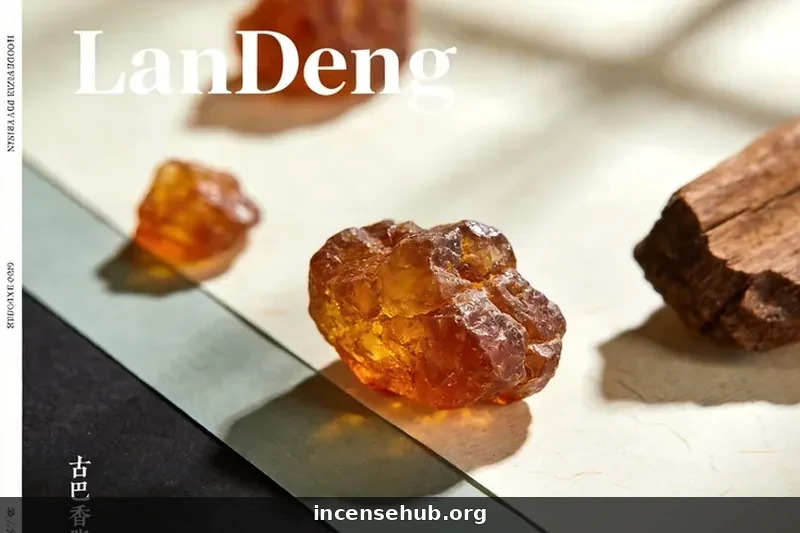
Key facts
| Chinese | 古巴香脂 (gǔbā xiāngzhī); copaiba balsam |
| Botanical source | Copaifera spp. (family Fabaceae) — the tapped oleoresin |
| What it is | A South American tree balsam, not a classical 香脂 |
| Aroma | Woody, balsamic, resinous, slightly sweet |
| Traditional role | None in classical Chinese incense; modern aromatherapy |
Aroma profile
Direct answer: Copaiba has a soft, woody, balsamic, resinous scent with a gentle, slightly sweet, almost creamy warmth — a mild, honeyed-wood balsam rather than a sharp pine or smoke. It is smoother and lighter than the heavier, vanilla-sweet Peru balsam.
copaiba (古巴香脂) has a soft, woody, balsamic, resinous scent with a gentle, slightly sweet, almost creamy warmth — a mild, honeyed-wood balsam rather than a sharp pine or smoke. It is smoother and lighter than the heavier, vanilla-sweet Peru balsam.
The defining contrast is against its better-known cousin, Peru balsam: where Peru balsam is dense, dark, and vanilla-cinnamon sweet, copaiba is lighter, more fluid, and woody-creamy. This is a mild balsam — the kind of note that recedes into a blend rather than asserting itself — which is precisely why it functions as a quiet fixative in modern aromatherapy and perfumery rather than as a lead fragrance.
A provenance note (read this)
Direct answer: copaiba (古巴香脂) is a modern crossover, not a classical Chinese 香材. Copaifera is a tropical South American genus (Fabaceae), the Chinese name is a modern trade label, and the balsam entered fragrance through modern Western practice — absent from the classical 香材 canon.
copaiba (古巴香脂) is a modern crossover, not a classical Chinese 香材:
- Copaifera is a tropical South American genus (Fabaceae), not native to China, and Flora of China does not record it.
- The Chinese name 古巴香脂 (“Cuba balsam”) is a modern trade name; the balsam is tapped mainly from South American Copaifera species, not from Cuba specifically.
- Copaiba balsam entered fragrance and aromatherapy through modern Western practice, absent from the classical 香材 canon.
This page records it honestly as a modern South American balsam — no classical Chinese origin is claimed, and none is fabricated.
Botanical source and origin
Direct answer: Copaifera is a genus of large legume-family trees (Fabaceae) native to tropical South America and parts of Africa. The balsam is a natural oleoresin tapped from the trunk and used directly, or steam-distilled into copaiba oil. GBIF records the genus; it is not a Chinese species and has no classical Chinese record.
Copaifera is a genus of large legume-family trees (Fabaceae) native to tropical South America and parts of Africa. The balsam is a natural oleoresin tapped from the trunk, collected much like a tree sap, and used directly or steam-distilled for copaiba oil. GBIF records the genus Copaifera (several species, all South American natives). It is not a Chinese species and has no classical Chinese record.
One botanical precision separates copaiba from the other “balsams”: copaiba is an oleoresin — a naturally fluid mixture of resin and volatile oil that flows from a tapped trunk — rather than a hardened gum-resin like frankincense or a semi-solid balsam like Peru balsam. This fluidity is why copaiba is often steam-distilled into an essential oil, a processing route the harder resins do not take as readily. The genus is species-rich, and “copaiba” as a trade material may come from several Copaifera species, so genus-level identity — not a single species — is the honest botanical statement.
Why is it used in fragrance and aromatherapy?
Direct answer: Copaiba balsam and copaiba oil are used as a soft, woody-balsamic base note and a mild fixative in modern aromatherapy and perfumery. It is a quiet, blending-friendly material that rounds a composition without asserting a strong note of its own — the opposite of a lead fragrance.
Copaiba’s role is quiet and structural: it supplies a soft woody-balsamic depth and a mild fixative action that rounds a blend from below. In aromatherapy it is used as a gentle woody-balsamic note, and in perfumery it can anchor lighter accords without imposing its own character. The material’s value lies in being sub-threshold — present without being the point — which makes it a useful blender rather than a signature ingredient. It has no classical Chinese incense role; any Chinese use is a modern crossover.
How is it processed?
Direct answer: Copaiba is produced by tapping the trunk of a Copaifera tree to collect the oleoresin, which may be used directly or steam-distilled into copaiba oil. The oleoresin and the distilled oil are two products of the same source, chosen by downstream use.
The trunk is tapped and the oleoresin collected, much like collecting a tree sap. From there the material branches by end use: the oleoresin may be used directly as a balsam, or it may be steam-distilled into copaiba essential oil. The oil is lighter, more fluid, and easier to dose in aromatherapy, while the oleoresin carries a fuller resinous body. This two-route processing — direct balsam versus distilled oil — is a defining feature of copaiba and distinguishes it from resins that are used only in solid or powdered form.
What determines quality?
Direct answer: Copaiba quality turns on species/origin, freshness, and the intended form. A good balsam is clean and free-flowing without adulteration; a good oil is clear and true to the woody-balsamic character. Because several Copaifera species can supply the material, genus identity and documentation matter.
The practical checks are: species and origin (which Copaifera species, and whether the material is balsam or oil), freshness and cleanliness (freedom from adulteration, sediment, or added solvent), and aroma fidelity (a clean woody-balsamic character, not a sharp or chemical edge). Because the trade name “copaiba” spans several species, a credible supplier should state the genus and form clearly rather than offering only the bare label.
Common forms
Direct answer: Copaiba is traded as the raw oleoresin (balsam) and as steam-distilled copaiba essential oil. The balsam is the fuller-bodied natural material; the oil is the lighter, easier-to-dose distillate — two forms of the same tree source.
| Form | Typical use |
|---|---|
| Copaiba balsam (oleoresin) | Direct balsam; mild fixative in blends |
| Copaiba essential oil | Aromatherapy; soft woody-balsamic base note |
The distinction between balsam and oil is a processing choice, not a quality statement — the same oleoresin in two different physical forms, selected by how the downstream product is formulated.
Traditional use vs modern evidence
- Traditional Use — none in classical Chinese incense. 古巴香脂 is a modern crossover with no place in the 香材 canon, and no traditional Chinese use is claimed.
- Historical Record — no classical Chinese incense record exists for copaiba; the name and use are modern trade-and-aromatherapy additions.
- Scientific Evidence — the botanical identity (Copaifera spp., Fabaceae) is established at genus level; the documented facts are botanical identity and the modern aromatherapy role, with no medical claims.
There is no classical Chinese incense record for copaiba (古巴香脂); its position is entirely modern. We make no medical claims. The documented facts are botanical identity, the Fabaceae placement, and its modern aromatherapy role.
Quality notes
Practical points:
- copaiba (古巴香脂) is the tapped oleoresin of Copaifera spp.; expect a soft, woody, balsamic, resinous, slightly sweet scent.
- Distinguish it from Peru balsam (Myroxylon balsamum) — another South American balsam, but denser and vanilla-sweet.
- It is a modern balsam note, not a classical Chinese 香脂 (such as 安息香 or 乳香).
Copaiba vs Peru balsam
Direct answer: Both are South American legume-family balsams, but different genera and characters. Copaiba (Copaifera spp.) is light, woody, creamy, and often steam-distilled into oil; Peru balsam (Myroxylon balsamum) is dense, vanilla-cinnamon sweet, and used as a heavy fixative. Neither is a classical Chinese 香材.
| Copaiba (古巴香脂) | Peru balsam (秘鲁香脂) | |
|---|---|---|
| Botanical source | Copaifera spp. (Fabaceae) | Myroxylon balsamum (Fabaceae) |
| Character | Light, woody, creamy, slightly sweet | Dense, vanilla-cinnamon sweet |
| Typical form | Oleoresin or distilled oil | Viscous balsam or resinoid |
| Key identification note | Genus identity; balsam vs oil | Contact sensitizer; geographic misnomer |
The two are often grouped as “South American balsams,” but they sit at opposite ends of the register — copaiba light and woody, Peru balsam dense and gourmand-sweet. See peru-balsam and the material comparison matrix.
Summary
Copaiba (古巴香脂) is the oleoresin of Copaifera trees (Fabaceae), a tropical South American genus whose balsam is light, woody, creamy, and often steam-distilled into an essential oil. It is a modern crossover with no classical Chinese incense record, and its “Cuba” name is a trade artifact. Its key identification points are genus identity, the balsam-versus-oil distinction, and the contrast with the denser, sweeter Peru balsam.
FAQ
What is copaiba (古巴香脂)? The oleoresin tapped from trees of the genus Copaifera, a legume-family (Fabaceae) group native to tropical South America. It yields a soft, woody, balsamic, resinous, slightly sweet balsam used in modern perfumery and aromatherapy.
Is copaiba (古巴香脂) a classical Chinese incense ingredient? No. Copaifera is a South American genus, not native to China, and it has no place in the classical 香材 canon. Its Chinese name 古巴香脂 is a modern trade name, and its use entered fragrance through modern Western practice.
Where does the name copaiba (古巴香脂) come from? It is a modern Chinese trade name meaning “Cuba balsam,” though the balsam is tapped mainly from South American Copaifera species rather than from Cuba specifically. The name reflects trade, not botanical origin.
What does copaiba smell like? Soft, woody, balsamic, and resinous, with a gentle, slightly sweet, almost creamy warmth — a mild, honeyed-wood balsam. It is smoother and lighter than the heavier, vanilla-sweet Peru balsam.
How is copaiba used in fragrance? As a soft woody-balsamic base note and a mild fixative in modern aromatherapy and perfumery, usually from the balsam or copaiba oil. It is a modern addition, not a classical 香材.
What is the difference between copaiba balsam and copaiba oil? They are two forms of the same tree source. The balsam (oleoresin) is the fuller-bodied natural resin, while copaiba oil is the lighter, easier-to-dose steam distillate used in aromatherapy. The distinction is a processing choice, not a quality difference.
See also: peru-balsam (秘鲁香脂), benzoin (安息香), labdanum (岩蔷薇), and the full scent guide.
Evidence & Sources
Botanical identity
Source: Copaifera on GBIF. Evidence type: Established (genus-level; Copaifera spp. are South American natives).
Modern use
Source: copaiba balsam/oil as a woody-balsamic aromatherapy and perfumery note; a modern crossover with no classical Chinese incense record. Evidence type: Modern aromatherapy — no classical Chinese record; none claimed.
Authenticity / provenance
Source: 古巴香脂 (copaiba, Copaifera spp.) vs Peru balsam (Myroxylon balsamum) — distinct South American balsams. Evidence type: Practical screening.
Safety
Source: incense combustion produces smoke and particulate matter; burn in a well-ventilated space. Evidence type: Established.
Evidence status
| Layer | Status |
|---|---|
| Botanical identity | Established (genus) |
| Traditional use | None (modern aromatherapy) |
| Authenticity test | Practical screening |
| Health claims | Not established |
Sources
Sources: botanical references on the genus Copaifera. copaiba (古巴香脂) is a modern South American balsam with no classical Chinese incense record; no such origin is claimed. This is editorial knowledge content, not medical advice.